
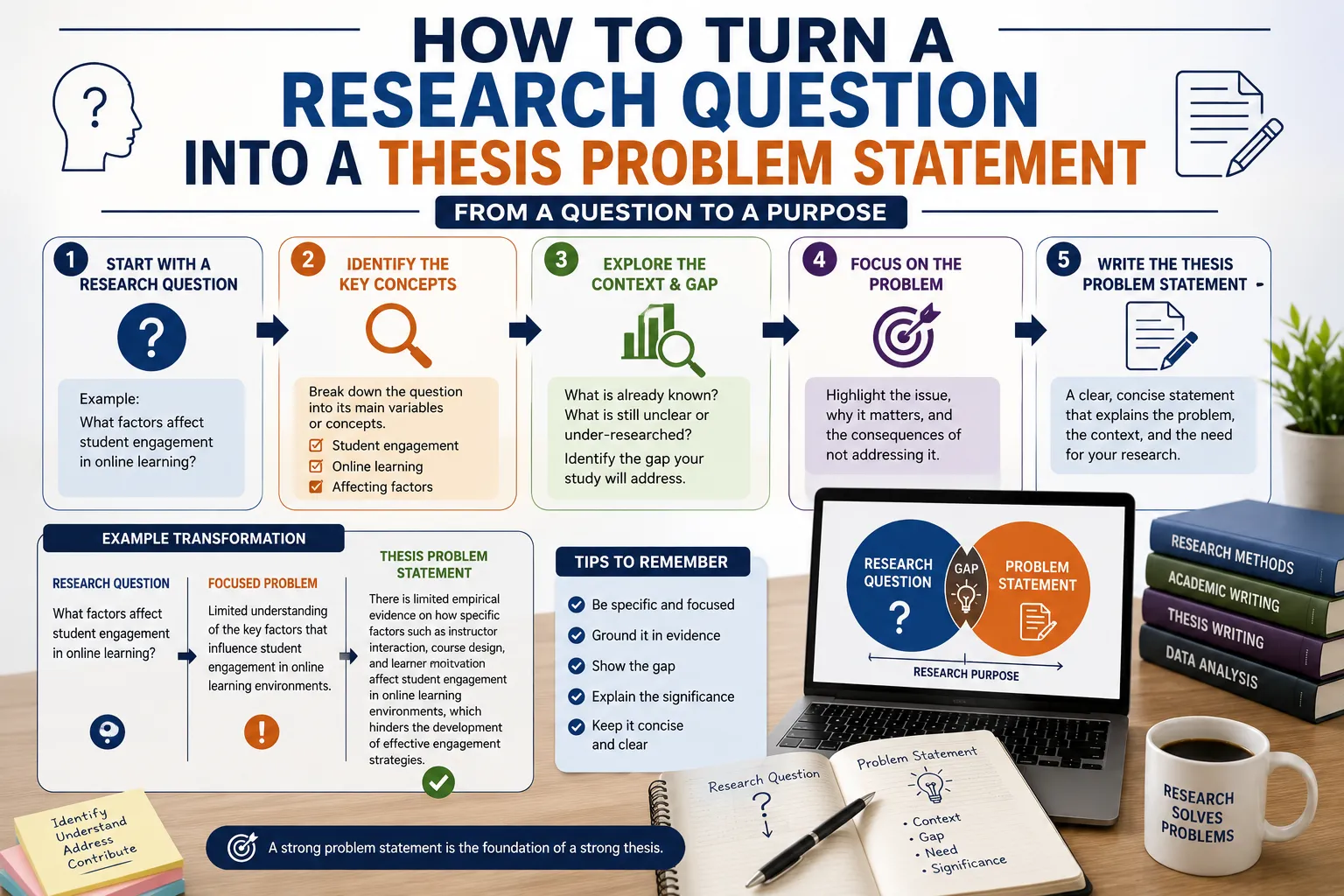
You have a research question you're excited about. Your supervisor nods, then asks: "But what's your problem statement?" If that question left you unsure what to write next, you're facing one of the most common stumbling blocks in early thesis writing. Learning how to turn a research question into a thesis problem statement is a distinct skill from choosing a topic or writing a question — and getting it right shapes everything that follows in your thesis.
A problem statement is a concise, evidence-based description of a specific gap in knowledge. It is not a topic description, not a literature summary, and not a proposed solution. Understanding exactly how it differs from your research question — and how to build one from the other — is the focus of this guide.
Research Question vs. Problem Statement: What's the Difference?
Many first-time thesis writers assume the research question is the problem statement, just phrased differently. It isn't. The two serve different functions in your thesis:
- The problem statement justifies asking. It explains why the issue matters, what remains unresolved, and what happens if it stays unresolved.
- The research question specifies what is asked. It is the narrow, testable, or explorable question your study will actually answer.
Put simply: your problem statement is the "why," and your research question is the "what." A thesis needs both, and the problem statement should come first, providing the evidence-based justification that makes your research question worth asking in the first place.
Topic vs. Research Question vs. Problem Statement
Although these terms are closely related, each serves a different purpose in a research study. Understanding the distinction helps in developing a clear and well-structured research proposal.
Topic: The topic is the broad subject area of the research. It defines the general field of study but does not specify the exact issue being investigated. Example: Climate Change and Agriculture.
Research Question: The research question is the specific question the study aims to answer. It narrows the topic into a focused investigation. Example: What adaptation strategies reduce yield loss for smallholder farms under two hectares?
Problem Statement: The problem statement explains why the research is necessary by identifying an existing issue or knowledge gap supported by evidence. It provides the rationale for conducting the study.
Example: Smallholder farmers face declining yields due to changing rainfall patterns, yet limited research has examined affordable adaptation strategies suitable for small farms.
Step-by-Step: How to Turn a Research Question Into a Thesis Problem Statement
Step 1: Confirm Your Research Question Is Actually Specific
Before you can build a problem statement around it, check that your research question is narrow enough to guide a single study. A good test: if your question could apply to dozens of different research designs, it's still too broad and needs refining first .
Step 2: Identify Where the Question Comes From
Research problems typically emerge from one of several sources: observations in professional practice, gaps in published literature, conflicting findings across studies, emerging issues in a field, or practical challenges lacking evidence-based solutions. Knowing which source your question comes from helps you decide what kind of evidence your problem statement needs.
Step 3: Gather 2–4 Grounding Citations
A problem statement is strengthened significantly by citations — statistics, prior findings, or reports from authoritative sources — that show the problem is real and evidenced, not a personal impression. Two to four references within the problem statement is typical (Source: Paperguide.ai). A reference manager like Mendeley can help you organize these sources, tag them by theme, and insert citations accurately as you draft, so you don't lose track of exactly which source supports which claim .
Step 4: Write the Background Context
Start broad — introduce the field or practice area your question sits within — then narrow steadily toward the specific issue. This mirrors how literature reviews are structured: begin wide, converge on the gap.
Step 5: State the Specific Gap or Unresolved Issue
This is the heart of your problem statement. Name precisely what is not yet known, not yet tested, or not yet resolved — supported by the citations you gathered in Step 3. Avoid vague phrasing like "more research is needed"; instead, specify the population, context, or method that remains unaddressed.
Step 6: Explain the Implications of Leaving It Unresolved
A strong problem statement doesn't just describe an absence — it explains why the absence matters. What decisions, policies, practices, or theoretical understanding remain uncertain because this gap hasn't been filled?
Step 7: Connect Back to Your Research Objectives
Close your problem statement by linking it directly to what your study aims to do. This is where your original research question re-enters — now justified, grounded, and framed as the logical next step given everything you've just established.
Step 8: Apply the FINER Test
Before finalizing, run your problem statement and underlying research question through the FINER framework: is it Feasible, Interesting, Novel, Ethical, and Relevant? Scholars are often advised to draft several candidate research questions and score each against these five criteria — the highest-scoring version is almost always the right one to formalize (Source: Tesify thesis-writing guide).
Practical Checklist: Is Your Problem Statement Ready?
- Does it include background context, the specific gap, implications, and objectives?
- Is it grounded in 2–4 credible citations rather than personal opinion?
- Is it specific enough that it couldn't apply to a dozen different studies?
- Does it clearly distinguish "why this matters" from "what I will study"?
- Does it avoid vague phrases like "not much research exists"?
- Is it roughly 300–500 words, appearing early in your introduction?
- Have you tested your underlying research question against FINER criteria?
- Does it connect logically to your stated research objectives?
Two Practical Scenarios
Scenario 1 — Refining an Overly Broad Question A scholar began with the research question, "How does social media affect student mental health?" Applying the specificity test revealed this could support dozens of different studies — quantitative surveys, qualitative interviews, cross-cultural comparisons, and more. After narrowing to a specific population and gap ("undergraduate students in Tier-2 Indian cities" and "the qualitative interpretation gap left by existing quantitative studies"), the resulting problem statement became defensible and the research question naturally sharpened alongside it.
Scenario 2 — Grounding a Practice-Based Observation A scholar in public health administration wanted to study delays in rural vaccine distribution, based on professional observation rather than an identified literature gap. By searching recent publications and finding that most existing studies focused on urban distribution logistics, the scholar was able to write a problem statement citing two supporting studies and one policy report, clearly establishing that rural-specific distribution challenges remained under-examined — turning a practice-based hunch into an evidence-grounded thesis problem.
Common Mistakes First-Time Thesis Writers Make
- Treating the research question and problem statement as interchangeable, rather than writing the problem statement first to justify the question.
- Skipping citations entirely, leaving the problem statement as an unsupported opinion rather than an evidenced claim.
- Writing a problem statement so broad it could apply to unrelated research designs and populations.
- Failing to state implications — describing the gap without explaining why it matters if left unresolved.
- Not testing feasibility early, resulting in a fascinating problem statement that cannot realistically be completed within a thesis timeline.
Frequently Asked Questions
How do you turn a research question into a thesis problem statement?
Start by confirming your question is specific enough to guide a single study, then build background context, name the precise gap with supporting citations, explain the implications of leaving it unresolved, and connect the statement back to your research objectives and original question.
How long does it take to complete a thesis using this approach?
Timelines vary by discipline, but scholars who ground their problem statement in literature evidence early typically avoid the proposal revisions that most often delay thesis progress — meaning this step, done well, tends to save time overall rather than add to it.
Is professional help available to turn a research question into a thesis problem statement?
Yes. ThesisLikho's PhD-qualified mentors have guided 10,000+ scholars through research question refinement, problem statement development, and full thesis writing assistance tailored to each scholar's discipline and university requirements.
Why should I turn a research question into a thesis problem statement carefully rather than quickly?
A weak or overly broad problem statement is one of the most common reasons supervisors and committees send proposals back for revision — investing time here reduces avoidable delays later in the thesis process.
When should you turn a research question into a thesis problem statement for a thesis?
As early as possible — ideally during topic selection and before finalizing your methodology, since a well-grounded problem statement shapes every subsequent research decision.
Get Expert Guidance on Your Thesis Problem Statement
Turning a promising research question into a defensible, evidence-grounded problem statement is a skill that improves enormously with experienced feedback. If you'd like an expert second opinion on whether your problem statement is specific, grounded, and feasible enough to defend before a committee, ThesisLikho's PhD-qualified team offers research question refinement, methodology support, and complete thesis writing assistance. If you need expert guidance with your research question, problem statement, or overall thesis structure, you can explore our Thesis Writing Assistance service.
Talk to a Thesis Expert → https://thesislikho.com/writing-services/thesis-writing