
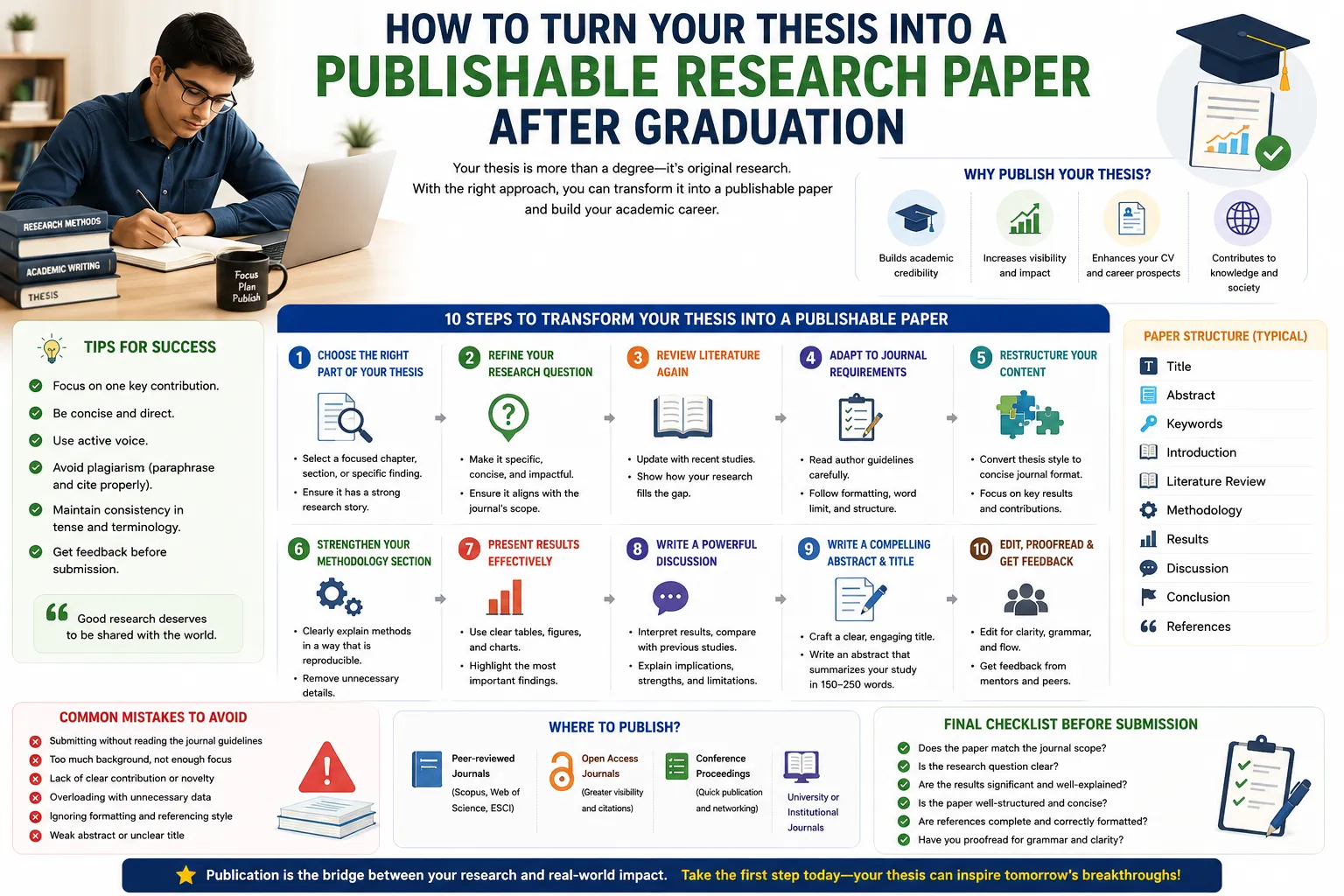
Completing your thesis is one of the most significant achievements in your academic journey. Whether you've earned a Master's degree, MPhil, or PhD, your thesis represents months—or even years—of careful planning, literature review, data collection, analysis, and writing. However, many graduates make one common mistake: they submit their thesis, receive their degree, and never use their research again.
The reality is that your thesis has the potential to reach a much wider audience. By converting it into a publishable research paper, you can share your findings with the academic community, strengthen your professional profile, improve your chances of pursuing higher education or research opportunities, and contribute valuable knowledge to your field.
Publishing your work may seem intimidating, especially if you are a first-time author. Many graduates assume they need to start a new research project to publish an article. Fortunately, that is not the case. Your thesis already contains the essential elements of a scholarly paper—it simply needs to be adapted to meet the expectations of academic journals.
In this comprehensive guide, you'll learn how to transform your thesis into a high-quality research paper, choose the right journal, navigate the peer-review process, and avoid common mistakes that prevent publication.
Why Publish Your Thesis After Graduation?
Publishing your thesis allows your research to have a lasting impact beyond university assessment.
Instead of remaining on a university library shelf or institutional repository, your work can contribute to academic discussions, inform industry practices, and inspire future research.
Publishing offers several benefits:
- Enhances your academic credibility.
- Strengthens your CV or résumé.
- Improves opportunities for PhD admissions and postdoctoral research.
- Increases visibility within your research community.
- Supports career advancement in academia and industry.
- Contributes to evidence-based decision-making.
- Demonstrates expertise in your field.
For many employers and universities, peer-reviewed publications are a strong indicator of research capability.
Can Every Thesis Be Published?
Yes—but not every thesis should be published in its original form.
A thesis and a research paper serve different purposes.
A thesis demonstrates your ability to conduct independent research and therefore includes detailed explanations, comprehensive literature reviews, extensive methodology sections, appendices, and supporting documents.
A research paper, on the other hand, is concise, focused, and designed to communicate one clear contribution to a scholarly audience.
Most journals expect articles between 4,000 and 8,000 words, whereas a thesis may exceed 50,000 to 100,000 words.
The goal is not to shorten your thesis randomly but to extract its strongest contribution and present it in a journal-friendly format.
Step 1: Identify the Core Contribution of Your Thesis
Before editing, ask yourself:
What is the single most important finding in my thesis?
Your thesis may address several objectives, but a journal article usually focuses on one primary contribution.
For example:
Thesis Topic
Artificial Intelligence Adoption in Higher Education
Possible Research Paper Topics:
- Factors Influencing AI Adoption Among University Students
- Impact of AI Learning Tools on Academic Performance
- Student Perceptions of AI-Assisted Learning
- AI Readiness in Indian Higher Education Institutions
Each paper highlights one specific aspect of the broader thesis.
Step 2: Choose the Right Journal
Selecting an appropriate journal before rewriting your paper saves considerable time.
Consider:
- Subject relevance.
- Journal scope.
- Target audience.
- Acceptance rate.
- Publication timeline.
- Word limit.
- Open-access policies.
- Indexing in Scopus, Web of Science, PubMed, or other recognised databases.
Read several recently published articles from your chosen journal to understand its writing style, structure, and expectations.
Never submit your manuscript to multiple journals simultaneously unless explicitly permitted.
Step 3: Review the Journal's Author Guidelines
Every journal has specific requirements regarding:
- Word count.
- Formatting.
- Citation style.
- Figures and tables.
- Abstract length.
- Keywords.
- File format.
- Ethical declarations.
Ignoring these guidelines is one of the most common reasons manuscripts are returned without review.
Create your manuscript according to the journal's instructions from the beginning.
Step 4: Rewrite the Title
Your thesis title may be descriptive but too long for a journal article.
Thesis Title
A Study of the Impact of Artificial Intelligence-Based Learning Systems on Academic Performance, Student Engagement, and Digital Readiness Among MBA Students in Selected Private Universities in Delhi NCR
Journal Article Title
Artificial Intelligence Learning Tools and Academic Performance Among MBA Students in India
Keep your title:
- Clear
- Concise
- Informative
- Keyword-rich
A strong title improves discoverability in academic databases.
Step 5: Write a New Abstract
Do not copy the thesis abstract.
Journal abstracts usually contain:
- Background
- Objective
- Methods
- Results
- Conclusion
Most journals limit abstracts to 150–250 words.
Include your most important findings rather than general descriptions.
Step 6: Condense the Literature Review
A thesis may include dozens of pages reviewing previous research.
A journal article should present only literature directly relevant to the research question.
Focus on:
- Key theories.
- Recent studies.
- Research gap.
- Justification for the study.
Remove unnecessary historical discussions and repetitive information.
Step 7: Streamline the Methodology
Your methodology should provide enough information for readers to understand how the study was conducted without overwhelming them with excessive detail.
Include:
- Research design.
- Population.
- Sample size.
- Sampling method.
- Data collection.
- Analytical techniques.
Avoid lengthy descriptions of standard procedures unless they are central to your study.
Step 8: Highlight the Most Important Results
Your thesis may include numerous analyses, tables, and appendices.
For publication:
- Present only findings directly related to your research question.
- Combine similar tables where possible.
- Remove redundant statistics.
- Use clear, well-labelled figures when appropriate.
Every result included should support your central argument.
Step 9: Strengthen the Discussion
The discussion section is often the most important part of a journal article.
Explain:
- What your findings mean.
- How they compare with previous research.
- Why similarities or differences exist.
- Practical implications.
- Theoretical contributions.
- Study limitations.
- Suggestions for future research.
Avoid simply repeating the results.
Instead, interpret and contextualise them.
Step 10: Revise the Conclusion
Journal conclusions should be concise and impactful.
Summarise:
- The research problem.
- Main findings.
- Contributions.
- Practical implications.
- Recommendations.
Avoid introducing new information in the conclusion.
Step 11: Update Your References
Before submission:
- Replace outdated references with recent studies where appropriate.
- Ensure consistency with the journal's citation style.
- Verify that every in-text citation appears in the reference list.
Reference management tools such as Zotero, Mendeley, or EndNote can simplify this process.
Step 12: Check for Plagiarism
Although the paper is based on your own thesis, journals may still screen manuscripts for similarity.
To reduce similarity scores:
- Rewrite sections rather than copying them directly.
- Update the literature review.
- Improve sentence structure.
- Cite your thesis if it is publicly available in an institutional repository.
- Follow the journal's policies regarding prior publication.
Always ensure your manuscript reflects original scholarly writing.
Step 13: Proofread Thoroughly
Before submission:
- Check grammar and spelling.
- Improve clarity and flow.
- Remove repetition.
- Verify tables and figures.
- Ensure consistency in terminology.
Ask your supervisor or a trusted colleague to review the manuscript before submission.
Fresh perspectives often identify issues you may overlook.
Step 14: Prepare a Strong Cover Letter
Many journals require a cover letter.
A professional cover letter should include:
- The manuscript title.
- A brief summary of the study.
- Why the article fits the journal's scope.
- Confirmation that the manuscript is original.
- A declaration that it is not under consideration elsewhere.
Keep the letter concise and professional.
Step 15: Navigate the Peer Review Process
Most journals follow a peer-review process.
Possible editorial decisions include:
- Accepted
- Minor revisions
- Major revisions
- Rejected
Receiving revision requests is completely normal.
Respond to reviewers by:
- Addressing every comment individually.
- Explaining revisions clearly.
- Remaining professional and respectful.
- Supporting disagreements with evidence.
A thoughtful response improves your chances of acceptance.
Can One Thesis Produce Multiple Research Papers?
In many cases, yes.
Large Master's and PhD theses often contain multiple publishable studies.
For example:
A thesis investigating digital transformation in healthcare might generate articles on:
- Technology adoption.
- Patient satisfaction.
- Organisational readiness.
- Healthcare policy.
- Digital literacy.
However, each article should present a distinct contribution and should not substantially duplicate content from another publication.
Common Mistakes to Avoid
Many graduates unintentionally reduce their publication chances.
Avoid these common errors:
- Submitting the entire thesis as a journal article.
- Choosing the wrong journal.
- Ignoring author guidelines.
- Using outdated references.
- Weak discussion sections.
- Excessive self-plagiarism.
- Poor grammar and formatting.
- Submitting without supervisor feedback.
- Targeting predatory journals.
Careful preparation significantly improves publication success.
Best Tools for Preparing a Publishable Research Paper
Several digital tools can simplify the publication process.
Literature Search
- Google Scholar
- Scopus
- Web of Science
Reference Management
- Zotero
- Mendeley
- EndNote
Academic Writing
- Microsoft Word
- Google Docs
- Grammarly
Statistical Analysis
- SPSS
- R
- Python
- SmartPLS
- AMOS
Journal Selection
- Elsevier Journal Finder
- Springer Journal Suggester
- Wiley Journal Finder
These tools help improve efficiency and manuscript quality.
Tips for Indian Graduates and Early-Career Researchers
If you completed your degree at an Indian university, publishing your thesis can significantly strengthen your academic profile.
Keep these recommendations in mind:
- Consult your thesis supervisor before preparing your manuscript. They can provide valuable guidance and may qualify for co-authorship based on university policies.
- Check whether your university has specific publication requirements before submitting your thesis to a journal.
- Target reputable journals indexed in Scopus, Web of Science, PubMed, or other recognised databases relevant to your discipline.
- Avoid predatory journals that promise rapid publication without a genuine peer-review process.
- Continue updating your literature review with recent studies so your paper reflects current developments in your field.
Publishing soon after graduation is often advantageous because your research is still current and your familiarity with the data remains fresh.
Frequently Asked Questions (FAQs)
Can I publish my thesis after graduation?
Yes. Most universities encourage graduates to convert their theses into journal articles. However, the thesis should be revised and adapted to meet the journal's formatting, scope, and word-count requirements.
Is publishing my thesis considered self-plagiarism?
Not necessarily. However, copying large sections of your thesis without revision may create similarity concerns. Rewrite the manuscript, update the literature review, and follow the journal's policies regarding previously submitted academic work.
How many research papers can I publish from one thesis?
A comprehensive Master's or PhD thesis can often produce multiple journal articles, provided each manuscript addresses a distinct research question or contribution and avoids duplicate publication.
Should I include my thesis supervisor as a co-author?
Authorship should follow your university's guidelines and the actual intellectual contributions of each individual. Discuss authorship openly with your supervisor before submitting the manuscript.
How long does the publication process take?
The timeline varies by journal. Peer review, revisions, and editorial decisions can take anywhere from a few months to more than a year, depending on the journal's review process and publication schedule.
Conclusion
Your thesis represents one of the most valuable pieces of research you will produce during your academic journey. Rather than allowing it to remain unread after graduation, transforming it into a publishable research paper enables your work to reach a wider audience, contribute to scholarly knowledge, and support your future academic and professional goals.
The process involves much more than shortening your thesis. It requires identifying your strongest contribution, restructuring the content to meet journal expectations, refining your writing, updating your references, and preparing your manuscript for rigorous peer review. Although publication may require patience and revisions, the long-term benefits—including enhanced credibility, career opportunities, and academic recognition—make the effort worthwhile.
Whether you are a recent graduate, an early-career researcher, or planning your next academic milestone, learning how to convert your thesis into a high-quality journal article is an investment in your future. With careful preparation, adherence to journal guidelines, and a commitment to scholarly excellence, your thesis can evolve from a university requirement into a published contribution that informs, inspires, and advances research in your field.
Contact ThesisLikho
Call / WhatsApp: +91 96438 02216
Website:www.ThesisLikho.com