
Here's a statistic worth sitting with before you write a single word of your discussion chapter: a substantial share of viva questions originate directly from this chapter, and examiners consistently cite it as the strongest single indicator of whether a student genuinely understands their own research. Your results chapter proves you collected data competently. Your discussion chapter proves you actually understand what that data means — and that distinction is exactly what separates a chapter that stands out from one that just restates numbers in prose.
This guide walks through how to write a dissertation discussion chapter that stands out the way an experienced research supervisor would — not just the standard structure, but the specific moves that lift a discussion chapter from competent to genuinely strong. If you're a first-time dissertation writer without a strong research background, this is written specifically for you.
At ThesisLikho, our PhD-qualified mentors have guided more than 10,000 scholars through dissertation writing, discussion chapter drafting, and viva preparation across disciplines. What follows draws on that mentoring experience, checked against established academic guidance on discussion chapter structure and what examiners specifically look for.
1. What Actually Distinguishes a Strong Discussion Chapter From an Average One
Your results chapter answers "what did I find?" Your discussion chapter answers "why does it matter, and what does it mean?" A common pitfall — and the single biggest reason discussion chapters underperform — is treating the chapter as a summary of everything that came before it, rather than the place where your findings, literature, theoretical framework, and methodology finally coalesce into one coherent argument.
A descriptive discussion chapter, one that simply restates results in slightly different words without genuine interpretation, is consistently flagged as one of the most common reasons discussion chapters receive lower grades. The chapter that stands out does something different: it makes a claim about what the findings mean, defends that claim against the literature, and is honest about where the claim's limits lie. That shift — from describing to arguing — is the entire difference between average and strong.
Think of it this way: your results chapter is a court's evidence exhibit, laid out neutrally for anyone to inspect. Your discussion chapter is your closing argument — the place where you actually make the case for what that evidence means, why it should be believed, and what follows from it. A chapter that just re-reads the exhibits aloud, however accurately, hasn't made an argument at all, and an examiner reading it will notice the absence immediately, even if every individual sentence is technically correct.
2. The Five Core Elements Every Discussion Chapter Needs
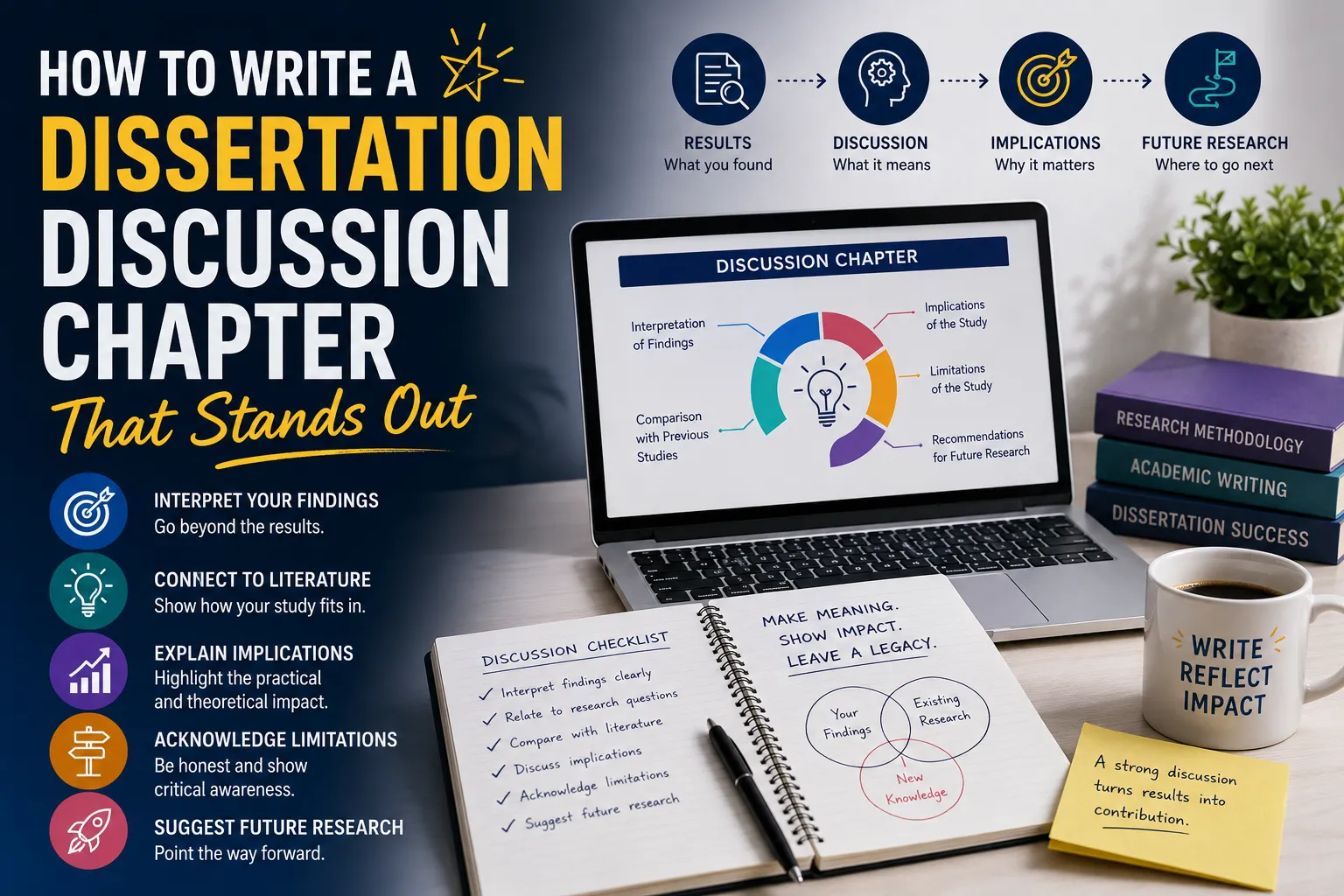
Nearly every credible guide to discussion chapter writing converges on the same five components, worked through in this order:
A brief summary of key findings — not a detailed repetition of your results chapter, but a short, concise recap stated as prose that directly answers your research questions, giving the reader just enough context to follow the interpretation that comes next.
Interpretation — what your results actually mean: the patterns, relationships, and whether they support or contradict your original expectations or hypotheses. This is the heart of the chapter, and it should occupy roughly half the total space.
Comparison with the literature — how your findings align with, diverge from, or extend existing research from your literature review, explicitly noting agreements, disagreements, and what any unexpected divergence might suggest.
Implications — the theoretical, practical, or policy significance of your findings: why they matter, to whom, and what someone should potentially do differently as a result.
Limitations and recommendations — an honest, non-apologetic account of your study's boundaries, followed by specific, evidence-based suggestions for future research that follow logically from what you found and where your study fell short.
Recommendations are sometimes treated as optional depending on your specific university's guidelines, so check your department's handbook — some programmes expect this content in your discussion chapter, others prefer it reserved for the conclusion.
3. Structuring Your Chapter Around Research Questions, Not Data Sources
One of the clearest, most consistently recommended structural choices: organize your discussion chapter around your research questions or major themes, not around your data collection instruments or sources. If you ran both a survey and a set of interviews, resist the temptation to write one section on "survey findings" and a separate section on "interview findings" — that structure describes your methods, not your argument, and it leaves the reader (and examiner) to do the work of connecting the two data types back to your actual research questions themselves.
Instead, mirror the structure you used in your results chapter, addressing each research question or major theme in turn, and pull in whichever data — survey, interview, or both — is relevant to that specific question at that point. This single structural decision does more to make a discussion chapter feel like a coherent argument, rather than a series of disconnected observations, than almost any other choice you'll make while drafting.
4. The Interpret-Discuss-Reflect Formula for Each Finding
A genuinely useful, repeatable formula for each individual finding within your chapter: interpret what the finding means, discuss it against the existing literature, and reflect on its broader significance. Open each paragraph or section with interpretation or comparison, not with a restated number — if a sentence could be pasted unchanged into your results chapter, it doesn't belong in your discussion.
Use one short orienting clause per finding to remind the reader what you're discussing, then spend the rest of the paragraph on what it actually means. A pattern many strong discussion chapters follow explicitly: state the finding briefly, relate it to specific literature (noting agreement or disagreement and why), then explain its contribution to the field or its practical significance — repeating this pattern consistently across your major findings gives the whole chapter a predictable, easy-to-follow rhythm rather than requiring the reader to reconstruct your logic each time.
A short worked example makes the formula concrete. Suppose your results showed that employees with flexible work arrangements reported higher engagement scores than those without. A weak version simply restates this: "employees with flexible arrangements had higher engagement scores (M=4.2) than those without (M=3.6)." A strong version interprets first — "this suggests flexibility itself, rather than simply reduced workload, may be driving the engagement difference" — then discusses against literature — "this aligns with [prior study]'s finding that autonomy is a stronger engagement predictor than schedule length alone, though it contrasts with [another study], which found no such effect in unionized workplaces, possibly reflecting differences in how autonomy is experienced across sectors" — then reflects — "this raises the question of whether flexibility's benefit is really about time itself, or about the signal of trust it sends to employees, a distinction this study wasn't designed to separate but future research could." Notice how much analytical ground that second version covers using the same underlying result.
5. Handling Unexpected or Non-Significant Results
A discussion chapter that only discusses the findings that confirmed your hypotheses, quietly skipping over unexpected or null results, is both intellectually thin and easy for an examiner to notice. Address unexpected findings directly: describe the unanticipated result, offer your best interpretation of why it appeared, and discuss its possible significance for the overall study — this is often exactly where the most interesting, examiner-impressing analysis happens, since it demonstrates you can think critically beyond simply confirming what you expected to find.
The same principle applies to non-significant or null results in quantitative work: end that discussion with a clear, honest statement of the finding's implications regardless of statistical significance, rather than treating a null result as an embarrassment to minimize. A null result handled with genuine analytical engagement often reads as more sophisticated than a chapter reporting only clean, confirmatory findings throughout.
6. Writing About Limitations Without Undermining Your Study
Every study has limitations, and naming them honestly is what builds credibility, not what damages it — provided you handle the tone correctly. Avoid an apologetic tone throughout this section; be honest and self-critical, but frame each limitation as a boundary of your specific study's scope, not as evidence the whole project was flawed.
A genuinely useful technique: for each limitation you name, add one clause explaining its likely, specific effect on your findings — "because the sample was drawn from a single organization, results may not generalize to firms of different sizes" is considerably more credible and useful than a bare, unexplained "the sample size was small." This level of specificity signals that you understand exactly how the limitation constrains your claims, rather than listing limitations as a generic formality.
Equally important: don't offer a recommendation for future research that could easily have been addressed within your own study — doing so signals to an examiner that you didn't fully think through your own design, rather than demonstrating awareness of genuinely new directions beyond your study's scope.
It's worth distinguishing two different kinds of limitations, since they call for slightly different framing. Design limitations — a convenience sample, a cross-sectional rather than longitudinal design, a single-organization case study — are choices you made deliberately, usually for good practical reasons, and should be framed as scoping decisions with known trade-offs rather than errors. Discovered limitations — a measurement issue you only noticed during analysis, an unanticipated confound, a response pattern you didn't expect — genuinely do reflect something you'd do differently given the chance, and it's fine to say so plainly. Conflating the two, treating a deliberate scoping choice as though it were an oversight, tends to undersell decisions that were actually reasonable given your constraints.
7. Making Your Implications Section Actually Land
This is frequently the section that separates a strong dissertation from an average one, because it requires you to step back from your specific findings and articulate why anyone outside your immediate research context should care. State your theoretical or academic contribution explicitly — what does your study add that wasn't already known or established — and state your practical implications concretely: who should do what differently, based specifically on what you found.
Vague implications ("this suggests further research is needed in this area") read as filler. Specific implications ("HR managers implementing flexible work policies should consider X, given this study's finding that Y") read as genuine scholarly contribution. If you're combining your discussion and conclusion chapters (common in some master's-level dissertations, though PhD theses almost always keep them separate), note that implications can sit in either chapter depending on your specific university's convention — check your handbook rather than assuming.
8. How Long Should It Be, and How Much Space Should Each Part Get
Length expectations vary meaningfully by degree level: a typical taught master's discussion chapter commonly runs somewhere in the range of 3,000 to 5,000 words, while a doctoral discussion chapter can run considerably longer, sometimes reaching 10,000 words or more, reflecting the deeper, more extensive engagement with literature and theory a PhD requires. As a rough proportional guide, the discussion chapter often represents somewhere around 15 to 25% of a dissertation's total word count, though this varies by subject and by your specific university's guidelines.
Within the chapter itself, weight your sections deliberately: interpretation should occupy roughly half the total space, since it's doing the chapter's core intellectual work; your summary of findings should stay brief, a few hundred words at most, since your results chapter has already done the detailed reporting; and limitations and recommendations typically need only a few focused paragraphs each. If your discussion chapter is running noticeably short relative to your university's expected proportion, that's often a sign you're describing rather than interpreting; if it balloons well past the expected range, you may be repeating your literature review or results chapter rather than building genuinely new analysis.
9. Common Mistakes That Cost Marks
- Simply restating results in different words, without genuine interpretation — the single most commonly cited reason discussion chapters underperform.
- Introducing new results not covered in your results chapter — the discussion should interpret data you've already reported, not introduce fresh findings your reader hasn't seen yet.
- Overinterpreting or speculating beyond what your data actually supports, making inflated claims your evidence can't carry.
- Discussing only confirmatory findings, quietly ignoring unexpected or non-significant results rather than engaging with them directly.
- Writing an apologetic, defensive tone around limitations, rather than a confident, honest acknowledgment of your study's genuine boundaries.
- Structuring the chapter by data source or methods rather than by research question or theme, leaving the reader to reconstruct your argument themselves.
- Recommending future research that your own study could have addressed, signaling incomplete self-reflection about your own design choices.
- Inconsistent tense and terminology relative to your introduction chapter — many readers move directly from your introduction to your discussion, and inconsistency between the two is a small but noticeable polish issue.
10. Two Realistic Case Studies
Case Study 1 — Turning a Descriptive Draft Into an Interpretive One
A dissertation scholar's first discussion chapter draft largely repeated the results chapter's numbers, restated in prose, organized by which survey question each result came from. On review, a supervisor pointed out that nearly every paragraph could be pasted unchanged into the results chapter without losing meaning — a clear sign the chapter wasn't yet interpreting anything. The scholar restructured the entire chapter around the three original research questions instead, and for each one, applied the interpret-discuss-reflect formula explicitly: stating what the finding meant, comparing it directly to two or three specific prior studies, and reflecting on its practical significance for the organization studied. The underlying findings didn't change at all — only the interpretive work built around them did — and the revised chapter was specifically praised for its analytical depth in the eventual viva.
Case Study 2 — Engaging Honestly With an Unexpected Null Result
A first-time dissertation writer's central hypothesis wasn't supported by their data — a result the scholar initially wanted to downplay or bury in a brief paragraph. Rather than minimizing it, the scholar devoted a full, honest section to the unexpected null result: describing it clearly, offering two plausible interpretations grounded in the literature (a possible measurement limitation, and a genuine theoretical reason the expected relationship might not hold in this specific context), and reflecting on what this meant for the theoretical framework the study was built around. This section, engaging critically with a result that didn't confirm the original hypothesis, became one of the strongest parts of the entire dissertation precisely because it demonstrated genuine analytical thinking rather than simply reporting a clean, expected outcome.
If you're working through your own discussion chapter, our Dissertation Writing service can help you move from description to genuine interpretation, chapter by chapter.
FAQs
How do I write a dissertation discussion chapter that stands out?
Structure it around your research questions rather than your data sources, apply an interpret-discuss-reflect approach to each major finding, engage honestly with unexpected or non-significant results rather than only confirmatory ones, and write your limitations with specific, non-apologetic detail — the combination of these moves is what separates a chapter that argues from one that merely describes.
Why does a strong discussion chapter matter this much?
Because examiners consistently identify it as the clearest single indicator of whether a student genuinely understands their own research, and a large share of viva questions originate directly from this chapter — a descriptive discussion chapter is one of the most common reasons for lower marks, even when the underlying research itself was solid.
When should you write your discussion chapter, relative to your other chapters?
Write it after your results chapter is finalized, since your discussion needs to interpret data you've already reported in full — many experienced writers also find it easier to draft after their literature review is complete, so the specific comparisons your discussion makes are readily at hand.
How long should a dissertation discussion chapter be?
Roughly 3,000 to 5,000 words is typical for a taught master's dissertation, while PhD discussion chapters often run considerably longer; as a rough guide, this chapter commonly makes up 15 to 25% of your total dissertation length, though your specific university's handbook is the authoritative source to check.
Is professional help available to write a dissertation discussion chapter that stands out?
Yes — support with structuring your discussion chapter, strengthening your interpretation of findings, and engaging critically with the literature is available through services such as Dissertation Writing.
Ready to turn your findings into a discussion chapter that genuinely impresses your committee? Get Dissertation Help Now from ThesisLikho's PhD-qualified mentors.