
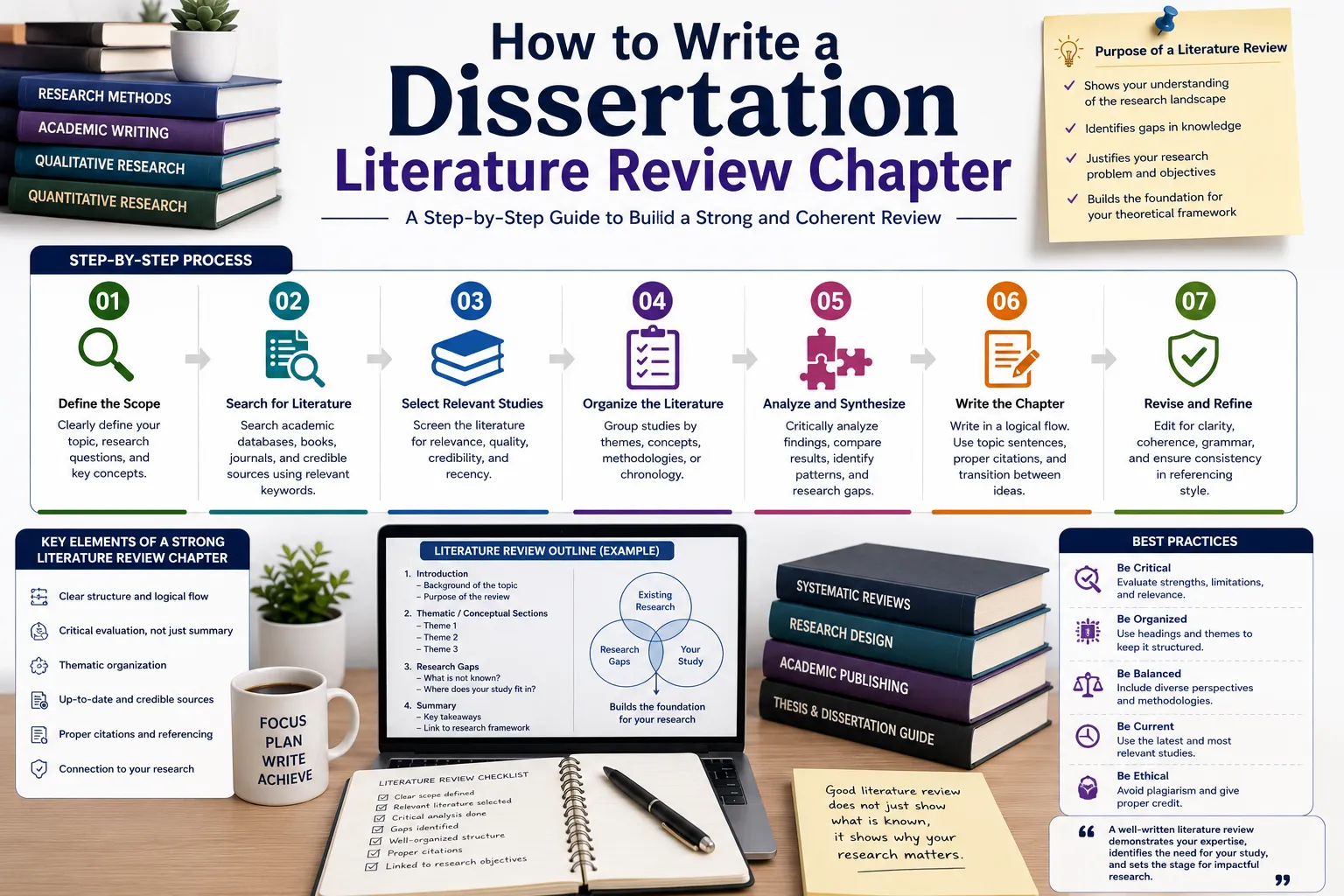
If you've read fifty papers, organized them into a folder, and still don't know how to turn that pile of reading into an actual chapter, you're facing one of the most common stalling points in dissertation writing. Learning how to write a dissertation literature review chapter isn't really about reading more — it's about synthesizing what you've already read into a structured argument that builds toward a clear gap. This guide walks through exactly how to do that: how to scope your review, organize your sources before you start writing, structure the chapter itself, and avoid the mistakes that turn a literature review into a bibliography with paragraphs.
What a Literature Review Chapter Actually Does
Before getting into process, it's worth being precise about what this chapter is actually for, because a lot of first drafts go wrong simply from misunderstanding its purpose. A literature review chapter needs to do four specific things: demonstrate your command of the existing field, reveal the specific gap your dissertation is designed to address, establish the theoretical or conceptual framework your study will build on, and directly inform your methodology choices. A chapter that only summarizes what various authors have said, without doing these four things, technically contains a lot of reading but hasn't actually functioned as a literature review.
The single most useful distinction to internalize here is the difference between summary and synthesis. A summary simply recaps what one source says. Synthesis reorganizes and integrates information across many sources — showing where they agree, where they genuinely conflict, and what pattern or gap emerges when you look at them together rather than one at a time. Most first-time dissertation writers are much more practiced at summarizing than synthesizing, which is exactly why this chapter tends to be harder to write well than its word count would suggest.
It's also worth understanding why examiners and supervisors weight this chapter so heavily relative to its position early in the dissertation. Everything that follows — your methodology, your specific research questions, your eventual discussion of findings — is meant to be read as a direct response to what this chapter establishes. A weak or purely descriptive literature review doesn't just read poorly on its own terms; it weakens the perceived justification for every decision made in the rest of the dissertation, since a reader can reasonably ask "why does this methodology matter" or "why does this specific gap matter" if the literature review hasn't already built a convincing case for it.
If you're also working on the theoretical grounding this chapter needs to support, our companion guide, [Link: Building a Theoretical Framework for Your Dissertation], covers that specifically, and if you haven't yet locked your proposal, [Link: Dissertation Proposal Defense: What to Expect and How to Prepare] covers the stage that typically precedes a full literature review chapter.
Narrative Review vs Systematic Review: Choosing Your Approach
Before you start organizing your sources, it's worth deciding — deliberately, not by default — which kind of review your dissertation actually calls for, since this is a genuine methodological choice rather than a stylistic preference.
A narrative review is flexible and author-guided: you select and synthesize literature based on your own judgment of what's relevant, organizing it thematically or conceptually to build a coherent picture of the field. This is the most common approach for dissertation literature review chapters, particularly where the review's job is to frame a broad topic, trace a field's conceptual development, or support a predominantly theoretical study.
A systematic review follows a predefined, documented, and reproducible protocol: specific databases searched with a documented strategy, explicit inclusion and exclusion criteria applied consistently, and a transparent record of how many sources were found, screened, and included. This approach is expected where your dissertation's own methodology depends on the reviewed evidence carrying real evidentiary weight — for instance, where you're aggregating existing empirical findings to answer a specific, narrowly defined question, rather than building a broader conceptual argument.
Many dissertation literature reviews land somewhere in between: a narrative review in overall structure, but one that borrows specific systematic-review discipline — a documented search strategy and explicit inclusion criteria — even without adopting a full formal protocol. This hybrid approach is worth naming explicitly in your methodology, since claiming to be "systematic" without the documented rigor to back it up is a credibility risk examiners specifically watch for, while a narrative review that's honest about its own selective, author-guided nature faces no such problem.
Step 1: Define Your Scope Before You Start Reading Further
Before organizing anything, get precise about your review's boundaries: what time period, what specific sub-topic or population, and what types of sources (empirical studies, theoretical papers, policy documents) actually fall within scope. This sounds like an obvious first step, but it's the one most commonly skipped — many scholars start reading broadly and only try to define scope after they're already overwhelmed with material that doesn't clearly belong. Writing a one-paragraph scope statement before you resume reading, even if you revise it later, gives you a concrete filter for deciding what to include and what to set aside.
Step 2: Search Systematically, Even for a Narrative Review
Even if you've chosen a narrative rather than fully systematic approach, it's worth documenting your search process as you go: which databases or sources you searched, which specific search terms you used, and roughly how you decided what to include. This isn't just good practice for its own sake — your chapter's introduction is expected to briefly explain how you searched for and selected your sources, and trying to reconstruct this retroactively once you've read forty papers is far harder than keeping a simple running log from the start.
Step 3: Organize With a Concept Map or Synthesis Matrix
This is the step that separates a well-organized literature review from a pile of open browser tabs. Rather than writing directly from your reading list, build a concept map or synthesis matrix early — a simple chart or diagram that sorts your sources into emerging themes or categories rather than keeping them in the order you happened to read them. This becomes the actual outline for your chapter. Expect this process to be iterative: as you write, you'll likely need to do additional targeted searches and revise your theme groupings, since writing itself tends to surface gaps and connections that weren't obvious during initial reading.
A synthesis matrix in its simplest form is just a table: sources down one axis, themes or questions across the other, with each cell noting what that specific source says about that specific theme. Filling this in as you read — rather than trying to build it retroactively from memory once you've finished reading everything — makes the later writing stage dramatically faster, since you can scan a single column and immediately see everything every source says about one theme, which is exactly the raw material a synthesized paragraph needs.
One specific, well-documented method worth adopting is thematic synthesis, which works through three stages: first, coding individual sources to identify recurring themes or concepts as you read; second, organizing those codes into broader descriptive themes that group related ideas together; and third, developing higher-order analytical themes that connect across sources in ways no single source states on its own — this third stage is specifically where genuine synthesis, rather than just categorization, actually happens.
Step 4: Write Thematically, Not Source by Source
Once your themes are set, write each body section around a theme, concept, or debate — not around an individual author or study. Begin each section with a clear topic sentence stating what the theme is and why it matters to your research question, then draw on multiple sources within that section, synthesizing what they collectively show rather than working through them one at a time in separate paragraphs. A useful test: if your paragraph could be rewritten by simply swapping the source's name at the start of each sentence without changing anything else, you're still summarizing rather than synthesizing.
Be judicious about direct quotation. Restating an author's argument in your own words is almost always the better default, reserving direct quotes for the rare cases where the exact original wording is itself significant — a precise definition, a particularly influential turn of phrase, or language you're specifically critiquing.
A brief, concrete illustration of the difference: a summary-style paragraph might read, "Smith (2020) found that remote work increased productivity. Jones (2021) found that remote work decreased team cohesion. Patel (2022) surveyed managers and found mixed views." A synthesized version of the same material might instead read: "Findings on remote work's organizational effects diverge sharply depending on what outcome is measured — productivity gains are consistently reported where individual task output is the metric, while cohesion and collaboration measures tell a more negative story, a split that recent manager surveys reflect directly rather than resolve." The second version draws the same three sources together into a single, more useful observation about the field itself, rather than reporting them as three separate, disconnected findings.
Step 5: Build Toward an Explicit Research Gap Statement
Every thematic section should be doing double duty: explaining what's known, and quietly building the case for what's still missing. Your chapter's final section should make this gap explicit rather than leaving it implied — stating clearly what existing literature has and hasn't addressed, and how your own dissertation is positioned to address that specific, now well-established gap. This is the single most important sentence-level payoff of the entire chapter; a strong literature review with a vague or missing gap statement at the end still fails at its core job.
If you'd like guidance identifying and articulating a genuine, defensible gap from your own reading, our Thesis Writing Service works with scholars specifically at this synthesis stage.
If You're Doing a Systematic Review, Know the Reporting Standard
If your dissertation's methodology genuinely calls for a systematic rather than narrative review — because your findings need to carry evidentiary weight for a specific, narrowly defined question — it's worth structuring your search and reporting process around the PRISMA (Preferred Reporting Items for Systematic Reviews and Meta-Analyses) framework, now in its 2020 revision. PRISMA provides a detailed checklist covering how you searched (which databases, what time period, what search terms), how you screened results against stated inclusion and exclusion criteria, and how many sources were found, screened, included, and excluded at each stage — typically visualized in a flow diagram that examiners and readers can follow to verify your process was genuinely systematic rather than just labeled that way.
Even if you're not running a full systematic review, borrowing PRISMA's core discipline — a documented, stage-by-stage account of how your source list narrowed from an initial broad search down to your final included set — considerably strengthens a narrative review's credibility too, since it shows your selection process wasn't simply "papers I happened to come across."
Managing Citations as Your Source List Grows
A dissertation literature review typically draws on far more sources than any earlier academic writing you've done, and trying to manage citations manually — retyping reference details, manually checking formatting against your required style — becomes a genuine time sink and a source of easily avoidable errors as your source list grows past thirty or forty entries. Setting up a reference management tool early, rather than partway through writing, pays off considerably: most let you import sources directly from database searches, tag and organize them by theme (which pairs naturally with the concept-mapping process described above), and automatically generate a correctly formatted reference list and in-text citations in whatever style your institution requires. Building this habit from your very first search session, rather than trying to reconstruct a clean reference list retroactively before submission, is one of the more painless ways to protect your later writing time.
Structuring the Chapter: The Three-Part Architecture
Most dissertation literature review chapters follow a consistent three-part structure, and it's worth using this as your default template even as you adapt the specific content to your topic: an introduction that states the review's scope and purpose, briefly explains your search and selection approach, and previews the themes that follow; thematic body sections, each addressing a distinct theme, concept, or debate with a clear topic sentence and genuine cross-source synthesis; and a concluding gap statement that explicitly names what remains unresolved and sets up your own dissertation's contribution. Sticking to this architecture, rather than defaulting to a chronological or author-by-author structure, is one of the most reliable ways to keep the chapter reading as an argument rather than an annotated bibliography.
Common Mistakes That Undermine an Otherwise Well-Read Chapter
- Writing a descriptive catalogue instead of a synthesized argument. A chapter that moves through sources one at a time — "Smith (2020) found X. Then Jones (2021) argued Y." — however accurate, reads as a summary rather than a review, and is one of the most commonly cited weaknesses in first drafts.
- Over-relying on direct quotation. Leaning on quotes instead of restating ideas in your own words suggests you haven't fully processed the material, and it also creates unnecessary originality risk in a chapter that should be built from your own critical synthesis.
- Failing to engage critically with sources. Accepting every claim at face value, without noting methodological limitations, contested findings, or genuine disagreements between authors, produces a flatter, less convincing review than one that shows where the literature itself is uncertain or divided.
- Neglecting to connect the literature back to your own research question. A review that's interesting in isolation but never explicitly ties back to why your specific study matters leaves the reader to make that connection themselves — which is your job, not theirs.
- Skipping scope definition and organizing later. Starting to read broadly without an early scope statement tends to produce an unfocused, overly long reading phase, since there's no clear filter for what counts as in-scope.
- Treating the literature review as a one-time task completed early and never revisited. New, relevant papers get published throughout your dissertation timeline; a review that isn't revisited closer to submission risks missing recent work a sharp-eyed examiner may already know about.
- Presenting sources as if they all carry equal weight. A single small pilot study and a large, well-replicated study addressing the same question are not equally strong evidence, and a good literature review signals this distinction explicitly rather than citing both with the same confident tone.
A Real Example: Restructuring a Chronological Catalogue Into an Argument
A first-time dissertation scholar wrote an initial literature review draft chronologically — walking through, roughly in publication order, what each major study in the field had found, one paragraph per source. It was thorough and accurate, but a supervisor's feedback was blunt: it read like an annotated bibliography rather than a chapter with an argument. Working from the same reading, the scholar built a concept map identifying four recurring themes across the sources — methodology disagreements, a contested definition, a consistent but under-explained finding, and a population that kept being excluded from studies — and rewrote the chapter entirely around those four themes instead of chronology. The same sources were used, but now each section synthesized what multiple studies collectively showed about a specific theme, closing with a clear statement that the excluded population represented a genuine, unaddressed gap the scholar's own dissertation would fill. The underlying reading hadn't changed at all — only the organizing structure had — but the chapter went from reading as a summary to reading as a genuine scholarly argument.
FAQs
How do you write a dissertation literature review chapter?
Define your scope, search and document your process even for a narrative review, organize your sources by theme using a concept map or synthesis matrix rather than reading order, write each section as a synthesis across multiple sources rather than source by source, and close with an explicit statement of the gap your dissertation addresses.
Why should you write a dissertation literature review chapter this way?
Because a literature review's actual job is to demonstrate command of the field, establish your theoretical framework, inform your methodology, and reveal your research gap — a chapter organized chronologically or source by source can be thorough and accurate and still fail at all four of these functions, which is why examiners routinely send back well-read but poorly structured drafts for revision.
When should you write a dissertation literature review chapter?
Iteratively and early — begin organizing themes as you read rather than waiting until reading is "finished," since writing itself tends to surface gaps and connections that prompt further targeted searching throughout the process, and it's worth revisiting your review closer to submission to check for newly published, relevant work
.
How long does it take to complete a dissertation using this approach?
This varies significantly by degree level and field, but organizing your literature thematically from early on — rather than reading unsystematically and organizing only once you sit down to write — is one of the more reliable ways to avoid the single biggest time sink in dissertation writing: an unfocused, constantly expanding reading phase with no clear endpoint.
Is professional help available to write a dissertation literature review chapter?
Yes. Experienced mentors routinely help scholars organize sprawling reading into coherent themes, synthesize rather than summarize, and build toward a clearly stated, defensible research gap — this is a core part of what services like ThesisLikho's dissertation writing support provide.
A literature review chapter that synthesizes rather than catalogues is what makes the rest of your dissertation's argument land. If you'd like support organizing your reading or structuring this chapter, Get Dissertation Help Now →