Somewhere between choosing your topic and starting your literature review sits a document that quietly decides how smoothly the rest of your dissertation will go: the proposal. Get it right, and your supervisor signs off with minor tweaks. Get it wrong — too vague, too ambitious, or missing a clear methodology — and you're stuck revising and resubmitting while your timeline slips.
This guide walks through how to write a dissertation proposal that gets approved, section by section, with the specific details examiners and supervisors actually look for. We've written it the way an experienced dissertation mentor would talk you through your first draft — because that's genuinely the role ThesisLikho's PhD-qualified mentors play for the thousands of scholars we've guided through this exact stage.
If you haven't settled on a topic yet, it's worth starting with How to Choose a Strong Thesis Topic Your Supervisor Will Approve before you draft a proposal around it.
What a Dissertation Proposal Actually Needs to Do
A proposal isn't a mini-dissertation — it's a pitch. Its entire job is to convince your supervisor (and sometimes a departmental committee) of three things: that your research question is genuinely worth answering, that you understand the existing landscape well enough to know where the gap sits, and that your proposed method is realistic to execute within your timeline.
Most students over-invest in one of these three and under-invest in the others. A common pattern: a student spends weeks polishing the background section while barely sketching the methodology, then gets sent back specifically because the committee can't tell how the research will actually be carried out. Keeping all three elements roughly balanced is one of the simplest ways to avoid a first-round rejection.
Typical Proposal Structure and Word Count
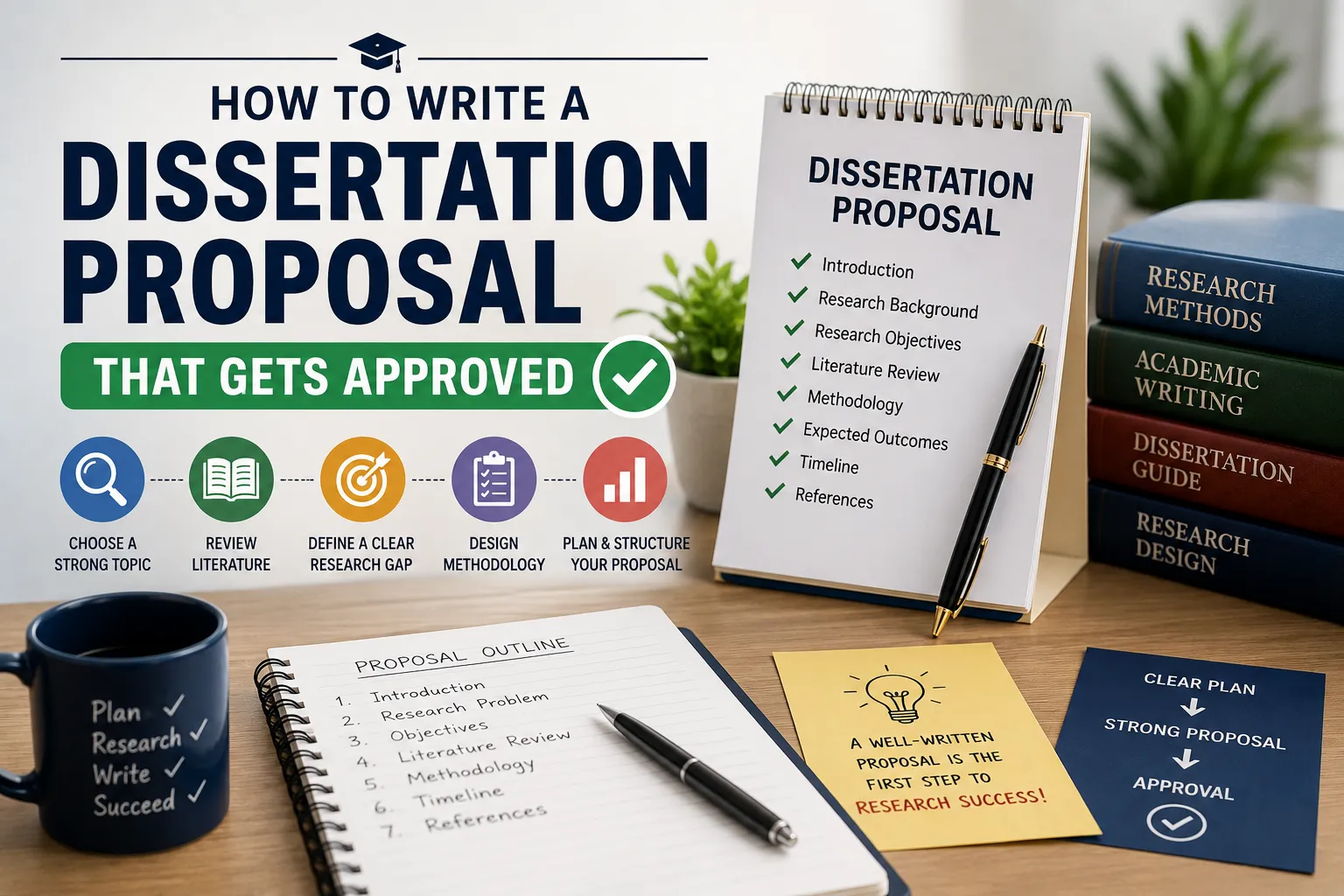
Most dissertation proposals — regardless of discipline — follow a similar core structure, even though section names and exact word counts vary by department. According to guidance from Research Prospect's structure breakdown, the typical sections are: title, background and problem statement, aims/objectives/research questions, literature review, proposed methodology, project schedule, and references, with some departments adding ethical considerations or expected outcomes.
Word count expectations scale with your degree level. Undergraduate proposals commonly run 1,000–2,000 words, master's proposals 1,500–3,000 words, and PhD proposals often extend to 3,000–5,000 words or more. These are useful reference ranges, not universal rules — always confirm the specific figure in your own department's handbook before finalizing your draft, since individual programs can and do specify their own limits.
Title & Background (15–20%)
Introduces the research problem, explains its importance, and provides background context.
Aims, Objectives & Research Questions (10%)
States the research aim, key objectives, and the questions the study will answer.
Preliminary Literature Review (30–35%)
Reviews existing studies, identifies the research gap, and justifies the proposed study.
Methodology (25–30%)
Explains the research design, data collection methods, and analysis approach.
Timeline & References (10–15%)
Presents the research schedule and lists the academic sources supporting the proposal.
Writing a Strong Title and Working Research Question
Your proposal's title doesn't need to be final — most dissertations end up with a slightly refined title by the time they're submitted — but it should already signal three things: the core phenomenon you're studying, the context or population involved, and (where relevant) the relationship you're investigating.
Compare: "A Study of Social Media and Marketing" versus "The Effect of Influencer Credibility on Purchase Intention Among Gen Z Consumers in Urban India." The second version already tells a reader your variables, your population, and your directional focus — which makes everything that follows in your proposal easier to write, because you've already narrowed the scope before you start.
Background and Problem Statement
This section answers a simple question: why does this research matter, right now? A strong problem statement usually does three things — establishes the broader context, narrows down to a specific unresolved issue within that context, and briefly states why that issue hasn't been adequately addressed yet.
Avoid two common traps here. The first is writing a background section that reads like a general encyclopedia entry on your topic, with no clear narrowing toward your specific question. The second is jumping straight into your research question without establishing why anyone should care — both leave your reader unconvinced that your research has real purpose.
Aims, Objectives, and Research Questions
Your aim is the single overarching goal of your research, stated as one clear sentence. Your objectives break that aim into specific, achievable steps. Your research questions (or hypotheses, for quantitative studies) are the precise questions your data collection and analysis will answer.
Example:
- Aim: To examine how influencer credibility affects purchase intention among Gen Z consumers in urban India.
- Objectives: (1) To identify the dimensions of influencer credibility most relevant to Gen Z consumers; (2) To measure the relationship between influencer credibility and purchase intention; (3) To assess whether brand trust mediates this relationship.
- Research Question: Does influencer credibility have a significant effect on purchase intention among Gen Z consumers, and is this relationship mediated by brand trust?
Notice how each objective maps to something measurable — this is what makes a methodology section easy to write later, since each objective effectively tells you what you'll need to test or explore.
The Preliminary Literature Review
This is usually the section students either over- or under-build. At the proposal stage, your literature review is meant to be a preliminary overview — enough to demonstrate you understand the key debates and existing gaps in your area, not a comprehensive review of everything ever published on the topic . Trying to write a full literature review at proposal stage often means you're duplicating work you'll need to do properly later anyway, once your reading has deepened.
A practical way to build this section efficiently: search using your core topic keywords plus reasonable synonyms and variations (a topic on "AI in healthcare" should also be searched as "machine learning in medicine" or "healthcare technology"), and keep a simple running table of each source's methodology, key finding, and relevance to your question as you read. This approach — organizing notes by theme rather than reading everything and sorting it out later — makes it far easier to spot where your specific gap sits once you've reviewed fifteen or twenty sources.
IEEE's own published reviewer-evaluation criteria judge submissions partly on the completeness of the literature review and whether cited references are relevant, recent, and reasonably balanced rather than over-reliant on a narrow set of sources — a useful standard to hold your own preliminary review against, even outside formal journal publishing.
For more detail on pinpointing your specific gap once your preliminary reading is done, see our companion piece: How to Identify a Research Gap for Your Dissertation, or the broader resource What Is a Research Gap and How to Identify One for Your Thesis.
Proposed Methodology
This is where most weak proposals fall apart — not because the idea is bad, but because the plan for executing it isn't concrete enough. Your methodology section should specify:
- Research design — qualitative, quantitative, or mixed methods, and why this fits your research question
- Population and sampling — who you'll study, how you'll select them, and roughly how many
- Data collection method — survey, interview, secondary data, or a combination, with enough detail that a reader could picture exactly how you'd carry it out
- Data analysis plan — the specific statistical tests or thematic analysis approach you intend to use, not just "the data will be analyzed"
- Limitations — an honest acknowledgment of what your chosen approach won't be able to tell you
A methodology section that says "a survey will be conducted and analyzed using appropriate statistical methods" tells a committee almost nothing. A stronger version specifies the sample size target, the sampling technique, the exact scale or instrument being used, and the specific test (e.g., regression analysis or a structural equation model) planned for the data.
Timeline and Feasibility
A realistic project schedule — often presented as a simple table or Gantt-style chart — is one of the most underrated parts of a proposal, because it's where you prove the research is actually completable within your program's deadline, not just conceptually sound.
Break your timeline into concrete phases: literature review completion, ethics approval (if needed), questionnaire/interview design and piloting, data collection window, data analysis, and writing. Vague timelines ("data collection: a few months") are a common reason committees ask for revisions, since they can't assess feasibility from a statement like that.
Ethical Considerations
Even a modest survey-based dissertation typically needs to address informed consent, confidentiality/anonymity of participant data, and how data will be stored and eventually disposed of. If your research involves vulnerable populations, sensitive topics, or organizational data, this section needs more detail — including how you'll secure any necessary permissions.
Many university ethics committees require a separate, more detailed ethics application later, but your proposal should still demonstrate you've thought this through, even in summary form.
References Section
Your reference list should be complete, correctly formatted in your required citation style (APA, Harvard, and IEEE are all common depending on discipline), and should represent genuinely current sources — a proposal citing only sources from a decade ago signals to reviewers that you haven't checked whether the field has moved on since then.
How Expectations Differ: Master's vs. PhD Proposals
While the core structure stays similar, what counts as "approvable" shifts meaningfully between degree levels.
A master's dissertation proposal is typically judged mainly on clarity and feasibility — can this specific student, with this specific timeline and access to data, actually complete this research? The bar for originality is real but modest: applying an established framework to a new context or population is usually sufficient.
A PhD proposal is judged more heavily on contribution to knowledge — committees expect a clearer articulation of exactly what gap in the literature your work fills, and how your findings would meaningfully extend (not just replicate) existing research. This is why PhD proposals tend to run longer (3,000–5,000+ words versus a master's 1,500–3,000) and typically require a more developed theoretical or conceptual framework section before methodology.
If you're a first-time PhD proposal writer coming from a master's background, the single biggest adjustment is usually in the literature review: a master's-level review can summarize the field competently, but a PhD-level review needs to take a position — showing not just what's been studied, but what's still genuinely unresolved and why that matters.
Formatting and Citation Style Basics
Most Indian universities specify a preferred citation style in their thesis manual — commonly APA for management and social science dissertations, or IEEE style for engineering and technical research. Rather than assuming a default, check your department's specific manual before you draft your reference list, since inconsistent citation formatting is one of the more common, easily avoidable reasons a proposal gets sent back for "minor revisions" even when the underlying research idea is sound.
Beyond citation style, confirm your program's expectations on font, margins, line spacing, and whether a cover page or declaration form is required at proposal stage — these vary enough between institutions that copying a template from a different university's guide can create avoidable friction during submission.
Why Proposals Get Rejected or Sent Back
- Research question too broad to be answered within the scope of a single dissertation
- No clear gap — the proposal reads like a restatement of settled knowledge rather than pointing toward something unanswered
- Vague methodology — no specific sample size, tool, or analysis method named
- Unrealistic timeline — data collection and analysis phases that don't add up given the submission deadline
- Thin or outdated literature review — too few sources, or sources that don't reflect current thinking in the field
- Mismatched method and question — for example, proposing a purely quantitative survey to answer a question that's really about lived experience and perception, which usually calls for a qualitative approach instead
What to Do If Your Proposal Is Sent Back
A first-round revision request is normal and doesn't mean your research idea is weak — it usually means the scope, method, or literature framing needs sharpening before the committee can properly evaluate feasibility. When this happens:
- Read the feedback for the underlying concern, not just the literal comment. "Your methodology needs more detail" often really means "I can't picture how you'd actually execute this" — so add specifics (sample size, tool, analysis method), not just more words.
- Don't defend the original draft; revise it. Students sometimes respond to feedback by explaining why their original version was fine, which slows the process rather than moving it forward.
- Ask directly if you're unsure what's being asked. A short clarifying question to your supervisor is far faster than guessing and resubmitting a second draft that misses the same point.
- Track your changes. Many committees expect a brief summary of what was revised and why, alongside your updated proposal — this makes the second review noticeably faster.
Most proposals that get sent back once are approved on the second submission, provided the revision genuinely addresses the specific concern raised rather than making cosmetic changes.
A Realistic Proposal Walkthrough (Two Examples)
Example 1 — Priya, a first-time master's dissertation writer Priya's first draft proposed studying "the impact of digital marketing on consumer behaviour" — a topic so broad her supervisor sent it back within a week, noting there was no way to meaningfully investigate "digital marketing" as a whole within her word limit. After narrowing her focus during a preliminary literature scan, she resubmitted with a specific research question about Instagram Reels marketing and purchase intention among college-age consumers in one city — same broad interest, dramatically more approvable scope.
Example 2 — Arjun, a PhD candidate proposing a mixed-methods study Arjun's initial methodology section simply stated he would "survey employees and interview managers." His committee asked for specifics: how many employees, selected how, and what specific themes his interview guide would explore. His revised proposal specified a target of 150 employee surveys via stratified sampling across departments, followed by 10–12 semi-structured manager interviews, with a clear description of how the two data sets would be integrated in his analysis. The revision wasn't a new idea — it was the same idea, made concrete enough to approve.
Tips for Getting Approved on the First Try
- Narrow your research question before you draft anything else. Every other section becomes easier once your scope is genuinely specific.
- Write your methodology with enough detail that someone else could execute it. If a stranger couldn't picture your data collection process from your description, your committee can't either.
- Show your literature review is current, not just comprehensive — cite recent work alongside foundational studies.
- Get informal feedback before formal submission. A quick read from a peer or senior scholar in your area often catches gaps in logic you've become too close to notice yourself.
- Build in a realistic buffer in your timeline. Data collection almost always takes longer than first estimated — a schedule with zero slack invites skepticism.
Pre-Submission Checklist
- Research question is specific enough to be answered within your dissertation's scope and timeline
- Background section clearly narrows from broad context to your specific unresolved issue
- Literature review demonstrates awareness of current, not just foundational, sources
- Methodology names a specific sample size, sampling technique, and analysis method — not vague language
- Timeline is broken into concrete phases with realistic durations
- Ethical considerations are addressed, even in summary form
- Reference list is complete and correctly formatted in your required citation style
- Word count matches your department's specific proposal requirements
When to Get a Second Opinion
Even strong researchers benefit from a second, more experienced read on a proposal before it goes to committee — a vague methodology or an overly broad research question is far cheaper to fix on paper than after months of data collection built on a shaky foundation.
ThesisLikho's mentoring team — PhD-qualified experts who've guided over 10,000 scholars through this exact stage — offers structured proposal review as part of our Dissertation Writing Service, helping you tighten your research question, literature framing, and methodology before submission. Once your proposal is approved and you're deeper into your research, our companion guide — How to Get Your Dissertation Ready for Journal Publication — is worth bookmarking for later.
Frequently Asked Questions
How do you write a dissertation proposal that gets approved?
Focus on a specific, answerable research question, a preliminary literature review that shows you understand the current gap, and a concrete, realistic methodology — vague scope or vague methods are the most common reasons proposals get sent back for revision.
How long does it take to complete a dissertation using this approach?
Drafting an approvable proposal typically takes 2–6 weeks of focused work, while the full dissertation — from proposal approval to final submission — usually runs 4–12 months depending on your degree level and research design.
Is professional help available to write a dissertation proposal that gets approved?
Yes — structured mentoring on proposal structuring, literature framing, and methodology justification is a standard, legitimate form of academic support. ThesisLikho's PhD-qualified mentors offer this kind of guided review for dissertation scholars.
Why should I write a dissertation proposal that gets approved on the first attempt?
A clean approval saves weeks of revision cycles and lets you start your literature review and data collection on schedule, rather than losing time reworking a rejected scope or methodology.
When should you write a dissertation proposal that gets approved?
Ideally, as soon as your topic is reasonably narrowed — waiting too long to formalize your proposal delays every subsequent stage, while proposing before your topic is specific enough often results in an avoidable first-round rejection.
Get Dissertation Help Now
If you'd like a mentor to review your proposal before it goes to your supervisor or committee, ThesisLikho's team is ready to help.