
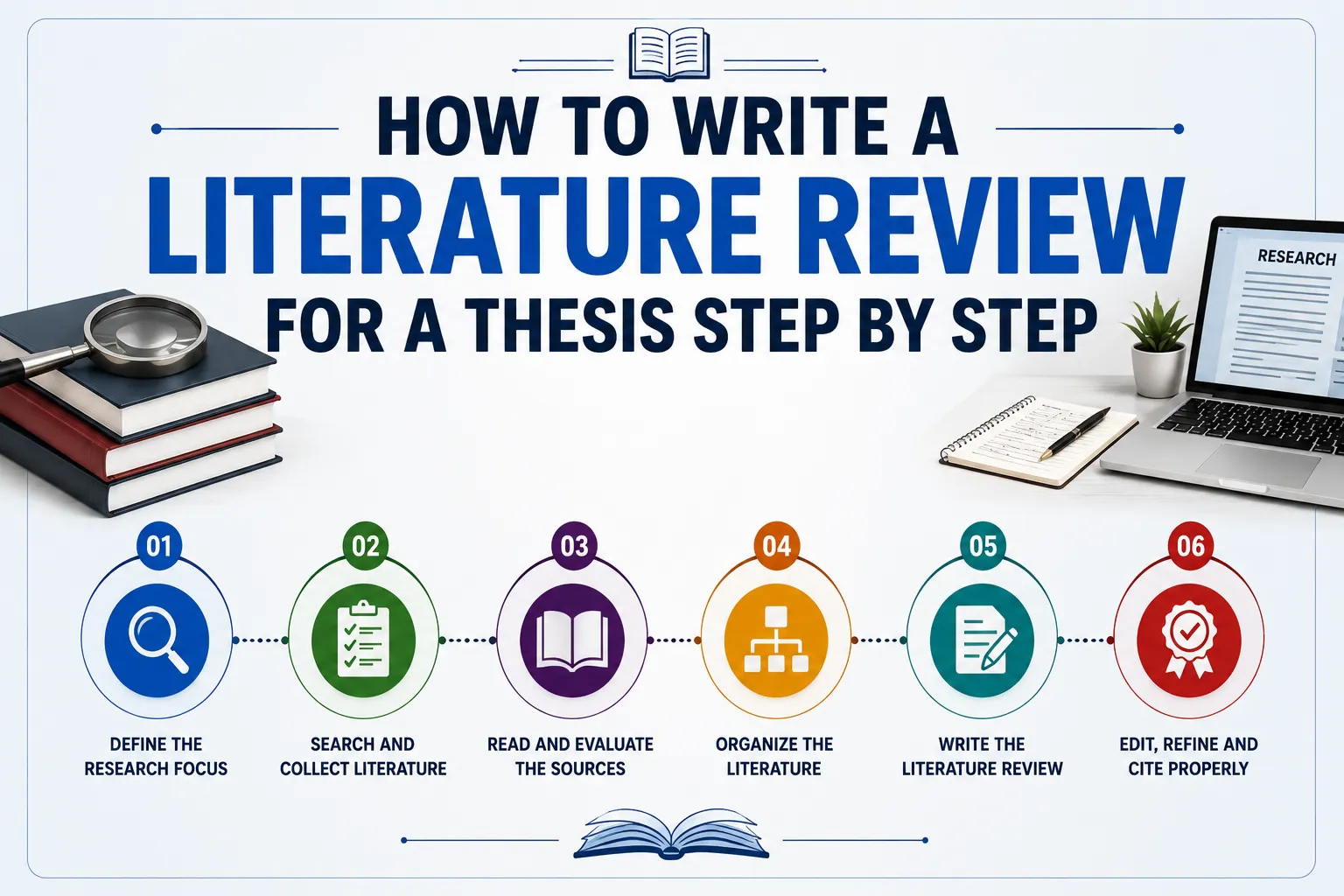
Ask most thesis writers which chapter took longest to get right, and the literature review usually wins by a wide margin. It's not that the reading itself is hard — it's that turning dozens of papers into one coherent, well-organized chapter, without it reading like a list of summaries, is a genuinely different skill from anything most students have practiced before.
This guide walks through how to write a literature review for a thesis step by step — from defining your scope, to searching systematically, to the synthesis technique that turns scattered notes into an argument, to citing consistently without slowing your writing down. We've written it the way an experienced thesis mentor would talk you through your own first draft, because that's genuinely the kind of guidance ThesisLikho's PhD-qualified team provides to the thousands of scholars we've supported through this exact chapter.
What a Literature Review Is Actually For
A literature review isn't a summary of everything you've read — it's an argument, built from existing research, about where the field currently stands and what's still unresolved. According to guidance drawn from Nature's editor and researcher interviews on review writing, a strong literature review does two things simultaneously: it provides historical context for how a field has developed, and it offers a perspective on where that field is heading next.
For a thesis specifically, this dual purpose matters because your literature review isn't a standalone piece — it exists to set up your research gap. Every source you include should be doing one of two jobs: helping the reader understand the established landscape, or helping you build the case for why your specific research question needs answering.
Step 1: Define Your Scope Before You Search
The single biggest time-waster in literature review writing is searching before you've defined boundaries. Before opening a database, get specific about:
- Your core topic and its key variables or concepts — not "digital marketing," but "influencer credibility and purchase intention"
- Your discipline lens — the same phenomenon can be studied through a marketing, psychology, or sociology lens; know which one your thesis sits in
- Your time window — are you covering the last 5 years, 10 years, or including foundational older studies too?
- Your geographic or population scope, if relevant — global literature, or literature specific to a region like India
Nature Masterclasses' guidance on review writing frames this as laying the foundation first — clarifying your motivation and refining your intended scope — before moving into the actual work of finding and evaluating sources. Skipping this step is exactly what leads to the common experience of "reading everything" and still not knowing where to stop.
Step 2: Search Systematically, Not Randomly
Once your scope is clear, search using a structured approach rather than a single loose keyword:
- Start with your core terms, then expand to synonyms and related terms (e.g., "influencer marketing" alongside "social media endorsement" and "opinion leader marketing")
- Use database filters for publication date, peer-review status, and subject area to keep your results relevant
- Follow citation trails — checking who cites a foundational paper (via Google Scholar's "cited by" feature) often surfaces more recent, directly relevant work faster than a fresh keyword search
- Track what you've searched, including which terms and databases you've already covered, so you don't waste time repeating searches or missing obvious ones
A good target for a thesis-level literature review is enough sources to demonstrate real command of the field's key debates — this typically means dozens rather than hundreds of sources for a master's-level thesis, with PhD-level reviews requiring meaningfully more depth and breadth. Exact expectations vary by department, so confirm this with your supervisor rather than assuming a fixed number.
Step 3: Organize Sources by Theme, Not by Reading Order
This is the step that quietly determines whether your final chapter reads as a synthesis or a list. As you read each source, resist the urge to simply summarize it in the order you read it. Instead, tag each source by the theme or sub-question it speaks to.
For example, a review on influencer marketing might organize sources into themes like: foundational theories of source credibility, empirical studies on influencer-driven purchase intention, studies on the mediating role of brand trust, and methodological approaches used in this research area. Once you've read fifteen or twenty sources this way, you already have a thematic skeleton for your chapter — you're not starting the writing stage from a blank page.
Step 4: Build a Synthesis Matrix
A synthesis matrix is one of the most practical tools for turning scattered research notes into a clear, evidence-based argument. Instead of reviewing each study individually, organize your sources by comparing their key claims, research methodology, major findings, and relevance to your own research question. For example, one study may conclude that influencer credibility significantly predicts purchase intention based on a survey using Structural Equation Modeling (SEM), making it a useful reference for supporting your first hypothesis and adapting its measurement scale. Another study might show that the relationship is mediated by brand trust through mediation analysis, providing a strong rationale for including brand trust as a mediator in your conceptual framework. A third study may find that the effect is weaker among older demographic groups, suggesting that a Gen Z-focused study could produce stronger or different results. Once you have organized your sources in this way, compare them collectively rather than one by one. This helps you identify where researchers agree, where their findings differ, and which questions remain unanswered. These patterns of agreement, disagreement, and research gaps form the foundation of a strong literature review and clearly demonstrate how your study contributes new knowledge to the existing body of research.
Step 5: Write to Synthesize, Not Summarize
This is where most first drafts fall short. A summarized literature review reads like: "Study A found X. Study B found Y. Study C found Z." A synthesized literature review reads like: "While early studies established that credibility drives purchase intention (Study A), more recent work has complicated this picture by identifying brand trust as a key mediating factor (Study B) — though this effect appears to weaken among older demographic segments (Study C), suggesting the relationship may be more context-dependent than initially assumed."
The difference isn't length — it's that the second version makes an argument about the relationship between sources, not just a list of what each one found individually. Guidance from academic writing centers on synthesis is consistent on this point: your job as a writer is to save your reader time by drawing conclusions across multiple sources, not simply reporting what each source said in isolation.
For deeper guidance on this specific chapter within a dissertation context, see our companion piece: [Link: How to Write a Dissertation Literature Review Chapter].
Step 6: Build Your Theoretical Framework
Many thesis literature reviews also need to establish a theoretical framework — the established theory or model your research is built on or extending. If your topic draws on an existing framework (like the Technology Acceptance Model, or Source Credibility Theory), your literature review needs to clearly explain that framework, cite its origins, and justify why it's the right lens for your specific research question.
This section often sits either within the literature review chapter or as its own subsection, depending on your department's conventions — check your specific thesis template rather than assuming one placement is universal.
For a deeper walkthrough specifically on this step, see our companion guide.
Step 7: Identify and State Your Research Gap
Your literature review's final job is to point directly at your research gap — the specific, unanswered question your thesis will address. This should read as a natural conclusion of everything that came before it, not an abrupt final paragraph tacked on.
A strong gap statement typically follows this pattern: "While existing research has established [what's known], and more recent work has extended this to [related finding], [a specific context, population, or angle] remains unexamined — this is the gap this thesis addresses." If your gap statement can't be filled in this way using your own synthesis matrix, it usually means more reading (or narrower scoping) is still needed before this section is ready to write.
Step 8: Cite Consistently (APA and Beyond)
Whichever citation style your department requires — APA is common across management and social science theses — consistency matters more than most students expect. APA Style's own guidance is explicit that published authors paraphrase far more often than they quote directly, and student writers should do the same, since paraphrasing keeps your own analytical voice front and center rather than stitching together other people's sentences.
A few practical APA rules worth knowing for a literature review specifically: when paraphrasing, you only need to cite the author and year (a page number is optional, useful mainly for long or complex sources); and once you've cited a source at the start of a paraphrased passage, you don't need to repeat that citation after every single sentence, as long as it stays clear you're still discussing the same source.
Choosing Between Systematic and Narrative Review
Not every thesis literature review takes the same form. A narrative review — the most common format for standard master's and PhD theses — synthesizes literature thematically to build a case for your research gap, without following a rigid, pre-registered search protocol. A systematic review follows a much stricter, pre-defined search and inclusion/exclusion process, often used when the review itself is the primary contribution of the thesis (common in health sciences and some social science methodology-focused theses).
Most thesis chapters use a narrative approach even when they borrow systematic-review habits like documented search terms and inclusion criteria — but if your specific research question calls for a formal systematic review as your core contribution, the process, documentation, and reporting standards involved are meaningfully more rigorous.
Citation Management Tools Worth Knowing
As your collection of research papers grows beyond twenty or thirty sources, manually managing citations quickly becomes time-consuming and increases the risk of referencing errors. According to guidance from Nature, choosing the right reference management software should be an early decision rather than an afterthought. These tools help you organize research articles, store PDFs, insert in-text citations, and automatically generate reference lists in the required citation style, making the writing process much more efficient.
Among the most widely used options, Zotero is an excellent choice for students because it is free, captures citations directly from web browsers, integrates smoothly with Microsoft Word, and supports thousands of citation styles. EndNote is a powerful reference management tool commonly provided through university library subscriptions, making it a popular option for researchers who need advanced organization and collaboration features. Mendeley combines reference management with PDF annotation, allowing researchers to highlight, comment on, and organize journal articles while maintaining a searchable citation library in one place.
Whichever reference management tool you choose, set it up before you begin your literature search rather than waiting until later. Organizing and tagging each paper as you read it is far easier than trying to sort dozens of downloaded PDFs after weeks or months of research. Building good citation management habits from the beginning saves time, improves accuracy, and makes writing your literature review significantly more organized.
Paraphrasing Without Losing Accuracy
Since a literature review leans so heavily on paraphrase rather than direct quotation, it's worth being deliberate about how you paraphrase, not just that you do it. A reliable process: read the original passage carefully, set it aside completely (don't look at it while writing), write the idea in your own words from memory, then check your version against the original to confirm you haven't distorted the claim.
This matters for two reasons. First, paraphrasing that stays too close to the original sentence structure — even with a few words swapped — can still register as a similarity match during plagiarism checks, since text-matching tools look at phrasing patterns, not just verbatim copying. Second, and just as important academically, a rushed paraphrase can accidentally overstate or understate what a source actually found, which undermines your credibility if a committee member checks the original. Reading, setting the source aside, then writing from understanding rather than from the page in front of you is the most reliable way to avoid both problems at once.
Scenario — Devansh, a first-time PhD scholar in an engineering department Devansh's initial literature review draft ran into repeated plagiarism-checker flags, even though he was confident he hadn't copied anything directly. On review with his supervisor, the issue turned out to be paraphrasing too close to the original sentence structure — swapping a few words while keeping the same sentence order and phrasing pattern as his sources. Once he switched to reading a passage, closing the tab, and writing the idea from memory before checking it against the original, his similarity score dropped substantially, and — just as importantly — his writing started sounding more like his own analytical voice rather than a lightly reworded version of someone else's.
How Much Literature Is Actually Enough?
One of the most common questions asked by first-time thesis writers is, "How many sources are enough for a literature review?" The honest answer is that there is no universal number because the required depth depends on your degree level, research topic, and university guidelines. Instead of aiming for a specific source count, focus on selecting high-quality, relevant, and up-to-date studies that directly support your research objectives.
For an undergraduate dissertation, a literature review typically draws on 15–25 carefully selected sources, with the emphasis on demonstrating an understanding of the most influential and frequently cited work within the chosen subject area. A Master's or MBA dissertation generally requires 30–60 sources, balancing foundational theories with recent research published within the last three to five years to show awareness of current developments. A PhD thesis usually involves 80–150 or more sources, reflecting a comprehensive understanding of the field, identifying research gaps, and positioning the study within the broader academic conversation.
These figures should be viewed as general reference points rather than strict requirements. A literature review built around 40 highly relevant, critically analyzed, and well-synthesized studies is far more valuable than one containing 100 loosely related references included simply to increase the count. Examiners and research committees consistently place greater importance on the quality of analysis, critical evaluation, and integration of evidence than on the total number of citations. The goal is to demonstrate a deep understanding of the existing literature and clearly explain how your research contributes new knowledge, rather than to impress readers with an unnecessarily long reference list.
Common Mistakes in Literature Reviews
- Summarizing instead of synthesizing — presenting sources one at a time rather than showing how they relate to each other
- No clear organizing structure — jumping between themes without a logical thread, making the chapter hard to follow
- Over-quoting — relying on direct quotes instead of paraphrasing in your own analytical voice, which both weakens your voice and increases plagiarism-check flags
- Citing outdated sources exclusively — a review with no recent literature signals to your committee that you haven't checked whether the field has moved on
- Missing the gap statement entirely — ending the chapter without clearly stating what remains unanswered, leaving your reader to guess why your research matters
- Starting to write before organizing sources thematically — leads to a first draft that has to be substantially restructured rather than lightly edited
A Realistic Example Walkthrough
Scenario — Ritika, a first-time master's thesis writer
Ritika's first literature review draft read like an annotated bibliography — one paragraph per source, in the order she'd read them, with no connecting analysis between paragraphs. Her supervisor's feedback was blunt: "I can't tell what argument you're making." She went back, built a synthesis matrix from her existing notes (the reading didn't need to be redone, just reorganized), and rewrote the chapter around four themes instead of a source-by-source structure. The rewrite took less time than the original draft, because the matrix had already done the hardest thinking — she was writing from an organized argument instead of a pile of notes.
This is a pattern we see constantly in our mentoring work: struggling literature reviews are rarely a reading problem. They're almost always an organization problem, solved much faster with a synthesis matrix than with more reading. If you'd like a second opinion on your own structure before you commit to a full draft, our Thesis Writing Service offers exactly this kind of structural review from PhD-qualified mentors.
Pre-Submission Checklist
- Scope is clearly defined (topic, discipline lens, time window, geographic focus)
- Sources are organized by theme, not by the order you read them
- A synthesis matrix (or equivalent) was used to identify agreement, disagreement, and gaps across sources
- The chapter synthesizes across sources rather than summarizing them one at a time
- A theoretical framework is clearly explained and justified, where relevant
- The chapter ends with a clear, specific research gap statement
- Citations are consistent and follow your required style (APA or otherwise) throughout
- Recent sources are included alongside foundational ones
Getting Expert Support
Even experienced researchers benefit from a second, structural read on a literature review draft before it goes to their supervisor — a chapter that reads as a list rather than an argument is one of the most common, and most fixable, issues at this stage.
Frequently Asked Questions
How do you write a literature review for a thesis step by step?
Define your scope, search systematically using core and related terms, organize sources by theme rather than reading order, build a synthesis matrix to compare findings across sources, then write by synthesizing across sources and ending with a clearly stated research gap.
How long does it take to complete a thesis using this approach?
Writing a solid literature review chapter typically takes 4–8 weeks of focused reading and drafting, though this depends heavily on how much preliminary reading was already done during your proposal or synopsis stage.
Is professional help available to write a literature review for a thesis step by step?
Yes — structured mentoring on search strategy, synthesis-matrix organization, and citation consistency is a standard, legitimate form of academic support. ThesisLikho's PhD-qualified mentors offer this kind of guided review for thesis scholars.
Why should I write a literature review for a thesis step by step rather than all at once?
A step-by-step approach — scoping, searching, organizing, then writing — prevents the most common failure mode: reading widely without a clear structure, which usually results in a chapter that has to be substantially rewritten rather than lightly polished.
When should you write a literature review for a thesis step by step?
Ideally, right after your topic and research gap are reasonably clear (post-proposal or post-synopsis stage) — starting too early means reading without focus, while starting too late leaves too little time to organize sources properly before your writing deadline.
Talk to a Thesis Expert
If you'd like a mentor to review your literature review structure or synthesis before you finalize the chapter, ThesisLikho's team is ready to help.