
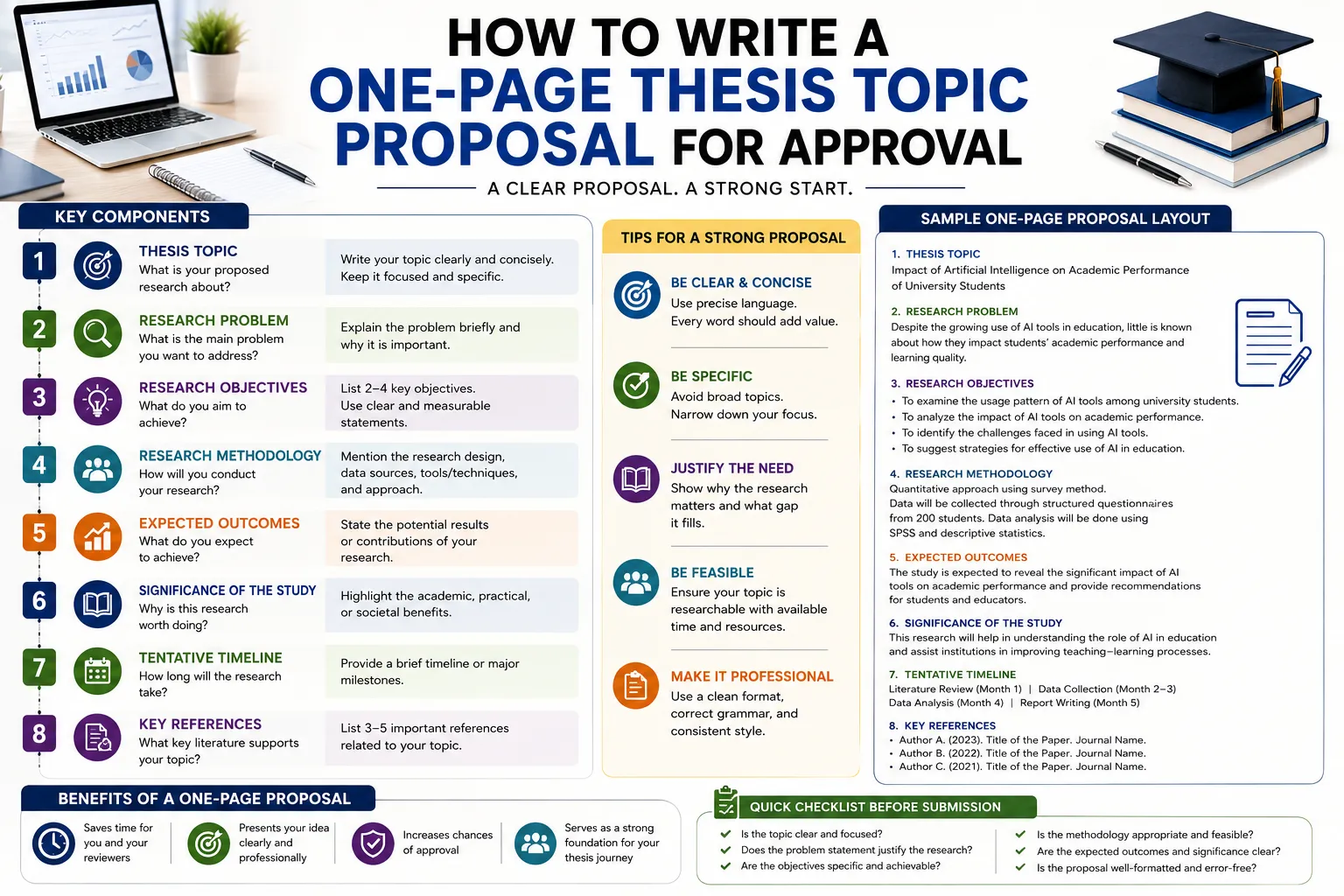
Before you write 80,000 words, you often need to get past a single page. Many universities require scholars to secure preliminary approval on a condensed thesis topic proposal before a fuller proposal or synopsis is even developed. If you're staring at that one page wondering how to fit an entire research plan into it, this guide walks you through exactly how to write a one-page thesis topic proposal for approval — what to include, what to cut, and how committees actually evaluate it.
A proposal, even a condensed one, is not a mini-thesis. It is a pitch — a document meant to convince your advisor or committee that your research is worth pursuing and that you can realistically complete it. Every sentence on that single page needs to earn its place.
Why a One-Page Proposal Exists — and What It's Actually For
Many institutions build a one-page gate into their approval process deliberately. A widely used doctoral proposal format explicitly separates a capped, one-page "summary of the research proposal" from the fuller research proposal document that follows later. Similarly, some institutions require a proposal of just 2–3 pages at the initial approval stage, attached to a formal signed approval form naming the student, advisor, and second reader before any further work begins.
The purpose is simple: committees need a fast, low-effort way to filter topics before scholars invest months in a full literature review and methodology design. A strong one-page proposal respects that purpose — it is dense with substance, not padded with background.
What Goes on the Page: Core Sections
Even compressed to one page, a topic proposal needs to cover the same essential ground as a full proposal, just in miniature. The core elements that must appear are: the topic and motivation for its selection, brief background, the specific research gap, the research question or objectives, and enough indication of method to establish feasibility.
1. Working Title
Specific enough to signal scope, population, and approach — avoid vague, overly broad titles.
2. Background and Motivation
Why this topic, why now. Keep this tight; it exists only to set context, not to summarize the field.
3. The Research Gap
State precisely what remains unaddressed in existing literature. This is the section committees scrutinize most, since a vague or unsupported gap statement is one of the fastest ways to get sent back for revision.
4. Research Question or Objectives
Vague research questions get rejected; specific ones get approved (Source: MyPerfectWords). State one central question clearly, with 2–3 objectives at most if space allows.
5. Proposed Methodology
Enough detail for the committee to judge feasibility — data source, method type (qualitative/quantitative/mixed), and rough scope. This does not need full methodological justification; that comes later.
6. Expected Contribution
What this research adds — practically, theoretically, or both.
7. Supervisor/Committee Details
Name of proposed supervisor and co-supervisor (if interdisciplinary), department, and date.
Step-by-Step: How to Write a One-Page Thesis Topic Proposal for Approval
Step 1: Draft Full-Length First, Then Cut
Write each section at normal length first — a paragraph rather than a sentence — then compress ruthlessly. It's far easier to identify what's essential once you've seen the fuller version.
Step 2: Lead With the Gap, Not the Background
On a single page, background context should be minimal. Committees are looking for the gap and the question; don't spend a third of your limited space narrating general field history.
Step 3: Name Your Search Approach Briefly
Even in a condensed proposal, briefly signaling how you identified your gap — which databases, which recent reviews, what timeframe — adds credibility. PRISMA's emphasis on transparent reporting of information sources and eligibility criteria is a useful discipline to borrow here, even in miniature: one sentence naming your search approach signals rigor far more than an unsupported claim.
Step 4: Make the Research Question Impossible to Misread
Read your question aloud. If it could apply to several different studies or disciplines, it's still too broad for a one-pager. Specificity is what separates an approved topic from one sent back for revision.
Step 5: State Feasibility Explicitly
Committees evaluating any topic proposal check whether a systematic plan for data or evidence collection exists and whether appropriate methods of analysis have been identified. Even in one sentence, name your data source and method type directly.
Step 6: Address Originality Up Front
Committees increasingly expect scholars to demonstrate early awareness of plagiarism thresholds and originality expectations, even before data collection begins. A brief note confirming your topic and approach are original (not a close replication of existing published work) can pre-empt committee questions.
Step 7: Attach the Required Approval Form
The one-page proposal rarely stands alone — most institutions pair it with a formal cover form naming the proposed supervisor, co-supervisor if relevant, and departmental reviewers, which is the actual mechanism through which approval is granted. Confirm your institution's specific form before submission.
Step 8: Proofread for Density, Not Just Grammar
Read the page once purely to check whether every sentence adds new information. Cut any sentence that restates something already implied elsewhere on the page.
One-Page Proposal vs. Full Thesis Proposal
A one-page proposal and a full thesis proposal serve different purposes in the research approval process. Understanding these differences helps you prepare the appropriate document for your academic stage.
Length: A one-page topic proposal is usually limited to one page (sometimes up to 2–3 pages), while a full thesis proposal typically ranges from 3 to 30 pages, depending on the degree level and university guidelines.
Literature Review: In a one-page proposal, the literature review is usually one or two sentences identifying the research gap. In contrast, a full thesis proposal includes an in-depth literature review spanning several pages that critically analyzes existing research.
Methodology: A one-page proposal briefly outlines the proposed research method in 2–3 sentences to demonstrate feasibility. A full thesis proposal provides a detailed methodology with justification for the research design, sampling, data collection, and analysis techniques.
Purpose: The primary purpose of a one-page proposal is to obtain initial approval for the research topic. A full thesis proposal is submitted for formal committee evaluation before the researcher begins data collection.
Typical Reviewer: A one-page proposal is generally reviewed by a supervisor or a small review committee, whereas a full thesis proposal is evaluated by the Doctoral Research Committee (DRC), Departmental Advisory Committee (DAC), or an equivalent academic review panel.
Practical Checklist: Is Your One-Page Proposal Ready?
- Title is specific, not generic
- Background is 2–3 sentences maximum
- Research gap is stated explicitly, not implied
- Research question is narrow enough to guide a single study
- Methodology names a data source and method type
- Expected contribution is stated in one or two sentences
- Originality/feasibility is addressed, even briefly
- Supervisor and departmental details are complete
- Every sentence on the page adds new information
- The required institutional approval form is attached
Two Practical Scenarios
Scenario 1 — Cutting an Overwritten Draft A scholar drafted a full page of background on the history of remote work research before even naming a gap, leaving no room for methodology. After rewriting with background compressed to two sentences and reallocating space to the gap and research question, the same committee approved the revised version within one review cycle — the content hadn't changed, but the emphasis had.
Scenario 2 — Vague Question Sent Back for Revision A scholar submitted a one-pager asking, "How does social media affect mental health?" — a question broad enough to fit dozens of different studies. The committee returned it citing insufficient specificity. Revising to name a specific population (university students in a defined region) and a specific gap (the qualitative interpretation gap left by existing quantitative work) resulted in approval on resubmission.
Common Mistakes First-Time Thesis Writers Make
- Spending too much space on background, leaving no room for the gap or question.
- Stating an overly broad research question that could fit multiple studies or disciplines.
- Omitting methodology entirely, leaving the committee unable to judge feasibility.
- Forgetting the required institutional approval form, delaying formal sign-off even after content approval.
- Treating the one-pager as a formality rather than a genuine gatekeeping document that shapes what follows.
Frequently Asked Questions
How do you write a one-page thesis topic proposal for approval?
Compress the core elements of a full proposal — title, brief background, research gap, research question, methodology indication, and expected contribution — into single sentences or short phrases, prioritizing the gap and question over general background, and attach any required institutional approval form.
Why should I write a one-page thesis topic proposal for approval carefully rather than quickly?
A vague or poorly prioritized one-pager is one of the most common reasons committees send topics back for revision — investing care here avoids delaying your entry into the full proposal or synopsis stage.
When should you write a one-page thesis topic proposal for a thesis?
As early as possible, typically before developing your full literature review or synopsis, since many institutions require this condensed approval gate before further work is authorized.
How long does it take to complete a thesis using this approach?
A well-prepared one-page proposal typically speeds up the overall thesis timeline, since it clears the initial approval gate quickly and reduces the risk of late-stage topic revisions.
Is professional help available to write a one-page thesis topic proposal for approval?
Yes. ThesisLikho's PhD-qualified mentors have guided 10,000+ scholars through topic proposal drafting, research gap articulation, and full thesis writing assistance tailored to individual university requirements.
Get Expert Guidance on Your Thesis Topic Proposal
A one-page proposal carries more weight than its length suggests — it's often the first real test of whether your topic will be approved at all. If you'd like expert feedback on whether your gap, question, and methodology are clear and specific enough to pass committee review, ThesisLikho's PhD-qualified team offers proposal drafting support, research methodology guidance, and complete thesis writing assistance. If you need expert guidance with your topic proposal, research question, or thesis structure, you can explore our Thesis Writing Assistance service.
Talk to a Thesis Expert → https://thesislikho.com/writing-services/thesis-writing