
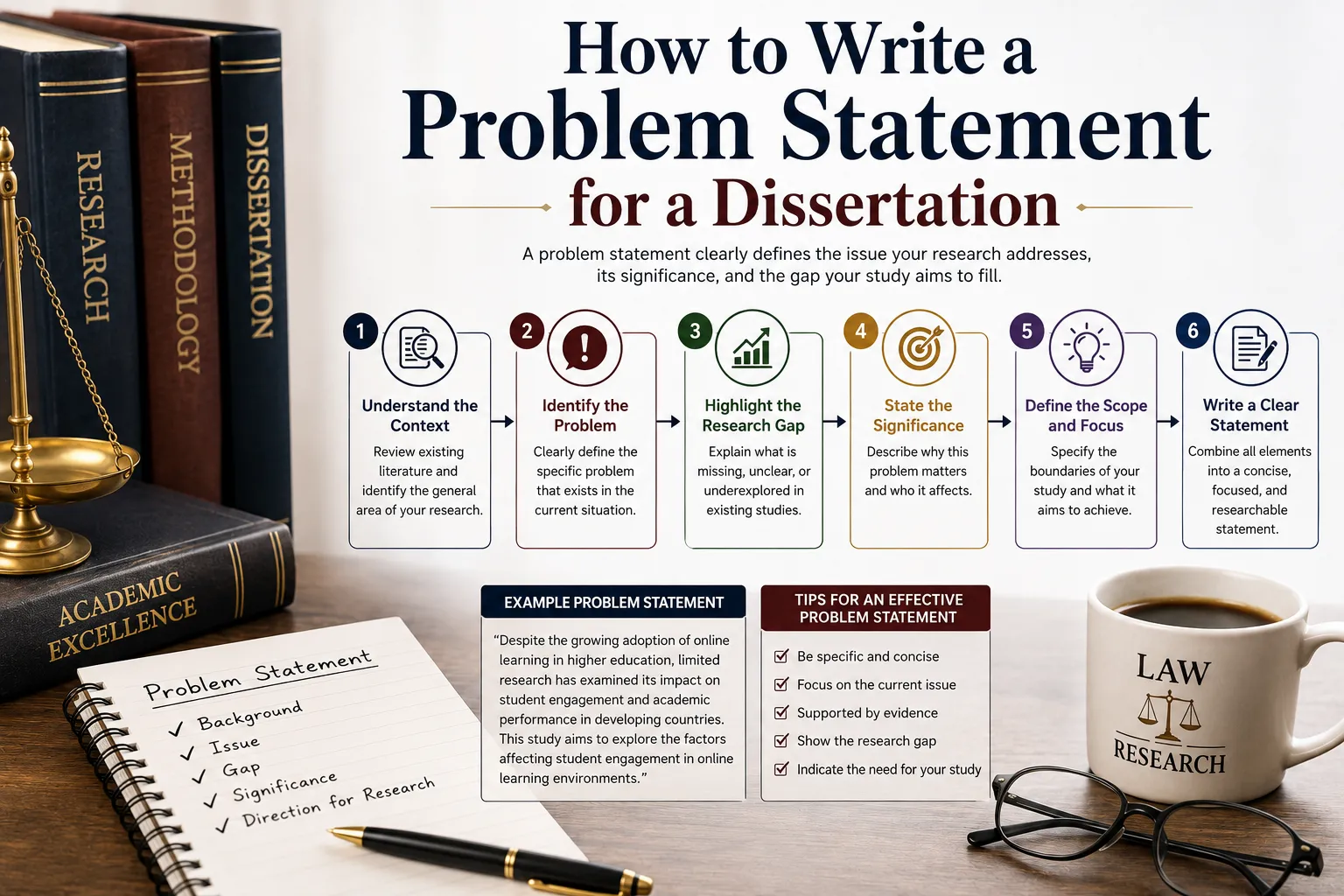
If your committee keeps sending your Chapter 1 back with some version of "what exactly is the problem you're studying?" — you're not failing at research, you're facing the single hardest paragraph in the entire dissertation. Learning how to write a problem statement for a dissertation is less about clever phrasing and more about discipline: naming one specific issue, grounding it in real evidence, and showing exactly why it matters enough to spend years studying.
This guide walks through what a strong problem statement actually contains, how to build one step by step, and the mistakes that most often send scholars back to the drawing board — the way an experienced dissertation chair would talk you through it before your proposal defense.
What a Problem Statement Actually Is (and Isn't)
A problem statement is a concise, evidence-backed description of a specific, real issue that your research will address — not your topic, not your thesis statement, and not a broad statement of interest. It's easy to conflate these, but they do different jobs: your topic names the general area you're working in, your thesis or purpose statement describes what you intend to do about the problem, and your problem statement is the "why does this need studying at all" that everything else responds to.
Most graduate guidance recommends keeping the problem statement itself genuinely tight — often 250 to 350 words at the doctoral level — because it needs to do far more work per sentence than a general introduction does. If you find yourself writing several pages before you've actually named the specific issue, that's usually a sign you're still describing the field, not the problem.
Why This Paragraph Decides Your Whole Dissertation
It's tempting to treat the problem statement as one section among many in Chapter 1, but it functions more like a foundation than a room. Your purpose statement should restate the same core idea in different words. Your research questions should each address a distinct sub-element of the problem you named. Your methodology has to be capable of actually answering that problem. If any of these pieces don't align with what the problem statement claims, committees flag it as a critical structural flaw — not a minor edit.
This is also, consistently, where dissertations run into the most trouble. A vague or poorly defined research problem is repeatedly cited as one of the leading causes of proposal rejection and revision requests — which means getting this one paragraph right early saves you from restructuring your entire proposal later.
When Should You Write Your Problem Statement?
Write a rough version of your problem statement before you finalize your literature review structure — not after. It should guide what you read and how you organize it, not be reverse-engineered from a review you've already written. A more polished version comes together once your literature review has confirmed the gap is real and current, and the final version should be locked before you draft your research questions and methodology, since both depend directly on it.
If you're choosing between spending more time on your literature review or locking your problem statement first, lock the problem statement first — even in draft form. It gives your reading a filter, rather than leaving you trying to connect scattered notes into a coherent problem after the fact.
Step 1: Ground the Problem in Current Literature
A problem statement isn't a personal opinion about what seems important — it's an evidence-backed claim that a real issue exists in the current body of knowledge. That means every problem statement needs literature behind it, and that literature needs to be current: a widely used guideline is that the problem should be substantiated by research published within roughly the last five years, not literature describing a problem that may already have been resolved or superseded.
A practical test: for every claim in your problem statement about what's missing or unresolved, you should be able to point to at least two or three recent, credible sources that either avoid the issue specifically, contradict each other on it, or explicitly name it as an open question in their own limitations sections.
Step 2: Name the Specific Gap, Not the Whole Field
This is where most first drafts fail. A problem statement built on a broad field-level claim — "there is limited research on employee engagement" — tells a committee nothing about what you'll actually study. A properly scoped problem statement names a specific population, context, or contradiction: which employees, in which sector, under what specific circumstance existing research hasn't addressed.
The gap itself should specify exactly what is missing in current research, literature, or theoretical understanding — not simply that the topic is under-discussed in general, but precisely which angle, population, or relationship remains unaddressed, and why your study is positioned to address it.
Step 3: Explain Why the Problem Matters
A specific, well-evidenced gap still isn't enough on its own — your problem statement also needs to answer "so what?" This is the piece scholars most often skip, assuming the significance is self-evident because they personally find the topic compelling.
Instead, state plainly who is affected by this problem, what the practical or theoretical cost of leaving it unaddressed is, and why now is the right moment to study it. A problem statement that names a real gap but never explains its stakes reads as technically correct but forgettable — and committees respond to stakes, not just novelty.
Step 4: Confirm It's Actually Researchable
A compelling problem statement that you cannot actually investigate with the population, data, and tools you have access to is not a usable problem statement — it's an aspiration. Before finalizing it, ask directly: can you reach the population your problem depends on? Do you have (or can you realistically obtain) access to the data your methodology will need?
A classic example of this mismatch: proposing to study leadership style among CEOs of major global corporations without any realistic access to that specific population. The problem might be genuinely interesting, but if you can't examine it with the tools and people actually available to you, the statement needs to be scoped down to something you can defend with real evidence, not just real curiosity.
Step 5: Check Alignment With Your Purpose, Questions, and Methodology
Before you consider your problem statement finished, run this alignment check: read only your problem statement and try to state, in one sentence, exactly what the research problem is. If you can't do that cleanly, a committee member won't be able to either.
Then check each downstream piece against it:
- Does your purpose statement restate the same core idea, just worded differently — not a new or expanded idea?
- Does each of your research questions address a distinct sub-element of the problem you named, rather than drifting into related-but-different territory?
- Is your methodology actually capable of answering the specific problem you've described — not just a generally appropriate method for the field?
If these four pieces don't visibly connect, reviewers will flag the misalignment as a structural weakness, regardless of how well any individual section is written.
A Real Example: From Vague Complaint to Defensible Problem Statement
One scholar we worked with arrived with a first-draft problem statement built around: "Remote work has become common, but there isn't enough research on how it affects productivity." It read like a reasonable observation — but it named no specific population, no specific industry, no specific aspect of productivity, and no time-bound literature gap. A committee reading this genuinely could not tell what the scholar intended to measure or in whom.
Here's exactly what was missing: the statement described a general trend (remote work) rather than a specific unresolved question. It didn't distinguish between different kinds of "productivity" (output volume, quality, collaboration effectiveness), didn't name an industry or role type, and didn't cite the specific literature gap it claimed existed.
After revision, the problem statement became: "While extensive research has examined remote work's effect on individual task output, its impact on cross-functional collaboration quality among mid-level managers in India's IT services sector — where hybrid schedules create asynchronous coordination challenges — remains largely unexamined in recent literature." This version named the population (mid-level IT services managers), the specific variable (collaboration quality, not general productivity), the context (India's hybrid IT sector), and implied exactly why the gap existed (asynchronous coordination). It gave the committee something precise enough to evaluate — and gave the scholar a problem statement that its own research questions and methodology could actually be built around.
If you'd like expert guidance in developing and refining your dissertation problem statement, you can check out our Dissertation Writing Service.
Common Mistakes Scholars Make Writing a Problem Statement
Mistake 1: Describing the field instead of naming the problem. Scholars often write a full page summarizing what's known about a topic before ever stating what's actually missing — burying the one sentence a committee is looking for underneath general context.
Mistake 2: Citing outdated literature to justify the gap. A problem statement built on sources from a decade or more ago is vulnerable to a simple, damaging question at proposal defense: "hasn't this already been studied since then?"
Mistake 3: Skipping the significance argument entirely. A real, well-evidenced gap without an explanation of who's affected and why it matters now reads as technically sound but unmotivated — and unmotivated research is harder to defend under questioning.
Mistake 4: Writing the problem statement and methodology independently of each other. Scholars sometimes draft an ambitious problem statement and a separate, disconnected methodology chapter, only to discover at review that the chosen method can't actually answer the specific problem as stated.
How Originality Checks Affect Your Problem Statement
Because your problem statement leans heavily on paraphrased literature — describing what others have found and where the gaps sit — it's also one of the sections most likely to trigger similarity-check concerns if it's written too close to the original sources' wording.
It's worth understanding upfront that plagiarism-detection tools like Turnitin don't actually measure "how much you plagiarized" — they measure how much of your text matches existing sources in their database, which is a different thing. There's no single universal acceptable percentage; what counts as acceptable similarity depends heavily on your specific university, department, and even individual supervisor's expectations. That said, common academic practice across many institutions treats a dissertation similarity score in the range of roughly 10–20% as generally reasonable, provided the matched text is properly quoted, paraphrased, and cited — a lower score with a handful of uncited matches can actually be more concerning than a higher score built almost entirely from correctly attributed quotes and a full bibliography.
The practical takeaway for your problem statement specifically: paraphrase every source in genuinely your own words rather than lightly rewording a sentence you found while reading, and cite consistently as you write rather than retrofitting citations afterward. This protects both your originality score and your credibility if a committee member cross-checks your claims against the literature you cite.
Best Practices If You Have No Research Background
If this is your first formal research project, a few adjustments make writing a strong problem statement far more manageable:
- Draft it in one sitting, badly, before refining it. A rough first attempt that names a specific issue — even imperfectly — is far more useful to revise than an empty page waiting for the "right" wording.
- Write your problem statement before your full literature review, not after. Doing this in reverse order often produces a review with no real filter and a problem statement that reads like an afterthought.
- Ask your supervisor to react to your one-paragraph draft specifically, rather than your full Chapter 1. It's a smaller, faster ask, and it catches a fundamental gap or scope issue before you've built pages of surrounding material around it.
- Read the problem statements of 3–5 recently completed dissertations in your specific sub-area. Seeing how other scholars scoped a real gap is often more instructive than any general template.
If any part of this process — identifying a genuinely current gap, scoping it precisely, or checking alignment across your problem statement, questions, and methodology — feels difficult to do alone, that's exactly where a structured, expert-guided process helps first-time scholars move from a vague concern to a defensible research problem.
FAQs
How do you write a problem statement for a dissertation?
Ground it in current literature (ideally from the last five years), name a specific gap rather than a broad field-level observation, explain who's affected and why it matters now, confirm it's genuinely researchable with the population and tools you have, and check that it aligns tightly with your purpose statement, research questions, and methodology.
Why should I write a problem statement for a dissertation carefully?
Because it's the foundation every other part of your dissertation is built on — your purpose statement, research questions, and methodology all need to trace back to it directly. A vague or poorly defined problem statement is one of the most commonly cited reasons committees send proposals back for revision.
When should you write a problem statement for a dissertation?
Write a rough version before you finalize your literature review, since it should guide what you read rather than being reverse-engineered from it. Lock the polished version before you draft your formal research questions and methodology, since both depend on it directly.
How do you write a problem statement for a dissertation?
See the five-step process above: ground it in recent literature, name the specific gap, explain its significance, confirm feasibility, and check alignment with the rest of your proposal.
How long does it take to complete a dissertation using this approach?
Timelines vary widely by program and discipline, but getting your problem statement right early typically adds only a few days to the drafting process — and it usually saves far more time later by preventing a rejected proposal or a late-stage discovery that your methodology can't actually answer the problem as originally stated.
Is professional help available to write a problem statement for a dissertation?
Yes. Many scholars, particularly first-time doctoral or master's researchers, work with experienced dissertation mentors to stress-test their problem statement's specificity, currency, and feasibility before submitting it formally. ThesisLikho's PhD-qualified writers have supported thousands of scholars through exactly this stage, helping shape a vague research interest into a precise, defensible problem statement.
If you're still unsure whether your problem statement is specific enough to survive committee questioning, it helps to get an experienced second opinion before you build your full proposal around it. Get Dissertation Help Now for guidance on sharpening your problem statement's scope, evidence, and alignment before you commit to it.