
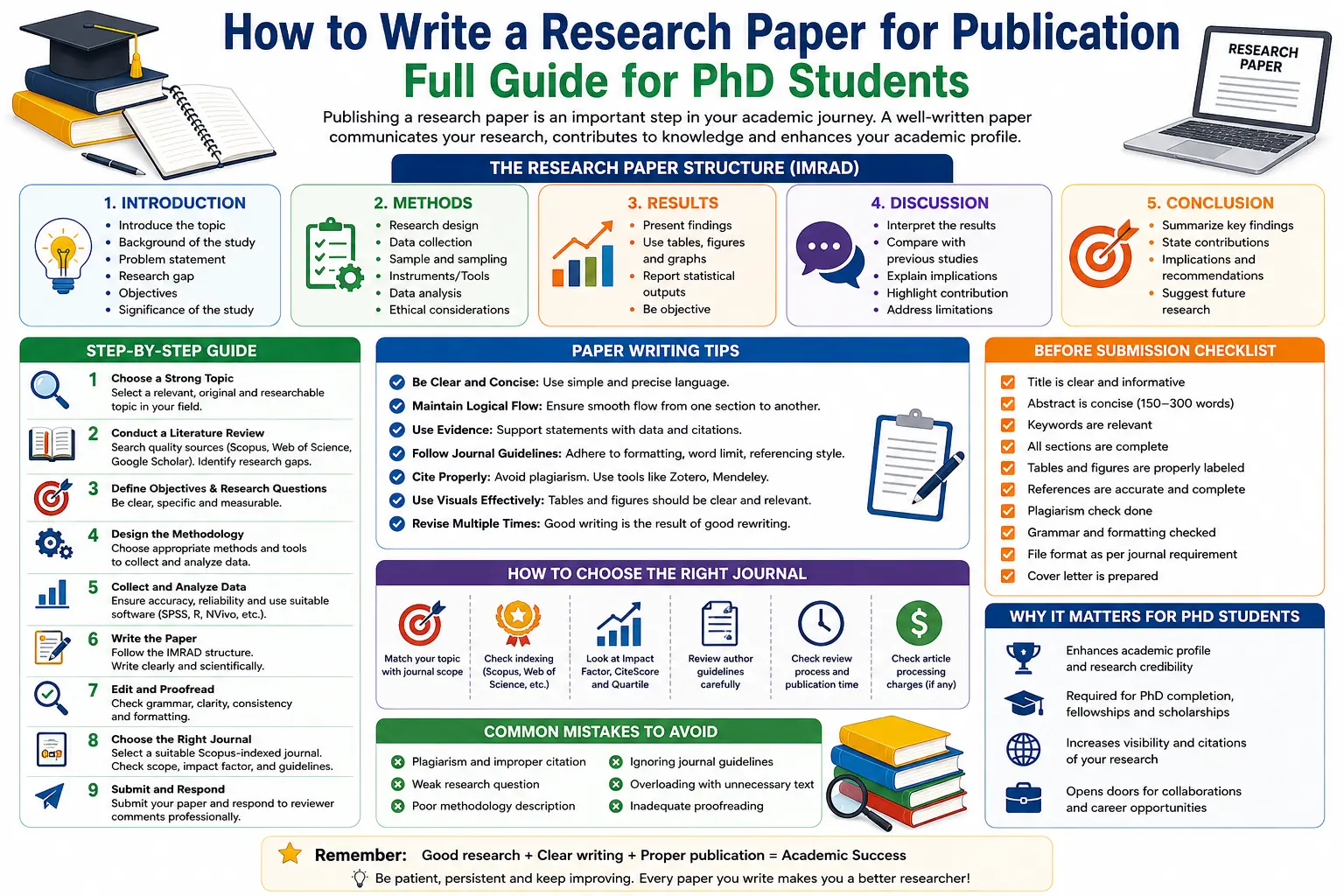
Publishing research papers is one of the most important responsibilities of a PhD scholar. Research publications not only contribute to academic knowledge but also help students build their academic profiles, secure research funding, improve career opportunities, and fulfill degree requirements. However, many PhD students struggle with converting their research into a well-structured manuscript suitable for publication in peer-reviewed journals.
Writing a research paper for publication is different from writing assignments, dissertations, or project reports. Academic journals expect originality, clarity, methodological rigor, and a significant contribution to the field. Understanding the publication process and following a systematic writing approach can significantly improve your chances of acceptance.
This comprehensive guide explains how to write a research paper for publication, from selecting a topic and conducting a literature review to choosing the right journal and responding to reviewer comments.
Why Research Publications Matter for PhD Students
Research publications play a critical role in a scholar's academic journey.
Publishing papers helps:
- Demonstrate research expertise
- Increase academic visibility
- Strengthen CVs and resumes
- Fulfill PhD requirements
- Improve chances of postdoctoral opportunities
- Support grant and fellowship applications
- Build professional credibility
Many universities in India and abroad require PhD scholars to publish research papers in peer-reviewed journals before thesis submission.
Understanding the Purpose of a Research Paper
A research paper communicates the results of a scientific investigation to the academic community.
A good research paper should:
- Address a research problem
- Present original findings
- Use appropriate methodology
- Analyze and interpret results
- Contribute new knowledge
The goal is not simply to report data but to explain why the findings matter.
Step 1: Choose a Strong Research Topic
The foundation of a publishable paper is a strong research topic.
A good topic should be:
Relevant
It should address current issues in your field.
Original
The study should contribute something new.
Researchable
Adequate data and resources should be available.
Significant
The findings should have academic or practical importance.
How to Identify Research Gaps
One of the best ways to find publishable topics is by identifying gaps in existing literature.
Ask questions such as:
- What issues remain unresolved?
- What limitations exist in previous studies?
- Are there contradictory findings?
- Have new technologies changed the research landscape?
Research gaps often become strong publication opportunities.
Step 2: Conduct a Comprehensive Literature Review
A literature review helps researchers understand existing knowledge and position their work within the field.
The review should:
- Summarize relevant studies
- Identify trends
- Highlight limitations
- Establish the research gap
Sources for Literature Review
Use high-quality academic databases such as:
- Google Scholar
- PubMed
- Scopus
- Web of Science
Avoid relying solely on websites or non-peer-reviewed sources.
Step 3: Develop Clear Research Objectives
Research objectives guide the entire study.
Strong objectives should be:
- Specific
- Measurable
- Achievable
- Relevant
- Clear
Example:
"To examine the impact of artificial intelligence adoption on operational efficiency among Indian manufacturing SMEs."
Clearly defined objectives improve manuscript focus.
Step 4: Design the Research Methodology
The methodology explains how the study was conducted.
It should provide enough detail for other researchers to replicate the work.
Common Research Methods
Quantitative Research
Uses numerical data and statistical analysis.
Examples:
- Surveys
- Experiments
- Statistical modeling
Qualitative Research
Focuses on experiences, perceptions, and meanings.
Examples:
- Interviews
- Focus groups
- Case studies
Mixed Methods Research
Combines quantitative and qualitative approaches.
Many interdisciplinary studies use this method.
Step 5: Collect and Analyze Data
Data collection should follow ethical and scientific standards.
Examples include:
- Surveys
- Interviews
- Observations
- Laboratory experiments
- Secondary datasets
Data Analysis
The analysis method depends on the research design.
Common tools include:
- SPSS
- R
- Python
- STATA
- NVivo
The analysis should directly address the research objectives.
Step 6: Structure Your Research Paper
Most journals follow the IMRAD format:
I – Introduction
M – Methods
R – Results
A – And
D – Discussion
Let's examine each section.
Title
The title is the first thing readers see.
A strong title should be:
- Clear
- Specific
- Informative
- Keyword-rich
Example:
"Impact of Artificial Intelligence Adoption on Business Performance in Indian SMEs"
Avoid vague titles such as:
"Study of AI"
Abstract
The abstract summarizes the entire paper.
Typically includes:
- Background
- Objectives
- Methods
- Results
- Conclusion
Most journals require 150–300 words.
Characteristics of a Good Abstract
It should:
- Be concise
- Highlight key findings
- Include relevant keywords
- Encourage readers to continue
Many readers decide whether to read the full paper based on the abstract.
Keywords
Keywords improve discoverability.
Choose:
- 5–8 keywords
- Field-specific terms
- Frequently searched concepts
Example:
- Artificial Intelligence
- Business Analytics
- SMEs
- Digital Transformation
- Emerging Economies
Introduction
The introduction explains:
- Research background
- Existing problem
- Research gap
- Objectives
- Significance
A typical introduction follows this structure:
Background
Introduce the topic.
Problem Statement
Explain the issue being addressed.
Research Gap
Identify missing knowledge.
Objectives
State research goals.
Contribution
Explain the study's significance.
Literature Review
The literature review demonstrates knowledge of previous research.
It should:
- Compare studies
- Identify trends
- Highlight inconsistencies
- Establish theoretical foundations
Avoid simply summarizing article after article.
Instead, synthesize findings into themes.
Methodology
The methodology section should clearly describe:
Research Design
Explain whether the study is:
- Experimental
- Survey-based
- Qualitative
- Mixed-method
Sample Selection
Describe:
- Population
- Sampling technique
- Sample size
Data Collection
Explain:
- Instruments used
- Procedures followed
- Timeframe
Data Analysis Methods
Provide details regarding:
- Statistical tests
- Software used
- Analytical frameworks
Transparency increases credibility.
Results
The results section presents findings objectively.
Use:
- Tables
- Graphs
- Figures
- Statistical outputs
Avoid interpretation in this section.
Simply present the evidence.
Discussion
The discussion interprets the findings.
Address questions such as:
- What do the results mean?
- How do they compare with previous studies?
- Why are the findings important?
This is often the most intellectually demanding section.
Conclusion
The conclusion summarizes:
- Key findings
- Contributions
- Implications
- Recommendations
Avoid introducing new information.
A strong conclusion leaves readers with a clear understanding of the study's importance.
References
Proper referencing is essential.
Common citation styles include:
- APA
- Harvard
- MLA
- Chicago
- Vancouver
Follow the journal's requirements precisely.
Step 7: Ensure Research Ethics
Ethical compliance is critical.
Researchers must:
- Avoid plagiarism
- Obtain necessary approvals
- Ensure informed consent
- Report findings honestly
Many journals screen manuscripts using plagiarism-detection software.
Common Ethical Issues to Avoid
Plagiarism
Copying content without attribution.
Self-Plagiarism
Reusing previously published content without disclosure.
Data Fabrication
Inventing data.
Data Manipulation
Altering results to fit expectations.
Ethical violations can lead to manuscript rejection and academic penalties.
Step 8: Improve Academic Writing Quality
Good research can be rejected due to poor writing.
Focus on:
Clarity
Use straightforward language.
Precision
Avoid ambiguity.
Logical Flow
Ensure smooth transitions between sections.
Consistency
Maintain consistent terminology.
Common Writing Mistakes
Avoid:
- Long sentences
- Excessive jargon
- Grammatical errors
- Unsupported claims
- Repetition
Professional editing can improve readability.
Step 9: Select the Right Journal
Journal selection significantly impacts publication success.
Consider:
Scope
Does the journal publish work in your field?
Indexing
Look for journals indexed in:
- Scopus
- Web of Science
- PubMed
Impact
Assess journal reputation and readership.
Review Timeline
Some journals provide faster review processes.
How to Avoid Predatory Journals
Predatory journals exploit researchers by charging fees without providing proper peer review.
Warning signs include:
- Unrealistic acceptance promises
- Poor website quality
- Aggressive email invitations
- Lack of indexing
Always verify journal credentials.
Step 10: Prepare for Submission
Before submission:
Review Journal Guidelines
Check:
- Formatting
- Word limits
- Citation style
- Figure requirements
Write a Cover Letter
Include:
- Manuscript title
- Research significance
- Originality statement
- Journal relevance
A professional cover letter strengthens the submission.
Step 11: Understand the Peer Review Process
After submission, the manuscript undergoes peer review.
Possible decisions include:
Accept
Rare on first submission.
Minor Revision
Small changes required.
Major Revision
Significant improvements needed.
Reject
Paper unsuitable in its current form.
Most papers require revisions before acceptance.
Step 12: Respond to Reviewer Comments Professionally
Reviewer feedback should be viewed as constructive.
When responding:
- Address every comment
- Remain respectful
- Provide evidence-based explanations
- Clearly indicate revisions
A strong response letter can significantly improve acceptance chances.
Tips for Increasing Publication Success
Start Writing Early
Don't wait until research is complete.
Write sections during the research process.
Read Published Papers
Study articles from your target journals.
Observe:
- Structure
- Style
- Methodology presentation
Seek Feedback
Ask supervisors and colleagues to review drafts.
External perspectives identify weaknesses.
Revise Multiple Times
Strong papers undergo multiple revisions before submission.
Be Patient
Publication often takes several months.
Persistence is essential.
Common Reasons Research Papers Are Rejected
Many submissions fail because of:
- Weak research questions
- Poor methodology
- Lack of originality
- Insufficient literature review
- Poor writing quality
- Journal mismatch
- Ethical concerns
Understanding these factors can help authors avoid common pitfalls.
Future Trends in Academic Publishing
Academic publishing is evolving rapidly.
Emerging trends include:
- Open-access publishing
- AI-assisted writing tools
- Open peer review
- Research data sharing
- Interdisciplinary collaboration
PhD students who understand these developments will be better positioned for future academic success.
Final Checklist Before Submission
Before submitting your paper, ensure:
Research objectives are clear
Literature review is comprehensive
Methodology is transparent
Results are accurate
Discussion is meaningful
References are complete
Grammar is checked
Plagiarism is minimized
Journal guidelines are followed
Cover letter is prepared
Conclusion
Writing a research paper for publication is one of the most valuable skills a PhD student can develop. A successful manuscript combines a strong research question, rigorous methodology, comprehensive literature review, clear analysis, and professional academic writing. While the publication process can be challenging, understanding each stage—from topic selection and manuscript preparation to journal submission and peer review—greatly improves the likelihood of success.
For PhD students, publishing is more than a degree requirement; it is an opportunity to contribute to knowledge, establish academic credibility, and build a foundation for future research careers. By following a structured approach, maintaining high ethical standards, and continuously refining your writing, you can transform your research into publishable work and achieve long-term success in the academic world.
Contact ThesisLikho Today
Call / WhatsApp: +91 96438 02216
Visit: ThesisLikho.com