
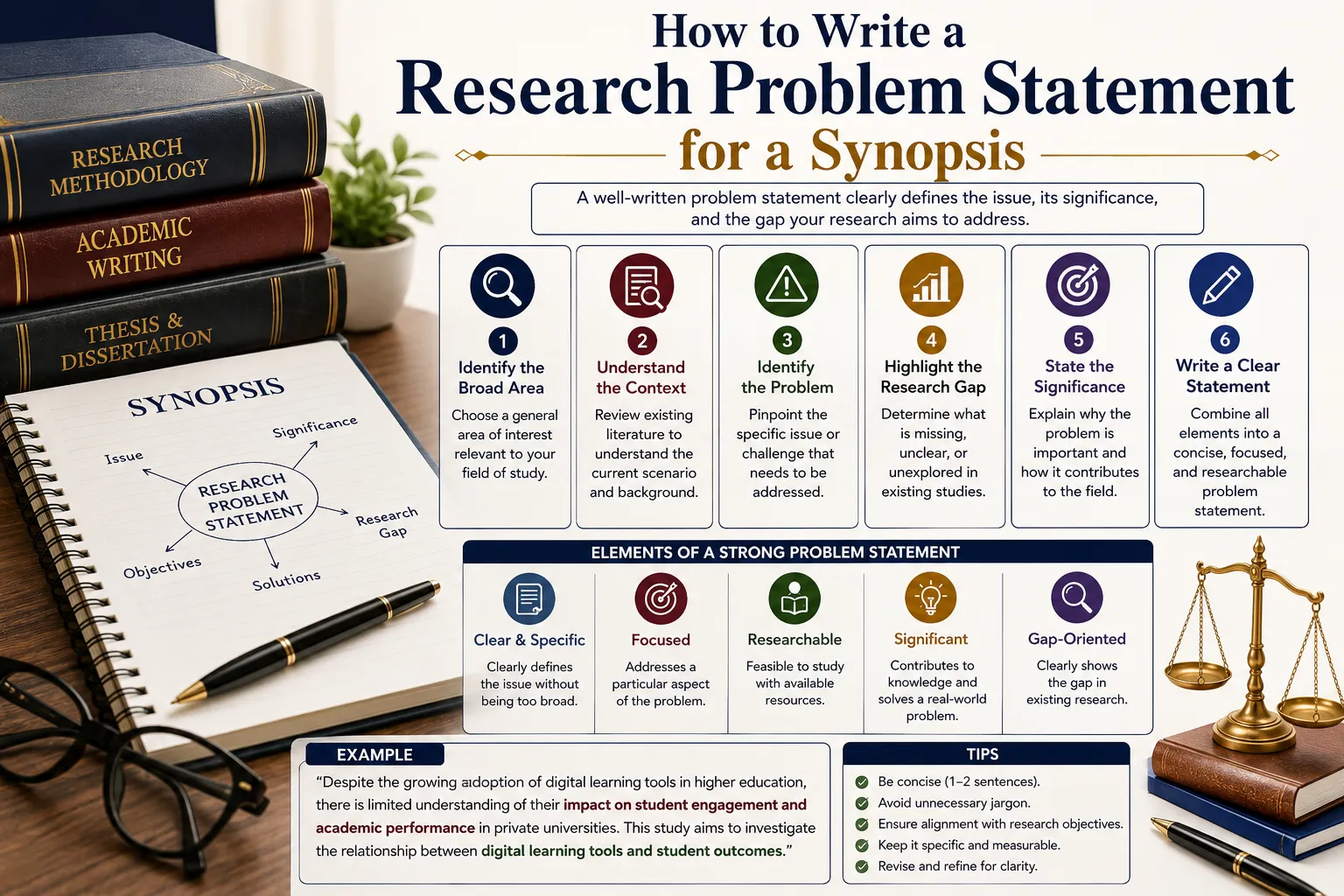
If your synopsis keeps coming back from your Doctoral Research Committee with "the problem statement needs more clarity" scribbled across it, you're stuck at the exact point where most first-time scholars struggle most. Learning how to write a research problem statement for a synopsis isn't the same task as writing one for a finished dissertation — a synopsis problem statement has to convince a committee your entire research direction is worth approving, often before you've done any deep fieldwork at all.
This guide walks through what makes a synopsis problem statement genuinely approvable, how it differs from later dissertation writing, and the exact structure and pitfalls that repeatedly show up at Doctoral Research Committee review — the way an experienced research guide would explain it before your synopsis submission.
What a Synopsis Problem Statement Actually Needs to Do
A synopsis problem statement has one job above all others: convince a Doctoral Research Committee, in a page or less, that a specific, real, and current gap in knowledge exists — and that you're the right scholar to address it. Your synopsis as a whole is typically a structured document of 2,000 to 5,000 words summarizing your proposed research, and most Indian universities require it to be reviewed and formally approved before you're even granted official registration for your degree.
This is a different pressure than writing a problem statement for a nearly finished dissertation. At synopsis stage, you're not defending a study you've already substantially completed — you're asking a committee to approve a direction you haven't yet fully walked down. That means your problem statement has to work harder on clarity and evidence, precisely because there's less finished research behind it to lean on.
How a Synopsis Problem Statement Differs From a Dissertation One
It's easy to assume a synopsis problem statement is just a shorter draft of what will eventually appear in Chapter 1 of the dissertation — but the two serve genuinely different functions. A dissertation problem statement justifies research that's largely been carried out; a synopsis problem statement justifies research that's about to begin. That shifts what the committee is actually checking.
A Doctoral Research Committee typically evaluates a synopsis against four core questions: is the research problem clearly defined and genuinely original, does the proposed methodology actually match the stated objectives, is the study realistically feasible within a typical program timeframe, and does the scholar show real familiarity with the existing literature rather than a surface-level reading of it. Your problem statement is where all four of these get tested at once — which is why a synopsis problem statement needs to be more explicitly argued, not just described.
Where the Problem Statement Sits in Your Synopsis Structure
Most Indian university synopsis formats follow a broadly similar structure, even though section names and ordering vary somewhat by institution: title, introduction and background, statement of the problem, review of literature, objectives of the study, hypotheses or research questions, research methodology, proposed chapter scheme, significance of the study, and references.
Your problem statement typically follows the introduction and sits just before (or is closely woven into) your literature review — which makes sense, since it's the literature review's job to prove the problem you've named is genuinely unaddressed rather than something you've simply assumed is missing.
Step 1: State the Problem in One Clear Sentence First
Before you write any surrounding context, draft the actual problem as a single, direct sentence. If you can't do this cleanly, everything you write around it will inherit that vagueness. A commonly used pattern for this looks something like: "Although several studies have examined [broader phenomenon], limited research has focused on [specific gap] in [specific context]."
This single-sentence discipline matters more at synopsis stage than almost anywhere else in your academic writing, because this is often the very first substantial piece of research writing your supervisor and committee will evaluate from you — and it directly shapes how they read everything that follows in your synopsis.
Step 2: Back It With Recent, Specific Literature
A synopsis problem statement is not a personal impression that something seems under-researched — it's a claim that has to survive a literature review section sitting right next to it. That means every problem statement needs specific, recent sources behind it, not general familiarity with the topic area.
A useful test: for the specific gap you've named, can you point to particular studies that either avoid your exact angle, contradict each other on it, or explicitly flag it as unaddressed in their own limitations or future-research sections? If you can only gesture vaguely at "the literature," your committee will (correctly) read that as a sign the literature review itself isn't done yet.
Step 3: Name the Population, Context, and Boundary
The single most common weakness in a first-draft synopsis problem statement is scope that's too broad to defend. "There is a lack of research on how digital marketing affects consumer behavior" names a topic, not a problem — it doesn't say which consumers, which sector, or which specific behavior.
A properly scoped version names all three: the population ("small businesses in rural India" rather than "businesses"), the specific variable or behavior you're studying, and the boundary that makes your study distinct from what's already been done. This isn't about making your problem sound smaller — it's about making it something a committee can actually evaluate as original and answerable, rather than something so broad it could describe half a dozen different possible studies.
Step 4: Connect the Problem Directly to Your Objectives
Your problem statement and your objectives need to read as two parts of the same argument, not two separately written sections. Every objective should follow a SMART-style structure — specific, measurable, achievable, relevant, and time-bound — and should trace back cleanly to the exact gap your problem statement named.
A weak objective looks like "to understand the impact of X" — vague enough that it's unclear what would count as having achieved it. A strong objective looks like "to critically examine the relationship between X and Y across a defined population within a specific time period, using a stated method." If your objectives don't visibly answer the specific problem you named earlier, a reviewer will notice the disconnect immediately — and every objective must be directly answerable by the methodology you go on to propose.
Step 5: Confirm Feasibility Within Your Program Timeline
A problem statement can be original and well-evidenced and still fail if the study it implies can't realistically be completed within your program's timeframe — typically three to five years for a PhD, considerably shorter for most master's-level research.
Before finalizing your problem statement, ask directly: does answering this problem require access to a population or dataset you can realistically reach? Does it require multi-site or longitudinal data collection that doesn't fit your program's actual timeline? A synopsis that reads as ambitious but not feasible is one of the more common reasons committees ask for revision, precisely because feasibility is one of the four things they're explicitly checking.
A Real Example: Sharpening a Synopsis Problem Statement That Kept Getting Sent Back
One scholar we worked with had a synopsis returned twice by their Doctoral Research Committee with feedback that simply said the problem statement "lacks clarity." Their original draft read: "There is a need to study how social media influences consumer purchasing behavior, as this area has not been fully explored." It was true in a general sense — but it named no specific platform, no specific consumer segment, no specific stage of the purchasing decision, and cited no recent literature to substantiate the claimed gap.
Here's exactly what the committee couldn't evaluate: the statement could have described dozens of different possible studies, and there was nothing in it that distinguished this scholar's specific proposed contribution from work that likely already existed. A committee reading this genuinely can't tell what would count as this study succeeding.
After revision, the problem statement became: "Although extensive research has examined social media's general influence on consumer behavior, limited research has focused on how short-form video content specifically shapes impulse-purchase decisions among first-time online shoppers aged 18–24 in Tier-2 Indian cities — a segment showing distinct trust and spending patterns compared to metro consumers." This version named the specific platform format, the specific behavior (impulse purchases, not general influence), the specific population (first-time shoppers, a defined age group, a defined geography), and implied the distinguishing rationale (different trust patterns from metro consumers). The synopsis was approved on the next submission.
If you'd like expert guidance in drafting and refining your synopsis problem statement, you can check out our Synopsis Writing Service.
Common Mistakes Scholars Make in a Synopsis Problem Statement
Mistake 1: Naming a topic instead of a problem. "There isn't enough research on X" describes an entire field, not a specific unresolved question — and a committee can't evaluate originality against a field-level claim.
Mistake 2: Writing the problem statement before doing any real literature reading. Scholars sometimes draft the problem statement first based on general impressions, then try to find literature to support it afterward — which usually produces a mismatch the committee notices immediately.
Mistake 3: Letting objectives drift from the stated problem. It's common to see a tightly scoped problem statement followed by objectives that quietly broaden the scope back out, which breaks the alignment a Doctoral Research Committee is specifically checking for.
Mistake 4: Ignoring feasibility until methodology is being written. A problem statement that implies access to a hard-to-reach population or years of longitudinal data can look strong on paper while being functionally unworkable within the actual program timeline.
Why Getting This Right at Synopsis Stage Matters Later
A synopsis isn't just a formality you move past quickly — once approved, it functions as a kind of contract for your research. Significant deviation between what your synopsis proposed and what your final dissertation actually delivers can create real complications at the viva stage, since examiners often check the final work against the originally approved plan.
There's also an originality dimension worth being aware of early. UGC plagiarism regulations work on a banded severity system rather than a single pass/fail number: similarity broadly under 10% is generally treated as acceptable, similarity in the roughly 10–40% range typically triggers a minor penalty and a revision requirement, and similarity above roughly 60% can lead to serious consequences up to thesis rejection. While these bands are most commonly discussed in relation to the final thesis, many universities also run originality checks on the synopsis itself before forwarding it to the committee — so a problem statement built on genuinely paraphrased, properly cited literature (rather than lightly reworded sentences from the sources you read) protects you at both stages, not just the end.
Best Practices If You Have No Research Background
If this is your first time writing a formal synopsis, a few adjustments make the problem statement noticeably easier to get right:
- Write the one-sentence version first, and only expand once that sentence is precise. Scholars who start with a paragraph often bury the actual problem inside general background information.
- Read the approved synopses of a few recently registered scholars in your department, if your university allows access to them — seeing how others scoped a real gap is often more useful than any generic template.
- Show your one-sentence problem statement to your supervisor before writing the full section around it. It's a much faster check than reviewing a completed draft, and it catches scope problems while they're still cheap to fix.
- Confirm feasibility with your supervisor at the same time you check the literature gap. A problem that's both original and researchable is a much stronger position than one that's original but has to be walked back for feasibility reasons later.
If any part of this process — scoping a problem precisely, aligning it with your objectives, or checking it's realistic within your program's timeline — feels unfamiliar, that's exactly where a structured, expert-guided process helps first-time scholars turn a promising research interest into a synopsis a committee will actually approve.
FAQs
How do you write a research problem statement for a synopsis?
State the problem in one clear sentence first, back it with specific and recent literature, name the population and context precisely rather than describing a broad field, make sure it connects directly to your objectives, and confirm the resulting study is genuinely feasible within your program's timeline.
Why should I write a research problem statement for a synopsis carefully?
Because your Doctoral Research Committee evaluates your entire synopsis largely through this one section — checking whether the problem is original, whether your methodology can actually answer it, and whether the study is realistically achievable. A vague problem statement is one of the most common reasons synopses get sent back for revision before registration is even granted.
When should you write a research problem statement for a synopsis?
Draft it after an initial round of literature reading — enough to confirm the gap is real — but before you finalize your objectives and methodology, since both of those need to be built directly around the problem you've named.
How do you write a research problem statement for a synopsis?
See the five-step process above: state it in one sentence, ground it in specific literature, name the population and boundary, align it with your objectives, and confirm feasibility.
How long does it take to complete a synopsis using this approach?
Most Indian university synopses run 2,000 to 5,000 words and can typically be drafted over several weeks once the initial literature reading is done, though timelines vary by university and discipline. Getting the problem statement precise early usually prevents the more costly delay of a Doctoral Research Committee sending the synopsis back for revision, which can add months before registration is finalized.
Is professional help available to write a research problem statement for a synopsis?
Yes. Many scholars, especially first-time researchers unfamiliar with what a Doctoral Research Committee specifically looks for, work with experienced synopsis mentors to sharpen their problem statement's scope and evidence before submission. ThesisLikho's PhD-qualified writers have supported thousands of scholars through exactly this stage, helping turn a promising but broad research interest into a precise, committee-ready problem statement.
If you're not sure whether your synopsis problem statement is specific enough to get approved on the first submission, it helps to get an experienced second opinion before you send it to your committee. Get Synopsis Help Now for guidance on sharpening your problem statement's clarity, evidence, and alignment with your objectives.