
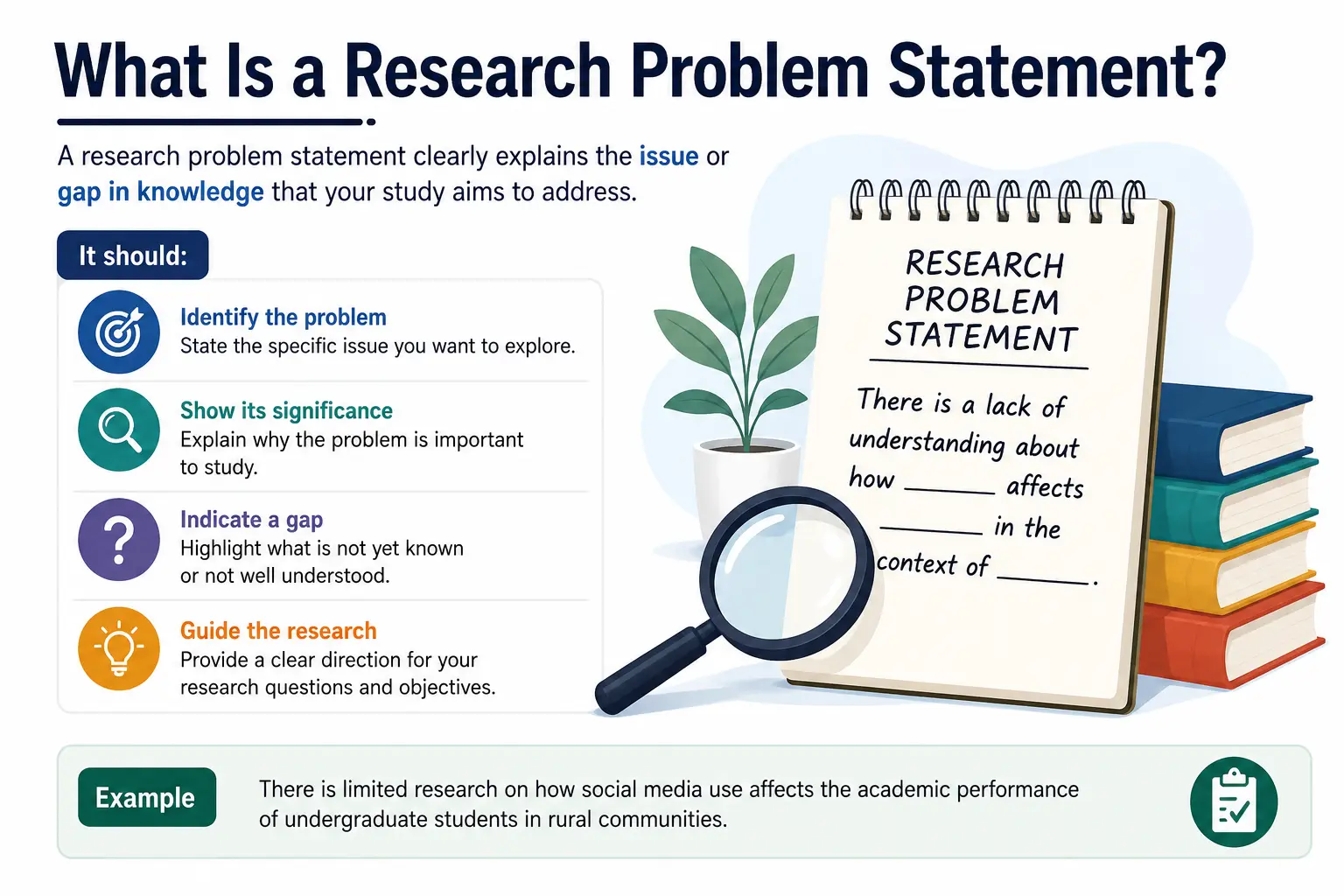
What Is a Research Problem Statement?
A research problem statement is a concise description of an issue, challenge, knowledge gap, or unanswered question that requires investigation. It explains what the problem is, why it exists, who it affects, and why it deserves scholarly attention.
In a PhD thesis, the problem statement serves as a bridge between the research topic and the research objectives. It helps readers understand the significance of the study and provides justification for conducting the research.
Example
Weak Problem Statement:
"Technology is changing education, and more studies are needed."
Strong Problem Statement:
"Despite the widespread adoption of digital learning platforms in higher education, limited research exists on their impact on student engagement among rural university students in India. This gap restricts policymakers' ability to develop effective digital learning strategies for underserved regions."
The second statement clearly identifies the problem, context, and research gap.
Why Is a Research Problem Statement Important?
A research problem statement plays several critical roles in a PhD thesis:
Provides Research Direction
It defines the focus of the study and prevents unnecessary deviations during research.
Establishes Significance
It demonstrates why the research matters and how it contributes to existing knowledge.
Supports Research Objectives
The problem statement forms the basis for research questions, hypotheses, and objectives.
Helps Gain Approval
A clear and compelling problem statement increases the likelihood of proposal acceptance by supervisors and research committees.
Enhances Research Quality
A well-defined problem ensures methodological clarity and strengthens the overall research design.
Characteristics of a Strong Research Problem Statement
An effective research problem statement should possess the following qualities:
Clarity
The problem should be easy to understand and free from ambiguity.
Specificity
Avoid broad or vague descriptions. Focus on a particular issue.
Relevance
The problem should address a meaningful concern within the academic field.
Researchability
The issue should be capable of being investigated through scientific methods.
Evidence-Based
The problem should be supported by literature, statistics, observations, or practical concerns.
Originality
It should address a knowledge gap or provide a new perspective on an existing issue.
Components of a Research Problem Statement
A comprehensive problem statement generally includes five key components.
1. Background of the Problem
Provide context about the issue and explain the broader situation.
Example:
"The rapid growth of online education has transformed teaching and learning practices worldwide."
2. Statement of the Problem
Clearly identify the specific issue that needs investigation.
Example:
"However, limited evidence exists regarding the effectiveness of online learning in improving academic performance among rural students."
3. Evidence Supporting the Problem
Present data, literature findings, or observations that validate the existence of the problem.
Example:
"Several studies report lower completion rates among rural learners compared to their urban counterparts."
4. Research Gap
Highlight what previous studies have overlooked.
Example:
"Most existing research focuses on urban educational settings, leaving rural populations underexplored."
5. Significance of the Study
Explain why solving the problem is important.
Example:
"Understanding these challenges can help policymakers design inclusive digital education strategies."
Step-by-Step Guide to Writing a Research Problem Statement
Step 1: Identify Your Research Area
Start by selecting a broad area of interest aligned with your academic discipline.
Examples:
- Artificial Intelligence in Healthcare
- Climate Change Adaptation
- Consumer Behavior in E-Commerce
- Educational Technology
- Sustainable Agriculture
Choose an area that genuinely interests you because you will spend several years investigating it.
Step 2: Conduct a Preliminary Literature Review
Read journal articles, conference papers, books, and reports to understand current knowledge.
Focus on:
- Existing theories
- Key findings
- Research limitations
- Contradictory results
- Emerging trends
The goal is to identify gaps that require further investigation.
Step 3: Identify a Knowledge Gap
A research gap may arise from:
Lack of Research
Very few studies have addressed the topic.
Methodological Limitations
Existing studies use outdated methods or small samples.
Contextual Gaps
Research exists in one context but not another.
Theoretical Gaps
Current theories fail to explain certain phenomena.
Practical Problems
Real-world challenges remain unresolved despite existing research.
Step 4: Define the Specific Problem
Narrow the gap into a focused issue.
Instead of:
"Social media affects mental health."
Write:
"The influence of short-form video content on anxiety levels among university students remains insufficiently understood."
Specificity improves research quality.
Step 5: Explain Why the Problem Matters
Demonstrate the significance of the issue.
Ask:
- Who is affected?
- What are the consequences?
- Why should researchers care?
Example:
"Increasing anxiety among university students negatively impacts academic performance, retention rates, and overall well-being."
Step 6: Connect the Problem to Existing Research
Show how your study contributes to academic knowledge.
Example:
"While previous studies have examined social media use generally, limited attention has been given to the psychological effects of short-form video platforms."
Step 7: Write and Refine
Draft your problem statement and revise it multiple times.
Ensure it is:
- Concise
- Logical
- Evidence-based
- Aligned with research objectives
Seek feedback from supervisors and peers.
Template for Writing a Research Problem Statement
You can use the following template:
"Although [existing knowledge or situation], there remains a lack of understanding regarding [specific issue or gap]. This gap is significant because [importance or consequence]. Therefore, further investigation is needed to examine [research focus] in order to [expected contribution]."
Example
"Although artificial intelligence has been widely adopted in healthcare systems, there remains limited understanding of its impact on diagnostic accuracy in rural healthcare facilities. This gap is significant because rural populations often experience healthcare disparities. Therefore, further investigation is needed to examine how AI-assisted diagnostic tools influence clinical decision-making in rural healthcare settings."
Examples of Research Problem Statements
Example 1: Education
"Despite increasing investment in digital learning infrastructure, student engagement levels in online classrooms remain inconsistent. Existing studies primarily focus on urban educational institutions, leaving rural learning environments underexplored. This knowledge gap limits the development of effective digital education policies for rural students."
Example 2: Healthcare
"The prevalence of diabetes continues to rise globally; however, limited research has examined the effectiveness of mobile health applications in improving medication adherence among elderly patients. Understanding this relationship may contribute to better chronic disease management strategies."
Example 3: Business Management
"Employee turnover remains a major challenge for organizations. While compensation has been widely studied as a predictor of retention, insufficient research exists regarding the influence of workplace flexibility on employee loyalty in remote work environments."
Common Mistakes to Avoid
Being Too Broad
Broad problems lead to unfocused research.
Poor Example:
"Climate change affects the world."
Better Example:
"The impact of climate change on wheat productivity among small-scale farmers in Northern India remains insufficiently understood."
Lack of Evidence
Always support claims with literature or data.
Confusing the Problem with the Topic
Topic:
"Artificial Intelligence in Education"
Problem:
"Limited evidence exists regarding the effectiveness of AI-powered tutoring systems in improving mathematics achievement among high school students."
Including Solutions Too Early
Focus on describing the problem rather than proposing solutions.
Using Complex Language
Academic writing should be clear and precise.
Relationship Between Problem Statement and Research Questions
The research problem statement directly influences the research questions.
Problem Statement
"There is limited understanding of how AI-based tutoring systems affect student learning outcomes."
Research Question
"How do AI-based tutoring systems influence student academic performance in mathematics?"
A clear problem statement naturally generates focused research questions.
Relationship Between Problem Statement and Research Objectives
Research objectives are derived from the problem statement.
Problem Statement
Limited evidence exists regarding the effectiveness of AI-based tutoring systems.
Objectives
- To examine the adoption of AI tutoring systems.
- To evaluate their impact on academic performance.
- To identify factors influencing their effectiveness.
Alignment between these elements strengthens the research framework.
Tips from PhD Supervisors
Experienced supervisors often recommend:
Read Extensively
The best problem statements emerge from deep engagement with literature.
Focus on One Core Issue
Avoid trying to solve multiple problems simultaneously.
Justify Every Claim
Support statements with evidence from credible sources.
Seek Feedback Early
Discuss your ideas with supervisors before finalizing the statement.
Revise Frequently
Strong problem statements usually go through several revisions.
Checklist for Evaluating Your Research Problem Statement
Before finalizing, ask yourself:
- Is the problem clearly defined?
- Is it specific and focused?
- Does it address a genuine knowledge gap?
- Is it supported by literature?
- Is it researchable?
- Does it explain why the problem matters?
- Is it aligned with research objectives?
- Is the language clear and concise?
If the answer is yes to all questions, your problem statement is likely strong enough for a PhD thesis.
Conclusion
Writing a research problem statement for your PhD thesis is one of the most important steps in the research process. A well-defined problem statement provides direction, establishes significance, and creates a strong foundation for research questions, objectives, and methodology. By identifying a meaningful research gap, supporting it with evidence, and explaining its importance, you can develop a compelling problem statement that strengthens your entire doctoral study.
Remember that a great PhD thesis begins with a great research problem. Invest time in refining your problem statement, seek constructive feedback, and ensure it aligns with your broader research goals. A clear and focused problem statement will not only guide your research journey but also increase the overall quality and impact of your doctoral work.
Contact ThesisLikho Today
Call / WhatsApp: +91 96438 02216
Visit: ThesisLikho.com