
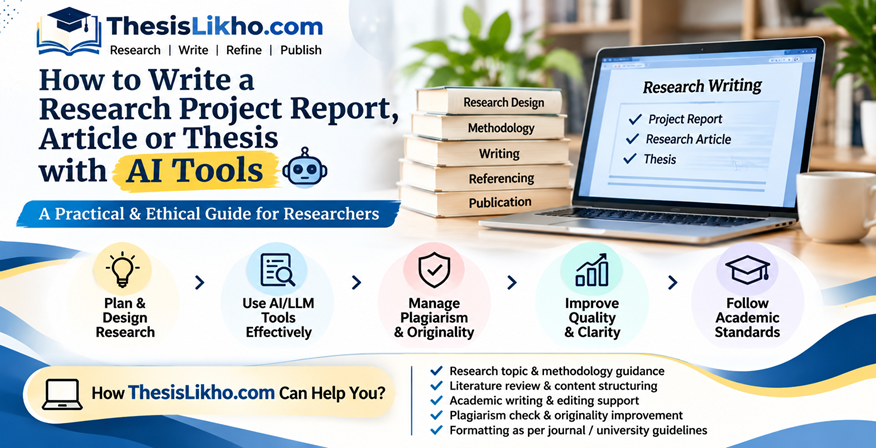
Large language models (LLMs) can help researchers plan a study, understand difficult concepts, organise notes, improve academic language and check the clarity of a draft. But they cannot replace a researcher's judgement, evidence, analysis or responsibility. The right approach is to use AI as a research and writing assistant—not as the author, source of evidence or shortcut to a finished thesis.
1. Understand what you are writing
A research project report, journal article and thesis share a commitment to evidence, but they serve different purposes. Before opening an AI tool, confirm the required format with your university, supervisor, department or target journal.
- Research project report: Documents a defined project, its objectives, methods, findings and practical conclusions. Follow the institution's prescribed chapter structure.
- Research article: Communicates a focused contribution to a scholarly audience. It commonly follows an IMRaD structure—Introduction, Methods, Results and Discussion—or the journal's own format.
- Thesis or dissertation: Presents a substantial, coherent investigation, including the research problem, literature review, methodology, analysis, conclusions and contribution to knowledge.
Do not assume that one template fits all three. Obtain the latest formatting rules, word limits, citation style, ethics requirements and AI-use policy first.
2. A reliable step-by-step writing workflow
- Define a researchable problem. Describe the issue, context, population or setting, and why it matters. Ask your supervisor to help narrow an overly broad topic. AI may suggest alternative wording or help identify concepts, but it should not decide the significance of your study.
- Frame objectives and research questions. Make each objective specific and answerable using the data and methods available. Check that the questions, hypotheses, variables and proposed analysis are aligned.
- Search for real scholarly literature. Search academic databases, publisher platforms and trusted repositories. Use AI to generate search terms, synonyms and possible themes—not to invent references. Open each source and confirm its authors, title, journal, year, DOI or stable URL, and the exact claim it supports.
- Build a literature matrix. Record each study's purpose, context, sample, method, findings, limitations and relevance. Compare studies in your own words. A literature review should synthesise and evaluate research, not simply list summaries.
- Design a defensible methodology. Explain the research design, sampling, instruments, procedures, measures and analysis plan. Obtain required ethics approval and informed consent before collecting data. Never ask an AI system to fabricate participants, responses, observations or results.
- Analyse actual data. Use appropriate statistical or qualitative methods and retain your working files, code, audit trail and decision notes. AI can explain a method or help debug code, but independently verify calculations and outputs.
- Draft from your evidence. Write each section using your research records and verified sources. AI can help improve structure and readability after you have established what you need to say.
- Verify, revise and disclose. Check every factual statement, quotation, citation, table and figure. Follow the institution or journal's rules for declaring AI assistance. Keep a record of substantial AI use.
3. Where LLM tools can help—and where they must not
| Research task | Appropriate AI assistance | Researcher's responsibility |
|---|---|---|
| Topic development | Suggest narrower angles, keywords and alternative research questions. | Establish the real research gap, relevance and feasibility from literature and expert guidance. |
| Literature review | Explain concepts, organise notes you provide, compare themes in verified excerpts. | Read original sources, assess quality and accurately attribute every idea. |
| Methodology | Explain research designs, help clarify a survey item or outline a method section. | Select and justify the method; ensure ethics, validity and feasibility. |
| Data analysis | Explain statistical concepts, suggest code structure or help troubleshoot scripts. | Use genuine data, validate code and outputs, and report limitations honestly. |
| Academic language | Improve grammar, flow, readability and consistency without changing meaning. | Confirm that the revised text still reflects your intended argument and evidence. |
| References | Format bibliographic details that you have verified. | Confirm each source exists and supports the cited statement. |
| Results and conclusions | Help make a results narrative clearer from supplied, verified findings. | Never let AI create findings, overstate causality or conceal inconvenient results. |
4. Practical prompts for responsible AI use
Good prompts define the task, provide bounded source material and explicitly prohibit invented evidence. Remove confidential, identifiable or sensitive participant information before using any external AI service, unless your institution has approved that environment and its data controls.
Prompt A: Improve a research question
Act as an academic writing assistant. My proposed topic is: [topic]. My study context is [context]. Suggest five narrower, researchable question options. For each, identify the key concept, possible population and data needed. Do not claim that any option fills a research gap unless evidence is supplied. List assumptions that I should verify.Prompt B: Organise literature I have already read
Using only the notes and verified source details below, organise the studies into themes. Compare their contexts, methods, findings and limitations. Do not add studies, citations, quotations or claims from outside the material. Mark missing information as “not provided” and distinguish the authors' findings from my interpretation. [Paste your notes and verified references.]Prompt C: Review a methodology draft
Review this methodology for clarity and internal consistency. Check whether the research questions, design, sampling, instrument and analysis plan align. Identify ambiguities and questions I should resolve. Do not invent sample sizes, procedures, approvals or measures. Explain suggested changes rather than silently rewriting the method. [Paste draft.]Prompt D: Edit academic language without changing meaning
Edit the passage for grammar, clarity and academic tone. Preserve my meaning, evidence, limitations and level of certainty. Do not add facts, citations, examples or stronger claims. Return (1) a revised version and (2) a short list of substantive changes for me to review. [Paste your own draft.]Prompt E: Audit citations
Check the consistency of the in-text citations and reference list using only the bibliographic details I provide. Flag missing fields, mismatched author names or dates, and references cited in only one place. Do not guess missing DOIs or publication details. Mark anything that requires checking against the publisher's original record. [Paste citations and references.]5. How to manage plagiarism, similarity and AI use ethically
Plagiarism and AI-generated text are related to academic integrity, but they are not the same issue. Plagiarism involves presenting another person's words, ideas, data or work without appropriate acknowledgement. AI-generated content may also be inaccurate, derivative, uncited or prohibited by a particular institution. A low similarity score does not prove that a work is original, and a high score does not automatically prove plagiarism: quotations, references, standard terminology and correctly cited material can affect similarity reports.
- Read before paraphrasing. Understand the source, close it, write the idea in your own analytical structure, then cite the source. Changing a few words or asking AI to “humanise” copied text does not make it original.
- Quote accurately. Use quotation marks and page or location details where required. Do not disguise quotations as paraphrases.
- Cite ideas, not just sentences. A paraphrased argument, theory, framework, dataset or distinctive finding still needs attribution.
- Verify every reference. LLMs can produce plausible but nonexistent papers, incorrect author lists, false DOIs and inaccurate summaries. Confirm references in the publisher's record or a trusted scholarly database.
- Do not manipulate similarity reports. Avoid synonym spinning, character substitutions, hidden text, translation loops or repeated paraphrasing designed only to defeat detection.
- Do not chase an AI-detector percentage. AI detectors can make mistakes and should not be treated as definitive proof of authorship. Follow the institution's policy and retain drafts, notes, source records and version history that demonstrate your process.
- Disclose material AI assistance. Follow the exact rules of your university, funder or journal. If disclosure is required, state the tool, purpose and extent of use accurately. Never list an AI system as an author unless the relevant policy explicitly provides otherwise; researchers remain accountable.
6. A simple quality-control checklist before submission
- My title, problem statement, objectives and research questions are aligned.
- My literature review is based on sources I have actually accessed and evaluated.
- Every quotation, paraphrase, borrowed idea, table and figure is acknowledged.
- My methodology accurately describes what I did, not what an AI tool suggested.
- All data, calculations, tables and results are genuine and reproducible where applicable.
- Every reference exists and supports the statement for which it is cited.
- I have checked the institution's similarity, citation, formatting and AI-use policies.
- I have disclosed AI assistance where required and can explain my use of it.
- The final argument, interpretation and conclusions are my own and are supported by evidence.
7. How ThesisLikho.com can support your research journey
Responsible research writing is not simply about producing pages. It involves choosing a workable topic, aligning objectives and hypotheses, reviewing literature, selecting methods, interpreting evidence and presenting the work in the required academic format. ThesisLikho.com can support researchers through a structured, researcher-led process.
- Topic and proposal guidance: Help refine a broad idea into a focused topic, problem statement, objectives and research questions.
- Research structure: Guidance on organising a project report, dissertation, thesis or journal article according to the applicable guidelines.
- Literature-review support: Help organise researcher-provided and verified literature into themes, comparisons and research gaps.
- Methodology and analysis guidance: Support in understanding research designs, tools, sampling approaches and suitable analysis—while keeping the actual research and data authentic.
- Academic editing: Improve clarity, grammar, coherence, formatting and citation consistency without replacing the researcher's ideas or evidence.
- Integrity-focused review: Help identify citation gaps, unclear paraphrasing, unsupported claims and areas that need source verification. Any similarity or AI-related report should be interpreted carefully and in line with institutional policy.
Use these services as academic guidance and editorial support, not as a substitute for conducting the study or as a promise of guaranteed acceptance, a particular similarity score or a detector outcome. The researcher must review and approve the work and remain responsible for the submitted document.
Make your research clear, credible and genuinely yours
Planning a research project report, journal article or thesis? Visit ThesisLikho.com to explore research-writing guidance and academic support for your next step.
Start with a sound research question. Build on verified evidence. Use AI transparently. Submit work you can confidently defend.
Frequently asked questions
Can I use ChatGPT or another LLM to write my thesis?
That depends on your university's or journal's rules. Many policies distinguish between permitted assistance—such as language editing or brainstorming—and submitting generated text or analysis as your own. Check the current policy before using a tool and disclose use when required.
Can AI write my literature review?
AI can help organise notes and compare material you provide, but it should not replace reading and evaluating original studies. Verify every source and claim against the actual publication.
Does a low similarity score mean my thesis is plagiarism-free?
No. Similarity software identifies text matches; it does not make the final academic judgement. Uncited ideas, fabricated sources or copied structure may be problematic even when a score is low. Correctly quoted and referenced text may also appear as a match.
Should I use an AI detector to prove that my writing is human?
No detector can provide a universally reliable proof of authorship. Follow institutional policy, maintain a transparent writing trail and be ready to explain your research decisions.
Further reading and policy references
Policies differ across institutions and publishers. Consult the latest rules that govern your submission. These resources offer useful starting points:
- UNESCO: Guidance for generative AI in education and research.
- Committee on Publication Ethics (COPE) — publication ethics resources and guidance.
- International Committee of Medical Journal Editors (ICMJE) Recommendations — including guidance relevant to AI-assisted technologies in scholarly manuscripts.