How to Write a Scopus-Indexed Article: Complete Guide, Checklist, Common Mistakes, and Tools
Abstract: Publishing in Scopus-indexed journals has become a key measure of a researcher's international academic impact. However, many researchers face rejection because they are unfamiliar with international journal writing standards, ethical requirements, and submission processes. This article systematically outlines the methodology for writing Scopus articles, covering IMRAD structure requirements, abstract and keyword conventions, pre-submission checklists, common rejection reasons, ethical red lines, and recommended tools for academic writing and referencing. It also explains how ThesisLikho, as a professional academic support platform, helps researchers overcome obstacles at every stage from writing to publication.
Keywords: Scopus article writing, IMRAD structure, publishing ethics, reference management tools, submission checklist, ThesisLikho
1. Why Scopus Publication Matters So Much
Scopus, launched by Elsevier in 2004, is the world's largest abstract and citation database of peer-reviewed literature, covering journals, books, and conference papers from more than 7,000 publishers. For researchers, Scopus indexing means broader visibility, higher citation opportunities, and greater competitiveness in grant applications, academic promotions, and research evaluations.
However, Scopus's selection standards are extremely rigorous. Its Content Selection and Advisory Board (CSAB) consists of 17 subject chairs who apply 14 quantitative and qualitative criteria to evaluate journals. Between 2011 and February 2024, 25,169 journals underwent review, and only 12,078 (48%) were accepted. This means more than half of the journals that applied were rejected—and articles published in already-indexed journals must still meet international standards.
2. Structural Requirements for Scopus Articles: The IMRAD Model
International journals generally require the IMRAD structure: Introduction, Methods, Results, and Discussion. This model emphasizes the logic and reproducibility of the research process.
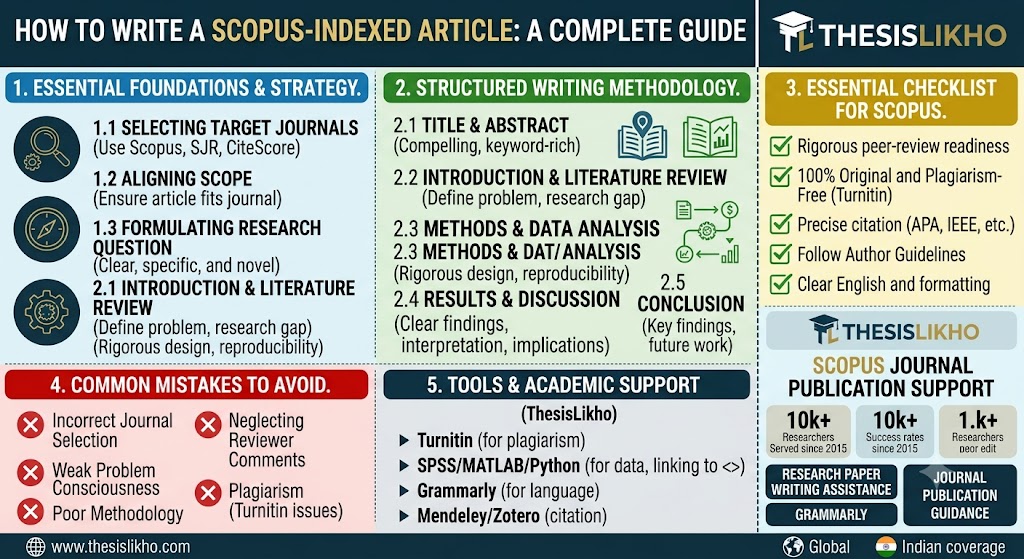
2.1 Title and Abstract
The title should be clear, concise, and accurately describe the research focus, avoiding technical jargon and abbreviations. Editors are particularly frustrated by titles that are "incomprehensible or fail to adequately represent the topic."
The abstract typically needs to be structured, including purpose, methods, findings, and conclusion, and should be kept between 200 and 250 words. Scopus journals pay special attention to abstract clarity, as this is one of the criteria CSAB uses to assess journal content quality.
2.2 Keywords
Keywords should be 5–7 standard international terms that facilitate database retrieval and citation. Poor keyword selection significantly reduces an article's visibility.
2.3 Methodology
The methods section must be detailed enough that "other researchers can replicate the study." This is one of the core requirements of Scopus journals. For established standard methods, cite the literature rather than repeating details; only modifications or innovations to the method need detailed explanation.
2.4 Results and Discussion
Results should present only the representative data essential to the discussion; secondary data can be placed in supplementary materials. Never "hide" data for future papers—this may cause you to lose the key evidence supporting your conclusions.
The discussion is the most important part of the article and the reason many manuscripts are rejected. The discussion should not simply repeat the results but compare your findings with existing literature, "engage directly" with inconsistent findings, and persuade readers. Scopus journals require the discussion to engage with international literature from the past 5–7 years.
2.5 Conclusion
The conclusion should explain how your work advances knowledge in the field, rather than simply repeating the abstract or listing experimental results. It should also indicate possible applications and future research directions.
3. Pre-Submission Checklist
Before submitting your manuscript, verify each item on the following checklist:
Structural Completeness
□ Is the abstract structured (purpose, methods, findings, conclusion) and within the journal's word limit?
□ Are there 5–7 standard international keywords?
□ Is the methodology detailed enough to be replicated?
□ Does the discussion compare with international literature from the past 5–7 years?
□ Does the conclusion explain how the research advances knowledge in the field?
Format and Language
□ Have you strictly followed the target journal's template and author guidelines?
□ Is the language professional academic English?
□ Are figures and tables clear, self-explanatory, and compliant with journal formatting requirements?
Ethics and Declarations
□ Have you confirmed originality, with no plagiarism or duplicate publication?
□ Have you disclosed all conflicts of interest?
□ Have all listed authors made substantive contributions to the research?
□ Have you obtained necessary ethical approvals (for human or animal research)?
Cover Letter
□ Have you written a strong cover letter explaining the study's novelty and significance to the journal?
□ Have you recommended suitable reviewers with justification?
4. Common Rejection Reasons and Ethical Red Lines
4.1 The Most Common Rejection Reasons
According to feedback from Scopus journal editors, the following problems are most common:
Unclear research gap. Many authors enter the writing stage without clearly defining the research gap, articulating the research question, or establishing a strong methodological foundation. Top international journals will reject a paper on this basis alone.
Weak discussion section. The discussion is the only opportunity to "sell" your data. If the discussion merely repeats results without engaging with international research, rejection is almost inevitable.
Reference errors. References are the most error-prone part of a manuscript and the most troublesome for editors. Common errors include excessive self-citation, over-citation of publications from the same region, and inconsistent citation formats.
Incomplete methodology description. Methods lacking reproducibility will be criticized by reviewers and may even lead to a direct recommendation of rejection.
4.2 Academic Ethical Red Lines: Absolutely Untouchable
Publishing ethics are governed by COPE (Committee on Publication Ethics) standards. Violations can lead to rejection, retraction, notification of the researcher's institution, and even legal consequences.
Plagiarism is one of the most serious forms of academic misconduct. Even using original phrases without quotation marks, imitating original sentence structures, or imitating paragraph organization (even with changed words) may be deemed plagiarism.
Data fabrication and falsification include inventing data and manipulating images. Publishers are using tools such as CrossCheck to detect such misconduct.
Duplicate submission means submitting the same manuscript to multiple journals simultaneously, which is strictly prohibited in academic publishing.
Inappropriate authorship includes "ghost authors" (omitting contributors who should be credited) and "gift authors" (including those who made no substantive contribution).
5. Recommended Writing and Reference Management Tools
5.1 Reference Management Tools
Zotero: Free and open-source, with a browser extension that captures reference information from web pages with one click, suitable for capturing citations directly from Firefox, Chrome, and Safari. Supports group sharing, making it ideal for team collaboration.
Mendeley: Free, an Elsevier product. Beyond reference management, it offers an academic social network feature that tracks paper readership and disciplinary trends. The desktop version supports automatic metadata extraction from PDFs.
EndNote: The most powerful professional-grade tool, supporting highly customized output styles and import filters. The 2025 version introduced AI-powered features including "Key Takeaway" (extracting key points from a single paper) and the "Find a Journal" journal-matching tool. The drawback is that it is paid and difficult to share across devices.
5.2 Writing Assistance Tools
Overleaf: An online LaTeX collaborative editor with real-time preview and collaboration, suitable for science and engineering papers requiring complex formula typesetting.
Turnitin/CrossCheck: Plagiarism detection tools. Self-checking before submission can prevent rejection caused by unintentional plagiarism.
5.3 Journal Selection Tools
SCImago Journal Rank (SJR): An important reference for evaluating journal influence, helping researchers select appropriate submission targets and avoid "predatory journals."
Scopus Source Title List: A regularly updated list of indexed and de-listed journals. Before submitting, confirm that the target journal is still indexed by Scopus.
6. How ThesisLikho Helps You Publish a Scopus Article
From writing to submission, Scopus publication is a systematic undertaking involving topic positioning, literature review, methodology design, data analysis, language polishing, format compliance, and ethical declarations. For many researchers, the challenge is often not the quality of the research itself but the ability to transform research into academic text that meets international journal standards.
ThesisLikho, as India's leading academic support platform, provides researchers with professional services covering the entire Scopus publication process.
Research Topic and Literature Review Support. ThesisLikho offers literature review writing services and PRISMA systematic review support, helping researchers quickly navigate the literature, identify research gaps, and build theoretical frameworks. This is particularly critical for avoiding the common rejection reason of an "unclear research gap."
Methodology and Data Analysis Assistance. The platform provides SPSS, MATLAB, and Python data analysis support, as well as methodology design assistance. For researchers dealing with complex econometric models or qualitative data analysis, this technical support can significantly enhance the rigor and reproducibility of the methods section.
Academic Writing and Editing Services. ThesisLikho's expert team comes from top Indian universities, providing paper writing assistance, structural optimization, and academic English polishing. This helps ensure that manuscripts meet Scopus journals' language and structure requirements.
Citation Management and Format Compliance. The platform provides citation and reference management support in APA, IEEE, MLA, and other formats, helping researchers avoid the high-frequency rejection reason of "reference errors."
Plagiarism Detection and Academic Integrity Assurance. Every paper includes a Turnitin plagiarism detection report, ensuring 100% originality. For Scopus journals, originality is a baseline requirement—any suspicion of plagiarism can lead to immediate rejection.
Journal Publication Support. ThesisLikho provides Scopus/SCI journal publication support, including cover letter writing guidance, reviewer response strategies, and end-to-end mentorship from topic selection to submission.
Pre-Submission Review. The platform offers pre-submission review services to help researchers identify and correct issues in structure, format, and ethical declarations before submission.
It must be emphasized that ThesisLikho's positioning is to enhance researchers' capabilities, not to replace researchers' work. The academic value of the research question itself, the innovativeness of the theoretical framework, and the rigor of data collection and analysis are always the foundation of whether a paper is accepted by a Scopus journal. The value of professional support lies in helping researchers present these core elements in the best possible way.
7. Conclusion
Publishing in a Scopus journal is essentially a dialogue with international academic standards. The "entry ticket" to this dialogue is not the scale or complexity of the research itself, but proficiency in international writing conventions, ethical standards, and submission processes.
The keys to successful publication can be summarized in three points: clear structure (strictly following IMRAD), clear contribution (a well-defined research gap and a substantive discussion), and flawless ethics (originality, transparency, and integrity). On this basis, using reference management tools to improve efficiency and leveraging professional support to compensate for language and methodological weaknesses can significantly increase the chances of acceptance.
For Indian researchers, the current moment is ideal for international publication: India's academic output continues to grow, Scopus's attention to Asian research is increasing, and professional platforms like ThesisLikho are lowering the barriers to international publication. Understand the rules, master the tools, uphold integrity—your research deserves to be seen by the world.
References
Elsevier Scopus Blog. (2024). Scopus content policy and selection changes. https://blog.scopus.com/scopus-content-policy-and-selection-changes/
Elsevier. (2024). Scopus content curation and efficient publication workflow management. https://ref.lib.nccu.edu.tw/Eserv/Scopus%20content%20curation_202410.pdf
Elsevier Researcher Academy. (n.d.). Publishing ethics – Author responsibilities. https://researcheracademy.elsevier.com/system/files/workshop/1638/presentation-files/elsevierauthor-workshop-early-researchersuniversity-tehran.pdf
Clarivate. (2025). Clarivate launches EndNote 2025 with AI tools. https://clarivate.com/news/clarivate-releases-endnote-2025-with-ai-powered-research-tools/
ThesisLikho. (2026). Professional thesis & research writing services. https://44rev.com/businesses/thesislikho.com
SRM Institute of Science and Technology. (2025). Drafting a research paper for successful publication in Scopus-indexed journals. https://www.srmist.edu.in/events/drafting-a-research-paper-for-successful-publication-in-scopus-indexed-journals-tips-and-techniques-from-editors-perspective/
Lawrence Berkeley National Laboratory. (2026). Citation management. https://commons.lbl.gov/pages/viewpage.action?pageId=150340097
Tracxn. (2026). ThesisLikho - Company profile. https://tracxn.com/d/companies/thesislikho/
National University of Kyiv-Mohyla Academy. (n.d.). The IMRAD model and the humanities model. https://www.ekmair.ukma.kiev.ua/bitstreams/2f3f0a06-8ac0-41a1-9451-cc29bed408cb/download
Elsevier. (n.d.). Scopus content policy and selection. https://www.elsevier.com/pt-br/products/scopus/content/content-policy-and-selection
Elsevier Researcher Academy. (n.d.). Author workshop – Writing a good cover letter and publishing ethics. https://researcheracademy.elsevier.com/system/files/workshop/2586/presentation-files/authorworkshoppolibari.pdf
Lawrence Berkeley National Laboratory. (2026). Mendeley. https://commons.lbl.gov/pages/viewpage.action?pageId=129697776
UIN Jakarta Faculty of Ushuluddin. (2026). Strengthening international publications: Training on Scopus-indexed journal article writing. https://fu.uinjkt.ac.id/en/strengthening-international-publications-faculty-of-ushuluddin-holds-training-and-mentoring-on-scopus-indexed-journal-article-writing
Yale University Library. (2026). African Studies research methods guide: Citation management. https://guides.library.yale.edu/c.php?g=1533609&p=11493862
Thai Citation Index Center. (2025). Scopus titles selection criteria and minimum criteria. https://oarkm.oas.psu.ac.th/sites/default/files/files-blog/2025-09/