
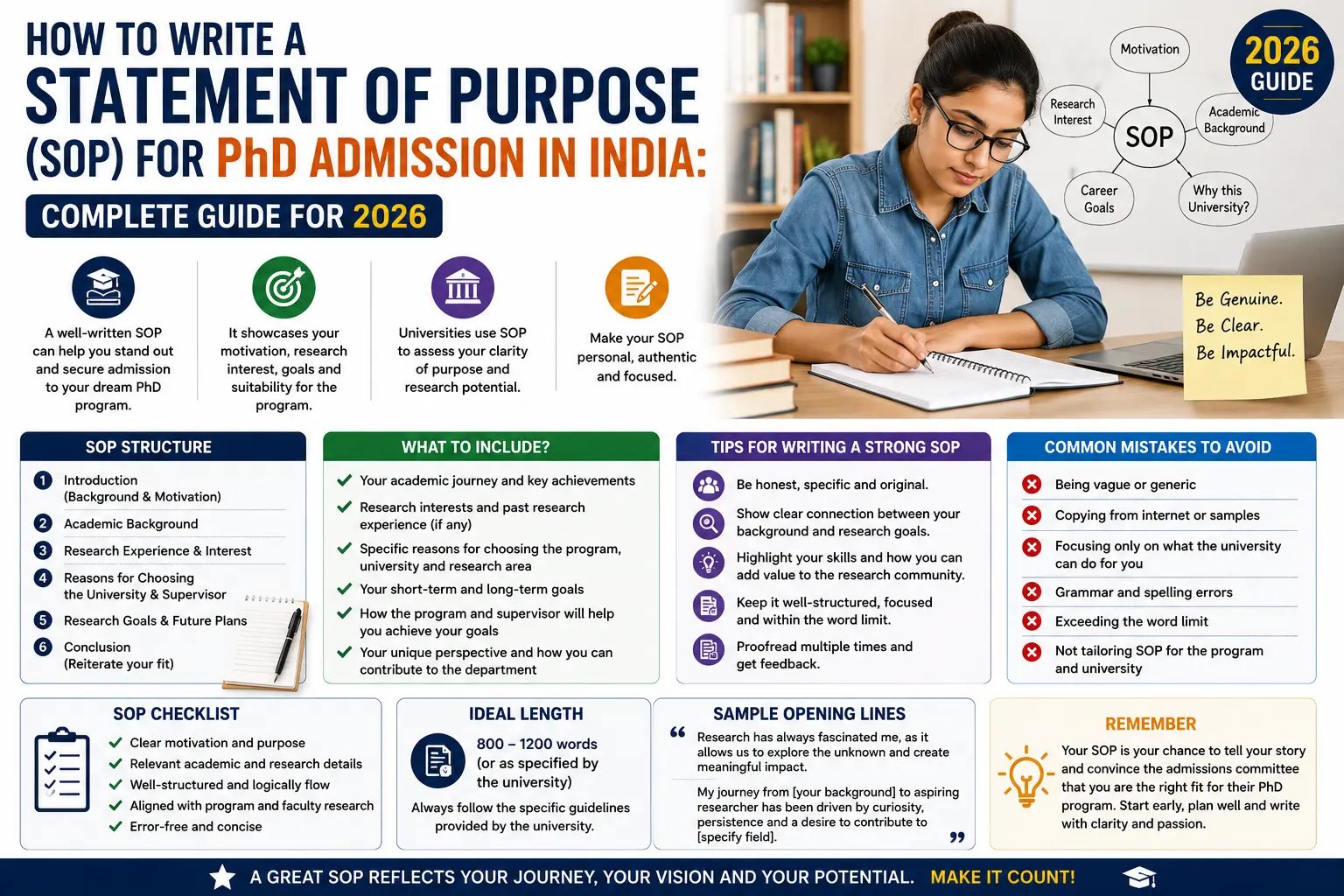
A Statement of Purpose (SOP) for PhD admission in India is one of the most important documents in the doctoral application process. While academic transcripts, entrance exam scores, research proposals, and interviews are essential, the SOP is your opportunity to tell the admission committee who you are, what motivates your research interests, and why you deserve a place in their PhD program.
Many universities in India, including IITs, IIMs, Central Universities, IISc, NITs, and private institutions, require applicants to submit a well-written SOP as part of the admission process. A strong SOP can significantly improve your chances of being shortlisted for interviews, while a poorly written one can weaken an otherwise strong application.
The challenge is that many applicants confuse an SOP with a resume or autobiography. An effective SOP is neither. Instead, it is a carefully structured document that highlights your academic background, research interests, career goals, and suitability for doctoral research.
In this comprehensive guide, we will explain how to write a Statement of Purpose for PhD admission in India, provide a step-by-step structure, discuss common mistakes, share expert tips, and answer frequently asked questions.
What is a Statement of Purpose (SOP)?
A Statement of Purpose is a formal essay submitted during the PhD admission process that explains:
- Your academic journey
- Research interests
- Motivation for pursuing a PhD
- Career aspirations
- Reasons for choosing a specific university
- Alignment with the research area and faculty
The SOP helps the admission committee evaluate whether you are academically prepared and genuinely committed to doctoral research.
Unlike a resume, which lists achievements, an SOP explains the story behind those achievements.
Why is an SOP Important for PhD Admission?
Universities receive applications from many candidates with similar academic records. The SOP helps distinguish one applicant from another.
A well-written SOP can demonstrate:
Research Potential
The committee wants evidence that you can conduct independent research.
Academic Maturity
Your writing should reflect critical thinking and clarity of purpose.
Subject Passion
The SOP reveals your enthusiasm for the chosen field.
Career Vision
Universities prefer candidates with clear long-term goals.
Program Fit
Admission panels assess whether your interests align with faculty expertise and institutional research priorities.
What Do Admission Committees Look for in an SOP?
Before writing your SOP, understand what evaluators want to see.
They typically assess:
- Clarity of research interests
- Academic preparedness
- Research experience
- Motivation for pursuing a PhD
- Knowledge of the chosen field
- Career objectives
- Writing and communication skills
An SOP should convince the committee that you are capable of contributing meaningful research.
Ideal Length of an SOP for PhD Admission
Most Indian universities recommend:
- 800–1500 words
However, requirements vary.
Some institutions may ask for:
- 500 words
- 1000 words
- 2–3 pages
Always check the university guidelines before drafting.
Structure of an Effective SOP for PhD Admission
A strong SOP typically consists of the following sections:
1. Introduction
Begin by introducing your academic interests and motivation for research.
The introduction should answer:
- Why are you interested in this field?
- What inspired your research journey?
Example:
"My interest in data-driven decision-making developed during my postgraduate studies in Management, where I explored the role of analytics in improving organizational performance."
Avoid clichés such as:
- "Since childhood, I wanted to become a researcher."
- "I am passionate about education."
Be specific and authentic.
2. Academic Background
The next section should discuss your educational qualifications.
Include:
- Undergraduate studies
- Postgraduate education
- Key academic achievements
- Relevant coursework
Focus on experiences that prepared you for research.
Example:
"During my MBA specialization in Marketing, I developed a strong foundation in consumer behavior, digital marketing, and research methodology."
Do not simply repeat information already available in your resume.
Instead, explain how your academic journey shaped your research interests.
3. Research Experience
This section is often the most important for PhD applicants.
Mention:
- Dissertation projects
- Research papers
- Publications
- Conferences
- Internships involving research
- Research assistantships
Discuss:
- Objectives
- Methodology
- Findings
- Skills gained
Example:
"My master's dissertation examined the impact of social media engagement on customer loyalty among Indian consumers. The study involved quantitative data analysis using SPSS and revealed significant relationships between digital interaction and brand trust."
Even if you do not have publications, discuss academic projects that demonstrate research aptitude.
4. Research Interests
Clearly explain your proposed area of research.
This section should answer:
- What do you want to study?
- Why is it important?
- What research gap exists?
Example:
"I am particularly interested in exploring the application of artificial intelligence in personalized healthcare systems. Existing studies have focused primarily on predictive analytics, leaving significant opportunities to investigate patient-centered decision support systems."
Avoid proposing an overly broad topic.
Specificity demonstrates seriousness and preparedness.
5. Why Do You Want to Pursue a PhD?
This is one of the most important questions your SOP must answer.
Admission committees want to understand your motivation.
Good reasons include:
- Interest in research
- Desire to contribute new knowledge
- Academic career aspirations
- Industry research goals
- Solving real-world problems
Avoid superficial reasons such as:
- Better salary prospects
- Social status
- Lack of other career options
Demonstrate genuine intellectual curiosity.
6. Why Did You Choose This University?
Many applicants write generic statements that could apply to any institution.
Instead, conduct detailed research.
Mention:
Faculty Expertise
Identify professors whose work aligns with your interests.
Research Facilities
Discuss laboratories, databases, or centers relevant to your research.
Academic Reputation
Highlight specific strengths of the department.
Example:
"I am particularly interested in working under Professor XYZ, whose research on digital transformation aligns closely with my proposed research interests."
Personalized responses show genuine interest.
7. Career Goals
Admission committees want to know how a PhD fits into your long-term plans.
Discuss:
Short-Term Goals
Examples:
- Conduct meaningful research
- Publish papers
- Develop expertise
Long-Term Goals
Examples:
- Become a professor
- Lead research projects
- Contribute to public policy
- Work in R&D organizations
Clear goals indicate commitment and direction.
8. Conclusion
End with a confident summary.
Reinforce:
- Research interests
- Motivation
- Program fit
- Future aspirations
Example:
"I believe that the doctoral program will provide the ideal environment to develop my research capabilities and contribute meaningful insights to the field. I look forward to the opportunity to engage with distinguished faculty and pursue impactful research."
Keep the conclusion concise and positive.
Tips to Make Your SOP Stand Out
Be Authentic
Admission committees can easily identify exaggerated claims.
Write honestly about your experiences and motivations.
Demonstrate Research Awareness
Show familiarity with:
- Current developments
- Research challenges
- Existing literature
This reflects academic maturity.
Focus on Research, Not Personal History
A PhD SOP should emphasize research readiness rather than unrelated life stories.
Use Specific Examples
Instead of saying:
"I am interested in research."
Write:
"My dissertation on consumer behavior introduced me to quantitative research methods and motivated me to explore digital marketing analytics further."
Specific examples are more persuasive.
Maintain a Professional Tone
Use formal academic language while remaining clear and readable.
Common SOP Mistakes to Avoid
Many applications are weakened by avoidable errors.
Using Generic Content
Avoid copying templates from the internet.
Admission committees quickly recognize generic statements.
Excessive Personal Stories
Personal experiences should support your research journey, not dominate the SOP.
Poor Structure
A disorganized SOP can make even strong candidates appear unprepared.
Grammar and Spelling Errors
Proofread carefully.
Errors create a negative impression.
Overly Ambitious Claims
Avoid statements such as:
- "My research will revolutionize the industry."
- "I will become the world's leading expert."
Stay realistic and professional.
Lack of Research Focus
Vague interests weaken your application.
Clearly define your area of interest.
Sample SOP Outline
A simple framework:
Introduction
Research motivation
Academic Background
Educational journey
Research Experience
Projects and publications
Research Interests
Proposed area of study
Why PhD
Motivation for doctoral research
Why This University
Faculty and research alignment
Career Goals
Short-term and long-term plans
Conclusion
Summary and commitment
How to Customize SOPs for Different Universities
Never submit the same SOP everywhere.
Tailor each SOP by:
- Mentioning specific faculty members
- Referencing research centers
- Aligning with departmental priorities
- Highlighting relevant resources
Customized applications demonstrate seriousness and preparation.
How Important Is the SOP Compared to Other Admission Components?
The SOP is often evaluated alongside:
- Academic records
- Entrance examination scores
- Research proposal
- Interview performance
A strong SOP can:
- Improve shortlisting chances
- Create a positive first impression
- Strengthen interview invitations
Many admission panels use the SOP to generate interview questions.
Final Checklist Before Submission
Before submitting your SOP, ensure:
✔ Clear research interests
✔ Logical structure
✔ University-specific customization
✔ Strong academic focus
✔ Research experience included
✔ Career goals explained
✔ No grammar errors
✔ Professional tone maintained
✔ Word limit followed
✔ Plagiarism-free content
Conclusion
Writing a compelling Statement of Purpose (SOP) for PhD admission in India requires careful planning, self-reflection, and attention to detail. More than just an application document, the SOP is your opportunity to demonstrate research potential, academic preparedness, and commitment to contributing meaningful knowledge in your chosen field.
A successful SOP clearly explains your academic journey, research experiences, proposed interests, reasons for pursuing a PhD, and alignment with the university's research environment. Rather than using generic templates, focus on authenticity, specificity, and clarity.
As PhD admissions become increasingly competitive in 2026, investing time in crafting a thoughtful and personalized SOP can significantly enhance your chances of securing admission to a prestigious doctoral program and beginning a rewarding research career.
Frequently Asked Questions (FAQs)
1. How long should a PhD SOP be?
Most universities prefer an SOP between 800 and 1500 words, though requirements vary by institution.
2. Is an SOP mandatory for PhD admission in India?
Yes, many universities require an SOP as part of the application process and use it for shortlisting candidates.
3. What should I include in a PhD SOP?
Include academic background, research experience, research interests, reasons for pursuing a PhD, university fit, and career objectives.
4. Can I use the same SOP for multiple universities?
You can use a common foundation, but each SOP should be customized to reflect the specific university, faculty, and research opportunities.
5. What are the most common SOP mistakes?
Common mistakes include generic content, grammatical errors, lack of research focus, excessive personal stories, and copying templates.
6. Can a strong SOP compensate for weaker academic scores?
While academic performance remains important, a well-written SOP can significantly improve your overall application and help demonstrate your research capabilities.
Contact ThesisLikho Today
Call / WhatsApp: +91 96438 02216
Visit: ThesisLikho.com