
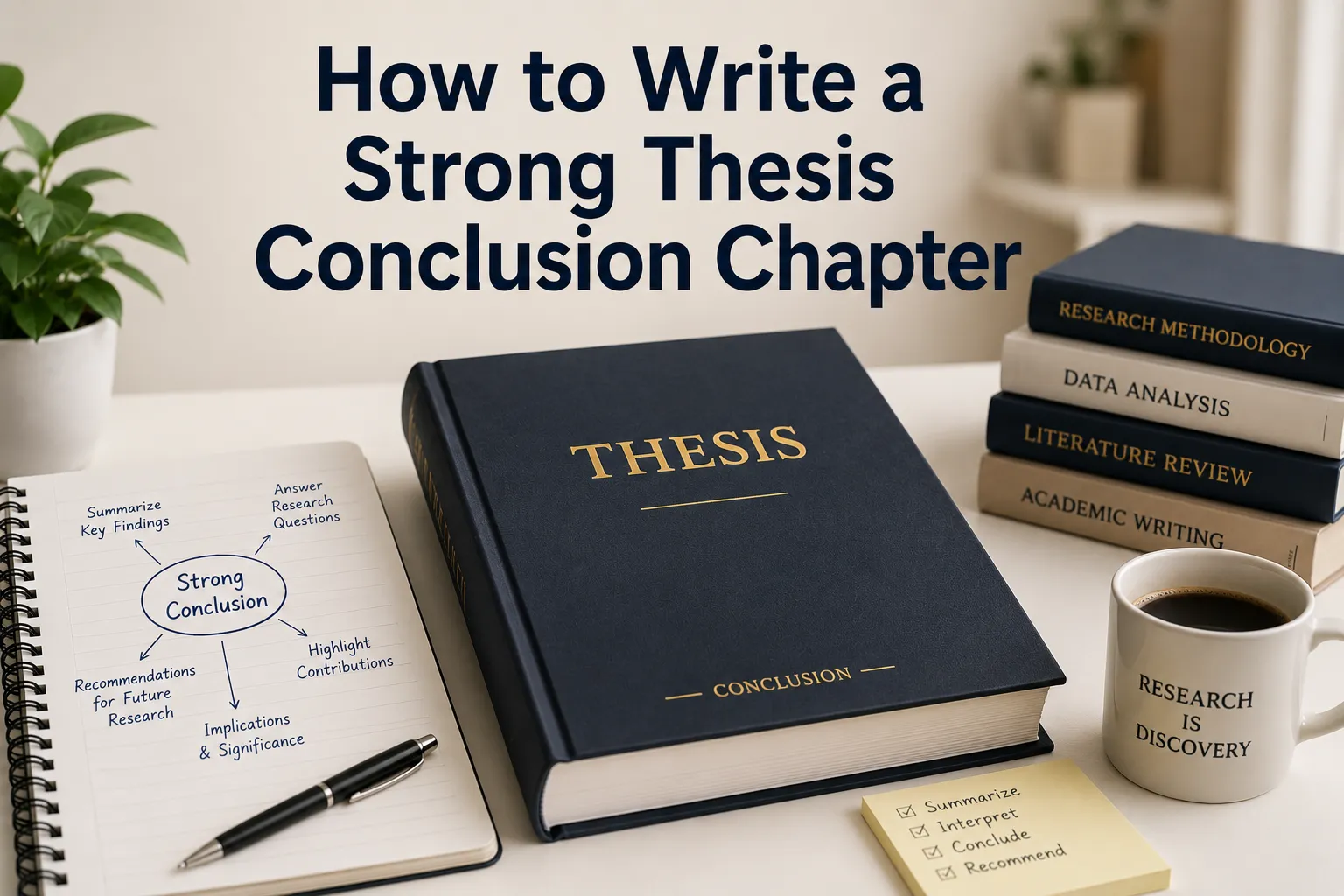
By the time you reach your conclusion chapter, you've spent months — sometimes years — building your argument. The temptation is to treat this final chapter as a formality, a quick recap before submission. That's a mistake. The conclusion is the last thing your examiners read closely, and it's where you make the explicit case for why your research actually matters. This guide walks through how to write a strong thesis conclusion chapter that does justice to everything that came before it.
The conclusion chapter is the final section of a thesis: it restates the research problem, summarizes the key findings, and states the study's contribution to knowledge — all without introducing new data or arguments. That last part matters more than it might seem: your conclusion is not the place to introduce a finding, a citation, or an argument your reader hasn't already encountered.
Understand How the Conclusion Differs From the Discussion
Before drafting, get clear on the boundary between your discussion and conclusion chapters, since confusing the two is one of the most common structural mistakes. The discussion chapter interprets your results in depth, engaging with existing literature and theory in detail and exploring why your findings turned out the way they did. The conclusion is shorter and broader — it synthesizes your overall argument and directly answers your main research question, without re-interpreting your data in detail all over again. If you find yourself re-explaining a specific result's statistical or thematic detail in your conclusion, that content likely belongs in your discussion chapter instead.
Use the Inverted Funnel Structure
While your introduction uses a funnel — moving from broad context down to specific research questions — most conclusion chapters use the reverse: an inverted funnel. You begin narrow, restating specifically what your study did, and gradually widen out toward broader significance and future directions. This mirrored structure gives your thesis a satisfying symmetry: you opened by narrowing toward your specific questions, and you close by widening back out to show why answering them mattered.
The Five Components of a Complete Conclusion
A complete conclusion restates the research question, synthesizes findings into an overall message (not just a list), states the study's contribution to the field, notes limitations honestly, and recommends future research. Each of these five components serves a distinct function, and a strong conclusion moves through them in a way that feels connected, not like five separate mini-sections stapled together.
1. A Brief Opening Roadmap
Open with a short paragraph telling your reader what to expect in the chapter and in what order — genuinely brief, just a paragraph or two. Its purpose is orientation, not a preview summary of your actual findings; save the substance for what follows.
2. Synthesize, Don't Just List, Your Findings
Provide a concise synthesis of your most important results, integrating them to highlight overarching patterns rather than repeating each finding in the sequence you originally reported them. Your reader has already read your results and discussion chapters — this section should pull the threads together into a coherent overall message, not walk back through them individually.
3. State Your Contribution Specifically
Being vague about your contribution is a specifically flagged common mistake. Name the specific method, model, or dataset that is new — not a generic claim like "this study contributes to the field." Discussing your contribution specifically in relation to previous scholarship in the area is one of the most effective ways to identify, emphasize, and explain it clearly. An isolated claim of originality is far less persuasive than one explicitly positioned against what already existed in the literature before your work.
4. Acknowledge Limitations Constructively
Limitations should be framed constructively, not apologetically. A specific pitfall worth avoiding: spending pages describing compelling results, only to turn at the very end to limitations in a way that deflates everything built up before. Limitations are an essential, expected part of rigorous research — they don't need to read as negative at all, particularly when combined with, or followed by, concrete recommendations for future research that turn a limitation into a genuine research opportunity.
5. Recommend Specific Future Research Directions
Suggest two to three concrete directions for future research that follow logically from your limitations or unanswered questions. Avoid vague suggestions like "more research is needed" without specifying what kind of research — a specific recommendation ("future studies could apply this framework to a larger, cross-regional sample" or "a longitudinal design would help establish whether this effect persists over time") gives your reader something genuinely useful, not just a hedge.
Close With a Statement Worth Remembering
End with a memorable closing statement — two to three sentences connecting your specific findings to the bigger picture of your field. This is the final impression you leave with your examiner, so it deserves careful, deliberate revision rather than being treated as an afterthought tacked on once everything else is done.
How Long Should Your Conclusion Actually Be?
A thesis conclusion should generally be roughly 5–7% of your total word count. For a 30,000-word master's-level thesis, that translates to about 1,500–2,100 words. PhD conclusions typically run 2,000–4,000 words specifically — shorter than your introduction, and significantly shorter than your discussion chapter. If your conclusion draft exceeds roughly 5,000 words, take this as a signal: you may be repeating material from other chapters rather than genuinely synthesizing it, and the chapter needs tightening rather than more content.
Step-by-Step: Drafting Your Conclusion Chapter
- Reread your introduction, results, and discussion chapters before drafting, to refresh exactly what your study set out to do and what it actually found
- Write a brief opening roadmap paragraph, kept genuinely short
- Draft a synthesized summary of your findings, integrated into an overall message rather than a list
- State your specific contribution, positioned explicitly against existing literature in your field
- Write your limitations section constructively, pairing each limitation with a related future research direction where possible
- Draft two to three specific, concrete recommendations for future research
- Write a memorable closing statement connecting your findings to the broader significance of your field
- Check your total length against the 5–7% benchmark, and tighten if you've exceeded it
- Confirm no new data, arguments, or citations have been introduced anywhere in the chapter
Practical Checklist: Is Your Thesis Conclusion Ready?
- No new data, arguments, or citations are introduced anywhere in the chapter
- Opens with a brief roadmap paragraph, not a preview summary
- Findings are synthesized into an overall message, not simply re-listed
- Contribution is stated specifically (named method, model, or dataset), not vaguely
- Contribution is positioned explicitly against existing scholarship, not claimed in isolation
- Limitations are framed constructively, not apologetically, and don't undercut the study's overall impact
- Two to three specific, concrete future research directions are suggested, not vague generalities
- Closing statement is memorable and connects findings to the broader significance of the field
- Overall length falls within the 5–7% benchmark for your thesis's total word count
- Content is clearly distinct from the discussion chapter, without re-interpreting results in detail
Two Practical Scenarios
Scenario 1 — Fixing a Vague Contribution Statement
A scholar's initial conclusion draft stated, "This study contributes valuable insights to the field of organizational behavior." A supervisor flagged this as too vague to be meaningful. The scholar revised it to specifically name the contribution: "This study contributes a validated measurement scale for remote-work engagement, adapted specifically for hybrid team contexts — a gap left unaddressed by existing scales developed prior to widespread hybrid adoption." This version told the reader exactly what was new, and positioned it directly against the existing literature.
Scenario 2 — Reframing Limitations Constructively
A scholar's original limitations section read as an extended, somewhat apologetic list of everything the study couldn't do, ending the thesis on a deflated note. Revising with the "limitations paired with recommendations" principle in mind, the scholar restructured each limitation to immediately connect to a specific future research direction — for example, noting the study's single-region sample as a limitation, then immediately proposing a specific cross-regional replication as a concrete next step. This reframing turned an apologetic list into a forward-looking research agenda.
Common Mistakes Thesis Writers Make With Conclusions
- Re-interpreting results in detail, duplicating content that belongs in the discussion chapter instead.
- Making a vague contribution claim without naming the specific method, model, or dataset that's new.
- Ending on limitations without pairing them with recommendations, leaving the thesis on a deflated note.
- Suggesting vague future research ("more research is needed") without specifying what kind.
- Writing an overly long conclusion that repeats earlier chapters rather than genuinely synthesizing them.
Frequently Asked Questions
How do you write a strong thesis conclusion chapter?
Restate your research question, synthesize your findings into an overall message, state your specific contribution positioned against existing scholarship, acknowledge limitations constructively paired with future research recommendations, and end with a memorable closing statement — all without introducing new data or arguments.
Why does a strong thesis conclusion matter?
The conclusion is the final impression your examiners take away from your thesis, and a vague, overly long, or apologetically framed conclusion can undercut the impact of otherwise strong research findings.
How does the conclusion chapter affect a thesis's overall impact?
A well-synthesized conclusion that clearly states the study's specific contribution helps examiners see the value of the research clearly; a conclusion that simply repeats earlier chapters or makes vague claims leaves that contribution unclear even if the underlying research was strong.
How long does it take to complete a thesis using this approach?
Drafting a conclusion using this structured approach — rather than writing freely and hoping it comes together — typically takes less revision time overall, since the five core components give the chapter a clear shape from the start.
Is professional help available to write a strong thesis conclusion chapter?
Yes. ThesisLikho's PhD-qualified mentors have guided 10,000+ scholars through conclusion chapter structuring, contribution framing, and complete thesis writing assistance tailored to individual disciplines and degree levels.
Get Expert Guidance on Your Thesis Conclusion Chapter
Writing a conclusion that genuinely synthesizes your research — rather than repeating it or trailing off into vague claims — takes careful, deliberate structuring. If you'd like expert input on framing your contribution, structuring your limitations, or crafting a memorable closing statement, ThesisLikho's PhD-qualified team offers conclusion chapter support, contribution framing guidance, and complete thesis writing assistance. If you need expert guidance with your conclusion, chapter structure, or overall thesis writing, you can explore our Thesis Writing Assistance service.
Talk to a Thesis Expert → https://thesislikho.com/writing-services/thesis-writing