
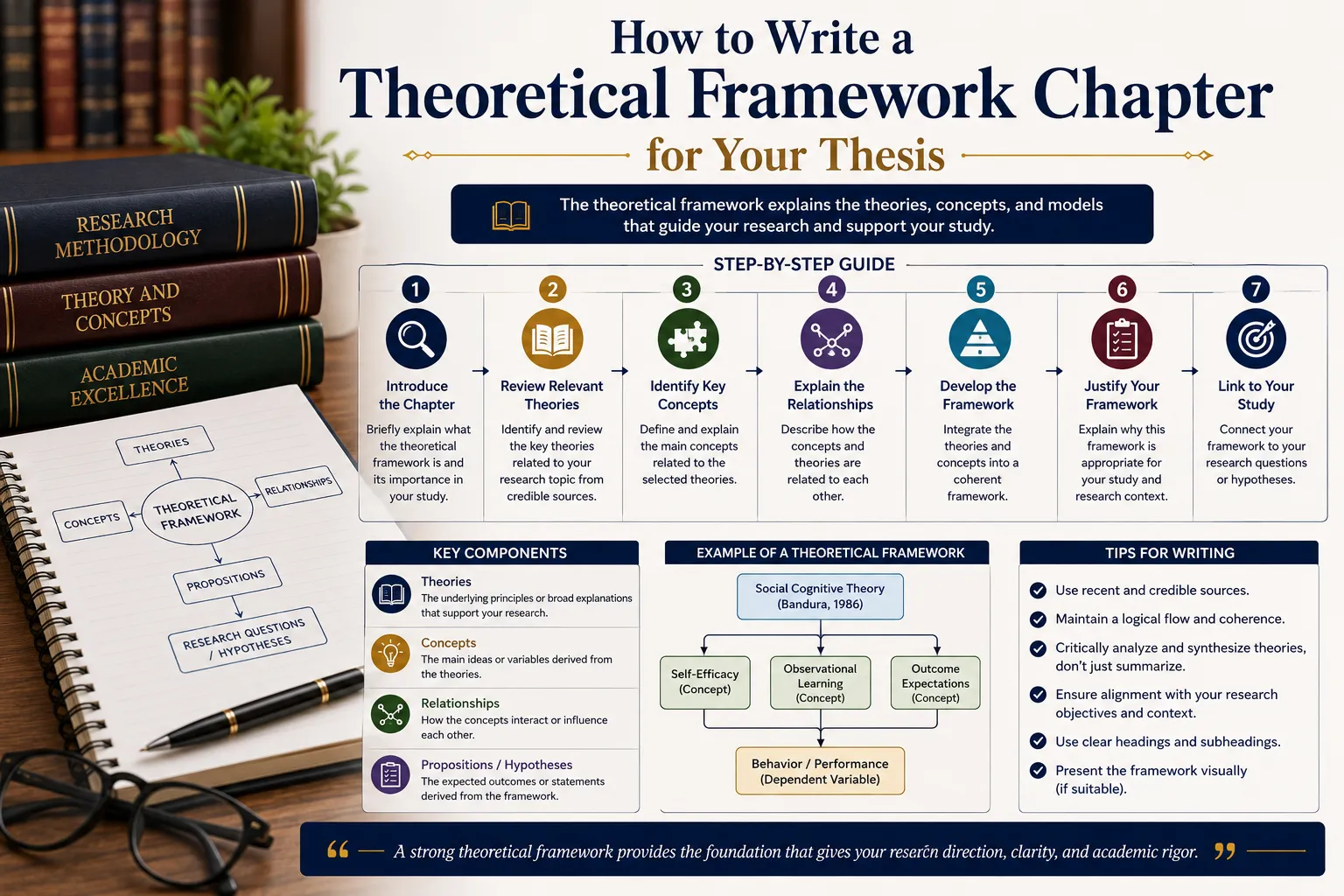
If your supervisor has scribbled "this reads more like a conceptual framework" across your draft and you're not entirely sure what that means, you're facing one of the most confusing chapters in the entire thesis-writing process. Learning how to write a theoretical framework chapter for your thesis starts with a distinction most scholars never get taught clearly: a theoretical framework is borrowed from established theory, while a conceptual framework is something you build yourself.
This guide walks through exactly what a theoretical framework chapter needs to contain, how it differs from the conceptual framework it's often confused with, and how to structure, source, and cite it so it holds up under committee questioning — the way an experienced thesis mentor would explain it before you sit down to write.
What a Theoretical Framework Chapter Actually Is
A theoretical framework describes the established theoretical underpinnings of your study — the named, existing theory or theories you're using to interpret your research problem. It's not a summary of everything you've read; it's a deliberate argument for which theoretical lens explains your problem best, and why.
Whether it deserves its own chapter or a section within your literature review depends mostly on how central and how complex the theory is to your argument. As a general rule, if your research draws on relatively straightforward theoretical grounding, folding it into the literature review works fine; if it involves several interacting theories or a genuinely complex theoretical debate, a dedicated chapter gives you the room to do it properly.
Theoretical Framework vs. Conceptual Framework: The Distinction That Confuses Everyone
This is the single most common point of confusion in thesis writing, and it's worth getting precise about early, because getting it wrong is exactly the kind of feedback that sends a chapter back for revision.
A theoretical framework interprets your study through one or more established, named theories — it's borrowed, not built. A conceptual framework, by contrast, is a structure you construct yourself, typically a diagram mapping the specific variables in your study and the relationships you expect between them, tailored to your particular research problem. One way to think about it: the theoretical framework is like borrowing an existing house design, while the conceptual framework is like sketching your own floor plan using elements from that design.
Disciplinary patterns matter here too. Theoretical frameworks tend to dominate in the humanities and social sciences, often paired with quantitative or deductive designs, while conceptual frameworks are more common in the sciences and in problem-specific applied research. These are tendencies, not fixed rules — always check what your specific program handbook asks for, since the terms are frequently (and confusingly) used as synonyms across different departments.
Where the Theoretical Framework Sits in Your Thesis
Placement varies meaningfully by discipline and institution, so there's no single universal answer — but a few patterns show up repeatedly. Most commonly, the theoretical framework sits within or at the start of the literature review chapter, functioning as the lens through which the rest of the review is organized. Some programs instead place it as its own standalone chapter positioned between the literature review and the methodology — a natural fit when the framework itself needs to carry real analytical weight rather than functioning as a short scene-setter.
If you're unsure which structure fits your work, this is a genuinely good early question for your supervisor rather than something to guess at — placement conventions differ enough across departments that following your program's precedent matters more than following a generic template.
Step 1: Let Your Research Questions Point to the Right Theory
Before searching for theories to use, go back to your research questions and ask what assumptions they already make about how the phenomenon you're studying actually works. A question about individual decision-making implies a different theoretical starting point than a question about institutional or structural behavior — and starting from your questions, rather than from a theory you already like, keeps the framework genuinely relevant to your study rather than decorative.
Once you've identified the kind of assumption your questions are making, look at how other researchers addressing similar questions in your field have framed their own theoretical grounding. This isn't about copying their choice of theory — it's about seeing which theoretical traditions your specific research question naturally sits within.
Step 2: Search the Literature Systematically, Not Casually
A theoretical framework built on a handful of papers you happened to come across reads very differently from one built on a genuinely systematic search — and reviewers can usually tell the difference. Two techniques make a real difference here.
The first is forward citation tracking: find a foundational, frequently cited paper establishing the theory you're considering, then use the "cited by" feature to see how that theory has been applied, extended, or challenged since. Filtering those citing papers by more recent date ranges is one of the fastest ways to move from a decade-old foundational paper to how the theory is actually being used today. The second is using "related articles" alongside citation tracking — this feature surfaces papers with similar citation patterns that a keyword search alone often misses, particularly when different authors describe the same underlying theory using different terminology.
Combining both techniques — tracing forward from a seminal paper and checking related-articles suggestions — gives a far more complete picture of a theory's current standing than keyword searching on its own, and it's the kind of visible rigor that strengthens your framework's credibility.
Step 3: Choose and Justify Your Core Theory or Theories
Once you've surveyed how the theory has been used, you need to explicitly justify why it's the right lens for your specific problem — not simply state that you're using it. This justification is often the single weakest part of first-draft theoretical framework chapters: scholars name a theory confidently but never explain why it, rather than a competing framework, best explains their research problem.
A strong justification typically does three things: names the theory and its originating scholar(s) clearly, briefly acknowledges at least one alternative theoretical lens you considered and why it was a weaker fit, and connects the chosen theory's core assumptions directly to the specific relationship or phenomenon your research questions are asking about.
Step 4: Apply the Theory to Your Own Research Problem
A theoretical framework that only describes a theory in the abstract, without ever connecting it to your specific study, isn't finished — it's still literature review material. The chapter needs to explicitly show how the theory's concepts map onto your research problem, and this is also where your problem statement, hypotheses, and research questions should be formally aligned with the framework you've just established.
This is also the natural point where many theses introduce a conceptual framework as a companion piece — a diagram built from the theoretical framework's concepts, but specific to your study's variables and expected relationships. If your research involves complex, interacting variables, this visual mapping often does more to clarify your argument than another page of prose would.
Step 5: Cite Consistently and Manage Your Sources as You Go
A theoretical framework chapter leans more heavily on precise citation than almost any other part of your thesis, since you're directly attributing specific ideas to specific theorists — getting an attribution wrong here is a more visible error than in a general literature summary.
If your field or program uses IEEE-style referencing (common in engineering, computer science, and related technical disciplines), the format is a numbered system: each source gets a sequential number in square brackets at the point it's first cited — for example, [1] — and that same number is reused every time you cite that source again, regardless of how far apart the citations appear. Numbers are assigned strictly in the order sources first appear in your text, not alphabetically by author, and the full reference list at the end is ordered by citation number rather than by author surname. This is a common point of error worth double-checking before submission: renumbering your entire reference list after adding a citation during revision is unnecessary — new citations simply take the next available number.
Whatever citation style your program requires, build the habit of logging each source and its exact page or section reference the moment you use it, rather than trying to reconstruct where a specific claim came from after the chapter is drafted. An annotated bibliography — even an informal one, a running document noting what each source argues and how it relates to your framework — pays for itself many times over when you reach the citation-checking stage.
A Real Example: Turning a Vague Theory Mention Into a Genuine Framework
One scholar we worked with was researching employee motivation in a manufacturing setting and had written a theoretical framework section that simply stated: "This study is grounded in Herzberg's Two-Factor Theory, which distinguishes between hygiene factors and motivators." The sentence was accurate, but the section stopped there — it summarized the theory without ever connecting it to the scholar's specific research questions about why sales staff at a particular company were underperforming.
Here's exactly what was missing: there was no justification for why Two-Factor Theory specifically suited this problem over competing motivation theories, no discussion of how the theory had been applied or critiqued in comparable workplace settings in recent years, and no explicit mapping between the theory's core categories (hygiene factors, motivators) and the specific variables the scholar intended to measure in their own study.
After revision, the chapter named Two-Factor Theory, briefly contrasted it against Expectancy Theory and explained why the hygiene/motivator distinction fit a sales-specific underperformance problem better than an effort-expectation framework would, cited several recent applications of the theory in comparable service and sales environments, and closed with an explicit statement connecting the theory's two categories to the specific variables — compensation structure, recognition practices, task variety — the study would go on to measure. The result read as a genuine analytical argument rather than a definition lifted from a textbook.
If you'd like expert guidance in developing and structuring your theoretical framework chapter, you can check out our Thesis Writing Service.
Common Mistakes Scholars Make Writing a Theoretical Framework
Mistake 1: Describing a theory instead of applying it. A chapter that explains what a theory says, without ever connecting its concepts to the scholar's own research problem, is still literature review material — not a functioning framework.
Mistake 2: Confusing theoretical and conceptual framework requirements. Submitting a diagram of study-specific variables when the program expects an established, named theoretical grounding (or vice versa) is one of the most common reasons this chapter gets returned for revision.
Mistake 3: Naming a theory without justifying the choice. Stating "this study uses Theory X" without explaining why Theory X specifically fits the research question — and what alternative was considered — leaves the choice looking arbitrary rather than argued.
Mistake 4: Building citations from memory instead of tracking sources as you write. Scholars who don't log page references and exact attributions while drafting often lose hours reconstructing citations later, and inconsistent numbering is a frequent, avoidable error in numbered citation styles like IEEE.
For more on managing the sources that feed into this chapter, see our companion guide, [How to Organize Sources and Citations for a Literature Review], and if you're still scoping how much literature your review needs overall, [How Many Sources Should a Thesis Literature Review Include] breaks that question down further.
Best Practices If You Have No Research Background
If this is your first time building a formal theoretical framework, a few adjustments make the process considerably more manageable:
- Start from your research questions, not from a theory you already find interesting. Working backward from a theory you like, rather than forward from what your questions actually assume, is one of the most common reasons a framework ends up feeling disconnected from the rest of the thesis.
- Read 2–3 recent theses or published studies in your specific sub-area for their theoretical framework chapters, not just their findings. Seeing how other scholars justified their theoretical choice is often clearer than any abstract description of the process.
- Use forward citation tracking on one foundational paper before committing to a theory. This single technique — finding a seminal paper and following who has cited it since — quickly reveals whether a theory is still actively used and debated or has largely fallen out of favor in current research.
- Ask your supervisor early which structure your program expects — a dedicated chapter or a section within the literature review — rather than guessing and restructuring later.
If any part of this process — distinguishing theoretical from conceptual framework requirements, justifying a theory choice, or managing citations consistently through a long chapter — feels unfamiliar, that's exactly where a structured, expert-guided process helps first-time scholars turn a definition-heavy draft into a genuine analytical framework.
FAQs
How do you write a theoretical framework chapter for your thesis?
Start from your research questions to identify what kind of theory fits, search the literature systematically using forward citation tracking and related-article searches, choose and explicitly justify your core theory against at least one alternative, apply the theory directly to your specific research problem rather than describing it in the abstract, and cite consistently as you write.
Why should I write a theoretical framework chapter for your thesis carefully?
Because it establishes the lens your entire analysis is built on — your problem statement, hypotheses, and research questions all need to align with it. A framework that merely summarizes a theory without applying it, or that gets confused with a conceptual framework, is one of the more common reasons this chapter is sent back for revision.
When should you write a theoretical framework chapter for your thesis?
Draft it once your research questions are reasonably stable and your literature review has surfaced the major theoretical traditions relevant to your problem — typically before you finalize your methodology, since your chosen theory should directly inform how you propose to study the problem.
How do you write a theoretical framework chapter for your thesis?
See the five-step process above: let your research questions guide theory selection, search systematically, choose and justify your theory, apply it to your specific problem, and manage citations carefully throughout.
How long does it take to complete a thesis using this approach?
Timelines vary widely by program and discipline, but building a genuine theoretical framework — rather than a summary paragraph — typically takes several weeks of focused reading and drafting once your research questions are settled. Getting it right early tends to save considerably more time later, since a weak or misapplied framework often requires revisiting the literature review, the hypotheses, and sometimes even the methodology.
Is professional help available to write a theoretical framework chapter for your thesis?
Yes. Many scholars, particularly first-time researchers unfamiliar with the theoretical-versus-conceptual distinction, work with experienced thesis mentors to choose, justify, and apply the right theoretical grounding for their specific research problem. ThesisLikho's PhD-qualified writers have supported thousands of scholars through exactly this stage, helping turn a theory summary into a genuine analytical framework a committee will accept.
If you're still unsure whether your theoretical framework is doing real analytical work or just summarizing a theory, it helps to get an experienced second opinion before your next supervisor meeting. Talk to a Thesis Expert for guidance on structuring, justifying, and applying your theoretical framework correctly.