
Writing a thesis is one of the most important milestones in an academic journey, but many students underestimate the importance of the abstract. A well-written abstract is often the first section that professors, examiners, and researchers read before deciding whether to continue with the full thesis. If it is unclear, lengthy, or poorly structured, it can create a negative first impression.
If you are searching for how to write a thesis abstract that gets approved, this guide will walk you through the complete format, writing process, expert tips, and practical samples. Whether you are pursuing a master's degree or a PhD, understanding the correct approach can significantly improve the quality of your research submission.
By the end of this guide, you will know exactly how to create a concise, informative, and approval-worthy thesis abstract.
What Is a Thesis Abstract?
A thesis abstract is a brief summary of your entire research project. It provides readers with an overview of your study, including the research problem, objectives, methodology, key findings, and conclusion.
Think of it as a snapshot of your thesis. In just a few hundred words, it should help someone understand what your research is about and why it matters.
Most universities require an abstract of 150–300 words, although specific guidelines may vary depending on the institution and academic discipline.
Why Is the Thesis Abstract So Important?
The abstract serves multiple purposes beyond simply summarizing your research.
It helps:
- Professors quickly evaluate your study.
- External examiners understand your research contribution.
- Journal editors assess publication suitability.
- Researchers find your thesis through search engines and academic databases.
- Readers decide whether to read the complete document.
Because of this, investing time in writing a clear and structured abstract can improve both academic evaluation and online discoverability.
Standard Thesis Abstract Format
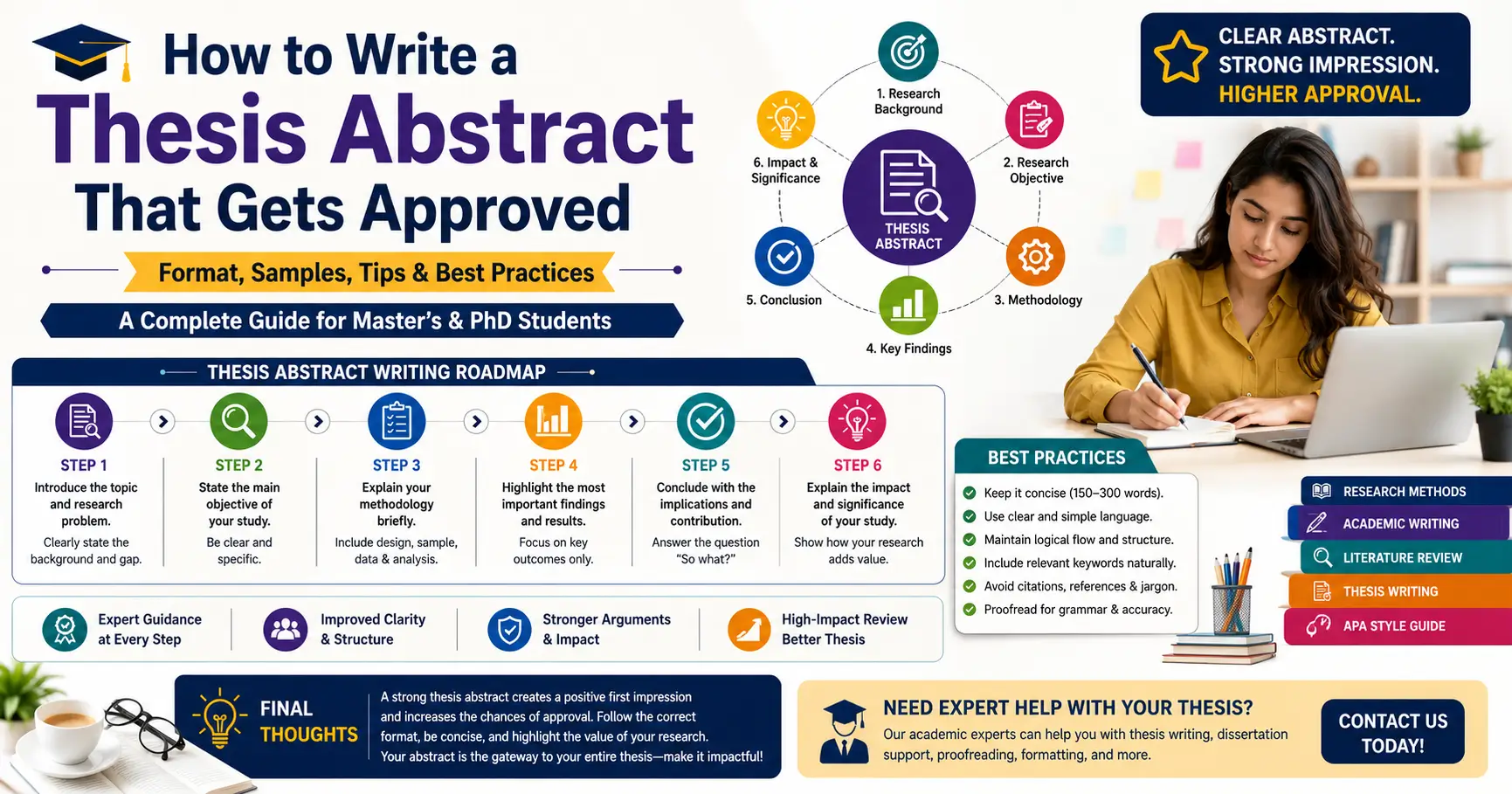
Students often ask about the ideal thesis abstract format. While universities may have slight variations, the following structure is widely accepted.
1. Research Background
Begin by introducing the topic and explaining the broader problem your study addresses.
Example:
"The rapid adoption of artificial intelligence in healthcare has created new opportunities for improving patient outcomes while raising ethical and regulatory concerns."
2. Research Objective
State the primary purpose of your study clearly.
Example:
"This research aims to evaluate the impact of artificial intelligence on diagnostic accuracy in public healthcare institutions."
3. Methodology
Briefly describe how the research was conducted.
Include information such as:
- Qualitative or quantitative approach
- Sample size
- Research design
- Data collection methods
- Analytical techniques
Example:
"A quantitative research design was adopted using survey responses collected from 350 healthcare professionals across five hospitals."
4. Key Findings
Present the most important results without unnecessary detail.
Example:
"The findings indicate that AI-assisted diagnostic tools improved accuracy by 18% while reducing average diagnosis time."
5. Conclusion
End with the overall implication or contribution of your research.
Example:
"The study concludes that responsible implementation of AI technologies can significantly enhance healthcare efficiency while maintaining patient safety."
How to Write a Thesis Abstract That Gets Approved
Many students struggle because they write the abstract before completing their thesis. The best practice is to draft it after the entire research has been finalized.
Follow these steps for better results.
Step 1: Finish Your Thesis First
Complete every chapter before writing the abstract. This ensures your summary accurately reflects the final research.
Step 2: Identify the Core Problem
Clearly define the research gap or issue your thesis addresses.
Ask yourself:
- What problem am I solving?
- Why is this issue important?
- Who benefits from this research?
Step 3: Summarize Your Objectives
Avoid lengthy explanations.
Instead of writing multiple objectives, combine them into one concise statement that highlights your primary research goal.
Step 4: Briefly Explain the Research Method
Readers should immediately understand how the study was conducted.
Mention only the essentials:
- Research design
- Participants
- Data source
- Analysis technique
Avoid discussing every procedural detail.
Step 5: Highlight the Main Results
Include only your most significant findings.
Do not introduce tables, citations, references, or statistical discussions unless absolutely necessary.
Keep this section straightforward and informative.
Step 6: End With a Strong Conclusion
Conclude by explaining what your findings contribute to existing knowledge or practical applications.
A good conclusion answers the question:
"So what?"
If readers understand the value of your research, your abstract becomes much stronger.
Sample Thesis Abstract (Management Research)
Title: Impact of Digital Marketing Strategies on Consumer Purchase Decisions
Abstract:
This study investigates the influence of digital marketing strategies on consumer purchasing behavior in India's e-commerce sector. The research aims to identify how social media advertising, influencer marketing, and personalized promotions affect customer decisions. A quantitative methodology was adopted using survey data collected from 500 online shoppers across metropolitan cities. Statistical analysis revealed that personalized recommendations and influencer endorsements significantly increase purchase intention among young consumers. The findings suggest that businesses should invest in targeted digital campaigns to improve customer engagement and conversion rates. The research contributes to understanding modern marketing strategies in the rapidly evolving digital economy.
Common Mistakes Students Make While Writing a Thesis Abstract
Even well-researched theses can lose impact because of avoidable abstract mistakes.
Some common errors include:
- Writing more than the recommended word limit.
- Including citations and references.
- Explaining background in excessive detail.
- Introducing information not discussed in the thesis.
- Using technical jargon without explanation.
- Failing to mention research findings.
- Writing vague or generic conclusions.
Review your abstract several times to eliminate these issues before submission.
Tips to Make Your Thesis Abstract Stand Out
To improve approval chances, follow these expert recommendations:
- Write the abstract only after completing the thesis.
- Keep sentences short and easy to understand.
- Use active voice whenever possible.
- Maintain logical flow from problem to conclusion.
- Include relevant academic keywords naturally.
- Avoid abbreviations unless universally recognized.
- Proofread carefully for grammar and consistency.
- Match university formatting guidelines exactly.
Best Practices for Writing an Approval-Worthy Thesis Abstract
A high-quality abstract is not just a summary—it is a reflection of your entire research work. Examiners often form their first impression based on this section, so every sentence should add value.
Here are some proven practices to improve your thesis abstract:
Use Clear and Simple Language
Academic writing does not have to be difficult to understand. Use straightforward language and avoid unnecessary complexity. Your goal is to communicate your research clearly, not to impress readers with complicated vocabulary.
Keep It Concise
Every word in the abstract should serve a purpose. Remove repetitive statements and avoid lengthy explanations. Most universities recommend an abstract between 150 and 300 words, so staying within the prescribed limit is essential.
Include Relevant Keywords Naturally
If your thesis is published online, search engines and academic databases rely on keywords to index it. Include your primary keyword and related LSI keywords naturally throughout the abstract without overstuffing them.
For example, terms like:
- thesis abstract format
- research abstract example
- academic abstract writing
- dissertation abstract sample
- how to write a thesis summary
- master's thesis abstract
- PhD thesis abstract
can improve discoverability when used appropriately.
Avoid Citations and References
An abstract should stand on its own. Do not include in-text citations, footnotes, or references because readers should understand your research without consulting external sources.
Maintain Logical Flow
Your abstract should move smoothly from:
- Background
- Research objective
- Methodology
- Findings
- Conclusion
Following this sequence makes the content easier to read and evaluate.
Thesis Abstract Sample for a PhD Research
Title: The Role of Renewable Energy Adoption in Sustainable Urban Development
Abstract:
Urbanization has increased global energy demand, creating challenges for sustainable development and environmental conservation. This research examines the impact of renewable energy adoption on sustainable urban planning in developing economies. The study employs a mixed-method research design involving surveys, expert interviews, and policy analysis across selected metropolitan regions. The findings indicate that integrating renewable energy infrastructure significantly reduces carbon emissions while improving long-term economic sustainability. Government incentives and public-private partnerships emerged as key drivers for successful implementation. The research concludes that strategic investment in renewable energy can accelerate sustainable urban development and support national climate goals.
Quick Checklist Before Submitting Your Thesis Abstract
Before finalizing your abstract, ask yourself the following questions:
- Have I clearly stated the research problem?
- Is the research objective easy to understand?
- Have I briefly explained my methodology?
- Did I mention the most important findings?
- Does the conclusion highlight the significance of the study?
- Is the abstract within the required word limit?
- Have I removed citations and unnecessary details?
- Is the grammar and spelling error-free?
- Does the abstract accurately reflect the completed thesis?
If your answer is "yes" to all of these questions, your abstract is likely ready for submission.
Frequently Asked Questions (FAQs)
1. What is the ideal length of a thesis abstract?
Most universities recommend a thesis abstract between 150 and 300 words. However, always check your institution's specific guidelines before submission.
2. Should I write the abstract before or after completing my thesis?
It is advisable to write the abstract after completing the full thesis so that it accurately summarizes your research, methodology, findings, and conclusions.
3. Can I include references in a thesis abstract?
No. A thesis abstract should not contain citations, references, or footnotes. It should present a self-contained summary of your research.
4. What should be included in a thesis abstract?
A strong thesis abstract should include:
- Research background
- Research objective
- Methodology
- Key findings
- Conclusion
These elements provide readers with a complete overview of your study.
5. How can I make my thesis abstract more effective?
Focus on clarity, brevity, logical structure, and accuracy. Avoid unnecessary details and ensure the abstract reflects the final version of your thesis.
6. Is the thesis abstract the same as the introduction?
No. The introduction explains the topic in detail and sets the context for the study, while the abstract provides a concise summary of the entire research project.
Final Thoughts
Learning how to write a thesis abstract that gets approved is an essential academic skill for master's and PhD students. A well-crafted abstract not only creates a positive first impression but also improves the visibility of your research in academic databases and search engines.
By following the correct thesis abstract format, summarizing your objectives clearly, explaining your methodology briefly, highlighting key findings, and ending with a meaningful conclusion, you can create an abstract that effectively represents your research and increases the likelihood of approval.
Remember that your abstract is often the first—and sometimes the only—section many readers will examine. Investing time in writing it carefully can significantly enhance the overall impact of your thesis.
Need Expert Help With Your Thesis?
Writing a compelling thesis abstract is only one part of successful academic research. If you need professional guidance with thesis writing, dissertation structuring, literature reviews, research methodology, plagiarism reduction, proofreading, or formatting, our experienced academic experts are here to help.
Contact us today for personalized thesis writing support and take the next step toward submitting a polished, well-structured, and approval-ready research document with confidence.
Website: www.thesisLikho.com
Call/WhatsApp: +91 96438 02216