
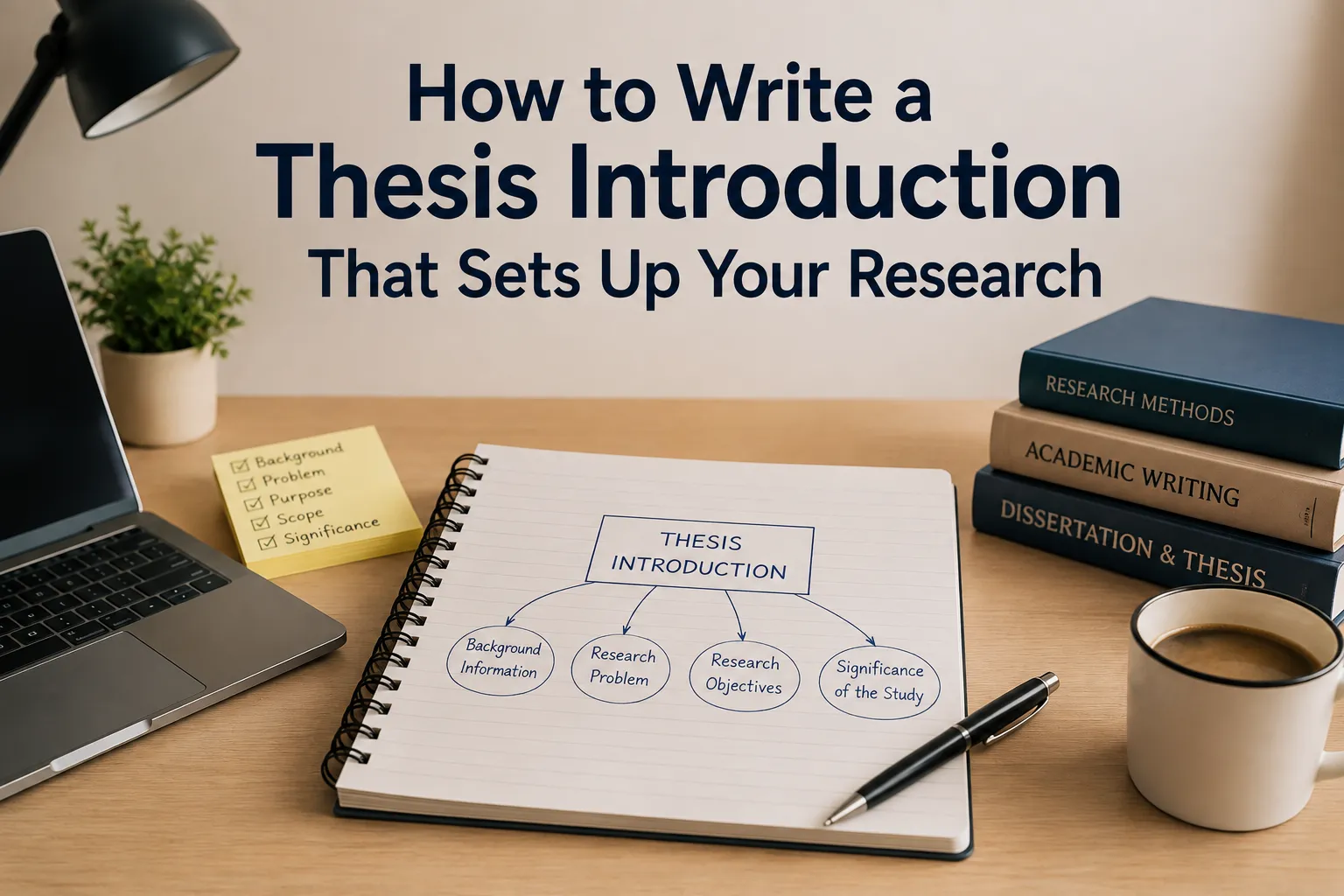
The introduction is often the first chapter a reader encounters and, ironically, one of the last chapters most experienced thesis writers actually finish. That's not an accident — it reflects something genuinely important about what this chapter needs to do. This guide walks through how to write a thesis introduction that sets up your research properly, giving your reader exactly what they need to follow your argument without either overwhelming or underpreparing them.
The introduction chapter isn't just a formality. Examiners use it to understand the scope of your study, assess how well you've framed the problem, and decide whether your objectives are clear and achievable. A vague or disorganized introduction can raise doubts before your reader even reaches your methodology section — which is exactly why this chapter deserves more deliberate structure than it often gets.
The Funnel Structure: Your Core Organizing Principle
The most common and effective structure for a thesis introduction moves from general to specific — a pattern widely described as a funnel. Your opening sentences establish the broad topic and its significance. Your middle sentences narrow the focus by providing relevant background and identifying a specific gap. Your closing sentences present your specific research questions or aims, positioned at the narrowest point of the funnel.
This structure works because it meets your reader where they are and guides them to where your thesis needs them to be. A reader who encounters your research questions without context doesn't understand why they matter. A reader who receives extensive background without ever arriving at your specific questions doesn't know what your thesis is actually trying to establish.
A Common Misunderstanding About "Broad"
The funnel structure doesn't mean starting with the broadest possible statement about human civilization. An opening like "Since the beginning of time, humans have debated issues of justice" is so general it could introduce virtually any paper on any topic — it establishes nothing specific about your particular research. Your opening should be broad relative to your thesis, establishing the relevant conversation, field, or problem — but not so broad that it loses connection to your specific argument.
The Five Essential Elements
A strong thesis introduction consistently includes five essential elements, regardless of discipline:
- Background context — establishing why your topic matters
- The specific research problem or gap — what's missing, unresolved, or in need of investigation
- Research questions or hypotheses — what your study specifically sets out to answer
- Significance of the study — why it matters to your field and potentially to practice
- A chapter outline — previewing how the rest of the thesis is structured
Each element serves a distinct purpose, and skipping or underdeveloping any one of them tends to leave your reader with an incomplete picture of what your thesis is actually setting out to do.
Writing Each Element Well
Background Context: Selective, Not Exhaustive
Your background section should stay selective, not exhaustive — a full literature review belongs in its own chapter, not the introduction. Two to four paragraphs are usually sufficient, covering the historical situation, current state of knowledge, and the broad environment your research sits within. Resist the temptation to demonstrate everything you know about your field here; that comprehensive engagement belongs in your literature review chapter.
The Gap Statement: The Hardest Sentence to Write
A clear gap statement, often signaled by a transitional phrase such as "despite this" or "however," is described as the hardest sentence in the introduction to write — and the most important one to get right. This is the pivot point where your background context turns into the specific justification for your study. Everything before this sentence establishes what's known; this sentence establishes what isn't, and why that matters.
Research Questions: Derived Logically From the Problem
Your research questions must derive logically from the problem you've just stated — a reader shouldn't be surprised by your questions after reading your problem statement. Your objectives, correspondingly, need to be measurable and actionable, not vague aspirations. Write them as active statements ("This study examines...", "This thesis investigates...") rather than as open questions, unless your specific discipline's convention favors question-format research questions.
Significance: Answer at Least One "So What"
A significance statement is strongest when it answers at least one of three sub-questions: so what for theory or knowledge, so what for practice or policy, and so what for the people or systems affected by the topic. Not every thesis needs to address all three, but addressing at least one explicitly avoids the common trap of vaguely claiming your study is simply "important" without specifying to whom or why.
Chapter Outline: A Roadmap, Not a Summary
Your chapter outline should tell your reader what each chapter does and how it connects to the previous one — not simply what each chapter is about. A roadmap sentence like "Chapter 3 builds on the theoretical framework established in Chapter 2 by detailing the mixed-methods design used to test the study's central hypothesis" does more work than "Chapter 3 discusses the methodology."
Openings to Avoid — And What to Use Instead
Common weak openings include starting with a dictionary definition of a key term, beginning with an extremely broad claim not specific to your study, or opening with an apology for the limitations of your work. None of these give your reader a genuine reason to keep reading.
Instead, aim to open with one of two stronger approaches: a specific, well-evidenced statement of the problem or phenomenon your thesis addresses, or a brief, concrete example or case that illustrates why the topic matters. Both approaches immediately engage your reader by establishing what's actually at stake, rather than easing in with generic throat-clearing.
How Emphasis Varies by Discipline
Disciplinary conventions genuinely differ in what an introduction emphasizes. Nursing introductions tend to emphasize clinical practice gaps. Business introductions stress organizational impact. Sociology foregrounds social theory. Literature-based disciplines foreground interpretive stakes rather than an empirical knowledge gap. Being aware of your specific discipline's convention — and matching your introduction's emphasis to it — signals to your reader that you understand your field's norms, not just general academic writing conventions.
A Genuinely Useful Piece of Practical Advice: Write It Last
A widely recommended, somewhat counterintuitive practice: write your introduction last, or substantially revise it after the rest of your thesis is complete. Your introduction needs to accurately describe what your thesis actually contains — something you can't fully know until the other chapters are written. Many students draft a rough introduction early on for structure and direction, then rewrite it once the rest of the thesis is finished and its actual shape has emerged. If you're staring at a blank Chapter 1 and feeling stuck, this is worth remembering: a rough draft to get moving is fine, but don't expect (or need) your first attempt to be your final version.
The Most Common Mistake: Too Much Background
One of the most common mistakes in student introductions is providing too much background information. How much context to include depends partly on whether your thesis has a standalone literature review or methods chapter — the goal is to present enough context to situate your research questions without overburdening your reader with material you'll cover again, in more depth, later. If you notice yourself writing several pages of dense historical or theoretical context in your introduction, much of that content likely belongs in your literature review chapter instead.
Step-by-Step: Drafting Your Thesis Introduction
- Draft your five essential elements roughly, in order: background, problem/gap, research questions, significance, chapter outline
- Write your opening using a specific problem statement or concrete example, not a dictionary definition or sweeping generalization
- Keep your background section to two to four focused paragraphs, saving deeper literature engagement for your literature review chapter
- Write your gap statement deliberately, using a clear transitional signal ("despite this," "however") to mark the pivot from background to justification
- Confirm your research questions follow logically and directly from your stated problem
- Write your significance statement answering at least one "so what" — theory, practice, or the people/systems affected
- Write your chapter outline as a roadmap showing how chapters connect, not just what each one covers
- Set the draft aside until the rest of your thesis is substantially complete, then revise it to accurately reflect what your thesis actually delivers
Practical Checklist: Is Your Thesis Introduction Ready?
- Opens with a specific problem statement or concrete example, not a dictionary definition or sweeping generalization
- Follows a funnel structure, moving from broad-but-relevant context toward specific research questions
- Background section stays selective (two to four paragraphs), not exhaustive
- Gap statement is clearly signaled and marks a genuine pivot from background to justification
- Research questions derive logically and directly from the stated problem
- Objectives are measurable and actionable, written as active statements
- Significance statement answers at least one "so what" (theory, practice, or affected people/systems)
- Chapter outline functions as a roadmap connecting chapters, not just a list of topics
- Emphasis matches disciplinary convention (clinical, organizational, theoretical, or interpretive, as appropriate)
- Draft has been revisited and revised after the rest of the thesis is substantially complete
Two Practical Scenarios
Scenario 1 — Fixing an Overly Broad Opening
A scholar's first draft opened with, "Throughout history, education has played a vital role in shaping societies." A supervisor flagged this as too broad to connect meaningfully to the thesis's specific focus on rural digital literacy programs. The scholar revised the opening to state a specific, evidenced problem instead: "Despite national digital literacy initiatives reaching 78% of urban schools by 2025, rural school enrollment in these programs remains below 30% in several Indian states." This version immediately established what was actually at stake in the specific research, rather than a generic claim about education broadly.
Scenario 2 — Trimming an Overloaded Background Section
A scholar's introduction draft ran to nearly six pages of background, covering the full history of a theoretical framework in dense detail. A committee member noted this essentially duplicated content that belonged in the literature review chapter. The scholar trimmed the background to three focused paragraphs covering only what was needed to situate the specific research gap, moving the detailed theoretical history to an expanded literature review chapter — resulting in a tighter, more focused introduction that didn't repeat itself later in the thesis.
Common Mistakes Thesis Writers Make With Introductions
- Opening with a dictionary definition or an extremely broad, generic claim that doesn't connect specifically to the thesis.
- Writing an exhaustive background section that duplicates content meant for the literature review chapter.
- Stating research questions that don't clearly derive from the problem statement, leaving the connection implicit rather than explicit.
- Claiming significance vaguely ("this study is important") without answering a specific "so what" question.
- Finalizing the introduction before the rest of the thesis is written, risking a chapter outline or framing that no longer matches what the thesis actually delivers.
Frequently Asked Questions
How do you write a thesis introduction that sets up your research?
Use a funnel structure moving from broad-but-relevant context to your specific research questions, include the five essential elements (background, problem/gap, research questions, significance, chapter outline), open with a specific problem or concrete example rather than a generic claim, and revise the chapter after the rest of the thesis is substantially complete.
Why does a well-written thesis introduction matter?
Examiners use the introduction to judge how well you've framed your problem and whether your objectives are clear and achievable — a vague or disorganized introduction can raise doubts before the reader even reaches your methodology.
How does the introduction affect a thesis's overall clarity?
A well-structured introduction gives your reader the context and orientation needed to follow your entire argument; a poorly structured one leaves readers either under-informed about why your research matters or overwhelmed with premature detail that belongs elsewhere.
When should you write a thesis introduction?
A rough draft early on helps establish direction and structure, but the introduction should be substantially revised — or in many cases essentially rewritten — after the rest of the thesis is complete, since it needs to accurately reflect what the finished thesis actually contains.
Is professional help available to write a thesis introduction that sets up your research?
Yes. ThesisLikho's PhD-qualified mentors have guided 10,000+ scholars through introduction chapter structuring, problem framing, and complete thesis writing assistance tailored to individual disciplines and degree levels.
Get Expert Guidance on Your Thesis Introduction
Writing an introduction that genuinely sets up your research — rather than either underwhelming or overwhelming your reader — takes careful attention to structure, framing, and disciplinary convention. If you'd like expert input on structuring your introduction chapter or sharpening your problem statement, ThesisLikho's PhD-qualified team offers introduction chapter support, framing guidance, and complete thesis writing assistance. If you need expert guidance with your introduction, chapter structure, or overall thesis writing, you can explore our Thesis Writing Assistance service.
Talk to a Thesis Expert → https://thesislikho.com/writing-services/thesis-writing