If writing your thesis in English feels like it's taking three times longer than it should, and you find yourself second-guessing sentences a native speaker would write without thinking, you're experiencing something genuinely well-documented, not a personal shortcoming. Every step of academic writing takes measurably longer for scholars writing in a second language — reading, drafting, and revising all demand more conscious effort, and additional steps like translation checking or professional editing often become necessary in ways they simply aren't for native English writers.
This guide walks through the specific challenges non-native English speakers face in thesis writing, evidence-based strategies for managing them, how to use AI writing tools responsibly and within your university's expectations, and when to bring in outside help. We've grounded this in current research on second-language academic writing and the patterns we see across scholars ThesisLikho supports through the writing and editing stage.
Why This Is Genuinely Harder, Not Just Different
It's worth stating this plainly at the outset: writing a thesis in English as a non-native speaker is objectively more demanding, not simply a different experience that evens out with enough practice. Scholars writing in an additional language face a genuine disadvantage in academic publishing and thesis writing broadly — every stage of the process, from reading source material to drafting to revising, takes measurably longer, and additional steps like translation checking, extra proofreading rounds, or professional language editing frequently become necessary in ways they don't for native English writers.
Recognizing this honestly matters practically, not just for reassurance: it justifies building meaningfully more time into your writing schedule from the start, rather than assuming you're simply working less efficiently than you should be. The extra time and effort required isn't a reflection of weaker scholarship — it's an accurate accounting of what the task genuinely demands.
The Three Core Challenges: Language, Structure, and Confidence
Non-native English scholars typically encounter difficulty in three distinct areas, and separating them helps target your preparation more effectively. Language proficiency — the raw challenge of advanced academic vocabulary, complex grammar patterns, and precise sentence construction — is the most obvious challenge, but not always the largest one. Structural and cultural differences in academic writing conventions are often underestimated: English-language academic writing typically favors direct, linear argumentation and explicit signposting of logic, a style that can differ meaningfully from academic writing conventions in other languages and traditions, meaning even scholars with strong English vocabulary sometimes structure arguments in ways that read as less clear to an English-trained reader. Confidence and emotional strain — worry about being judged for language ability, a documented source of genuine anxiety and something close to imposter syndrome among non-native scholars — is a real factor affecting writing quality and pace, not simply a side issue separate from the technical writing challenge.
Addressing all three areas deliberately, rather than assuming better grammar alone will solve the whole problem, produces considerably better results than focusing on vocabulary and grammar in isolation.
Building English Academic Fluency Through Reading
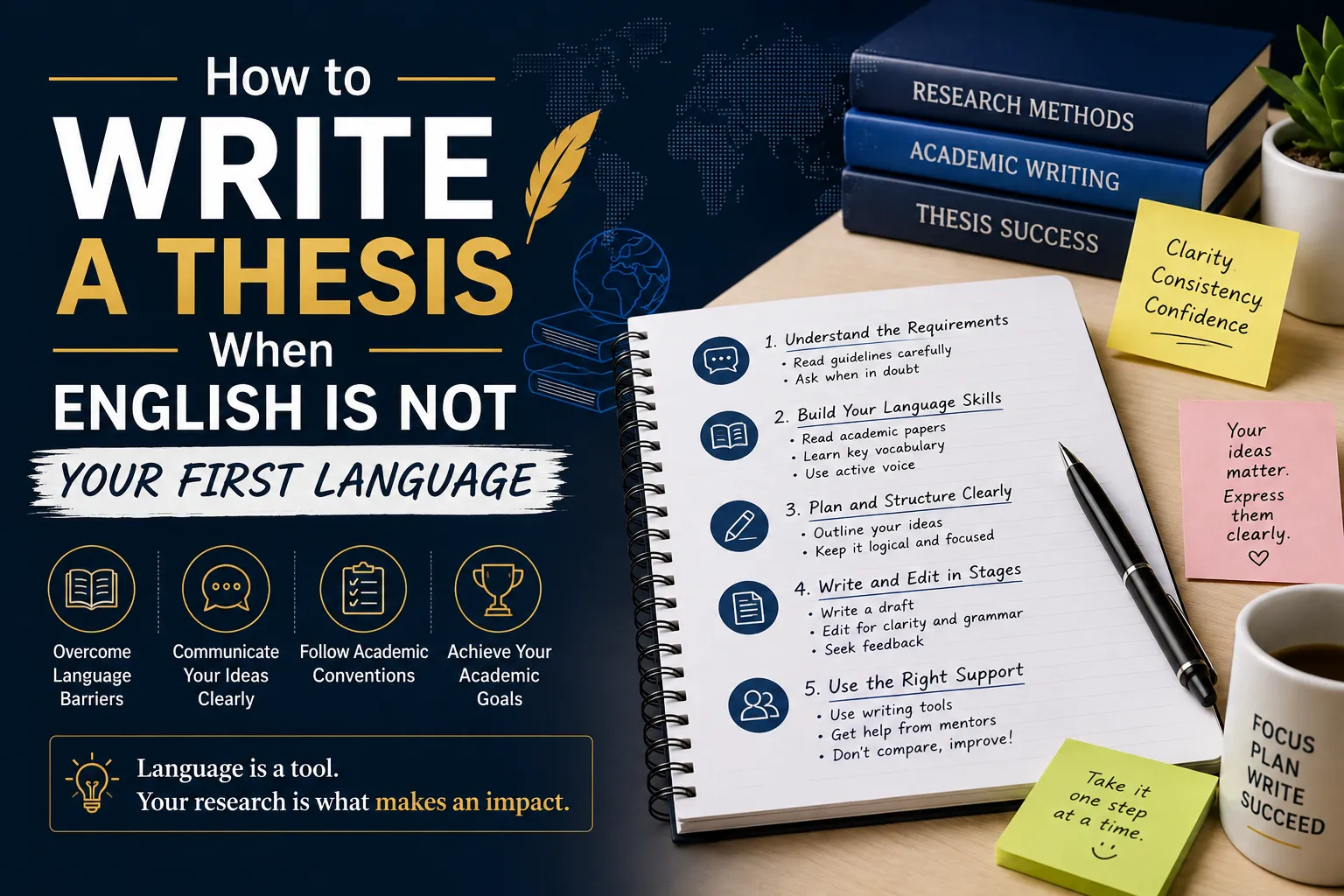
One of the most consistently recommended strategies for non-native scholars is deliberate, regular reading of academic texts in your specific field, written in English. This does double duty: it reinforces field-specific vocabulary and terminology in authentic context, and it familiarizes you with how scholarly arguments are typically structured, signposted, and supported in your discipline's English-language literature — knowledge that transfers directly into your own writing in a way that studying grammar rules in isolation doesn't.
Reading with active attention — noting phrases, transitional expressions, and sentence structures you find effective, rather than reading purely for content — accelerates this benefit considerably. Keeping a running collection of useful academic phrases and transitions you encounter, organized by function (introducing a finding, expressing a limitation, connecting two ideas), gives you a genuinely useful reference to draw on during your own drafting.
Studying Successful Theses in Your Own Field
Beyond general academic reading, examining complete theses or dissertations successfully written by scholars in your specific discipline — ideally from your own department or a closely related one — offers concrete, field-specific insight into structural and stylistic expectations that generic writing advice can't provide. Pay particular attention to how strong theses in your field structure their literature reviews, transition between sections, and frame research contributions, since these patterns are often more discipline-specific than general academic writing guidance accounts for.
This is also a practical, low-pressure way to absorb structural conventions: rather than trying to learn abstract rules about "how English academic writing works," you're studying concrete, successful examples in exactly the genre and field you're writing in yourself.
Understanding Cultural Differences in Argument Structure
Academic writing conventions genuinely vary across linguistic and cultural traditions in ways that go beyond vocabulary and grammar — how directly a thesis is expected to state its argument, how much background context precedes the main point, and how explicitly transitions and logical connections need to be signposted for the reader all differ meaningfully across academic cultures. English-language academic writing, particularly in the empirical social sciences and STEM fields, typically favors clear, direct statements of purpose early in a section, explicit signposting of logical structure ("this section examines... first... then... finally"), and relatively linear argument progression rather than a more circular or context-building structural approach common in some other academic traditions.
If you find your drafts consistently receive feedback about clarity or structure even when your grammar and vocabulary are strong, this cultural dimension — rather than language proficiency itself — may be the underlying issue. Explicitly discussing structural expectations with your supervisor, and studying successful theses in your field as described above, are the most effective ways to close this specific gap.
Writing in Your First Language and Translating Strategically
For some scholars, particularly those whose English proficiency is still developing, drafting complex ideas first in their first language and then carefully translating and adapting into English can produce clearer, more precisely reasoned writing than attempting to compose directly in English for genuinely difficult conceptual passages. This isn't universally the right strategy — for scholars with strong English fluency, direct composition in English is often faster and produces writing that reads more naturally — but for specific sections requiring nuanced, precise argumentation, it's a legitimate and often underused approach worth testing.
If you use this strategy, be deliberate about the translation stage itself: translating word-for-word tends to produce awkward, unnatural English sentence structures, since grammatical patterns rarely map directly between languages. Translating for meaning and then reconstructing the sentence using natural English academic phrasing — rather than mechanically substituting words — produces considerably stronger results.
Using AI Writing Tools Responsibly
AI language tools have become a genuinely useful resource for non-native scholars, capable of catching obvious grammar and spelling errors quickly and offering rephrasing suggestions for awkward sentences. That said, research specifically examining AI language editing tools' effectiveness for non-native scholars has found real but genuinely limited benefit — these tools lack full context, sometimes flag entirely correct sentences as errors, and can miss deeper issues in tone, flow, and argumentative clarity that a human reader would catch. The honest conclusion from this research: optimism about AI tools fully leveling the playing field for non-native English writers should be tempered rather than treated as a complete solution.
The most effective use of AI writing tools is as one input among several — useful for catching surface-level grammar issues and generating rephrasing options to consider, but not a substitute for the structural, disciplinary, and cultural understanding covered elsewhere in this guide, and not a replacement for human review before anything goes into your final submitted thesis.
UGC and University Expectations Around AI-Assisted Writing
Indian universities increasingly expect explicit disclosure of AI tool use in thesis preparation, including for language editing and polishing, though no single national UGC threshold currently exists — specific disclosure requirements and permitted use vary by institution. Before relying on AI tools for language assistance at any meaningful scale, check your specific university's current policy on AI use in thesis writing, and disclose your use of such tools where required, separate from and in addition to your standard plagiarism and originality declarations.
This matters beyond simple compliance: using AI tools transparently and within your institution's stated boundaries protects you from exactly the kind of academic integrity concerns that have drawn increasing scrutiny at Indian universities recently, while still letting you benefit from these tools for the legitimate language-support role they're genuinely useful for.
Building Extra Time Into Your Writing Schedule
Given that every stage of writing genuinely takes longer for non-native English scholars, building this reality explicitly into your overall thesis timeline — rather than budgeting the same writing time a native English speaker might need and then feeling behind schedule throughout — produces a considerably less stressful writing process. This means allocating meaningfully more time specifically for drafting and, especially, for revision and proofreading rounds, since these later stages tend to be where the language-related time cost compounds most heavily.
If you're building a formal research timeline as part of your synopsis or thesis planning, factor this realistically into your writing-phase estimates from the start, rather than treating language as a minor complication to be absorbed within a standard timeline built without it in mind.
When and How to Get Outside Editing Help
Self-editing has a genuine, well-documented limitation for non-native scholars specifically: after reading your own text repeatedly, errors that would be immediately obvious to a fresh reader — particularly a native English speaker — become genuinely difficult to spot in your own writing, simply because familiarity dulls your ability to notice what no longer looks unusual to you. Taking real breaks before proofreading passes, rather than editing immediately after drafting, helps somewhat, but external review remains considerably more effective at catching these blind spots than self-editing alone, however careful.
Outside help can take several forms depending on your resources and stage: a university writing center or English language support program, if your institution offers one; peer review from labmates or colleagues, ideally including at least one native or highly fluent English speaker familiar with your field; structured mentoring or peer-editing platforms designed specifically to support scholars writing in English as an additional language; or professional academic editing services for a final, thorough language pass before submission. Whichever combination you use, building at least one round of genuine outside review into your revision plan — not just a final automated grammar check — meaningfully strengthens the final draft.
Managing the Emotional Weight of Writing in a Second Language
The anxiety and self-doubt many non-native scholars experience while writing in English is a real, documented phenomenon, not a sign of inadequate preparation or ability — worrying about being judged for language rather than ideas is common enough among non-native academic writers that it's specifically named and discussed in guidance written for this population. Recognizing this as a shared, common experience rather than a personal weakness can meaningfully reduce the pressure that otherwise compounds the technical writing challenge itself.
Practically, this often means separating your evaluation of your ideas from your evaluation of your English proficiency during early drafting specifically — getting a rough version of your argument down without excessive real-time self-correction, then addressing language precision in a dedicated later revision pass, rather than trying to produce polished English and sophisticated argumentation simultaneously in a single drafting effort. This staged approach tends to reduce both the time cost and the emotional strain of the writing process considerably.
Real Scholar Strategies
Example 1 — Structural gap, not language gap. A scholar whose English vocabulary and grammar were genuinely strong kept receiving supervisor feedback that his literature review chapter felt "hard to follow" despite technically correct sentences. Working through several successful, recently completed theses from his department, he noticed his own drafts buried the main argument of each section deep within lengthy contextual background, while the successful examples stated their core point early and used explicit signposting throughout. Restructuring his writing around this more direct, explicitly signposted pattern — without changing his vocabulary or grammar significantly — resolved the clarity feedback almost entirely.
Example 2 — Realistic timeline planning. A scholar initially budgeted her thesis writing phase using the same rough timeline her native-English-speaking labmates were using. After the first chapter took nearly twice as long as planned, she rebuilt her overall timeline with a meaningfully longer writing and revision phase, explicitly accounting for the additional drafting and editing time she genuinely needed. This adjustment, discussed openly with her supervisor, removed a significant source of ongoing stress and let her produce stronger, more carefully revised chapters without the pressure of an unrealistic internal deadline.
Common Mistakes ESL Scholars Make
- Budgeting the same writing timeline as native English-speaking peers, rather than realistically accounting for the genuinely longer time the process takes.
- Relying entirely on AI grammar tools as a complete substitute for human review, missing the deeper structural and tonal issues these tools consistently fail to catch.
- Translating word-for-word rather than translating for meaning and reconstructing with natural English academic phrasing.
- Attributing structural feedback to a language deficiency when the underlying issue is actually a cultural difference in argument structure and signposting conventions, not vocabulary or grammar.
- Skipping outside review entirely, relying only on self-editing despite the well-documented difficulty of catching your own errors after repeated exposure to the same text.
- Not disclosing AI tool use where a specific university policy requires it, risking academic integrity concerns that are entirely avoidable with transparent, policy-compliant use.
- Trying to perfect language and argument simultaneously during initial drafting, rather than separating rough-draft argument development from a later, dedicated language-precision revision pass.
- Treating the writing struggle as a personal failing rather than a genuine, well-documented, and manageable challenge shared by scholars writing in an additional language across the world.
Second-Language Thesis Writing Checklist
Before and during your thesis writing process, confirm you have:
- Built meaningfully more time into your writing and revision timeline than you might assume a native English speaker would need
- Established a habit of regular academic reading in English within your specific field
- Studied at least a few successful, recently completed theses from your own department or field
- Discussed structural and stylistic expectations explicitly with your supervisor if you've received unclear feedback despite strong grammar
- Checked your university's specific policy on AI tool use and disclosure requirements before relying on them for language editing
- Used AI writing tools as one input among several, not a complete substitute for human review
- Identified at least one source of outside editing help — a writing center, peer reviewer, or professional editor — for a genuine outside-perspective pass
- Separated argument drafting from language-precision revision as distinct stages rather than attempting both simultaneously
How Long Does It Take to Complete a Thesis Using This Approach?
Non-native English scholars should realistically budget meaningfully more time for the writing and revision stages specifically than a rough general estimate might suggest — often 30 to 50 percent more time for drafting and revision combined, depending on your current English proficiency and the complexity of your specific chapters. Building this extra time in explicitly from the start, rather than discovering the shortfall partway through, is what keeps the writing process manageable rather than a source of ongoing, compounding stress.
Is Professional Help Available to Write a Thesis When English Is Not Your First Language?
Yes — many scholars work with academic mentors, professional editors, or research consultancies specifically for language support at every stage, from structural feedback on early drafts to final line-by-line language editing before submission. ThesisLikho's PhD-qualified research experts have supported non-native English thesis writers through exactly this challenge, helping ensure every chapter communicates your genuine research contribution clearly and precisely — all while keeping the ideas, arguments, and findings entirely your own. Explore ThesisLikho's thesis writing services for one-on-one guidance.
FAQs
How do you write a thesis when English is not your first language? Build meaningfully more time into your writing and revision schedule, read academic texts in your field regularly to build fluency and structural familiarity, study successful theses from your own discipline, use AI writing tools as a supplement rather than a substitute for human review, and get genuine outside editing help since self-editing alone is well-documented to miss errors that are difficult to catch in your own writing.
How long does it take to complete a thesis using this approach?
Non-native English scholars typically need 30 to 50 percent more time for drafting and revision than a rough general estimate might suggest, and building this in explicitly from the start avoids the stress of falling behind an unrealistic timeline.
Is professional help available to write a thesis when English is not your first language?
Yes. Academic mentors, professional editors, and research consultancies, including ThesisLikho's PhD-qualified experts, provide structural and language support at every stage while preserving full ownership of the underlying research and argument.
Why should I write a thesis when English is not your first language carefully?
Because language-related writing challenges are genuine and well-documented, not a reflection of weaker scholarship — treating them with deliberate, realistic strategy rather than personal frustration produces a stronger final thesis and a considerably less stressful writing process.
When should you write a thesis when English is not your first language for a thesis?
Start building extra time and support structures into your plan from the very beginning of your thesis timeline, not after you've already fallen behind — the strategies in this guide work best when integrated into your process from the first chapter rather than introduced as a late-stage fix.
Ready to write a thesis that communicates your research clearly and confidently?
Talk to a Thesis Expert → https://thesislikho.com/writing-services/thesis-writing