
Introduction
Many students believe that academic writing should be filled with complicated vocabulary, long sentences, technical jargon, and sophisticated expressions to sound "scholarly." This misconception often leads to writing that is difficult to understand, repetitive, and unnecessarily complicated. While such writing may appear impressive at first glance, it can confuse readers and weaken the overall impact of your research.
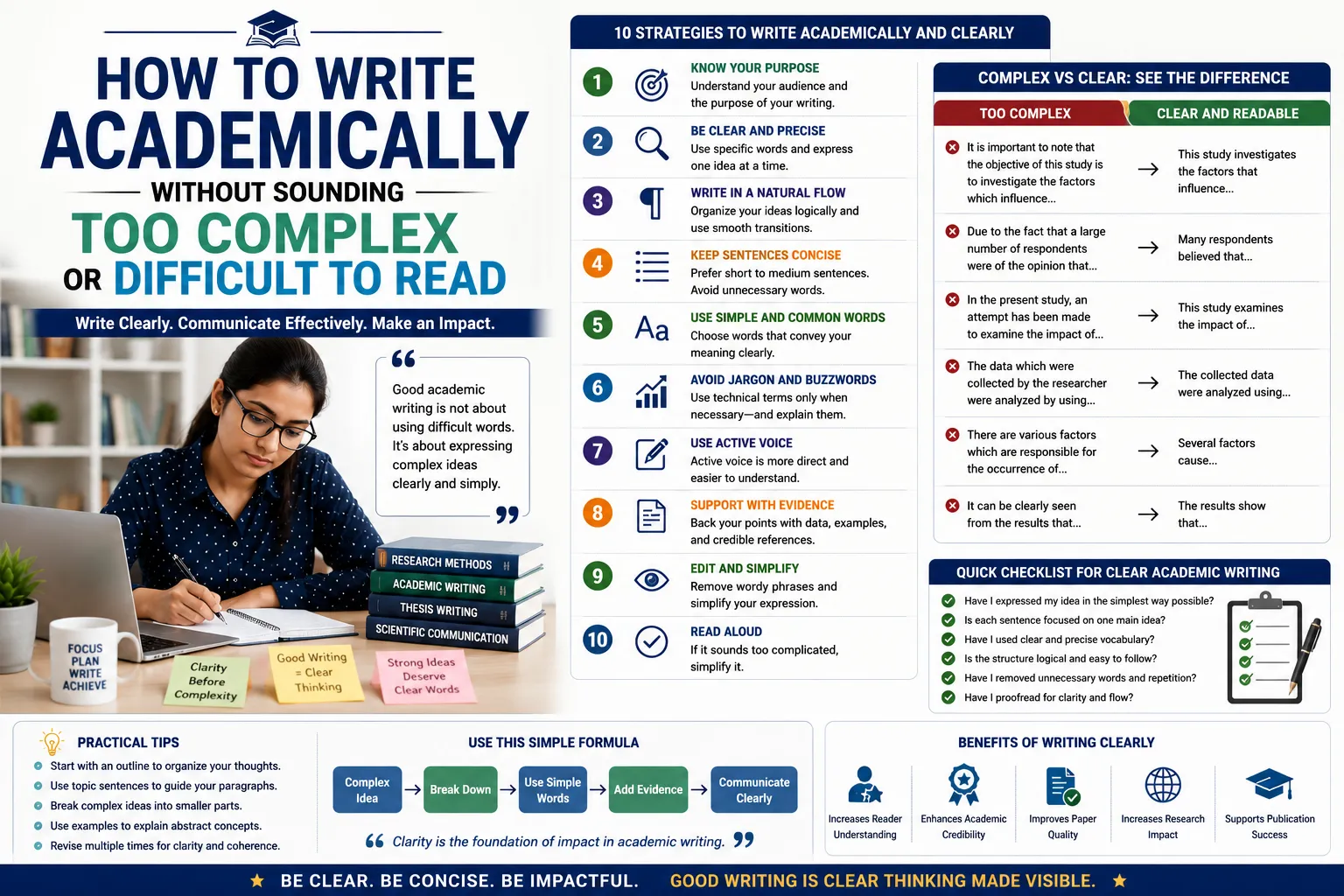
The true purpose of academic writing is not to impress readers with complex language—it is to communicate ideas clearly, logically, and accurately. Whether you are writing a PhD thesis, master's dissertation, journal article, conference paper, or research proposal, your goal is to present evidence, explain concepts, and support arguments in a way that readers can easily follow.
Experienced supervisors, examiners, and journal reviewers often value clarity over complexity. A thesis written in simple, precise language is far more persuasive than one overloaded with jargon and unnecessarily long sentences. Clear writing demonstrates that you understand your topic well enough to explain it effectively.
Fortunately, writing academically without sounding overly complex is a skill that anyone can develop. By focusing on structure, precision, logical flow, and reader-friendly language, you can produce research that is both scholarly and accessible.
This comprehensive guide explores practical strategies for writing academically while maintaining clarity, professionalism, and readability.
What Is Academic Writing?
Academic writing is a formal style of communication used in universities, research institutions, and scholarly publications. It presents ideas, evidence, and arguments in a logical, objective, and well-supported manner.
Academic writing is commonly used in:
- PhD theses
- Master's dissertations
- Research papers
- Literature reviews
- Research proposals
- Conference papers
- Case studies
- Systematic reviews
- Technical reports
Its purpose is to inform, analyze, evaluate, and contribute to knowledge rather than entertain or persuade through emotional language.
Why Simplicity Matters in Academic Writing
Many of the world's leading academic journals encourage authors to write as clearly as possible. Clarity makes research easier to understand, evaluate, and apply.
Simple academic writing offers several advantages:
- Improves reader comprehension.
- Makes arguments more persuasive.
- Reduces ambiguity.
- Helps examiners evaluate your work more efficiently.
- Increases the likelihood of publication.
- Broadens the accessibility of your research.
Remember, complexity of ideas does not require complexity of language.
Common Misconceptions About Academic Writing
Many students unintentionally make their writing more difficult because they believe:
- Long sentences sound more intelligent.
- Technical words make research more scholarly.
- Passive voice should always be used.
- Every paragraph must include advanced vocabulary.
- Complex grammar demonstrates expertise.
In reality, excessive complexity often obscures meaning rather than enhancing it.
Good academic writing balances sophistication with clarity.
Characteristics of Effective Academic Writing
High-quality academic writing is:
- Clear
- Logical
- Objective
- Concise
- Evidence-based
- Well-organized
- Grammatically correct
- Consistent in style
- Properly referenced
These qualities help readers focus on your ideas rather than struggle with your language.
1. Understand Your Audience
Before writing, consider who will read your work.
Your audience may include:
- Research supervisors
- Thesis examiners
- Journal reviewers
- Fellow researchers
- Students
- Industry professionals
Write with enough detail for readers to understand your arguments, but avoid assuming they share your exact background knowledge.
2. Use Simple and Precise Language
Academic writing does not require complicated vocabulary.
Instead of choosing the longest or most technical word available, select the one that communicates your meaning most accurately.
For example:
Instead of:
"Utilize"
Write:
"Use"
Instead of:
"Commence"
Write:
"Begin"
Instead of:
"Subsequently"
Write:
"Then" or "Later" (where appropriate).
Simple language makes your writing stronger, not weaker.
3. Avoid Unnecessary Jargon
Technical terminology is appropriate when it is essential to your discipline, but excessive jargon can make your work difficult to read.
For example, if you are writing for a broad academic audience, explain specialized terms the first time they appear.
Ask yourself:
- Is this technical term necessary?
- Can it be replaced with a simpler alternative?
- Have I explained it clearly?
Using discipline-specific vocabulary thoughtfully improves both precision and accessibility.
4. Write Shorter Sentences
Long sentences often contain multiple ideas, making them harder to follow.
Compare these examples:
Less Effective
"Considering the fact that technological innovation has significantly influenced organizational processes in recent years, it can therefore be argued that companies should attempt to integrate digital transformation strategies wherever feasible."
Improved
"Technological innovation has changed organizational processes significantly. As a result, companies should integrate digital transformation strategies whenever appropriate."
Breaking complex ideas into shorter sentences improves readability without sacrificing meaning.
5. Keep One Main Idea Per Paragraph
Each paragraph should focus on one central idea.
A well-structured paragraph usually contains:
- A topic sentence introducing the main point.
- Supporting evidence or explanation.
- Analysis or interpretation.
- A concluding or transition sentence.
Avoid introducing multiple unrelated ideas in the same paragraph.
6. Use Active Voice When Appropriate
Although passive voice has its place in academic writing, excessive use can make sentences awkward and indirect.
Passive Voice
"The questionnaire was distributed by the researcher."
Active Voice
"The researcher distributed the questionnaire."
Active voice is generally clearer and more direct, especially when describing actions.
Use passive voice only when the actor is unknown, unimportant, or when emphasizing the process rather than the researcher.
7. Eliminate Redundant Words
Many academic writers use unnecessary phrases that add length but little value.
Examples include:
Instead of:
"Due to the fact that"
Write:
"Because."
Instead of:
"In order to"
Write:
"To."
Instead of:
"It is important to note that"
Simply present the information unless the emphasis is genuinely necessary.
Concise writing is often more persuasive.
8. Support Every Claim with Evidence
Academic writing relies on evidence rather than opinion.
Support your arguments with:
- Peer-reviewed journal articles
- Books
- Government reports
- Official statistics
- Reputable organizational publications
Avoid unsupported statements such as:
"Everyone knows online education is effective."
Instead, reference relevant research that demonstrates the effectiveness of online learning.
9. Maintain an Objective Tone
Academic writing should remain impartial and evidence-based.
Avoid emotional language such as:
- Amazing
- Terrible
- Obviously
- Clearly (unless supported)
- Incredible
Instead, use neutral expressions like:
- The findings suggest...
- The results indicate...
- The evidence demonstrates...
- Previous studies have reported...
Objectivity enhances credibility.
10. Use Logical Transitions
Transitions guide readers smoothly from one idea to the next.
Useful transition words include:
For addition:
- Furthermore
- Moreover
- In addition
For contrast:
- However
- Nevertheless
- On the other hand
For cause and effect:
- Therefore
- Consequently
- As a result
For examples:
- For example
- For instance
- Specifically
Transitions improve coherence and help readers follow your reasoning.
11. Avoid Repetition
Repeating the same words or ideas weakens your writing.
Instead of repeating a key term in every sentence, vary your language where appropriate while maintaining accuracy.
For example, after introducing "participants," you may later refer to them as "respondents" or "individuals" if the meaning remains clear.
However, avoid replacing technical terms with inaccurate synonyms merely for variety.
12. Explain Complex Concepts Clearly
Some research topics are inherently complex. Your job is to make them understandable.
Strategies include:
- Define unfamiliar terms.
- Use examples.
- Present information step by step.
- Include diagrams or tables where appropriate.
- Relate new concepts to familiar ideas.
A reader should never struggle to understand your explanation because of unclear writing.
13. Edit Ruthlessly
Excellent academic writing rarely emerges in the first draft.
During editing, ask yourself:
- Can this sentence be shorter?
- Is every word necessary?
- Have I repeated myself?
- Is the meaning immediately clear?
- Does each paragraph contribute to my argument?
Removing unnecessary words often strengthens your writing.
14. Read Your Work Aloud
Reading your writing aloud helps identify:
- Awkward phrasing
- Run-on sentences
- Missing words
- Repetitive language
- Unnatural sentence flow
If a sentence is difficult to read aloud, it will likely be difficult for readers to understand.
15. Seek Feedback
Fresh perspectives reveal issues you may overlook.
Ask:
- Your supervisor
- Fellow researchers
- Academic writing mentors
- Professional editors (if appropriate)
Constructive feedback helps improve clarity and organization.
Common Mistakes That Make Academic Writing Difficult to Read
Many students unintentionally reduce readability by making avoidable mistakes.
These include:
- Using unnecessarily long sentences.
- Overloading paragraphs with multiple ideas.
- Excessive passive voice.
- Too much technical jargon.
- Poor organization.
- Weak transitions.
- Repetition.
- Unsupported claims.
- Inconsistent terminology.
- Grammar and punctuation errors.
Identifying these problems early makes revision more effective.
Practical Tips for Writing Clearly Every Day
Developing strong academic writing habits takes practice. Consider these daily strategies:
- Write regularly instead of waiting for inspiration.
- Draft first, edit later.
- Read high-quality academic articles to observe effective writing styles.
- Keep a list of overused words and replace them with clearer alternatives.
- Use grammar and spell-checking tools as a first review, but always proofread manually.
- Focus on communicating ideas rather than impressing readers with vocabulary.
- Break large writing tasks into smaller, manageable sections.
Small improvements made consistently lead to significant progress over time.
A Simple Academic Writing Checklist
Before submitting any chapter or paper, review the following questions:
- Is my main argument clear?
- Does each paragraph focus on one idea?
- Have I used simple, precise language?
- Are technical terms explained where necessary?
- Have I avoided unnecessary jargon?
- Is every claim supported by evidence?
- Have I used logical transitions?
- Is the writing objective and professional?
- Have I removed redundant words?
- Have I proofread for grammar, spelling, and punctuation?
Using a checklist helps ensure your writing is polished and reader-friendly.
Conclusion
Academic writing is most effective when it communicates complex ideas with clarity, precision, and logical organization. Contrary to popular belief, sounding scholarly does not require long sentences, complicated vocabulary, or excessive technical jargon. In fact, the strongest theses and research papers are often those that explain sophisticated concepts in language that is straightforward and easy to understand.
By focusing on clear sentence structure, concise wording, logical flow, evidence-based arguments, and thoughtful editing, you can produce academic work that is both professional and accessible. Remember that your goal is not to impress readers with complexity but to help them understand your research, evaluate your evidence, and appreciate the significance of your findings.
Whether you are writing your first dissertation chapter or preparing a manuscript for publication, developing a clear academic writing style will strengthen your arguments, improve reader engagement, and enhance the overall quality of your work. With consistent practice and careful revision, you can write confidently in an academic tone without sacrificing readability—making your research more impactful, persuasive, and memorable.
Call / WhatsApp: +91 96438 02216
Website:www.ThesisLikho.com