
Introduction
The abstract is often the first section readers encounter when they open a research paper, thesis, dissertation, journal article, or conference paper. Although it appears at the beginning of a research document, it is usually written last because it summarizes the entire study.
A well-written abstract can determine whether readers continue reading your paper or move on to another study. Journal editors, reviewers, researchers, and students frequently use abstracts to evaluate the relevance and quality of research before reading the complete paper.
For PhD scholars, master's students, faculty members, and academic researchers, learning how to write an effective abstract is a crucial academic skill. A strong abstract increases the visibility of your research, improves discoverability in databases, and enhances the chances of publication.
This comprehensive guide explains what a research abstract is, why it matters, different types of abstracts, standard formatting, step-by-step writing methods, examples, and common mistakes to avoid.
What Is an Abstract in Research?
An abstract is a concise summary of a research paper that provides readers with an overview of the study's purpose, methodology, findings, and conclusions.
It allows readers to quickly understand:
- What the research is about
- Why it was conducted
- How the study was performed
- What results were obtained
- What conclusions were reached
Think of an abstract as a "mini version" of your entire research paper.
Simple Definition
An abstract is a brief summary that describes the key elements of a research study in approximately 150–300 words.
Why Is an Abstract Important?
Many researchers underestimate the significance of an abstract. However, it serves multiple important functions.
1. Creates the First Impression
Editors and reviewers often read the abstract before examining the full manuscript.
A well-written abstract immediately communicates professionalism and clarity.
2. Helps Readers Decide
Researchers use abstracts to determine whether a paper is relevant to their interests.
A clear abstract attracts the right audience.
3. Improves Searchability
Academic databases such as:
- Google Scholar
- Scopus
- Web of Science
- PubMed
Index papers using information contained in abstracts.
Good keyword placement improves discoverability.
4. Supports Publication Success
Many journals use abstracts during the initial screening process.
A weak abstract may lead to early rejection.
5. Enhances Citation Potential
Papers with informative and searchable abstracts often receive more visibility and citations.
Characteristics of a Good Abstract
An effective abstract should be:
Concise
Summarize the research without unnecessary details.
Clear
Use simple and direct language.
Accurate
Represent the study honestly.
Complete
Cover all major research components.
Independent
Allow readers to understand the study without reading the full paper.
Objective
Avoid exaggerations and unsupported claims.
Types of Abstracts
Different academic disciplines and journals require different types of abstracts.
1. Descriptive Abstract
A descriptive abstract briefly explains:
- Research topic
- Purpose
- Scope
It does not usually include detailed findings.
Length
50–150 words
Commonly Used In
- Humanities
- Literature
- Philosophy
2. Informative Abstract
The informative abstract is the most common type.
It includes:
- Research problem
- Objectives
- Methods
- Results
- Conclusions
Length
150–300 words
Commonly Used In
- Sciences
- Engineering
- Medicine
- Social Sciences
3. Critical Abstract
A critical abstract evaluates the study and discusses strengths or weaknesses.
Length
300–500 words
Commonly Used In
Research reviews and critiques.
4. Structured Abstract
Structured abstracts use separate headings.
Example:
- Background
- Objectives
- Methods
- Results
- Conclusion
Commonly Used In
Medical and healthcare research.
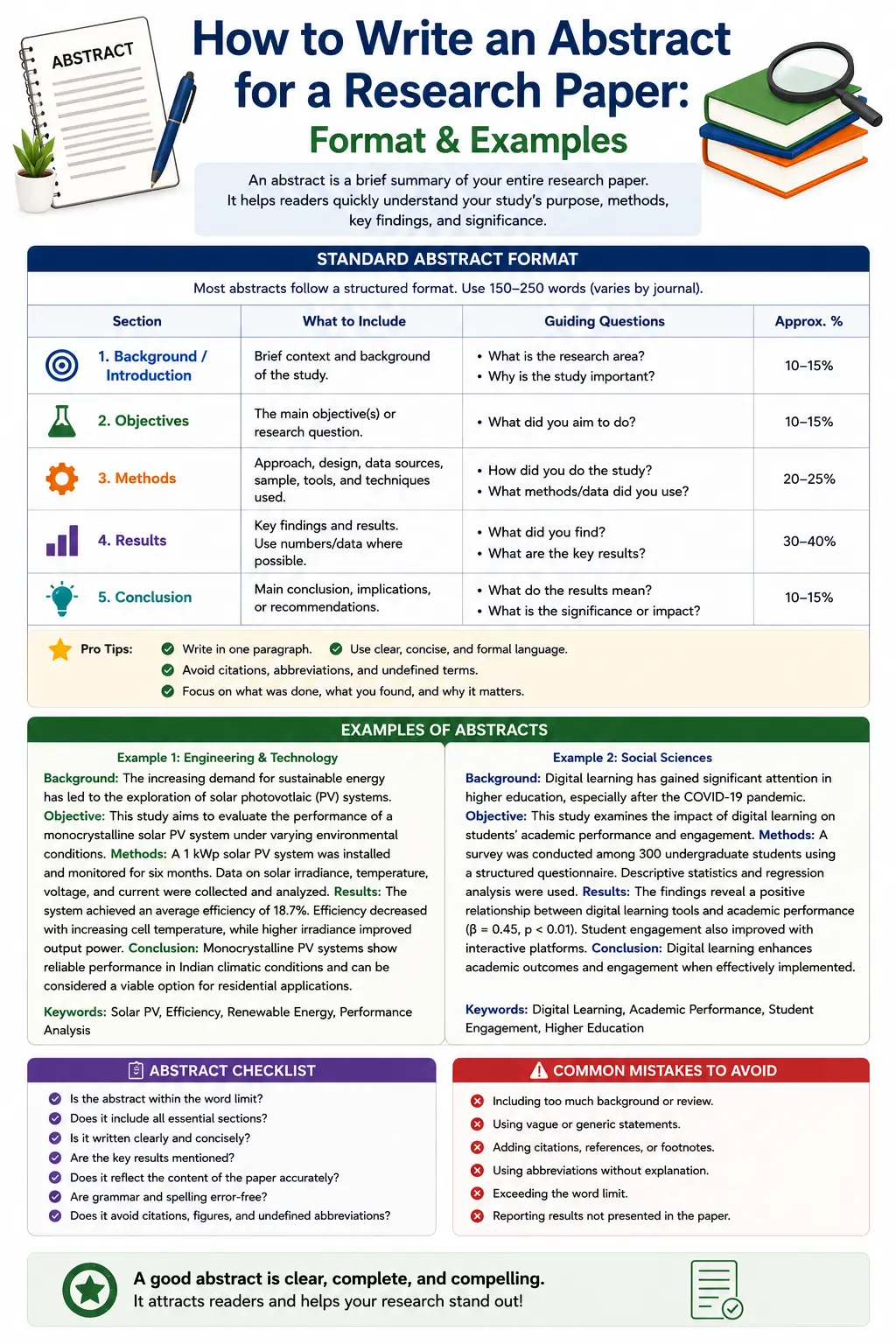
Standard Structure of a Research Abstract
Most research abstracts follow five essential components.
1. Background or Problem Statement
Introduce the research problem.
Answer:
What issue is being investigated?
Example
"Climate change is significantly affecting agricultural productivity worldwide."
2. Research Objective
Explain the purpose of the study.
Answer:
What does the study aim to achieve?
Example
"This study examines the impact of climate variability on wheat production in Northern India."
3. Methodology
Briefly describe research methods.
Answer:
How was the research conducted?
Example
"A quantitative analysis of agricultural data collected from 500 farms was performed."
4. Results
Present key findings.
Answer:
What did the study discover?
Example
"Results showed a 15% reduction in wheat yield associated with rising temperatures."
5. Conclusion
State the implications of findings.
Answer:
Why do the results matter?
Example
"The findings highlight the need for climate-resilient farming practices."
Recommended Abstract Length
Typical word limits include:
Document Type Word Count
Research Paper 150–250 words
Journal Article 150–300 words
Conference Paper 200–500 words
Thesis 250–500 words
Dissertation 300–500 words
Always follow journal or university guidelines.
Step-by-Step Guide to Writing an Abstract
Step 1: Complete the Research Paper First
Write the abstract after finishing:
- Introduction
- Literature Review
- Methodology
- Results
- Discussion
- Conclusion
This ensures accuracy.
Step 2: Identify the Main Research Question
Clearly define:
- Problem
- Objective
- Research gap
Focus on the central purpose of the study.
Step 3: Summarize the Methodology
Include only essential details.
Mention:
- Research design
- Sample size
- Data collection method
- Analytical approach
Avoid excessive technical details.
Step 4: Highlight Key Findings
Present the most important results.
Readers want to know what your research discovered.
Step 5: Write the Conclusion
Explain the significance of findings.
Discuss practical or theoretical implications.
Step 6: Add Relevant Keywords
Include important keywords naturally.
This improves visibility in search engines and academic databases.
Step 7: Edit and Refine
Remove:
- Repetition
- Jargon
- Unnecessary explanations
Ensure every sentence adds value.
Example of a Good Research Abstract
Research Topic
Impact of Artificial Intelligence on Student Learning
Abstract Example
Artificial Intelligence (AI) is increasingly being integrated into educational environments worldwide. This study investigates the impact of AI-powered learning tools on student academic performance in higher education institutions. A quantitative research design was employed involving 600 undergraduate students from five Indian universities. Data were collected through surveys and academic performance records and analyzed using statistical techniques. The findings revealed that students using AI-assisted learning platforms demonstrated significantly higher engagement levels and improved academic outcomes compared to traditional learning methods. Additionally, personalized learning features contributed to enhanced knowledge retention and student satisfaction. The study concludes that AI technologies have the potential to transform higher education by improving learning effectiveness and supporting individualized instruction. These findings provide valuable insights for educators, policymakers, and educational institutions seeking to integrate AI into teaching and learning practices.
Example of a Poor Abstract
Poor Example
"This paper discusses artificial intelligence and education. Various methods were used. Several results were found. Conclusions are presented."
Problems
- Too vague
- No methodology
- No findings
- No objective
- No significance
Readers cannot understand the research.
Common Mistakes to Avoid When Writing an Abstract
1. Writing the Abstract First
Always write it after completing the paper.
2. Including Too Much Detail
Avoid:
- Lengthy explanations
- Extensive literature reviews
- Detailed statistics
Keep it concise.
3. Using Undefined Abbreviations
Avoid introducing unfamiliar abbreviations without explanation.
4. Adding Citations
Most abstracts should not contain references or citations.
5. Including New Information
Everything mentioned in the abstract must appear in the main paper.
6. Making Unsupported Claims
Do not exaggerate results.
Stay objective.
7. Ignoring Keywords
Strategically include important research terms.
Abstract Writing Tips for PhD Scholars
PhD students often prepare abstracts for:
- Thesis submissions
- Journal articles
- Conference papers
- Research proposals
Best Practices
- Focus on originality
- Highlight research contribution
- Include measurable results
- Use academic language
- Follow university guidelines
- Proofread carefully
A strong abstract increases the likelihood of positive reviewer responses.
SEO Tips for Research Abstracts
Researchers increasingly publish papers online.
To improve visibility:
Use Relevant Keywords
Include terms related to:
- Research topic
- Methodology
- Industry
Avoid Keyword Stuffing
Keywords should appear naturally.
Use Specific Terms
Instead of:
"Technology"
Use:
"Artificial Intelligence in Higher Education"
Specific phrases improve discoverability.
Future of Abstract Writing in the AI Era
With AI-powered databases and search engines becoming more advanced, abstracts are more important than ever.
Modern indexing systems use abstracts to:
- Categorize research
- Recommend articles
- Rank search results
Researchers who write clear, keyword-rich abstracts can significantly improve research visibility and citation potential.
Even when using AI tools for writing assistance, scholars must ensure that abstracts accurately represent their original research findings.
Conclusion
An abstract is one of the most important components of any research paper. It serves as a concise summary that helps readers, editors, reviewers, and researchers understand the purpose, methodology, findings, and significance of a study.
A well-crafted abstract can improve publication success, increase visibility in academic databases, and attract a wider readership. By following a clear structure, focusing on key findings, and avoiding common mistakes, researchers can create compelling abstracts that effectively communicate the value of their work.
Whether you are writing a journal article, thesis, dissertation, conference paper, or research proposal, mastering abstract writing is an essential skill that contributes significantly to academic success.
Frequently Asked Questions (FAQs)
1. What is the ideal length of a research abstract?
Most research abstracts range from 150 to 300 words, depending on journal or university requirements.
2. Should an abstract contain references?
Generally, abstracts should not include citations or references.
3. When should I write the abstract?
It is best to write the abstract after completing the entire research paper.
4. What are the main parts of an abstract?
Background, objective, methodology, results, and conclusion.
5. Can I include tables or figures in an abstract?
No. Abstracts should consist only of concise text.
6. Is an abstract mandatory for journal publication?
Yes. Almost all academic journals require an abstract.
7. What is the difference between an abstract and a summary?
An abstract follows a structured academic format, while a summary may be more general.
8. How can I improve my abstract?
Focus on clarity, include key findings, use relevant keywords, and eliminate unnecessary details.
Contact ThesisLikho Today
Call / WhatsApp: +91 96438 02216
Visit: ThesisLikho.com