
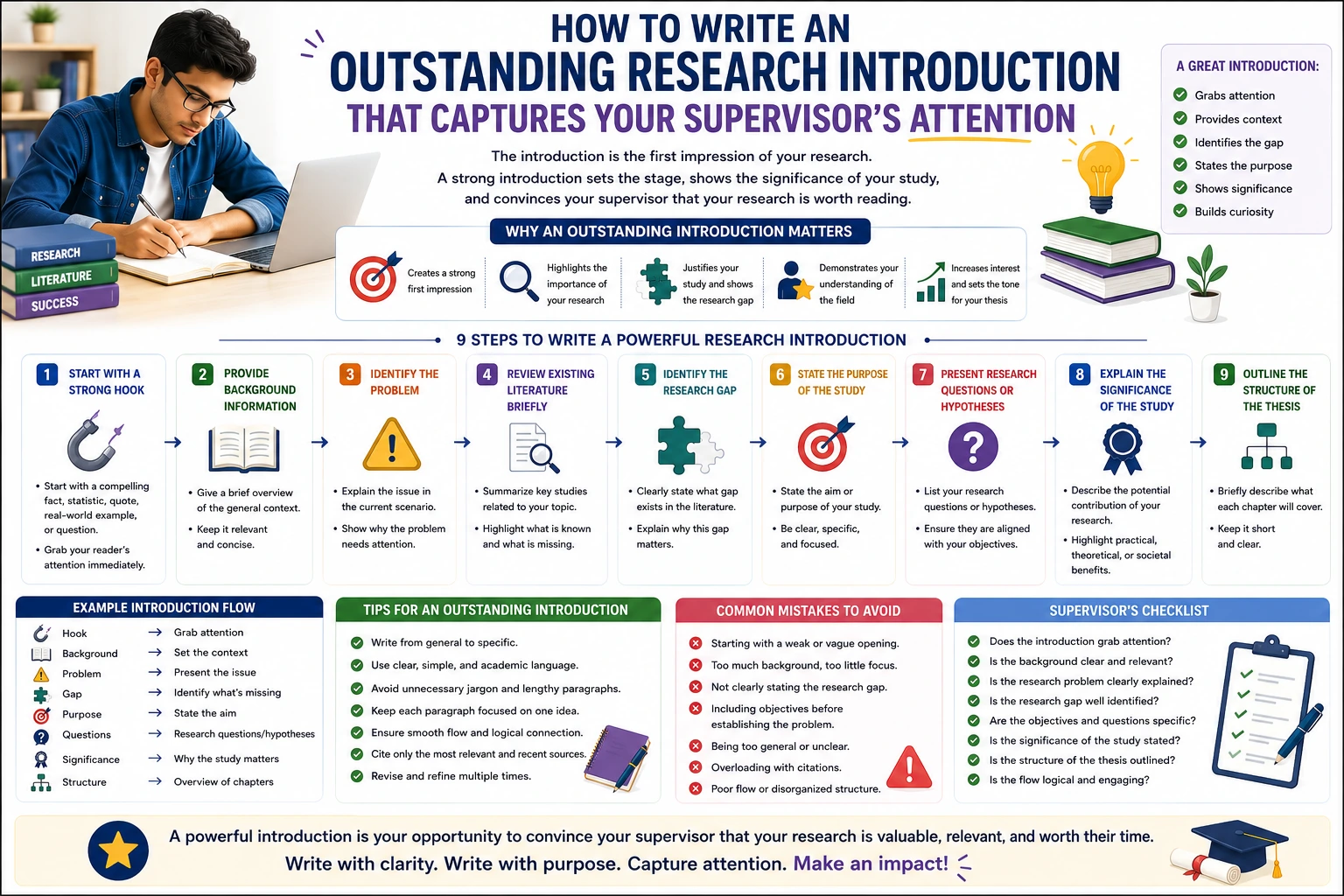
The introduction is one of the most important chapters of any thesis, dissertation, or research paper. It serves as the gateway to your research, providing readers with the background, context, and rationale for your study. More importantly, it is often the first section your supervisor, research committee, or journal reviewer reads in detail. A well-written introduction immediately demonstrates that you understand your research area, have identified a meaningful problem, and know exactly what your study aims to achieve.
Unfortunately, many students underestimate the importance of this chapter. Some begin with broad definitions copied from textbooks, while others jump directly into technical details without establishing why their research matters. A weak introduction can create a poor first impression, making supervisors question the clarity and direction of the entire study—even if the remaining chapters are well written.
An outstanding research introduction does much more than introduce a topic. It tells a compelling academic story. It gradually narrows the focus from a broad research area to a specific problem, highlights gaps in existing knowledge, explains why the study is important, and prepares readers for the chapters that follow.
Whether you are writing a PhD thesis, Master's dissertation, MPhil research project, or journal article, this comprehensive guide will teach you how to write an engaging and academically strong introduction that captures your supervisor's attention and establishes a solid foundation for your research.
What Is a Research Introduction?
A research introduction is the opening chapter or section of a thesis, dissertation, or research paper. Its purpose is to provide readers with the necessary background information, define the context of the study, introduce the research problem, and explain the objectives and significance of the research.
Think of the introduction as a roadmap. It tells readers:
- What the research is about.
- Why the topic is important.
- What problem exists.
- What gap the research addresses.
- What the study aims to achieve.
- How the thesis is organised.
A strong introduction encourages readers to continue, while a weak one may reduce confidence in the study from the outset.
Why the Introduction Is So Important
Supervisors and examiners often form their first impression based on the introduction. An effective introduction demonstrates that you have carefully planned your research and understand the broader academic context.
A strong introduction helps you:
- Establish the relevance of your research.
- Demonstrate familiarity with the subject area.
- Present a clear research direction.
- Justify the need for your study.
- Build interest in your work.
- Lay the foundation for subsequent chapters.
For journal articles, the introduction also plays a crucial role in convincing editors and reviewers that your research deserves publication.
Characteristics of an Outstanding Research Introduction
An effective introduction is more than a summary of the topic. It should be:
- Clear and concise.
- Logically organised.
- Evidence-based.
- Focused on the research problem.
- Free from unnecessary detail.
- Supported by recent scholarly literature.
- Closely aligned with the study's objectives.
It should lead readers naturally from the broader research area to the specific issue your study investigates.
Standard Structure of a Research Introduction
Most universities recommend a logical "funnel" structure.
The introduction generally progresses through the following stages:
- Background of the Study
- Context of the Research
- Research Problem
- Research Gap
- Research Aim
- Research Objectives
- Research Questions or Hypotheses
- Significance of the Study
- Scope and Delimitations
- Thesis Structure
Each section plays an important role in building a convincing academic argument.
Step 1: Begin with the Background of the Study
Start by introducing the broader subject area.
Provide sufficient context for readers who may not be specialists in your exact topic.
For example:
Instead of writing:
Artificial intelligence is a modern technology.
Write:
Artificial intelligence has transformed industries such as healthcare, education, finance, and manufacturing by enabling intelligent decision-making, automation, and personalised services. In higher education, AI-powered learning platforms are increasingly being adopted to improve student engagement and learning outcomes.
This approach immediately establishes relevance and context.
Step 2: Narrow the Focus
After introducing the broader topic, gradually narrow the discussion toward your specific area of research.
For example:
Broad Topic:
Artificial Intelligence
↓
Education
↓
Higher Education
↓
Indian Universities
↓
Postgraduate Students
↓
AI Learning Tools
↓
Academic Performance
This funnel approach creates a logical flow and helps readers understand exactly where your study fits.
Step 3: Present the Research Problem
The research problem explains what issue exists and why it requires investigation.
A strong problem statement should answer:
- What is happening?
- Why is it a problem?
- Who is affected?
- Why has previous research not solved it?
Example:
Although artificial intelligence is widely used in higher education worldwide, limited evidence exists regarding its influence on postgraduate students' academic performance in Indian universities. This lack of context-specific evidence makes it difficult for educational institutions to develop effective AI integration strategies.
This clearly identifies the problem and justifies the study.
Step 4: Identify the Research Gap
The research gap distinguishes your work from previous studies.
Your gap may involve:
- Understudied populations.
- Geographic limitations.
- Methodological weaknesses.
- Contradictory findings.
- Emerging technologies.
- New theoretical perspectives.
Rather than simply stating that "no studies exist," explain what existing research has overlooked and how your study will address that limitation.
Step 5: State the Aim of the Study
Your research aim provides a broad statement of what the study intends to accomplish.
Example:
The aim of this study is to examine the impact of artificial intelligence learning tools on academic performance among postgraduate students in Indian universities.
Keep the aim concise and directly connected to the research problem.
Step 6: Write Clear Research Objectives
Objectives divide the overall aim into measurable tasks.
Example:
- To examine the relationship between AI learning tools and academic performance.
- To identify factors influencing AI adoption among postgraduate students.
- To evaluate students' perceptions of AI-assisted learning.
Each objective should contribute directly to achieving the research aim.
Step 7: Include Research Questions or Hypotheses
Research questions guide qualitative and exploratory studies, while hypotheses are common in quantitative research.
Examples of research questions:
- How do AI learning tools influence academic performance?
- What factors affect AI adoption among postgraduate students?
Examples of hypotheses:
- H1: AI learning tools positively influence academic performance.
- H2: Perceived usefulness significantly affects AI adoption.
Ensure alignment between the problem, objectives, questions, and methodology.
Step 8: Explain the Significance of the Study
The significance section answers an important question:
Why should anyone care about this research?
Discuss the potential contributions to:
Academic Knowledge
Will your study extend existing theories or fill a research gap?
Industry
Can organisations use the findings to improve practice?
Policymakers
Will the results support evidence-based decision-making?
Society
Does the research address an important social, educational, environmental, or economic issue?
Clearly explaining significance strengthens the value of your study.
Step 9: Define the Scope and Delimitations
Every study has boundaries.
Clarify:
- Geographic location.
- Target population.
- Time period.
- Variables examined.
- Research setting.
Also acknowledge what your study does not cover and explain why these limitations are appropriate.
This helps readers understand the context and applicability of your findings.
Step 10: Briefly Outline the Thesis Structure
Many universities expect the introduction to conclude with a short overview of the remaining chapters.
For example:
- Chapter One introduces the study.
- Chapter Two reviews the literature.
- Chapter Three explains the methodology.
- Chapter Four presents the findings.
- Chapter Five discusses the results and conclusions.
This roadmap prepares readers for the organisation of the thesis.
Writing Style Tips for an Engaging Introduction
The quality of your writing influences how your research is perceived.
Follow these best practices:
- Use formal academic language.
- Write clear and concise sentences.
- Avoid unnecessary jargon.
- Support claims with credible references.
- Maintain logical flow between paragraphs.
- Use transition words to connect ideas.
- Avoid personal opinions unless appropriate for your discipline.
Remember that clarity is more valuable than complexity.
Common Mistakes Students Make
Many introductions lose impact because of avoidable errors.
Starting with Dictionary Definitions
Avoid opening with generic definitions copied from textbooks or online sources.
Instead, begin by discussing the broader context and importance of the topic.
Being Too Broad
An introduction should gradually narrow toward your specific research problem.
Avoid spending several pages discussing unrelated background information.
Failing to Identify the Research Gap
Without a clearly defined gap, readers may question the originality of your research.
Always explain what previous studies have overlooked.
Including a Literature Review
The introduction should reference relevant studies but should not become a detailed literature review.
Reserve comprehensive analysis for the literature review chapter.
Writing Objectives That Do Not Match the Research Problem
Ensure every objective contributes directly to solving the stated research problem.
Consistency throughout the thesis is essential.
Example Outline of a Strong Introduction
A typical introduction might follow this sequence:
- General background of the research area.
- Current developments.
- Importance of the topic.
- Existing challenges.
- Research problem.
- Research gap.
- Aim of the study.
- Research objectives.
- Research questions.
- Significance.
- Scope.
- Thesis structure.
Following this logical progression helps readers understand the purpose and direction of your study.
Best Tools for Writing a Research Introduction
Several digital tools can simplify the writing process.
Literature Search
- Google Scholar
- Scopus
- Web of Science
Reference Management
- Zotero
- Mendeley
- EndNote
Writing
- Microsoft Word
- Google Docs
- Grammarly
Research Mapping
- Connected Papers
- ResearchRabbit
- Litmaps
Using these tools effectively can improve organisation, citation accuracy, and writing quality.
Tips for PhD and Master's Students in India
If you are writing a thesis for an Indian university, consider these practical recommendations:
- Review your university's thesis guidelines before drafting the introduction.
- Use recent peer-reviewed literature, especially studies published within the last five to ten years.
- Highlight the relevance of your research within the Indian context where appropriate.
- Ensure your introduction aligns with your supervisor's expectations regarding structure and depth.
- Revise the introduction after completing the thesis to ensure it accurately reflects the final version of your research.
Many experienced researchers rewrite their introductions near the end of the writing process because they gain a clearer understanding of their study as it develops.
Frequently Asked Questions (FAQs)
How long should a thesis introduction be?
The length depends on your university and discipline. In many Master's and PhD theses, the introduction typically represents 10–15% of the total thesis length, although institutional guidelines should always take precedence.
What should come first in an introduction?
Begin with the broader background of the research area before gradually narrowing the discussion toward the specific research problem.
Can I include references in the introduction?
Yes. The introduction should include relevant scholarly references to establish context and support key claims. However, detailed analysis belongs in the literature review chapter.
Should I write the introduction first or last?
Many researchers draft the introduction early to guide their work and revise it after completing the thesis to ensure it accurately reflects the final research.
What makes an introduction stand out to a supervisor?
A strong introduction clearly explains the importance of the topic, identifies a genuine research gap, presents focused objectives, and demonstrates a logical connection between the problem, the study's purpose, and its potential contribution.
Conclusion
An outstanding research introduction does much more than introduce your topic—it establishes the intellectual foundation for your entire thesis. By moving logically from the broader research context to a clearly defined problem, identifying a genuine gap in existing knowledge, and presenting focused aims, objectives, and research questions, you show your supervisor that your study is purposeful, well planned, and academically significant.
Writing an effective introduction requires careful organisation, critical thinking, and a strong understanding of the existing literature. Rather than trying to impress readers with complex language, focus on presenting a clear, evidence-based argument that demonstrates why your research deserves attention. Every paragraph should contribute to guiding the reader toward the central purpose of your study.
Whether you are preparing a Master's dissertation, a PhD thesis, or a research paper for publication, investing time in crafting a compelling introduction will strengthen every chapter that follows. A well-written introduction not only captures your supervisor's attention but also provides a confident and persuasive beginning to research that has the potential to make a meaningful contribution to your field.
Contact ThesisLikho
Call / WhatsApp: +91 96438 02216
Website:www.ThesisLikho.com