Read enough thesis introductions and you'll notice a pattern: the research itself is often sound, but the objectives and hypotheses describing it are vague, hedged, or grammatically tangled enough that a reader has to work to figure out what the study is actually claiming. Learning how to write clear research objectives and hypotheses is a writing skill as much as a research skill — it's about precision at the sentence level, not just conceptual soundness at the design level.
This guide focuses specifically on the craft of writing this section well: the exact verbs and sentence structures that signal clarity, the precision habits APA-style academic writing demands, and the wording mistakes that quietly weaken an otherwise strong thesis. We've grounded this in current academic writing style guidance and the patterns we see across scholars ThesisLikho supports through the drafting stage.
Objective, Question, or Hypothesis: Getting the Terms Right
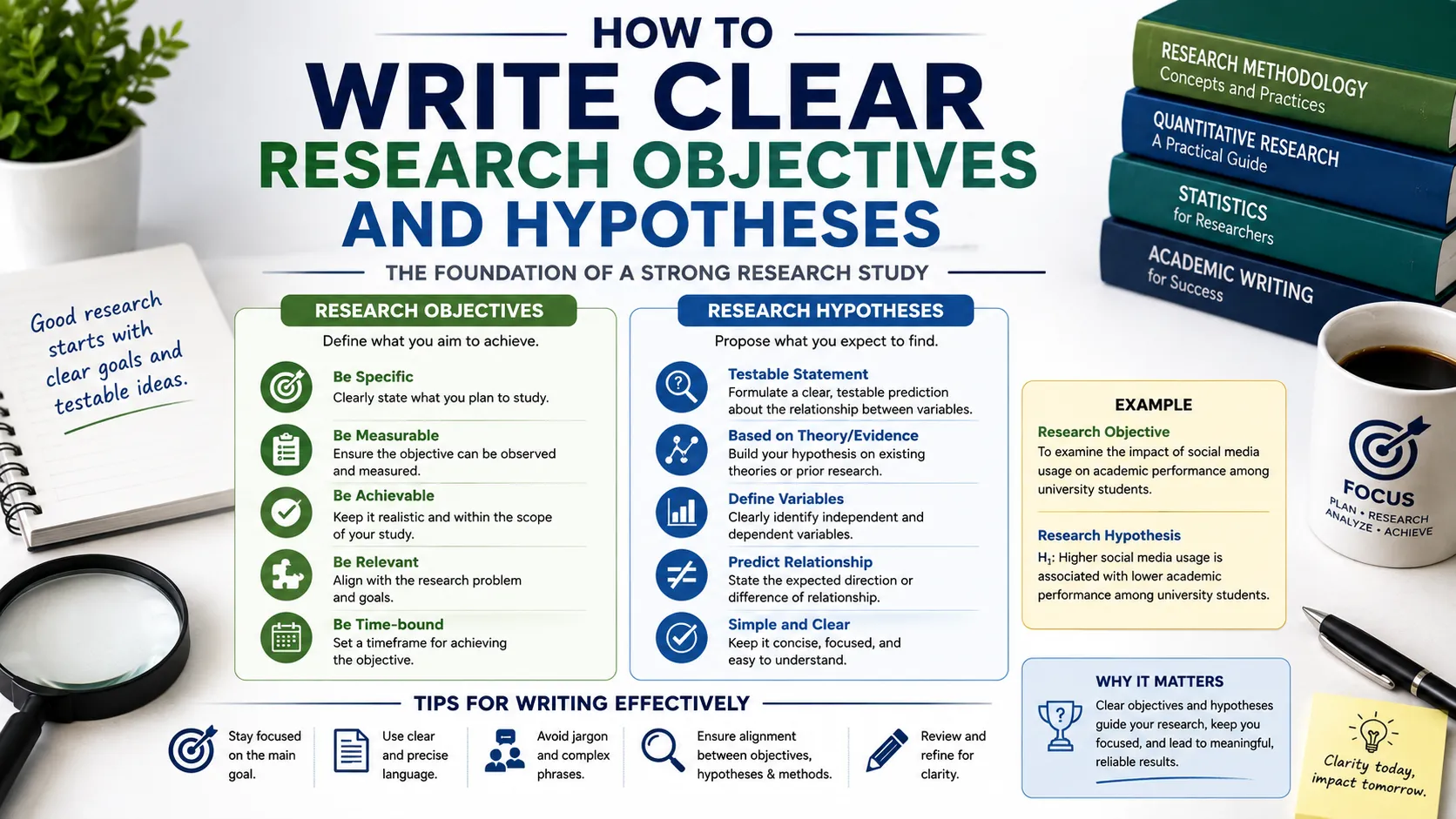
Before working on clarity at the sentence level, it's worth being precise about which of these three things you're actually writing, since confusing them is one of the most common mistakes in academic writing and it shows up immediately in weak phrasing. A research objective states what the study will do — it's action-oriented and describes an intended outcome: "To assess the relationship between remote work flexibility and employee productivity." A research question asks what the study wants to find out, framing the inquiry without stating an expected result: "How does remote work flexibility relate to employee productivity?" A hypothesis predicts the expected outcome and is typically used in quantitative research: "Remote work flexibility is positively associated with employee productivity."
Each of these calls for a different sentence structure and a different verb choice, and writing clearly here starts with knowing which one you're actually producing before you start drafting the sentence.
Why Sentence-Level Precision Matters Here Specifically
Nearly every other section of a thesis has room for some stylistic variation and narrative flexibility — your literature review can build an argument gradually, your discussion can explore implications at some length. Your objectives and hypotheses don't have that same room. This is the section where your reader — a supervisor, an examiner, eventually a journal reviewer — needs to know exactly, unambiguously, what you're claiming and what you intend to do about it. Vague phrasing here doesn't just read poorly; it creates real downstream confusion about what your methodology should be measuring and what your findings are actually supposed to confirm or refute.
This is also, not coincidentally, one of the most heavily scrutinized sections of any thesis draft, precisely because its clarity (or lack of it) is so immediately visible to a reader in a way that's harder to hide behind confident-sounding prose.
The Verbs That Signal a Strong Objective
The single most important word in any research objective is its main verb, and some verbs are considerably more precise — and more defensible — than others. Strong, standard objective verbs include to examine, to assess, to evaluate, to compare, to identify, and to determine — each of these commits you to a specific kind of analytical action a reader can picture. Weaker, vaguer verbs like to study, to look at, to explore the issue of, or to understand more about sound academic but commit to nothing concrete — a reader finishing the sentence still doesn't know what you'll actually do with your data.
Compare: "To study employee engagement in remote work settings" versus "To assess the relationship between remote work flexibility and employee engagement among mid-level managers." The second sentence, built around a precise verb and specific variables, tells the reader exactly what will be measured and how; the first could describe almost any research design imaginable.
Writing Hypotheses With Genuine Predictive Precision
A hypothesis needs to commit to a specific, testable claim — which means avoiding hedging language that quietly undermines the prediction it's supposed to be making. Phrases like "might be related to," "could potentially influence," or "may have some effect on" read as cautious, but they actually weaken the hypothesis by making it unfalsifiable in any meaningful sense — a claim that something "might" happen can't really be confirmed or refuted by data in the same clean way a direct prediction can.
A strong hypothesis states its predicted relationship directly: "Perceived organizational support is positively associated with employee organizational citizenship behaviour," not "Perceived organizational support may possibly be linked in some way to employee organizational citizenship behaviour." If your literature review genuinely doesn't support predicting a specific direction, it's more honest and more precise to state that directly ("this study tests whether a relationship exists between X and Y, given mixed findings in prior research") than to hedge a directional claim you don't actually have strong grounds for.
The APA Principle of Quantified, Unhedged Language
Academic writing style guidance is consistent on this point: scientific and scholarly writing should avoid unquantified adverbs — words like "really," "very," "surprisingly," "quite," or "significantly" (used in its everyday sense rather than its precise statistical meaning) — because they add emotional or intensifying color without adding measurable information. "Employee engagement was significantly higher" reads as precise but is actually vague unless "significantly" refers to an actual statistical test; "employee engagement was notably higher" is even less precise, since "notably" has no defined threshold at all.
This same principle extends to avoiding overstated causal or definitive claims your evidence doesn't actually support — academic writing conventions distinguish carefully between "proving" something (a claim research essentially never gets to make) and providing or failing to find supporting evidence for it. Writing "this study proves that X causes Y" is a stronger claim than almost any single study can actually support; "this study provides evidence that X is associated with Y" is both more accurate and, properly understood, no less rigorous or confident.
Making Objectives and Hypotheses Flow From Your Literature
One of the clearest markers of strong academic writing in this section is that the objectives and hypotheses feel like an inevitable conclusion to what's been presented beforehand, not a list dropped in without connective tissue. A reader finishing your literature review and problem statement should reach your objectives and think, in effect, "of course — given everything just discussed, this is exactly what the study needs to investigate next."
Achieving this in your writing means explicitly connecting each objective or hypothesis back to a specific gap, contradiction, or unresolved question you've already established in your preceding text — rather than introducing objectives that, however individually well-written, don't obviously follow from the argument you've built so far. A useful check: could a reader guess most of your objectives just from reading your problem statement and literature review closely, before actually reaching the objectives section? If the connection is that clear, your writing is doing its job.
Tense, Voice, and Structural Conventions
Research objectives are conventionally written in the infinitive form ("to examine," "to assess") rather than as a future-tense statement ("this study will examine") — both are grammatically acceptable and used across different style traditions, but consistency matters more than which specific convention you choose, so pick one and apply it uniformly across every objective rather than mixing forms. Hypotheses are typically written as present-tense declarative statements about the relationship being predicted ("X is positively associated with Y"), since you're stating a proposition to be tested, not describing an action you'll perform.
Academic style guidance also generally favors keeping each objective and hypothesis to a single, clear sentence — resist the temptation to pack multiple relationships or qualifications into one long, compound sentence, since doing so almost always reduces clarity even when every individual clause is technically accurate.
Formatting Multiple Objectives and Hypotheses
When a thesis includes more than one or two objectives or hypotheses, standard academic convention is to present them as a numbered list rather than folding them into continuous prose paragraphs — this isn't just a formatting preference, it genuinely improves clarity by letting a reader see the full structure of your research intent at a glance, and it makes it considerably easier for you to later trace each finding back to a specific, numbered claim in your discussion chapter.
Keep the phrasing parallel across the full list — if your first objective begins "To assess..." and your second begins "To examine...", don't switch your third to "Understanding how..." without a deliberate reason, since inconsistent grammatical structure across a numbered list reads as careless even when each individual item is well-written on its own.
Revising for Clarity: A Practical Process
A reliable way to sharpen this section during revision: read each objective and hypothesis in isolation, without the surrounding paragraph, and ask whether a reader unfamiliar with your specific study could understand exactly what you mean. If a sentence needs its surrounding context to make sense, it likely isn't precise enough on its own. Next, check every verb against the strong-verb list covered earlier, replacing any vague verb you find. Then check for hedging language in your hypotheses specifically, tightening any phrase that softens a prediction without good reason. Finally, read the full set — objectives together, then hypotheses together — checking for consistent grammatical structure and confirming each one traces logically back to something already established earlier in your thesis.
This kind of dedicated, isolated revision pass — reading this section on its own, separate from your general read-through of the whole chapter — consistently catches clarity problems that get missed when you're reading the section only as part of a longer continuous text.
Before-and-After Examples
Weak objective: "To look at how digital transformation affects companies." Clearer version: "To assess the relationship between digital transformation maturity and organizational agility among mid-sized Indian manufacturing firms."
Weak hypothesis: "There might possibly be some connection between employee autonomy and job satisfaction." Clearer version: "H1: Employee autonomy is positively associated with job satisfaction."
Weak, overstated claim: "This study proves that leadership style significantly determines organizational performance." Clearer, more defensible version: "This study provides evidence that leadership style is associated with organizational performance outcomes."
In each pair, the clearer version isn't simply shorter or more formal-sounding — it commits to something specific, testable, and appropriately confident given what a single study can actually establish.
Real Thesis Examples
Example 1 — Revising vague objectives into precise ones.
A scholar's initial draft included the objective "to study leadership in Indian organizations," which her supervisor flagged as too vague to guide any specific methodology. Working through a revision pass focused specifically on verb choice and specificity, she rewrote it as "to assess the relationship between servant leadership behaviour and employee innovative work behaviour among mid-level managers in Indian manufacturing firms" — a single sentence that now clearly specified the leadership style, the outcome variable, the population, and the sector, giving her methodology chapter an unambiguous target to design around.
Example 2 — Removing hedging from a hypothesis.
A scholar's early hypothesis draft read "employee autonomy might be somewhat connected to job satisfaction, depending on various factors." Her writing group flagged the hedging as undermining the entire point of stating a hypothesis. She revised it to a direct, testable claim: "H1: Employee autonomy is positively associated with job satisfaction among knowledge workers in Indian technology firms," moving the acknowledgment of moderating factors into a separate, explicitly stated moderating hypothesis rather than folding uncertainty into the core prediction itself.
Common Writing Mistakes in This Section
- Using vague verbs ("to study," "to look at," "to explore") that don't commit to a specific analytical action.
- Hedging hypotheses with uncommitted language ("might," "could possibly," "may potentially") that weakens their testability.
- Overstating claims with words like "proves" or "confirms" that a single study's evidence typically can't support.
- Using unquantified intensifying adverbs ("significantly," "notably," "considerably") without an actual statistical or defined threshold backing the claim.
- Writing objectives and hypotheses in isolation from the literature review, so they don't read as a logical conclusion to the argument already built.
- Inconsistent grammatical structure across a numbered list of objectives or hypotheses, mixing infinitive and future-tense forms without reason.
- Packing multiple relationships into a single long sentence, reducing clarity even when the underlying content is accurate.
- Confusing objectives, questions, and hypotheses, using hypothesis-style predictive language for what's actually an exploratory research question, or vice versa.
Clarity Checklist
Before finalizing your objectives and hypotheses section, check it against this list:
- Each item is clearly identified as an objective, research question, or hypothesis, not blurred between categories
- Every objective opens with a precise, committing verb (assess, examine, evaluate, compare, identify, determine)
- Every hypothesis states a specific, testable, unhedged prediction
- No unquantified intensifying adverbs appear without a defined statistical or evidentiary basis
- No claim uses "proves" or equivalent overstated language where "provides evidence for" would be more accurate
- Each objective or hypothesis reads as a logical continuation of the preceding literature review and problem statement
- Grammatical structure (infinitive form, tense, sentence pattern) is consistent across the full numbered list
- Each sentence is understandable in isolation, without requiring its surrounding paragraph for clarity
For guidance on the closely related skill of representing source material accurately while writing this and other sections, see our related guide, [how to paraphrase research sources without losing meaning]. And for the broader grammatical precision this section depends on, see [common grammar mistakes that weaken a thesis draft].
How Long Does It Take to Complete a Thesis Using This Approach?
Revising objectives and hypotheses specifically for sentence-level clarity typically takes a few focused hours once the underlying research design is already settled — the work here is almost entirely about precision in wording rather than new conceptual development. Scholars who build this clarity in from the first draft, rather than treating it as a late-stage polish, generally find their methodology and findings chapters easier to write, since a precisely worded objective or hypothesis gives every later chapter something specific and unambiguous to build around.
Is Professional Help Available to Write Clear Research Objectives and Hypotheses?
Yes — many scholars work with academic mentors or research consultancies specifically to sharpen the sentence-level clarity of their objectives and hypotheses, catching vague verbs, unnecessary hedging, and overstated claims before a supervisor or examiner does. ThesisLikho's PhD-qualified research experts have supported thesis writers through exactly this kind of precision editing, helping ensure every objective and hypothesis is both academically rigorous and genuinely clear to read — all while keeping the underlying research and ideas entirely your own. Explore ThesisLikho's thesis writing services for one-on-one guidance.
FAQs
How do you write clear research objectives and hypotheses?
Use precise, committing verbs for objectives (assess, examine, evaluate) rather than vague ones (study, look at); write hypotheses as direct, testable predictions without hedging language; avoid unquantified intensifying adverbs and overstated causal claims; and make sure each item flows logically from your preceding literature review.
How long does it take to complete a thesis using this approach?
Sharpening this section for clarity typically takes a few focused hours once your research design is settled, since the work is primarily about precise wording rather than new conceptual development.
Is professional help available to write clear research objectives and hypotheses?
Yes. Research consultancies and academic mentors, including ThesisLikho's PhD-qualified experts, help scholars refine the clarity and precision of this section while preserving full ownership of the underlying research and ideas.
Why should I write clear research objectives and hypotheses carefully?
Because this section is one of the most heavily scrutinized parts of any thesis, and vague or hedged wording creates real downstream confusion about what your methodology should measure and what your findings are meant to confirm — clarity here isn't just stylistic, it shapes how defensible your entire thesis is.
When should you write clear research objectives and hypotheses for a thesis?
Draft them as soon as your research problem and literature review are substantially developed, then revise them specifically for sentence-level clarity as a dedicated pass — not folded into a general read-through — before finalizing your methodology chapter, since your methodology should be designed around precisely worded objectives, not the other way around.
Ready to sharpen your objectives and hypotheses into precise, defensible statements?
Talk to a Thesis Expert → https://thesislikho.com/writing-services/thesis-writing
Email: support@thesislikho.com
Mobile No.: +91-9289068414 , +91-9643802216