
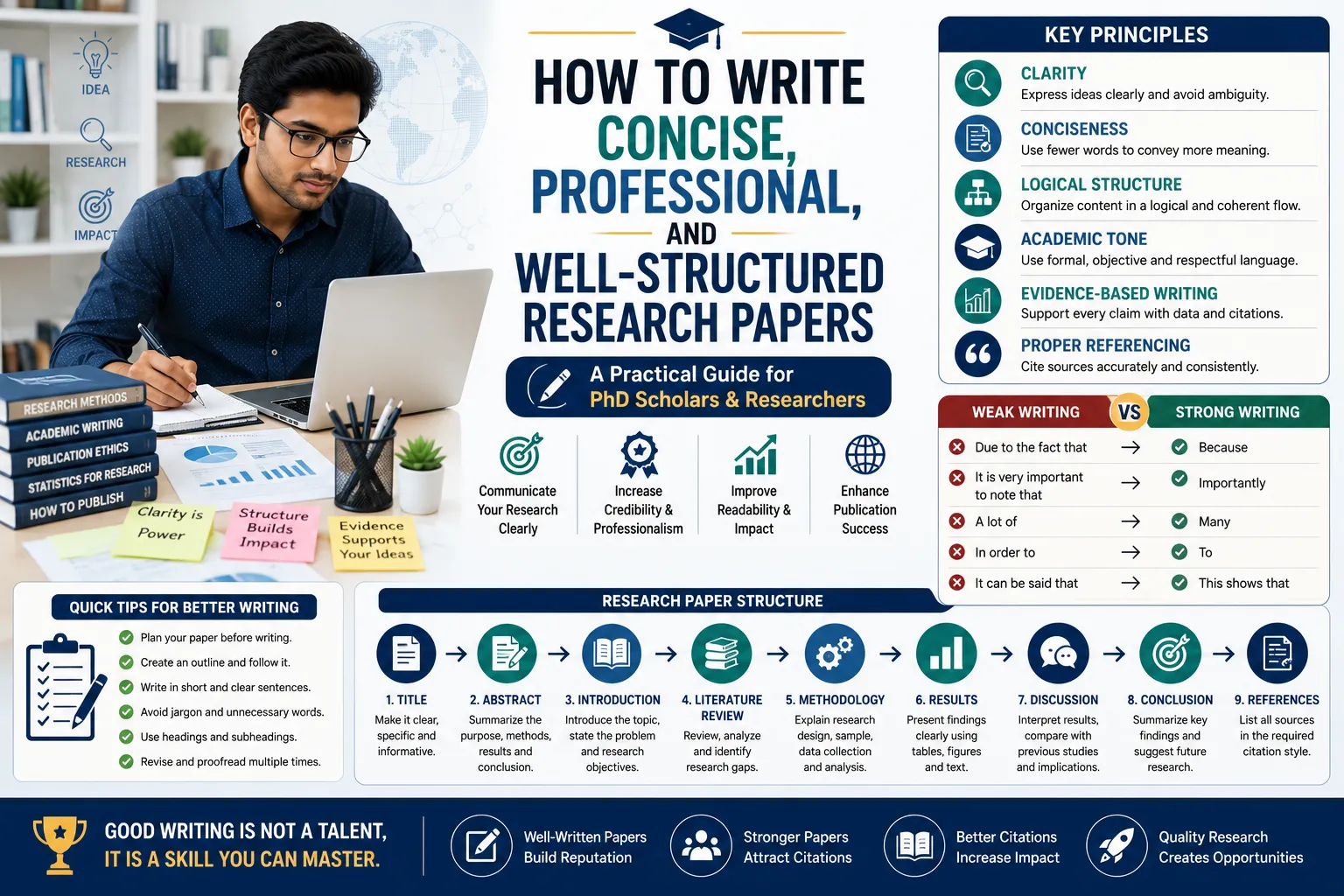
Introduction
Writing a research paper is one of the most important academic responsibilities for university students, researchers, and scholars. Whether you are preparing a Master's assignment, a PhD thesis chapter, a conference paper, or a manuscript for a peer-reviewed journal, the quality of your writing significantly influences how your research is received. Even groundbreaking research can lose its impact if it is presented in a confusing, poorly organized, or unnecessarily lengthy manner.
Many students believe that academic writing should be filled with complicated vocabulary, lengthy paragraphs, and technical jargon. However, experienced supervisors, journal editors, and reviewers often value clarity, precision, and logical organization over complexity. A well-written research paper is not one that sounds difficult—it is one that communicates complex ideas in a clear, professional, and evidence-based manner.
Concise writing does not mean leaving out important details. Instead, it means eliminating unnecessary words, avoiding repetition, and ensuring that every sentence contributes to your research objectives. Professional writing requires an objective tone, proper citation practices, and adherence to academic standards. A well-structured paper guides readers naturally from the research problem to the methodology, findings, discussion, and conclusions without causing confusion.
This comprehensive guide explains how to write concise, professional, and well-structured research papers that meet university expectations and increase the likelihood of publication in reputable academic journals.
Why Good Research Writing Matters
A research paper is more than a document—it is the primary means by which scholars communicate knowledge. Strong writing allows readers to understand your ideas, evaluate your evidence, and build upon your work.
Well-written research papers offer several benefits:
- Improve readability and reader engagement.
- Increase the credibility of your research.
- Help supervisors and examiners assess your work more effectively.
- Enhance the chances of publication in peer-reviewed journals.
- Reduce the need for extensive revisions.
- Strengthen your academic and professional reputation.
Ultimately, good writing ensures that your research has the impact it deserves.
Characteristics of an Effective Research Paper
High-quality research papers share several defining characteristics.
They are:
- Clear and easy to understand.
- Logically organized.
- Concise without sacrificing important information.
- Supported by credible evidence.
- Objective and unbiased.
- Properly referenced.
- Free from grammatical and formatting errors.
- Focused on answering the research question.
Keeping these principles in mind throughout the writing process leads to stronger academic work.
Step 1: Understand the Purpose of Your Research Paper
Before writing, clearly define the purpose of your paper.
Ask yourself:
- What research problem am I addressing?
- What question am I trying to answer?
- Why is this study important?
- What contribution does my research make?
Having a clear purpose helps you stay focused and prevents unnecessary content from entering your paper.
Step 2: Create a Detailed Outline
A strong outline serves as a roadmap for your writing.
Typical sections include:
- Title
- Abstract
- Introduction
- Literature Review
- Methodology
- Results
- Discussion
- Conclusion
- References
- Appendices (if required)
Under each heading, list the main points you intend to discuss. This planning stage improves logical flow and reduces the risk of overlooking important information.
Step 3: Write a Strong Introduction
The introduction is your opportunity to capture the reader's attention and establish the significance of your study.
An effective introduction should:
- Introduce the research topic.
- Provide background information.
- Identify the research gap.
- State the research problem.
- Present the research objectives or questions.
- Briefly describe the structure of the paper.
Avoid providing excessive detail. Save in-depth discussions for later sections.
Step 4: Conduct a Critical Literature Review
A literature review should do more than summarize previous studies.
It should:
- Compare existing research.
- Identify strengths and weaknesses.
- Highlight gaps in knowledge.
- Explain how your study addresses those gaps.
Organize the literature thematically or chronologically rather than discussing studies one by one without connections.
Critical analysis demonstrates your understanding of the field and positions your research within existing scholarship.
Step 5: Describe Your Methodology Clearly
Readers should understand exactly how your research was conducted.
Include information about:
- Research design
- Target population
- Sampling method
- Sample size
- Data collection techniques
- Research instruments
- Reliability and validity
- Ethical considerations
- Data analysis methods
Write with enough detail for another researcher to replicate your study if necessary.
Step 6: Present Results Objectively
The results section should report findings without interpretation.
Present data using:
- Tables
- Figures
- Charts
- Graphs
- Summary statistics
Describe the key findings clearly, but avoid discussing their meaning until the discussion section.
Every table and figure should have a clear title and be referenced within the text.
Step 7: Write a Thoughtful Discussion
The discussion section explains the significance of your findings.
Address questions such as:
- What do the results mean?
- How do they compare with previous studies?
- Do they support your hypotheses?
- What are the practical implications?
- What limitations should readers consider?
Interpret your findings honestly and avoid overstating their importance.
Step 8: End with a Strong Conclusion
A conclusion should not simply repeat earlier sections.
Instead, it should:
- Summarize the main findings.
- Explain how the research answered the objectives.
- Highlight the study's contribution.
- Discuss practical implications.
- Suggest areas for future research.
Leave readers with a clear understanding of why your study matters.
Write Concisely Without Losing Meaning
Concise writing improves readability.
Eliminate Redundant Words
Instead of:
"Due to the fact that"
Write:
"Because."
Instead of:
"In order to"
Write:
"To."
Instead of:
"At this point in time"
Write:
"Now."
Every unnecessary word increases the reader's effort.
Avoid Repetition
Repeating the same ideas or phrases weakens your writing.
Review each paragraph and ask:
- Have I already explained this?
- Can two similar sentences be combined?
- Does this paragraph contribute new information?
Removing repetition strengthens your argument.
Keep Sentences Focused
Each sentence should communicate one primary idea.
Long sentences often contain multiple arguments, making them difficult to follow.
Breaking them into shorter sentences improves clarity.
Maintain a Professional Academic Tone
Professional writing is:
- Objective
- Respectful
- Evidence-based
- Neutral
- Formal
Avoid:
- Emotional language
- Personal opinions without evidence
- Informal expressions
- Slang
- Conversational phrases
Instead of writing:
"This amazing result proves..."
Write:
"The findings suggest..."
Professional language enhances credibility.
Use Evidence Effectively
Every major claim should be supported with credible evidence.
Reliable sources include:
- Peer-reviewed journal articles
- Academic books
- Government publications
- Official reports
- Conference proceedings
- Reputable institutional data
Avoid relying on unsupported opinions or outdated sources unless historically relevant.
Improve Paragraph Structure
Each paragraph should contain:
Topic Sentence
Introduces the main idea.
Supporting Evidence
Provides data or references.
Analysis
Explains why the evidence matters.
Transition
Links to the next paragraph.
This structure improves coherence and readability.
Use Clear Transitions
Transition words help readers follow your reasoning.
Examples include:
For addition:
- Furthermore
- Moreover
- In addition
For contrast:
- However
- Nevertheless
For cause and effect:
- Therefore
- Consequently
For examples:
- For instance
- Specifically
Smooth transitions make research papers easier to read.
Use Tables and Figures Wisely
Visual elements should clarify information—not replace explanations.
Best practices include:
- Number all tables and figures.
- Use descriptive titles.
- Explain key findings within the text.
- Avoid overcrowded visuals.
- Ensure consistency in formatting.
Every visual should have a clear purpose.
Avoid Common Academic Writing Mistakes
Many research papers are weakened by avoidable errors.
Examples include:
- Long, confusing sentences
- Poor organization
- Weak thesis statements
- Unsupported claims
- Inconsistent terminology
- Grammar mistakes
- Incorrect citations
- Overuse of passive voice
- Excessive jargon
- Lack of critical analysis
Recognizing these issues early improves the quality of your paper.
Edit in Multiple Stages
Professional writing requires careful revision.
Suggested editing stages include:
First Review
Check overall structure.
Second Review
Improve clarity and logical flow.
Third Review
Correct grammar and punctuation.
Fourth Review
Verify citations and references.
Final Review
Proofread formatting, headings, tables, and page numbering.
Editing in stages is more effective than trying to fix everything at once.
Useful Writing Habits for Researchers
Developing consistent writing habits leads to long-term improvement.
Consider the following practices:
- Write a little every day instead of waiting for large blocks of time.
- Set realistic word-count goals.
- Keep a document for ideas and references.
- Revise previous sections regularly.
- Read published research papers to observe effective writing styles.
- Seek feedback from supervisors and peers.
- Maintain a checklist for grammar, structure, and citations.
Small, consistent improvements often produce better results than last-minute writing sessions.
Research Paper Writing Checklist
Before submitting your paper, ask yourself:
- Does the title accurately reflect the study?
- Is the abstract concise and informative?
- Does the introduction clearly define the research problem?
- Have I critically reviewed relevant literature?
- Is the methodology described clearly?
- Are the results presented objectively?
- Does the discussion interpret findings appropriately?
- Is the conclusion meaningful and supported by the evidence?
- Have I cited every source correctly?
- Have I proofread for grammar, spelling, formatting, and consistency?
Using a checklist reduces the likelihood of overlooking important details.
Final Tips for Publishing-Ready Research Papers
If you intend to submit your paper to a journal, consider these additional recommendations:
- Read the journal's author guidelines before writing.
- Follow the required formatting and citation style.
- Use current and relevant references.
- Ensure your paper has a clear contribution to the field.
- Avoid plagiarism by paraphrasing appropriately and citing all sources.
- Ask a colleague or supervisor to review the manuscript before submission.
- Be prepared to revise your paper based on reviewer feedback.
A polished manuscript demonstrates professionalism and improves your chances of acceptance.
Conclusion
Writing a concise, professional, and well-structured research paper is not about using complex language or impressing readers with technical vocabulary. It is about communicating your research in a way that is clear, logical, evidence-based, and easy to follow. The strongest research papers guide readers through every stage of the study—from the research problem and methodology to the findings and conclusions—without unnecessary complexity or confusion.
By planning your paper carefully, creating a clear outline, writing focused paragraphs, supporting every claim with credible evidence, maintaining an objective academic tone, and editing thoroughly, you can significantly improve the quality of your work. Remember that concise writing does not mean omitting important information; it means presenting essential information as clearly and efficiently as possible.
Whether you are writing a Master's dissertation, a PhD thesis chapter, a conference paper, or a manuscript for publication, these principles will help you produce research papers that are professional, engaging, and academically rigorous. Over time, consistent practice and thoughtful revision will strengthen your writing skills, allowing your research to reach a wider audience and make a lasting contribution to your field.
Call / WhatsApp: +91 96438 02216
Website:www.ThesisLikho.com