
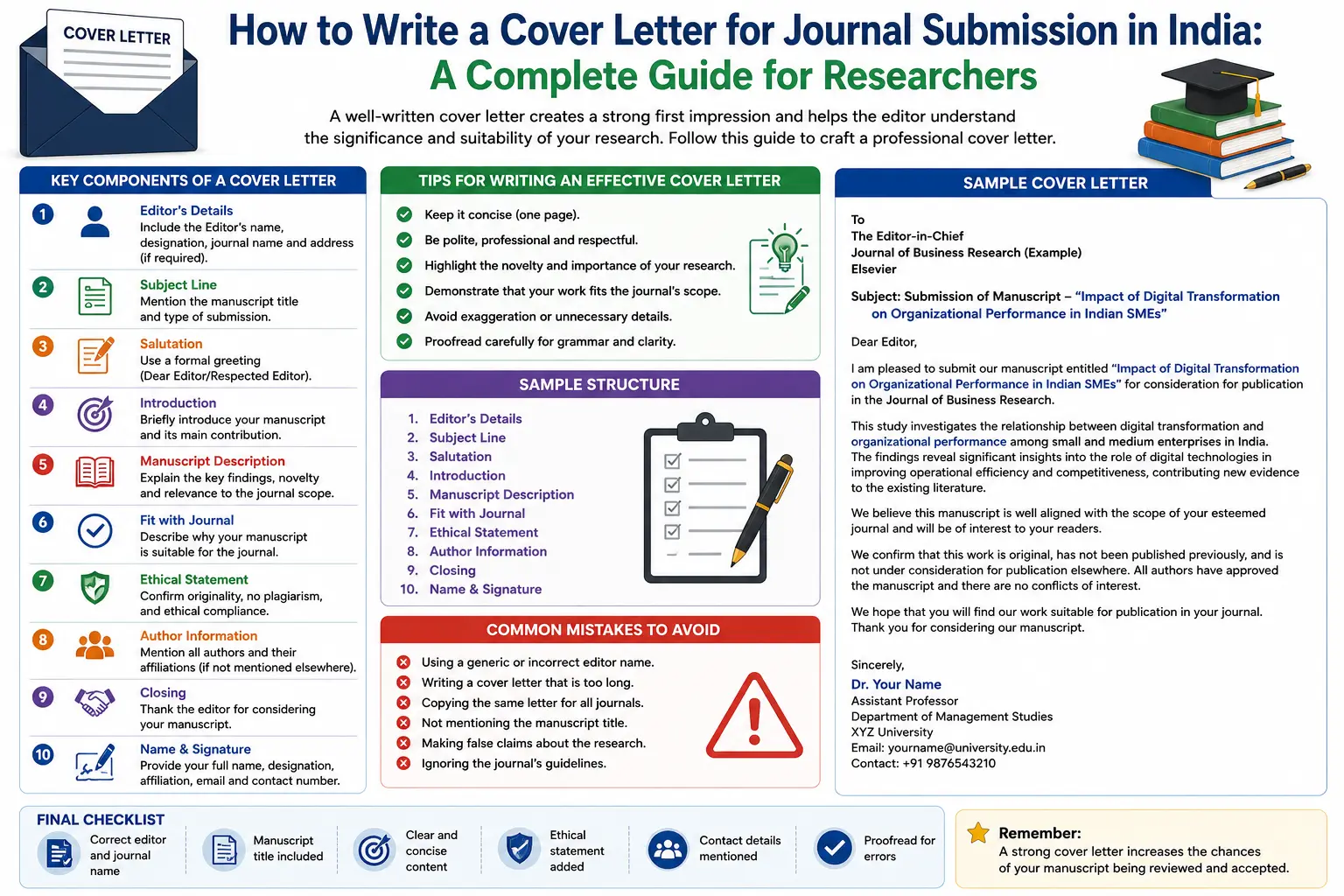
Publishing research in academic journals is an important achievement for researchers, PhD scholars, faculty members, and postgraduate students. While significant attention is usually given to preparing the manuscript, many authors overlook one critical document that can influence the editor's first impression—the cover letter.
A well-written cover letter serves as your manuscript's introduction to the journal editor. It explains the significance of your research, demonstrates why the paper is suitable for the journal, and highlights important information that may support the editorial decision.
For researchers in India, especially those submitting to Scopus-indexed, UGC CARE-listed, Web of Science, or international journals, understanding how to write an effective cover letter can improve the professionalism of the submission package and increase the likelihood of a positive editorial response.
In this comprehensive guide, we will explain everything you need to know about writing a cover letter for journal submission in India, including its purpose, structure, format, best practices, common mistakes, and sample templates.
What Is a Cover Letter for Journal Submission?
A cover letter is a formal document submitted alongside a research manuscript when applying for publication in an academic journal.
The letter is addressed to the journal editor and provides:
- An introduction to the manuscript
- The purpose of the research
- The novelty of the study
- Confirmation of originality
- Disclosure of conflicts of interest
- Information about ethical approvals (if applicable)
Think of it as a professional pitch explaining why your paper deserves consideration.
Why Is a Cover Letter Important?
Many authors assume editors focus only on the manuscript.
However, editors often read the cover letter before examining the paper.
A strong cover letter helps:
Create a Positive First Impression
Editors receive hundreds of submissions every month.
A concise and professional cover letter immediately signals seriousness and professionalism.
Highlight Research Significance
The cover letter provides an opportunity to explain:
- Why the study matters
- What research gap it addresses
- Why readers will find it valuable
Demonstrate Journal Fit
Editors want manuscripts that align with their journal's aims and scope.
A cover letter can explain why your research is suitable for the journal.
Confirm Ethical Compliance
The letter allows authors to confirm:
- Originality of the work
- Absence of duplicate submissions
- Ethical approvals
- Conflict of interest declarations
Is a Cover Letter Mandatory?
The answer depends on the journal.
Many international journals require a cover letter during submission.
Examples include journals published by:
- Elsevier
- Springer Nature
- Wiley
- Taylor & Francis
- SAGE Publishing
Even when optional, submitting a cover letter is considered good academic practice.
Who Should Write the Cover Letter?
Typically, the corresponding author writes and submits the cover letter on behalf of all co-authors.
The corresponding author should ensure that:
- All authors approve the submission.
- The manuscript is complete.
- The information provided is accurate.
Key Elements of a Journal Submission Cover Letter
An effective cover letter contains several important components.
Let's examine each section.
1. Date and Editor Information
Begin with:
- Date
- Editor's name
- Journal name
Example:
22 June 2026
Editor-in-Chief
Journal of Business Research
If the editor's name is unavailable, use:
Dear Editor-in-Chief,
or
Dear Editorial Team,
2. Opening Salutation
Use a professional greeting such as:
Dear Editor,
or
Dear Editor-in-Chief,
Avoid casual greetings like:
- Hello Editor
- Hi Sir/Madam
Professional language is essential.
3. Mention the Manuscript Title
Immediately introduce the manuscript.
Example:
I am pleased to submit our manuscript entitled "Artificial Intelligence Adoption in Indian SMEs: Opportunities and Challenges" for consideration for publication in the Journal of Business Research.
This informs the editor exactly what is being submitted.
4. Explain the Purpose of the Study
Provide a concise summary of the research.
Answer questions such as:
- What problem does the study address?
- Why is it important?
- What was investigated?
Example:
This study examines the factors influencing artificial intelligence adoption among small and medium-sized enterprises in India and evaluates its impact on operational efficiency and business growth.
Keep this section brief.
5. Highlight the Novelty of the Research
Editors want original contributions.
Clearly explain:
- What makes the study unique?
- What new knowledge does it provide?
Example:
To the best of our knowledge, this is among the first empirical studies examining AI adoption challenges across multiple industry sectors within the Indian SME ecosystem.
Novelty is often a deciding factor in publication decisions.
6. Explain Why the Journal Is Appropriate
This is one of the most overlooked sections.
Show that you understand the journal's focus.
Example:
We believe this manuscript aligns well with the journal's emphasis on emerging business technologies, innovation management, and organizational transformation.
Editors appreciate authors who carefully select journals.
7. Confirm Originality
Editors need assurance that the work is original.
Example:
We confirm that this manuscript is original, has not been published previously, and is not currently under consideration by any other journal.
This statement is extremely important.
8. Declare Conflicts of Interest
Transparency is essential.
Example:
The authors declare that there are no conflicts of interest related to this research.
If conflicts exist, disclose them honestly.
9. Mention Ethical Approval (If Applicable)
For studies involving:
- Human participants
- Surveys
- Interviews
- Clinical research
Include ethical approval information.
Example:
Ethical approval was obtained from the Institutional Ethics Committee of XYZ University prior to data collection.
10. Closing Statement
Thank the editor.
Example:
Thank you for considering our manuscript for publication. We appreciate your time and look forward to your response.
11. Author Information
Include:
- Corresponding author name
- Institution
- Department
- Email address
- Contact number
This helps editors communicate efficiently.
Ideal Length of a Journal Cover Letter
One of the most common questions among Indian researchers is:
"How long should the cover letter be?"
The ideal length is:
- 250–500 words
- One page
- Three to five paragraphs
Editors prefer concise communication.
Avoid writing a detailed research proposal.
Standard Cover Letter Format
A typical structure looks like:
Introduction
Introduce manuscript and journal.
Research Significance
Explain study purpose and findings.
Journal Relevance
Describe alignment with journal scope.
Compliance Statements
Declare originality, ethics, and conflicts.
Closing
Thank the editor and provide contact details.
Sample Cover Letter for Journal Submission
Date: 22 June 2026
Dear Editor,
I am pleased to submit our manuscript entitled "The Impact of Artificial Intelligence on Business Decision-Making in Indian SMEs" for consideration for publication in your journal.
This study investigates how artificial intelligence technologies are transforming decision-making processes within small and medium-sized enterprises across India. The findings provide valuable insights into adoption barriers, implementation strategies, and performance outcomes.
We believe this manuscript is highly relevant to the journal because it contributes to current discussions on technology management, innovation, and business transformation. The study offers practical implications for researchers, policymakers, and business leaders.
We confirm that this manuscript is original, has not been published previously, and is not under consideration by any other journal. All authors have approved the submission and have no conflicts of interest to declare. Ethical approval was obtained where required.
Thank you for considering our manuscript. We appreciate your time and look forward to your response.
Sincerely,
[Author Name]
[Institution]
[Department]
[Email Address]
You can customize this template according to your discipline and journal requirements.
Common Mistakes to Avoid
Many manuscripts are weakened by poorly written cover letters.
Avoid these mistakes.
Writing an Overly Long Letter
Editors do not want to read multiple pages.
Keep the message concise and focused.
Repeating the Entire Abstract
The cover letter should summarize the study, not duplicate the abstract.
Highlight only key points.
Using Generic Statements
Avoid vague claims such as:
"This study is very important."
Instead explain specifically why it is important.
Ignoring Journal Scope
Never submit a generic cover letter to every journal.
Customize each letter.
Editors can easily identify copied templates.
Making Exaggerated Claims
Avoid statements like:
- Revolutionary research
- Groundbreaking discovery
- Unmatched contribution
Let the research speak for itself.
Grammatical Errors
Poor grammar creates a negative first impression.
Always proofread before submission.
Cover Letter Tips for Indian Researchers
Researchers in India often submit to:
- Scopus-indexed journals
- UGC CARE journals
- Web of Science journals
- International publishers
To improve success rates:
Research the Journal
Read:
- Aims and scope
- Recent articles
- Submission guidelines
Mention Local Relevance
If your study addresses Indian issues, explain its broader significance.
Example:
The findings contribute to understanding digital transformation challenges in emerging economies.
This increases international relevance.
Follow International Standards
Use professional and formal language.
Avoid unnecessary praise of the journal.
Editors prefer factual communication.
Can AI Help Write a Cover Letter?
Yes, AI tools can assist researchers by:
- Improving grammar
- Refining language
- Creating drafts
- Enhancing clarity
However:
- Authors must verify accuracy.
- Personalization is essential.
- Ethical declarations should be reviewed carefully.
Never submit an AI-generated letter without editing.
Checklist Before Submitting Your Cover Letter
Before submission, ensure:
Manuscript title included
Journal name mentioned
Research significance explained
Novelty highlighted
Journal fit described
Originality statement included
Conflict of interest declaration added
Ethical approval information provided
✅ Professional tone maintained
✅ Author details included
Conclusion
A cover letter may seem like a small part of the journal submission process, but it plays an important role in shaping an editor's first impression of your research. A well-crafted cover letter introduces your manuscript professionally, highlights its significance, demonstrates its fit with the journal, and assures the editor that ethical and publication standards have been met.
For researchers in India aiming to publish in Scopus-indexed, UGC CARE, Web of Science, or international journals, mastering the art of writing an effective cover letter is a valuable skill. By keeping the letter concise, customized, professional, and focused on the manuscript's contribution, authors can strengthen their submission package and improve their chances of progressing successfully through the editorial and peer-review process.
Remember, while the manuscript showcases your research, the cover letter is your opportunity to personally introduce that research to the editor. Make it clear, compelling, and professional.
Contact ThesisLikho Today
Call / WhatsApp: +91 96438 02216
Visit: ThesisLikho.com