
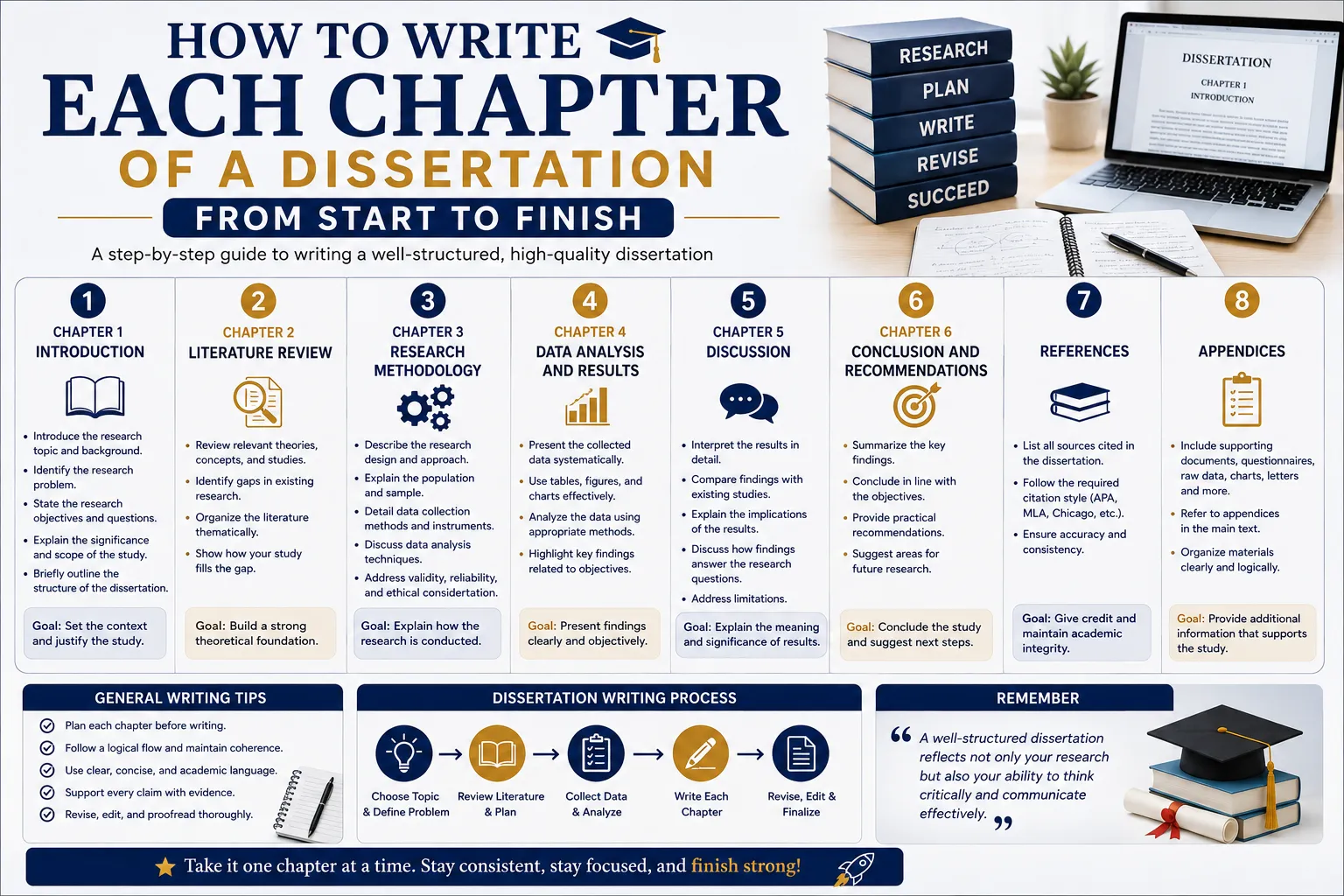
Here's the piece of advice almost nobody gives a first-time dissertation writer, and it would save most of them months of frustration: don't write your dissertation in the order it will eventually be read. Scholars who open a blank document and start typing "Chapter 1: Introduction" on day one are setting themselves up to rewrite that chapter completely once the actual research reveals what the study turned out to be about.
This guide walks through how to write each chapter of a dissertation from start to finish the way an experienced research supervisor would — not just what goes in each chapter, but the order that actually works, chapter by chapter, and the specific traps that stall most first-time writers at each stage. If you're a first-time dissertation writer without a strong research background, this is written specifically for you.
At ThesisLikho, our PhD-qualified mentors have guided more than 10,000 scholars through dissertation writing from proposal to final defense across disciplines. What follows draws on that mentoring experience, checked against established academic writing guidance on dissertation structure and chapter sequencing.
1. The Order You Should Actually Write In
The single most useful piece of practical advice in this entire guide is one most scholars never hear until they're already stuck: write your methodology and results chapters first, while the research process is still fresh in your memory, then move to your literature review and discussion, and write your introduction and conclusion last. The abstract comes dead last, after everything else is finished, since it needs to accurately summarize a completed document rather than a document you're still hoping to write.
This ordering feels counterintuitive at first, because a finished dissertation reads front to back — introduction, then literature review, then methodology, and so on. But the writing process and the reading process don't need to match, and forcing them to match is exactly what causes so many scholars to write an introduction chapter early, only to discover months later that it no longer accurately frames the study they actually ended up conducting. Your introduction needs to introduce research that already exists in some concrete form; writing it first means introducing research you haven't actually finished thinking through yet.
Think of it this way: a reader needs the dissertation presented in a logical, front-loaded order because they're encountering your research for the first time and need context before detail. You, as the writer, don't have that same constraint — you already know where the research is headed, or you're actively discovering it as you go. Writing in the order that matches your own actual knowledge and access to detail, rather than the order a stranger would need to read it in, is simply the more efficient path, and it's the sequence experienced supervisors consistently recommend for exactly this reason.
2. The Standard Chapter Structure (and When It Varies)
The five-chapter model — Introduction, Literature Review, Methodology, Results, and Discussion/Conclusion — is the most widely used dissertation structure across disciplines internationally, with each chapter mapping onto a distinct stage of the underlying research process: what you're asking and why, what's already known, how you'll investigate it, what you found, and what it means.
Real dissertations vary from this baseline in fairly predictable, discipline-driven ways. Sciences and STEM fields sometimes use a separate "Materials and Methods" chapter, or combine Discussion and Conclusion into a single chapter. Humanities dissertations often move away from a single "Results" chapter entirely, adopting a more thematic structure with multiple analytical chapters instead. Social sciences tend to follow the standard five-chapter model most closely. Always check your specific university's format guidelines before assuming any of these variants applies to you — the structure below is the reliable default, not a rigid universal requirement.
Word count expectations for each chapter also vary meaningfully by degree level and country, so treat any generic proportional guidance as a starting point rather than a fixed rule. What matters more than hitting a specific length is proportional balance — a literature review that's disproportionately short relative to a thin discussion chapter, for instance, often signals that the connective work between existing research and your own findings hasn't been fully developed yet, regardless of what the raw word counts happen to be.
3. Writing the Methodology Chapter
Start here, genuinely, not just because supervisors recommend it but because the reasoning is sound: your methodology is easiest to write accurately while you're still executing your research design, not months afterward when specific procedural details have faded.
Cover your overall research approach and design, your population and sampling strategy, your data collection instrument and procedure, and your analysis plan — each explicitly justified against your specific research questions rather than simply described. This chapter is consistently identified as one of the hardest for students specifically because it requires justifying every decision to committee standard, not just describing what you did. Write it in enough procedural detail that another researcher could genuinely replicate your approach, and draft it as you're actually collecting data, updating it as your real procedure inevitably diverges slightly from your original plan — a far more accurate approach than trying to reconstruct exact procedural details from memory later.
4. Writing the Results Chapter
Write your results chapter next, immediately after or even alongside your methodology chapter, while your data and your analysis process are still fresh. This chapter should present your findings clearly and objectively — organized either by research question or by theme, depending on what makes your specific findings easiest to follow — without yet interpreting what they mean; that interpretive work belongs in your discussion chapter, and mixing the two together is one of the most common structural weaknesses in first drafts.
Use tables, figures, and clear prose to present your findings, and resist the urge to over-narrate every statistic or interview excerpt — a results chapter should let the data speak plainly, with just enough surrounding text to orient the reader to what they're looking at and why it's organized that way. Writing this chapter early, while you still remember exactly why certain results were unexpected or which specific test produced which specific output, saves you from having to painstakingly reconstruct that context later.
5. Writing the Literature Review Chapter
Move to your literature review after methodology and results are drafted, even though you likely started reading literature long before this point in your actual research process. The writing itself benefits from coming after your other technical chapters, because by now you know precisely which gap your study actually filled — which means you can organize your literature review specifically to build toward that exact gap, rather than writing a more generic survey of the field and hoping it connects.
Organize this chapter thematically rather than as a chronological list of studies — group related work around key themes, debates, or variables relevant to your research questions, synthesizing across sources rather than summarizing them one after another. Every heading and subheading in this chapter should link directly back to your research questions; a literature review section that doesn't clearly serve that connection is either misplaced or unnecessary. Close the chapter by explicitly stating the specific gap your study addresses, setting up the methodology and results chapters that (in the final reading order) follow it.
6. Writing the Discussion Chapter
The discussion chapter is where most first-time writers underestimate the difficulty, since it requires more than describing what your methodology and results chapters already established — it requires building an original argument connecting your findings to prior literature, not just summarizing what you found a second time in different words.
Structure your discussion around your research questions, in the same order you used in your results chapter — this creates a clean, easy-to-follow line of accountability from question to finding to interpretation that a committee can trace without effort. For each finding, address explicitly: what did you find, how does it relate to existing literature (does it confirm, contradict, or extend prior work), and what does it actually mean for your field or your stated research problem. This is also the natural place to discuss your study's limitations honestly, and to distinguish clearly between findings your data genuinely supports and any broader speculation you're offering beyond what the data itself demonstrates.
7. Writing the Introduction Chapter
Write your introduction only after your literature review, methodology, results, and discussion are all in solid draft form — this is the chapter that most directly benefits from the "write it last, read it first" principle. An introduction written before you've actually conducted your research is, at best, a reasonable guess at what the study will turn out to be about; an introduction written afterward can accurately frame the actual research problem, actual objectives, and actual significance of a study you've now genuinely completed.
A strong introduction presents your topic, your specific research problem, your objectives and research questions, and the rationale for why the study matters — setting up the reading order that follows (literature review, then methodology, then results, then discussion) even though you wrote all of those chapters first. It's genuinely fine, and often useful, to draft a rough working introduction early in your process purely to guide your own thinking — just plan to substantially rewrite it once the rest of the dissertation is actually finished, rather than treating that early draft as final.
8. Writing the Conclusion Chapter
Your conclusion chapter, like your introduction, is written near the end, and the two should feel like bookends — your introduction opens with the research question, your conclusion closes by directly answering it. Summarize your key findings concisely, restate your study's original contribution clearly, and connect back explicitly to the significance you established in your introduction.
This is also the appropriate place for recommendations and future research directions, distinct from the limitations discussion that belongs earlier in your discussion chapter. Keep this chapter focused and relatively brief relative to your core chapters — its job is to close the argument cleanly, not to introduce substantial new analysis or evidence that should have appeared earlier in the document. End with a clear, memorable statement of why the work matters, since this is often the last substantive content a reader (or examiner) encounters before your reference list.
9. Writing the Abstract
Write your abstract absolutely last, after every other chapter is complete — typically a concise 150 to 300 word summary covering your research problem, methodology, key findings, and conclusions. Since its entire job is accurately summarizing a finished document, writing it any earlier means summarizing work that doesn't fully exist yet, which is exactly why abstracts written prematurely so often need substantial revision once the actual dissertation is complete and sometimes turned out differently than originally planned.
10. Keeping Every Chapter Connected to Your Research Questions
Regardless of which chapter you're writing or when you write it, one discipline matters throughout: everything in your dissertation should trace back to your core research questions. Your introduction states them; your literature review shows what's already known about them; your methodology explains how you investigated them; your results present what you found in relation to them; your discussion interprets what those findings mean; and your conclusion directly answers them. This is the underlying logic that makes a dissertation read as one coherent argument rather than several loosely related chapters bundled together.
A practical check worth running once a full draft exists: read through every chapter heading and subheading and confirm each one links clearly back to a specific research question or objective. Content that doesn't pass this check is either misplaced in the wrong chapter or genuinely unnecessary to the document — and cutting it, however good the writing itself might be, usually strengthens the dissertation as a whole.
This same connective thread is worth checking at the sentence level too, not just the heading level, especially in your longer chapters. A literature review section, for instance, might contain several different segments — each covering a distinct theme or body of work — and each of those segments benefits from its own clear sub-heading, ideally closing with a short linking sentence that ties it back to your specific research gap before moving to the next segment. This kind of explicit signposting throughout a chapter, rather than only at its opening and closing paragraphs, is what makes a long, dense chapter genuinely easy for a reader or examiner to follow rather than something they have to work to hold together themselves.
11. Common Mistakes First-Time Dissertation Writers Make
- Writing chapters in reading order rather than a more effective working order, leading to an introduction and abstract that no longer accurately describe the finished research, requiring substantial rewrites.
- Mixing results and interpretation together, presenting findings and their meaning in the same chapter rather than keeping objective presentation (results) separate from interpretive argument (discussion).
- Treating the literature review as a summary rather than a synthesis, listing studies one after another instead of organizing them thematically around the gap the dissertation actually addresses.
- Underestimating the discussion chapter's difficulty, treating it as a restatement of results rather than the chapter requiring genuine original argument-building.
- Drafting the abstract too early, before the rest of the dissertation is genuinely finished, requiring it to be substantially rewritten later anyway.
- Letting chapters drift from the research questions, adding content that's interesting but doesn't actually serve the specific questions the dissertation set out to answer.
- Ignoring discipline-specific structural variations, forcing a rigid five-chapter model onto research (particularly in the humanities) that's better served by a more thematic structure, without checking what the specific department or university actually expects.
12. Two Realistic Case Studies
Case Study 1 — Avoiding a Costly Introduction Rewrite A dissertation scholar wrote a full introduction chapter early, before beginning data collection, describing anticipated objectives and expected significance in detail. Partway through data collection, the actual findings shifted the study's focus in a genuinely important way the original introduction hadn't anticipated. Because the scholar had followed the recommended writing order for every other chapter — methodology and results first, introduction near the end — only the already-flagged, intentionally rough working introduction needed substantial revision, rather than a completed, polished chapter requiring a difficult, morale-sapping rewrite under deadline pressure.
Case Study 2 — Fixing a Discussion Chapter That Read Like a Second Results Section
A first-time dissertation writer's initial discussion chapter draft largely repeated the results chapter's findings in slightly different wording, without genuinely connecting them back to the literature review or building an original argument about what they meant. On feedback, the scholar restructured the chapter explicitly around each research question in turn — for each one, stating the specific finding, comparing it directly to what specific prior studies had found, and explicitly stating what the comparison revealed. This restructuring, without changing the underlying findings at all, transformed the chapter from a repetitive summary into the kind of original, examiner-satisfying interpretive argument the discussion chapter is actually meant to provide.
If you're working through your own dissertation chapter by chapter, our Dissertation Writing service can help you sequence your writing effectively and strengthen each chapter as you go.
FAQs
How do I write each chapter of a dissertation from start to finish?
Write your methodology and results chapters first while the research is fresh, then your literature review and discussion, and finally your introduction and conclusion, with the abstract written last of all — this working order differs from the final reading order and produces chapters that accurately reflect the research you actually conducted rather than what you initially expected to conduct.
Why should I write each chapter of a dissertation from start to finish in this particular order?
Because writing chapters in their final reading order — introduction first — means describing and framing research before you've fully conducted or understood it, which typically requires substantial, time-consuming rewrites once the actual study is complete and may have shifted from its original plan.
When should you write each chapter of a dissertation from start to finish, relative to your data collection?
Begin your methodology chapter as you're actively executing your research design, write your results chapter as soon as your analysis is complete, and save your introduction, discussion, conclusion, and abstract for after the technical core of your dissertation is already in solid draft form.
How long does it take to complete a dissertation using this approach?
Timelines vary considerably by discipline and scope, but writing in an effective working order — rather than a strict reading order — typically saves meaningful time overall by avoiding the substantial rewrites that come from framing chapters before the underlying research is genuinely finished.
Is professional help available to write each chapter of a dissertation from start to finish?
Yes — support with sequencing your writing process effectively and strengthening each chapter, from methodology through to your final abstract, is available through services such as Dissertation Writing.
Ready to write a dissertation that reads as one coherent argument, chapter by chapter? Get Dissertation Help Now from ThesisLikho's PhD-qualified mentors.
Email: support@thesislikho.com
Mobile No.: +91-9289068414 , +91-9643802216