
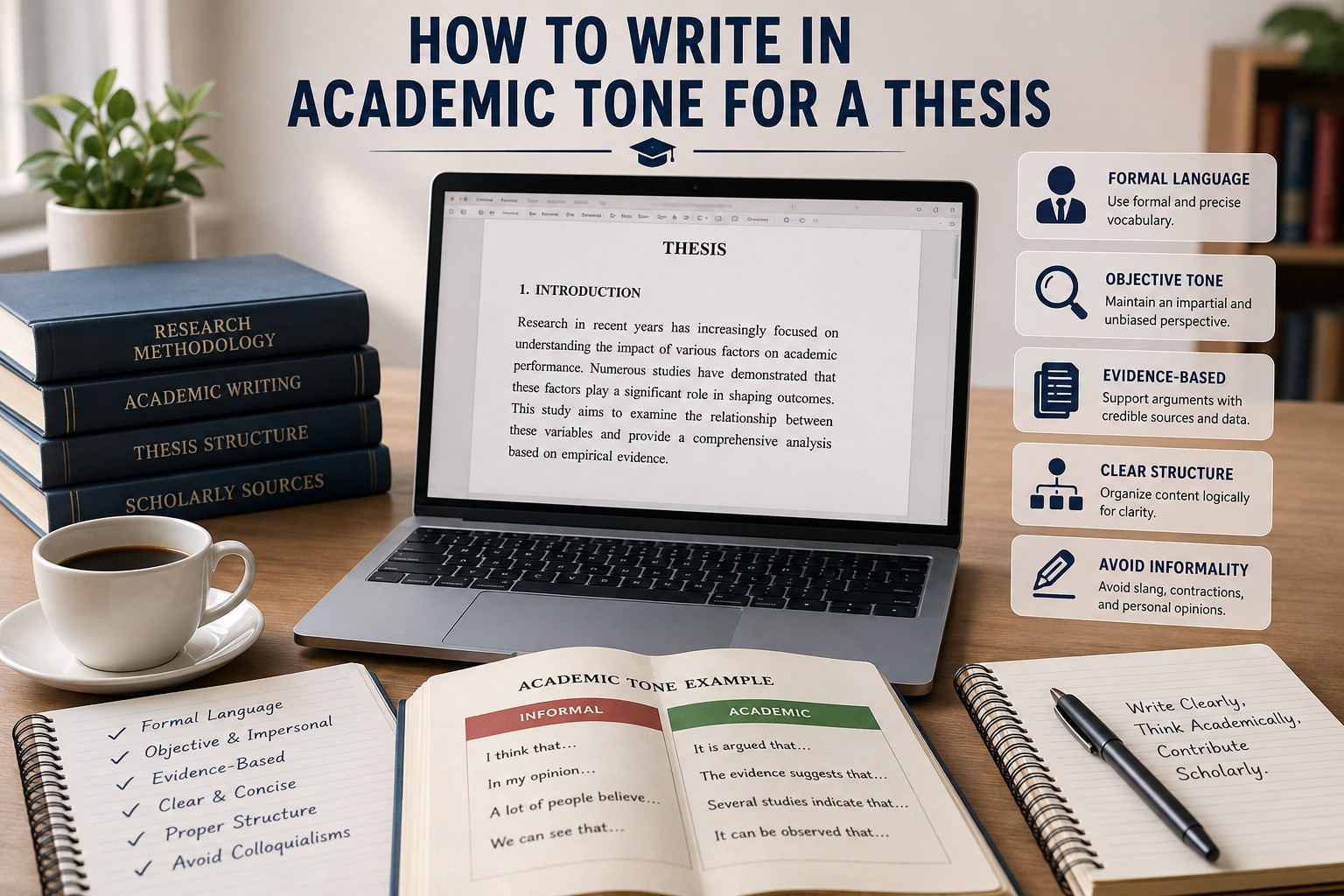
If you've been told your thesis draft "doesn't sound academic enough" without a clear explanation of what that actually means, you're facing one of the more frustratingly vague pieces of feedback in the entire thesis writing process. How to write in academic tone for a thesis isn't really about sounding impressive or reaching for complicated vocabulary — it's a specific, learnable set of conventions around formality, hedging, and word choice that this guide breaks down concretely, with real examples of what to change and why.
This guide is written for first-time thesis writers in India who want to understand exactly what "academic tone" means in practice, not just be told to have more of it.
What Academic Tone Actually Means
Academic tone is characterized by formality, objectivity, clarity, and precise word choice — presenting evidence-based statements with measured, appropriately calibrated confidence rather than personal opinion or casual assertion. It's worth being clear about what this doesn't mean: academic tone isn't the same as unnecessarily complex vocabulary or convoluted sentence structure. Reaching for an inflated word when a simpler, precise one does the same job is actually its own tone failure — described in writing guidance as "too pretentious" — and reads as trying too hard rather than as genuinely authoritative.
ThesisLikho's PhD-qualified mentors, who've guided over 10,000 scholars through thesis writing, consistently see the same pattern: scholars who've been told their writing "isn't academic enough" often respond by adding longer words and more complicated sentences, when the actual fix usually involves something more specific — better hedging, consistent formality, and precise rather than inflated word choice.
Hedging: The Single Most Important Academic-Tone Skill
Hedging means using appropriately cautious language to avoid overclaiming beyond what your actual evidence supports. Instead of writing "this proves that X causes Y," academic tone calls for language like "this suggests that X may contribute to Y," or "the evidence indicates a relationship between X and Y." This isn't weakness or a lack of confidence — it's a specific mark of methodological maturity, since very few individual studies genuinely "prove" anything in an absolute sense, and overclaiming beyond what your data supports is exactly the kind of overreach an examiner is trained to catch.
Common hedging phrases worth having genuinely available in your own writing vocabulary include "may," "appears to," "suggests," "the evidence indicates," "it is possible that," and "this could be attributed to." The skill isn't simply inserting these phrases everywhere — over-hedging every single sentence, including ones where your evidence genuinely is strong, makes even well-supported claims sound uncertain and can read as a lack of confidence in your own findings. The real skill is calibration: match your hedging language's strength to how much evidence actually supports each specific claim, using stronger, more direct language for well-established findings and more cautious language for tentative or exploratory ones.
A practical way to check your own calibration: for each significant claim in your results or discussion chapter, ask yourself honestly how confident your specific evidence actually makes you. A finding backed by a large, representative sample and a statistically robust test can reasonably be stated with more direct language ("the data show," "this indicates") than a finding drawn from a small, exploratory sample or a single case study, which calls for more explicitly tentative framing ("this suggests," "these findings may indicate"). Mismatching your hedging strength to your actual evidence strength — either direction — is a subtle but real credibility issue an attentive examiner will notice.
Contractions and Colloquial Language
Contractions — "don't," "can't," "it's," "shouldn't," "won't" — are avoided throughout formal academic writing, with their full forms used instead ("do not," "cannot," "it is," "should not," "will not"). This is one of the more mechanical, easy-to-fix elements of academic tone, and running a simple search through your draft for common contractions is a genuinely efficient way to catch and correct this pattern before submission.
Casual intensifiers and vague colloquial phrases should similarly be replaced with more precise, formal alternatives. "A lot" becomes "substantial" or "considerable." "Stuff" becomes a specific, named term for whatever you're actually referring to. "Basically" and "kind of" are generally cut entirely, since precise academic writing states things directly rather than softening them with vague hedging words that aren't doing genuine evidentiary work. This distinction matters: casual hedges like "kind of" and "basically" are different from the genuine evidentiary hedging covered above — one softens a claim without adding real information, the other calibrates a claim's strength to actual evidence.
The First-Person Question: More Nuanced Than You've Been Told
This deserves specific, careful attention, since it's one of the most commonly misunderstood aspects of academic tone. Many scholars have absorbed a blanket rule that academic writing must always avoid "I" and "we" — but this isn't actually accurate. Formal academic tone and first-person pronoun use are genuinely compatible; they are not opposites. You can write in a fully formal, scholarly register and still use "I" or "we" where appropriate.
Whether first person is the right choice depends on several genuine factors. Your discipline's convention matters significantly: humanities and qualitative social science research increasingly accept, and sometimes actively prefer, first person for interpretive statements, since acknowledging your own analytical voice is considered part of genuine scholarly contribution in these fields. STEM fields more commonly favor an impersonal, passive-voice-heavy style, though this convention is genuinely shifting somewhat even there. Your authorship situation matters too: for a solo-authored thesis, "I" is appropriate where you're describing a decision or interpretation that's specifically yours; for sections describing genuinely collaborative work (with your supervisor or co-researchers), "we" is the more accurate choice. And your specific institution or supervisor's stated preference should always take priority over any generic online guidance, including this one — some departments have explicit, specific conventions worth confirming directly before you finalize your own approach.
The genuinely useful rule to take away: don't default to blanket avoidance of "I" out of a vague sense that it's "unacademic." Instead, check your specific discipline's convention, your authorship situation, and your department's preference, and use first person deliberately and consistently where it's appropriate, rather than either avoiding it entirely by habit or using it inconsistently without a clear rationale.
One practical distinction worth carrying into your own writing: even in disciplines and sections where first person is appropriate, it works best for statements about your own decisions, interpretations, or procedures — "I selected this sampling approach because," "I interpret this pattern as reflecting" — rather than as a substitute for evidence-based claims about your findings themselves. Writing "I found that X causes Y" isn't inherently wrong, but "the data indicate that X predicts Y" often reads as more precise, since it's the evidence making the claim rather than simply your personal observation of it. Used this way, first person and evidence-led language work together rather than competing with each other.
How Academic Tone Varies by Discipline
Beyond the first-person question specifically, broader tone expectations shift meaningfully by field. STEM fields tend toward more impersonal, passive-voice-heavy writing, with precise, unambiguous technical terminology treated as more important than stylistic variety. Social sciences generally balance objectivity with genuine engagement with human context and factors, and voice conventions vary more by specific sub-field, journal, or institution than in STEM. Humanities increasingly value an interpretive authorial voice, with first person genuinely welcomed as part of demonstrating original critical engagement rather than treated as a lapse in formality. Business and other applied fields tend to balance formality with readability, given how often this research is meant to reach a practically oriented audience beyond purely academic readers.
Knowing your own field's specific convention — by checking recently completed, successfully examined theses from your own department — is more reliable than applying a single, generic academic-tone rule uniformly across every discipline.
Precise Word Choice Over Impressive Vocabulary
A genuine, common misconception: that academic tone means reaching for the most complex or unusual word available. In practice, precise, simple verbs are generally preferred over inflated alternatives when the simpler word accomplishes the same thing — "showed," "found," and "demonstrated" over showier alternatives that add length and apparent sophistication without adding genuine clarity or precision. The actual goal of academic word choice is precision and appropriate specificity, not impressiveness for its own sake.
This matters practically because reaching for unnecessarily complex vocabulary often backfires, producing writing that's harder to follow and reads as insecure about its own substance rather than confident and authoritative. Choose the word that most precisely and accurately conveys your actual meaning, and only reach for more specialized or technical terminology when your field's actual conventions call for it, defining any genuinely necessary technical term clearly the first time you use it.
Transitions and Connectives That Signal Formal Register
The connecting words between your sentences and ideas contribute meaningfully to overall tone, often more than writers realize. Casual connectives — starting a sentence with "but," or overusing "and" to string ideas together — read as less formal than academic alternatives like "however," "although," "nevertheless," "in addition," and "moreover." This isn't a rigid, absolute rule (occasional casual connectives don't ruin an otherwise formal piece), but consistently favoring more formal transitional language throughout your thesis contributes real, cumulative weight to your overall tone.
Equally important: your transitions should genuinely connect ideas logically, not just insert a formal-sounding word between unrelated sentences. A formal connective used where the logical relationship it signals doesn't actually hold (using "therefore" where your second point doesn't genuinely follow from your first) is a more serious problem than an occasionally casual transition, since it signals confused reasoning rather than just informal style.
Objectivity: Evidence-Led, Not Opinion-Led
Academic tone requires presenting claims as grounded in evidence and reasoning rather than personal opinion or feeling. This means favoring language like "research demonstrates" or "the data suggest" over "I think" or "I feel," except in contexts — like a methodology chapter explaining your own specific design decisions, or, in disciplines where it's genuinely conventional, a reflective or interpretive discussion section — where describing your own reasoning directly and explicitly is actually the more accurate and appropriate choice.
This objectivity principle also means avoiding emotive or unsupported declarative language — describing a finding as "surprising" or "unfortunate" without evidence-based justification for that characterization, or making sweeping claims that go beyond what your specific study can actually support. Academic writing appeals to a reader's reasoning through evidence, not to their emotions through loaded language.
The Eight Weak-Tone Patterns to Check Your Draft Against
A genuinely useful, concrete list of the recurring tone failures worth specifically checking your own draft against: writing that's too casual (slang, contractions, informal phrasing); writing that's too pretentious (unnecessarily complex vocabulary without genuine need); inconsistent tone (shifting registers within the same piece, formal in one paragraph and casual in the next); writing that's too personal (emphasizing personal experience over evidence outside appropriate contexts); weak or absent hedging (overclaiming beyond what evidence supports); the opposite problem of excessive hedging (undermining even well-supported claims with unnecessary qualification); vague language lacking precision; and jargon overload (excessive specialized vocabulary without adequate explanation for a reasonably informed but non-specialist academic reader).
Running your own draft against this specific list, section by section, is a genuinely efficient self-editing technique — far more actionable than a vague instruction to simply "sound more academic."
Before-and-After: Rewriting a Casual Passage Into Academic Tone
A first-draft passage might read: "A lot of people think procrastination is just laziness, but it's not really that simple. I think it's usually more about anxiety." This passage has several of the weak-tone patterns covered above: a vague colloquialism ("a lot of people"), a contraction ("it's"), a casual sentence-starting "but," and an unsupported personal opinion ("I think") presented without evidence.
A revised, academically toned version: "Procrastination is commonly attributed to laziness; however, research suggests it often stems from underlying anxiety rather than a simple lack of motivation." Notice what changed: "a lot of people think" became "commonly attributed to" (precise, evidence-oriented framing rather than a vague crowd reference); "but" became "however" (formal connective); the contraction was removed; and "I think" became "research suggests" (evidence-led rather than opinion-led, while still appropriately hedged with "suggests" rather than overclaiming). The underlying idea is identical — only the tone genuinely changed.
A Practical Self-Editing Process
Once your thesis chapters are drafted, run a dedicated tone-editing pass separate from your content-editing pass, since trying to fix both simultaneously often means tone issues get missed. Search your document for common contractions and casual colloquialisms ("a lot," "stuff," "basically," "kind of") and replace each one with a precise, formal alternative. Check your hedging calibration — for your strongest, best-supported claims, confirm you're not over-hedging them into apparent uncertainty; for your more exploratory or tentative claims, confirm you're not overclaiming beyond what your evidence actually supports. Confirm your first-person usage, if any, is consistent with your discipline's convention and your specific authorship situation, applied deliberately rather than inconsistently. And read a few paragraphs aloud — casual tone often becomes more obvious when heard rather than only read silently on the page.
Common Mistakes When Adjusting Academic Tone
- Assuming academic tone means avoiding first person entirely, rather than checking your specific discipline's actual convention
- Overcorrecting toward unnecessarily complex vocabulary, producing writing that's harder to follow rather than more authoritative
- Over-hedging every single sentence until even well-supported claims sound uncertain
- Leaving casual connectives and vague colloquialisms unaddressed simply because they're easy to overlook during a content-focused edit
- Applying a uniform tone standard without checking how your own specific field's conventions genuinely differ from a generic, one-size-fits-all academic-writing rule
- Treating tone editing as a final, rushed pass rather than a dedicated stage deserving its own focused attention
Academic Tone Checklist
Before finalizing your thesis chapters, confirm the following:
- Contractions have been searched for and removed throughout, replaced with their full forms
- Hedging language is calibrated to your actual evidence strength — neither overclaiming nor over-qualifying every claim
- Casual colloquialisms and vague intensifiers have been replaced with precise, formal alternatives
- Your first-person usage (if any) is deliberate, consistent, and matched to your specific discipline's convention and authorship situation
- Word choice favors precision over unnecessarily complex vocabulary chosen purely to sound impressive
- Transitional language favors formal connectives ("however," "although," "moreover") over casual ones, while genuinely reflecting the logical relationship between ideas
- Claims are presented as evidence-led ("research suggests," "the data indicate") rather than opinion-led ("I think," "I feel"), except where your specific discipline and context genuinely call for direct first-person reasoning
How Long Does This Take to Develop?
Consciously adjusting your writing to consistently reflect strong academic tone typically takes real, deliberate practice over several weeks rather than a single editing pass — most scholars need to write with active attention to these specific patterns across at least a full chapter or two before the adjustments start becoming more natural and automatic. For an already-completed draft, a dedicated tone-editing pass across a full thesis typically takes one to two weeks, done as its own distinct stage separate from content or structural revision.
If you'd like expert feedback on your thesis's current tone, or guidance developing a stronger academic voice for your specific discipline, you can explore our Thesis Writing service, where our PhD-qualified mentors help scholars refine their writing to a genuinely examiner-ready academic register.
FAQs
How do you write in academic tone for a thesis?
Focus on appropriately calibrated hedging language, avoid contractions and casual colloquialisms, choose precise rather than unnecessarily complex vocabulary, and present claims as evidence-led rather than opinion-led. First-person use is genuinely compatible with formal academic tone, depending on your specific discipline's convention and authorship situation.
Why should I write in academic tone for a thesis carefully rather than just writing naturally?
Academic tone signals methodological maturity and credibility to examiners, and its absence — overclaiming, casual phrasing, inconsistent register — can make genuinely strong research read as less rigorous than it actually is. A thesis is also typically archived as a permanent academic record, evaluated by a formal committee, making consistent formal register throughout genuinely important.
When should you write in academic tone for a thesis?
From your very first draft, ideally, though most scholars find it more efficient to draft content first and run a dedicated tone-editing pass afterward, since trying to perfect tone and content simultaneously on a first draft often slows both down.
How long does it take to complete a thesis using this approach?
Developing consistent academic tone as a writing habit typically takes several weeks of deliberate practice across at least a full chapter or two. A dedicated tone-editing pass on an already-completed draft typically takes one to two weeks for a full thesis.
Is professional help available for writing in academic tone for a thesis?
Yes. Many scholars work with experienced thesis mentors to refine their academic tone, calibrate hedging language appropriately, and match their writing style to their specific discipline's conventions — this is exactly the kind of support ThesisLikho's PhD-qualified mentors provide.
Talk to a Thesis Expert: If you'd like feedback on your thesis's current tone or help developing a stronger academic voice, ThesisLikho's PhD-qualified mentors can help you refine your writing to an examiner-ready standard. Explore our Thesis Writing Service →
Email: support@thesislikho.com
Mobile No.: +91-9289068414 , +91-9643802216