
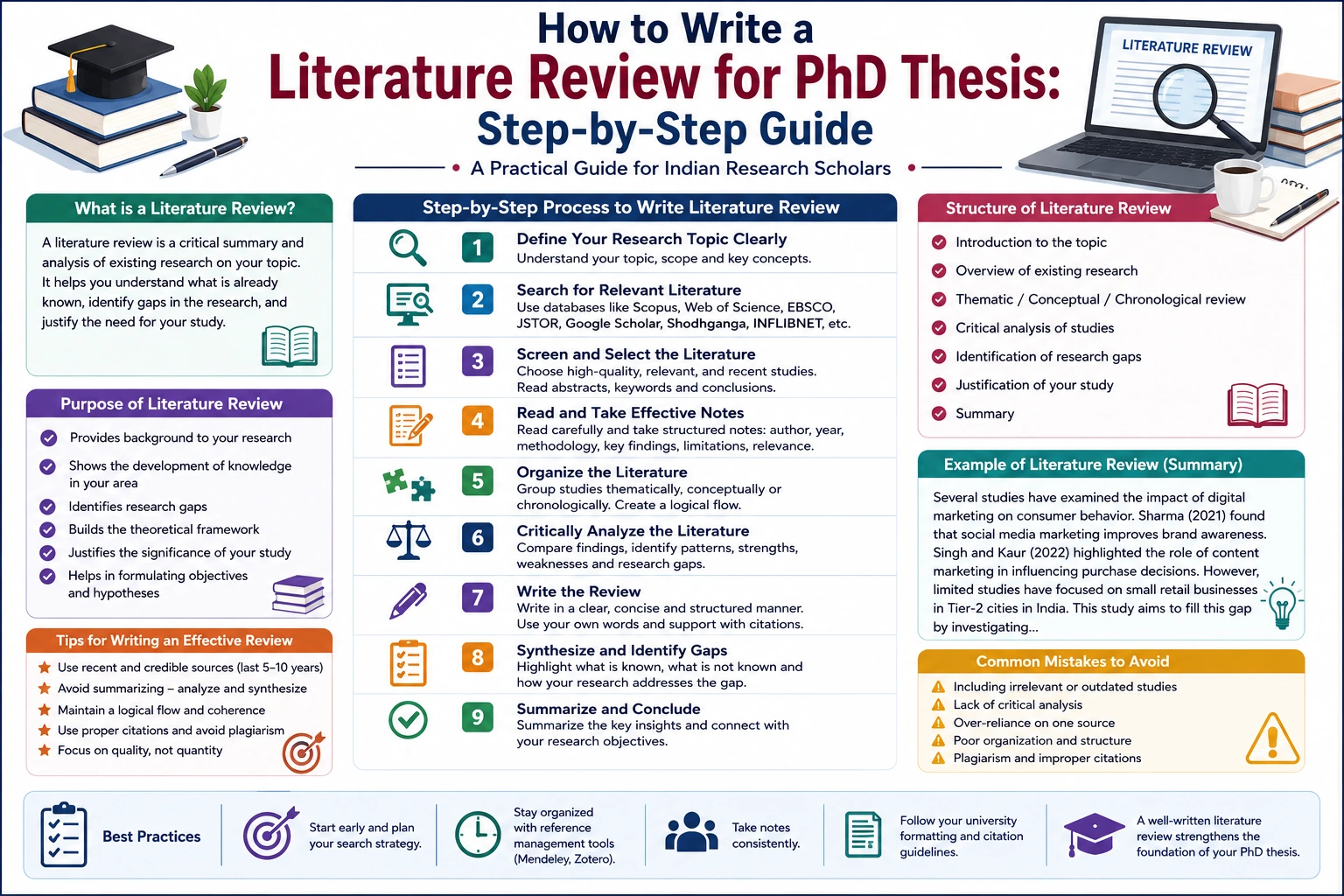
The literature review is one of the most intellectually demanding chapters of a PhD thesis. It is much more than a collection of summaries from journal articles or books—it is a critical evaluation of existing knowledge that demonstrates your understanding of the research landscape, identifies gaps in the literature, and establishes the foundation for your own study.
For many PhD scholars, writing the literature review is one of the most time-consuming stages of the research journey. With thousands of journal articles, conference papers, books, reports, and dissertations available online, deciding what to include, how to organize the material, and how to critically analyze previous studies can be overwhelming.
Many first-time researchers ask questions such as:
- How many sources should I include?
- Should I summarize every article?
- How do I identify a research gap?
- How do I synthesize multiple studies instead of simply describing them?
The answers lie in understanding the true purpose of a literature review. Rather than listing what previous researchers have done, a strong literature review compares, critiques, and connects existing studies to explain what is known, what remains unknown, and why your research is needed.
In this comprehensive guide, you'll learn how to write a high-quality literature review for a PhD thesis, explore its ideal structure, discover effective search strategies, and understand how to synthesize academic literature to produce a chapter that meets university expectations.
Table of Contents
- What Is a Literature Review?
- Why the Literature Review Is Important
- Objectives of a Literature Review
- Types of Literature Reviews
- Standard Structure of a Literature Review
- Step-by-Step Guide to Writing a Literature Review
- Literature Review Examples
- Common Mistakes
- Frequently Asked Questions
- Conclusion
What Is a Literature Review?
A literature review is a critical analysis of published research related to your topic. It examines previous studies, theories, methods, and findings to provide an overview of the current state of knowledge while identifying gaps that justify your own research.
Unlike an annotated bibliography or article summary, a literature review is analytical rather than descriptive.
It answers questions such as:
- What is already known about the topic?
- Which theories dominate the field?
- Where do researchers agree or disagree?
- Which methods have been used?
- What limitations exist?
- Which research gaps remain?
The literature review forms the bridge between existing knowledge and your proposed study.
Why Is the Literature Review Important?
A well-written literature review serves several important purposes.
It helps you:
- Demonstrate subject expertise.
- Understand theoretical foundations.
- Identify research gaps.
- Avoid duplicating previous research.
- Refine research questions.
- Select appropriate research methods.
- Build a conceptual framework.
- Justify the significance of your study.
For examiners, the literature review demonstrates whether the researcher has a deep understanding of the field and whether the proposed study is genuinely needed.
Objectives of a Literature Review
Although every discipline has its own expectations, most literature reviews aim to achieve the following objectives:
Review Existing Knowledge
Summarize major theories, concepts, and findings relevant to your research topic.
Critically Evaluate Previous Studies
Discuss the strengths and weaknesses of existing research instead of merely describing it.
Compare Different Perspectives
Identify similarities and differences across studies.
Explain where researchers agree and where debates continue.
Identify Research Gaps
Highlight unanswered questions, methodological limitations, under-researched populations, or contradictory findings.
These gaps provide the justification for your research.
Develop a Theoretical Foundation
A literature review establishes the conceptual and theoretical basis for your study.
This foundation helps explain why your research questions and hypotheses are appropriate.
Types of Literature Reviews
Different research projects require different review approaches.
Narrative Literature Review
A narrative review provides a broad overview of previous research.
It is commonly used in master's dissertations and traditional PhD theses.
Systematic Literature Review (SLR)
An SLR follows a structured, transparent process to identify, evaluate, and synthesize research.
It often includes predefined inclusion and exclusion criteria.
Scoping Review
Scoping reviews map the available literature on a topic without necessarily evaluating study quality.
They are useful for emerging research areas.
Integrative Literature Review
This approach combines findings from different research methods and theoretical perspectives.
Meta-analysis
Meta-analysis statistically combines quantitative findings from multiple studies.
It is commonly used in medicine, psychology, and education.
Standard Structure of a Literature Review
Although university guidelines differ, a literature review generally follows this structure:
- Introduction
- Theoretical Background
- Conceptual Review
- Empirical Review
- Critical Analysis
- Research Gap
- Conceptual Framework (if applicable)
- Chapter Summary
Each section should build logically toward explaining why your research is necessary.
Step-by-Step Guide to Writing a Literature Review
Step 1: Define the Scope
Before searching for literature, clearly define your topic.
Ask yourself:
- What is my research question?
- Which concepts are most important?
- Which keywords should I search?
- Which years should I include?
- Which disciplines are relevant?
A clearly defined scope prevents the literature review from becoming too broad.
Step 2: Search for High-Quality Sources
Use reliable academic databases rather than relying solely on general internet searches.
Examples include:
- Google Scholar
- Scopus
- Web of Science
- PubMed (for health sciences)
- IEEE Xplore (engineering)
- JSTOR
- ScienceDirect
- SpringerLink
- Wiley Online Library
- Taylor & Francis Online
Focus on peer-reviewed journal articles, academic books, conference proceedings, and reputable reports.
Step 3: Evaluate the Literature
Not every published article should be included.
Assess each source based on:
- Relevance
- Research quality
- Publication date
- Methodology
- Sample size
- Journal reputation
- Contribution to the field
Recent studies are particularly valuable for identifying current research trends.
Step 4: Organize Your Sources
Rather than storing articles randomly, organize them systematically.
You may group studies by:
- Themes
- Theories
- Variables
- Research methods
- Chronology
- Geographic regions
Creating a literature matrix or evidence table can help compare studies efficiently.
Step 5: Identify Patterns
Look for recurring themes across multiple studies.
For example:
- Frequently studied variables.
- Popular theoretical frameworks.
- Common research methods.
- Consistent findings.
- Contradictory evidence.
- Under-researched populations.
These patterns help develop a coherent narrative rather than isolated article summaries.
Step 6: Synthesize Rather Than Summarize
This is one of the biggest challenges for PhD scholars.
Instead of writing:
"Author A found... Author B found... Author C found..."
combine studies into broader insights.
For example:
"Several studies have reported a positive relationship between employee engagement and organisational performance, although the strength of this relationship varies across industries and cultural contexts."
Synthesis demonstrates higher-level academic thinking and critical analysis.
Step 7: Critically Evaluate Previous Research
A strong literature review does not simply describe existing studies—it evaluates them.
Consider questions such as:
- Were the methods appropriate?
- Were sample sizes adequate?
- Can the findings be generalized?
- Which limitations were acknowledged?
- Which assumptions influenced the results?
Critical evaluation helps identify opportunities for further research and strengthens the justification for your study.
Step 8: Identify the Research Gap
After reviewing and synthesizing the literature, the next step is to identify the research gap—the unanswered question or limitation that justifies your study.
A research gap may arise because:
- Previous studies focused on different populations.
- Existing research was conducted in another country or industry.
- Researchers used limited or outdated methodologies.
- Findings across studies are inconsistent.
- Emerging technologies or social changes have created new research opportunities.
- Important variables have not been examined together.
For example:
"Although previous studies have explored artificial intelligence adoption in banking, most have focused on developed economies. Limited research has examined AI-driven customer experience in Indian public sector banks, creating a gap that this study seeks to address."
The research gap should naturally lead to your research objectives and questions.
Organizing Your Literature Review
There is no single correct way to organize a literature review. The best structure depends on your research topic and discipline. However, the following approaches are commonly accepted in Indian and international universities.
Thematic Structure
This is the most widely used approach.
Group studies according to major themes rather than discussing each article individually.
Example:
Topic: Digital Marketing
- Social Media Marketing
- Influencer Marketing
- Content Marketing
- Consumer Engagement
- Purchase Intention
This approach creates a logical flow and encourages synthesis.
Chronological Structure
Arrange studies based on publication year to show how research has evolved over time.
This approach works well when discussing:
- Emerging technologies
- Policy developments
- Historical trends
- The evolution of theories
Methodological Structure
Group studies according to the research methods used.
For example:
- Quantitative studies
- Qualitative studies
- Mixed-methods studies
- Experimental research
- Case studies
This helps identify methodological gaps.
Theoretical Structure
Organize literature around major theories or conceptual frameworks.
For example:
- Technology Acceptance Model (TAM)
- Unified Theory of Acceptance and Use of Technology (UTAUT)
- Diffusion of Innovation Theory
- Resource-Based View (RBV)
This approach is especially useful for management, business, education, and social science research.
Literature Review Examples
Example 1: Management
"Previous studies consistently demonstrate that transformational leadership improves employee performance and organizational commitment. However, most research has been conducted in large multinational corporations, while evidence from Indian small and medium-sized enterprises remains limited. Furthermore, existing studies primarily rely on cross-sectional survey data, suggesting opportunities for longitudinal research. These limitations indicate the need for further investigation into leadership practices within India's SME sector."
Example 2: Education
"Research on blended learning has increased significantly following the COVID-19 pandemic. Existing studies generally report positive effects on student engagement and academic achievement. Nevertheless, most investigations have focused on urban universities, leaving rural higher education institutions comparatively underexplored. Additionally, few studies examine the long-term sustainability of blended learning practices, highlighting an important research gap."
Example 3: Healthcare
"Numerous studies have examined telemedicine adoption among healthcare providers. While these investigations emphasize technological readiness and organizational support, relatively little attention has been given to patients' perspectives in rural healthcare settings. Addressing this gap can improve digital healthcare implementation strategies."
Literature Review Writing Template
The following template can be adapted to almost any discipline:
Paragraph 1: Introduce the Theme
Introduce the concept and explain why it is relevant to your research.
Paragraph 2: Summarize Previous Research
Discuss the main findings from several studies rather than reviewing one article at a time.
Paragraph 3: Compare and Contrast
Highlight similarities, differences, and conflicting evidence.
Paragraph 4: Critical Evaluation
Discuss methodological strengths, weaknesses, and limitations.
Paragraph 5: Research Gap
Identify what remains unknown and explain how your study will address it.
Using this structure throughout the chapter helps create consistency and improves readability.
Tips for Writing an Effective Literature Review
A strong literature review reflects both breadth of reading and depth of analysis. The following practices can improve the quality of your chapter:
- Read widely before you begin writing.
- Prioritize peer-reviewed journal articles and reputable academic books.
- Use recent literature wherever appropriate, particularly for rapidly evolving fields.
- Organize sources using reference management software such as Zotero, Mendeley, or EndNote.
- Compare studies instead of describing them in isolation.
- Support every major claim with credible academic sources.
- Link each section back to your research objectives.
- Revise the chapter multiple times to improve coherence and logical flow.
Common Mistakes to Avoid
Many literature reviews lose marks because they focus on description rather than analysis. Be aware of these common mistakes.
Summarizing Every Article
Listing one article after another creates an annotated bibliography rather than a literature review.
Instead, synthesize studies around themes or concepts.
Using Outdated Sources
While classic studies remain important, relying heavily on older references may weaken the review.
Include recent research to demonstrate awareness of current developments.
Ignoring Contradictory Findings
Conflicting evidence often reveals valuable research opportunities.
Discussing these differences strengthens your critical analysis.
Failing to Identify a Research Gap
A literature review should naturally lead readers to the unanswered question that your study addresses.
Without a clearly defined gap, the purpose of your research may appear weak.
Poor Organization
Jumping between unrelated topics can confuse readers.
Use clear headings, transitions, and thematic sections to maintain logical flow.
Literature Review Checklist
Before submitting your thesis, review your literature review using this checklist:
- Defined the scope of the review.
- Included relevant and recent academic sources.
- Organized studies logically.
- Synthesized findings rather than summarizing articles individually.
- Critically evaluated previous research.
- Discussed theoretical and empirical literature.
- Identified clear research gaps.
- Linked the review to research objectives.
- Used consistent referencing throughout.
- Concluded with a summary that leads into the methodology chapter.
Frequently Asked Questions
How many references should a PhD literature review include?
There is no universal number. The quantity depends on your discipline, topic, and university guidelines. The emphasis should be on relevance, quality, and critical analysis rather than simply citing a large number of sources.
Can I include books in a literature review?
Yes. Books are especially valuable for theoretical foundations. However, recent peer-reviewed journal articles should generally form the core of your review.
Should I include only recent studies?
Not necessarily. Include foundational studies where relevant, but also incorporate current research to reflect the latest developments in your field.
What is the difference between a literature review and an annotated bibliography?
Conclusion
The literature review is much more than a summary of previous studies—it is the intellectual foundation of your PhD thesis. By critically evaluating existing knowledge, comparing theories, identifying methodological strengths and weaknesses, and uncovering research gaps, you demonstrate your understanding of the field and justify the need for your own study.
A high-quality literature review requires systematic searching, careful organization, critical thinking, and effective synthesis. Rather than describing articles individually, focus on building a coherent narrative that connects previous research to your research objectives. Organizing the review thematically, methodologically, or theoretically can help readers follow your argument and appreciate the contribution of your work.
Finally, remember that writing an excellent literature review is an iterative process. As your understanding of the topic evolves, revisit earlier sections, refine your analysis, and ensure that every paragraph supports the overall purpose of your thesis. With thoughtful planning and rigorous evaluation, your literature review can become one of the strongest chapters in your research.
Call / WhatsApp: +91 96438 02216
Website:www.ThesisLikho.com