
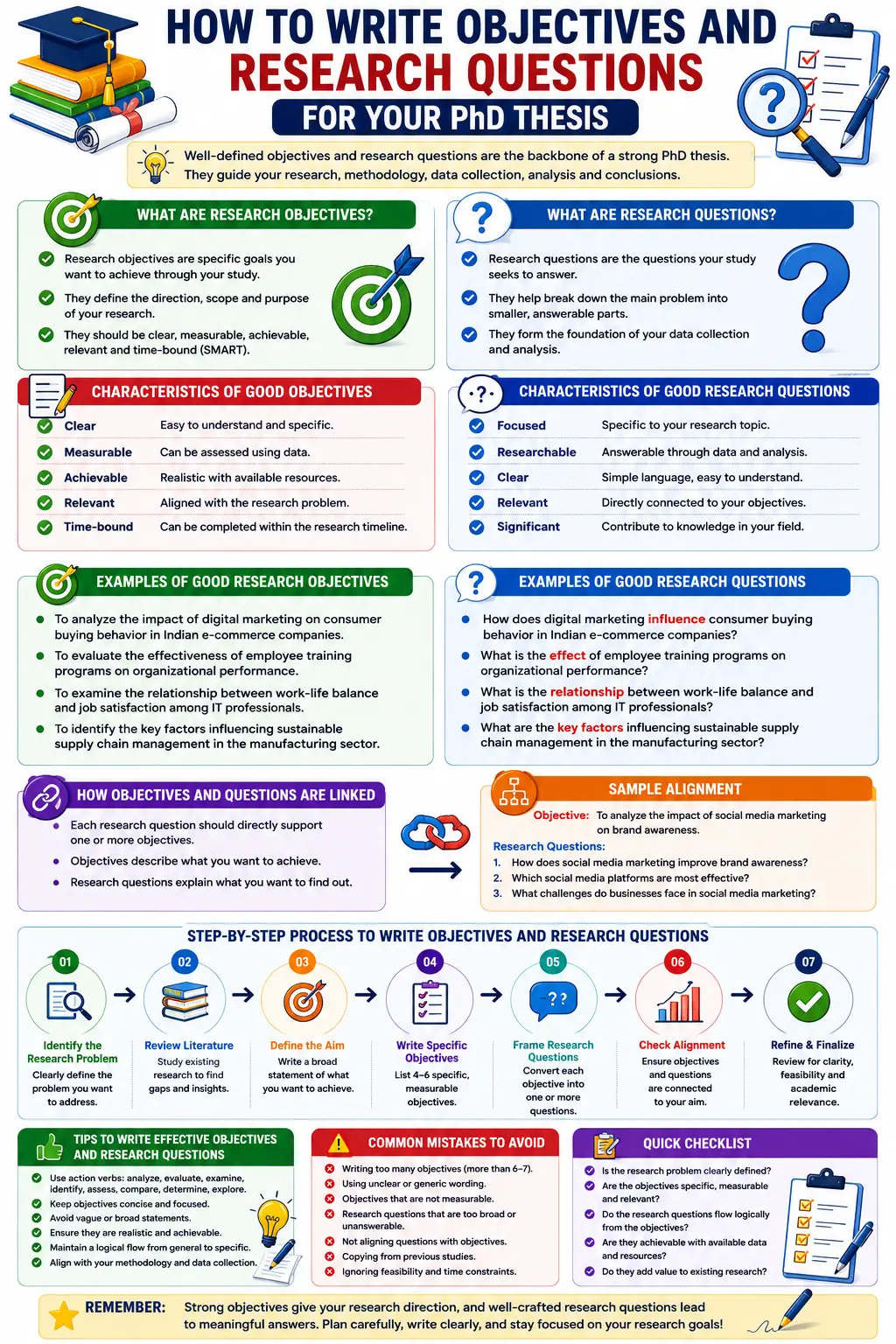
Writing a PhD thesis is one of the most significant academic achievements in a research scholar's career. Before collecting data, conducting experiments, or analyzing results, every successful thesis begins with a strong research foundation. Two of the most important components of this foundation are research objectives and research questions.
Many PhD scholars, especially beginners, struggle to differentiate between research objectives and research questions. Some write objectives that are too broad, while others create questions that cannot be answered through research. Poorly written objectives often lead to confusion throughout the research process, affecting literature review, methodology, data collection, and final conclusions.
This comprehensive guide explains how to write effective research objectives and research questions for your PhD thesis, along with practical examples, common mistakes, and expert tips specifically for Indian research scholars.
What Are Research Objectives?
Research objectives are clear statements that describe what your research intends to achieve. They provide direction to your study and help readers understand the purpose of your research.
Think of research objectives as your research roadmap. Every chapter of your thesis should contribute toward achieving these objectives.
Good research objectives answer questions like:
- What will this research accomplish?
- What variables will be studied?
- What relationships will be examined?
- What problems will be solved?
Research objectives should be:
- Clear
- Specific
- Measurable
- Achievable
- Relevant
- Time-bound (where applicable)
What Are Research Questions?
Research questions are the specific questions your study aims to answer.
Unlike objectives, which describe goals, research questions focus on the knowledge gap your study intends to fill.
For example:
Research Topic
Impact of Artificial Intelligence on Higher Education
Research Objective
To examine the impact of AI tools on students' academic performance.
Research Question
How do AI-based learning tools influence students' academic performance?
Notice that the objective states what will be done, while the research question asks what the study seeks to answer.
Why Are Research Objectives Important?
Well-written objectives help researchers:
- Define the study scope
- Select appropriate research methods
- Design questionnaires
- Conduct focused literature reviews
- Analyze relevant data
- Draw meaningful conclusions
Without clear objectives, research often becomes unfocused and difficult to complete.
Why Research Questions Matter
Research questions determine:
- What data needs to be collected
- Which methodology is appropriate
- Which statistical techniques should be used
- How results will be interpreted
Strong research questions also improve the quality of your literature review because they guide your search for relevant studies.
Types of Research Objectives
1. General Objective
The general objective describes the overall aim of the study.
Example
To investigate the factors affecting employee productivity in IT companies.
2. Specific Objectives
Specific objectives break the overall aim into measurable tasks.
Example
- To identify factors affecting employee productivity.
- To measure employee satisfaction.
- To evaluate workplace flexibility.
- To determine the relationship between motivation and productivity.
Most universities require one general objective and 3–6 specific objectives.
Characteristics of Good Research Objectives
Effective objectives should follow the SMART principle.
Specific
Avoid vague statements.
Weak
To study education.
Better
To examine the impact of online learning on postgraduate students in Indian universities.
Measurable
Objectives should produce measurable outcomes.
Example
To assess customer satisfaction levels using a structured survey.
Achievable
Ensure objectives are realistic within your available time and resources.
Relevant
Objectives should directly relate to your research problem.
Clear
Readers should immediately understand your research purpose.
Action Verbs for Writing Research Objectives
Use strong academic verbs such as:
- Analyze
- Assess
- Compare
- Determine
- Evaluate
- Examine
- Explore
- Identify
- Investigate
- Measure
- Test
- Validate
- Develop
- Estimate
- Explain
Avoid weak verbs like:
- Know
- Learn
- Understand
- Think
- Believe
How to Write Research Objectives
Step 1: Understand Your Research Problem
Every objective should directly address your research problem.
Example
Problem:
Many university students experience stress during online education.
Objective:
To identify the major causes of stress among university students during online learning.
Step 2: Define Your Variables
Clearly identify:
- Independent variables
- Dependent variables
Example
Independent Variable
Social media usage
Dependent Variable
Academic performance
Objective
To examine the impact of social media usage on academic performance.
Step 3: Keep Objectives Limited
Avoid writing too many objectives.
Generally, 3–5 specific objectives are sufficient for most PhD studies.
Step 4: Arrange Objectives Logically
A good sequence is:
- Identify
- Analyze
- Compare
- Evaluate
- Recommend
How to Write Research Questions
Research questions should naturally emerge from your objectives.
Suppose your objective is:
To evaluate customer satisfaction in online shopping.
Your research question becomes:
What factors influence customer satisfaction in online shopping?
Another example:
Objective
To compare rural and urban healthcare facilities.
Question
How do rural healthcare facilities differ from urban healthcare facilities?
Characteristics of Good Research Questions
A strong research question should be:
Focused
Too broad
How does education work?
Focused
How does online education affect engineering students in India?
Researchable
Questions should be answerable using available data.
Feasible
Ensure data collection is possible.
Significant
The question should contribute new knowledge.
Ethical
Avoid questions that require unethical methods.
Common Formats for Research Questions
Examples include:
- What factors affect...?
- How does... influence...?
- What is the relationship between...?
- How effective is...?
- What are the challenges of...?
- Why do...?
- How can... be improved?
Examples for Different Research Areas
Education
Objectives
- To assess students' satisfaction with online learning.
- To identify factors affecting academic performance.
- To evaluate digital learning tools.
Research Questions
- What factors influence students' academic performance?
- How effective are digital learning platforms?
- What challenges do students face in online education?
Management
Objectives
- To analyze employee engagement.
- To examine leadership effectiveness.
- To assess organizational commitment.
Research Questions
- How does leadership style influence employee engagement?
- What factors improve organizational commitment?
Healthcare
Objectives
- To identify barriers to healthcare access.
- To evaluate patient satisfaction.
Research Questions
- What barriers affect healthcare accessibility?
- How satisfied are patients with healthcare services?
Computer Science
Objectives
- To develop a machine learning model.
- To compare classification algorithms.
Research Questions
- Which machine learning algorithm provides the highest prediction accuracy?
- How can prediction accuracy be improved?
Linking Objectives with Methodology
Your research objectives determine your research design.
For example:
Objective
To compare customer satisfaction between two banks.
Method
Comparative quantitative study.
Objective
To explore teachers' experiences.
Method
Qualitative interviews.
Objective
To examine relationships between variables.
Method
Correlation or regression analysis.
Always ensure your methodology directly supports achieving your objectives.
Common Mistakes to Avoid
Writing Too Many Objectives
Having ten or more objectives often makes research unfocused.
Being Too Broad
Weak
To improve education.
Better
To evaluate the effectiveness of blended learning among postgraduate students.
Including Solutions Instead of Goals
Objectives should describe what you will investigate, not the final solution.
Using Ambiguous Language
Avoid words like:
- Better
- Good
- Nice
- Improve
Instead, use measurable academic language.
Asking Unanswerable Questions
Poor
Will artificial intelligence replace teachers?
Better
How does artificial intelligence affect teaching effectiveness in higher education?
Sample Research Objectives and Questions
Research Topic
Impact of Social Media on Academic Performance of University Students
General Objective
To examine the impact of social media usage on students' academic performance.
Specific Objectives
- To identify social media usage patterns.
- To measure academic performance.
- To examine the relationship between study time and social media use.
- To evaluate students' perceptions of educational social media content.
Research Questions
- How frequently do students use social media?
- How does social media affect academic performance?
- What relationship exists between study time and social media usage?
- How do students perceive educational content on social media?
Checklist Before Finalizing Your Objectives
Before submitting your research proposal, ask yourself:
- Are the objectives clear?
- Are they specific?
- Are they measurable?
- Can they be achieved?
- Are they directly linked to the research problem?
- Do the research questions match the objectives?
- Can each question be answered through research?
- Does the methodology support the objectives?
If the answer to all these questions is "Yes," your research framework is likely well-structured.
Tips for Indian PhD Scholars
Many universities in India expect research objectives and questions to align closely with the approved synopsis. To improve your work:
- Review your university's PhD thesis guidelines before drafting.
- Keep terminology consistent throughout the proposal, thesis, and publications.
- Align your objectives with the chosen research design and statistical methods.
- Discuss your objectives with your research supervisor before beginning data collection.
- Avoid copying objectives from previously published theses. Tailor them to your unique research problem.
Strong objectives not only strengthen your thesis but also make it easier to write subsequent chapters, including the methodology, results, and discussion.
Final Thoughts
Research objectives and research questions are the backbone of every PhD thesis. They define the direction of your study, influence your methodology, and ensure your research remains focused from start to finish.
Take time to refine these sections before beginning your literature review or data collection. A well-crafted set of objectives and research questions will save you significant time, reduce confusion during analysis, and improve the overall quality of your thesis.
Remember that effective objectives are specific, measurable, achievable, relevant, and logically connected to your research problem, while strong research questions are clear, focused, researchable, and capable of generating meaningful answers. By mastering these essential elements, you lay a solid foundation for a successful PhD journey and a thesis that contributes valuable knowledge to your field.
Website: www.thesislikho.com
Call / WhatsApp: +91-96438 02216