
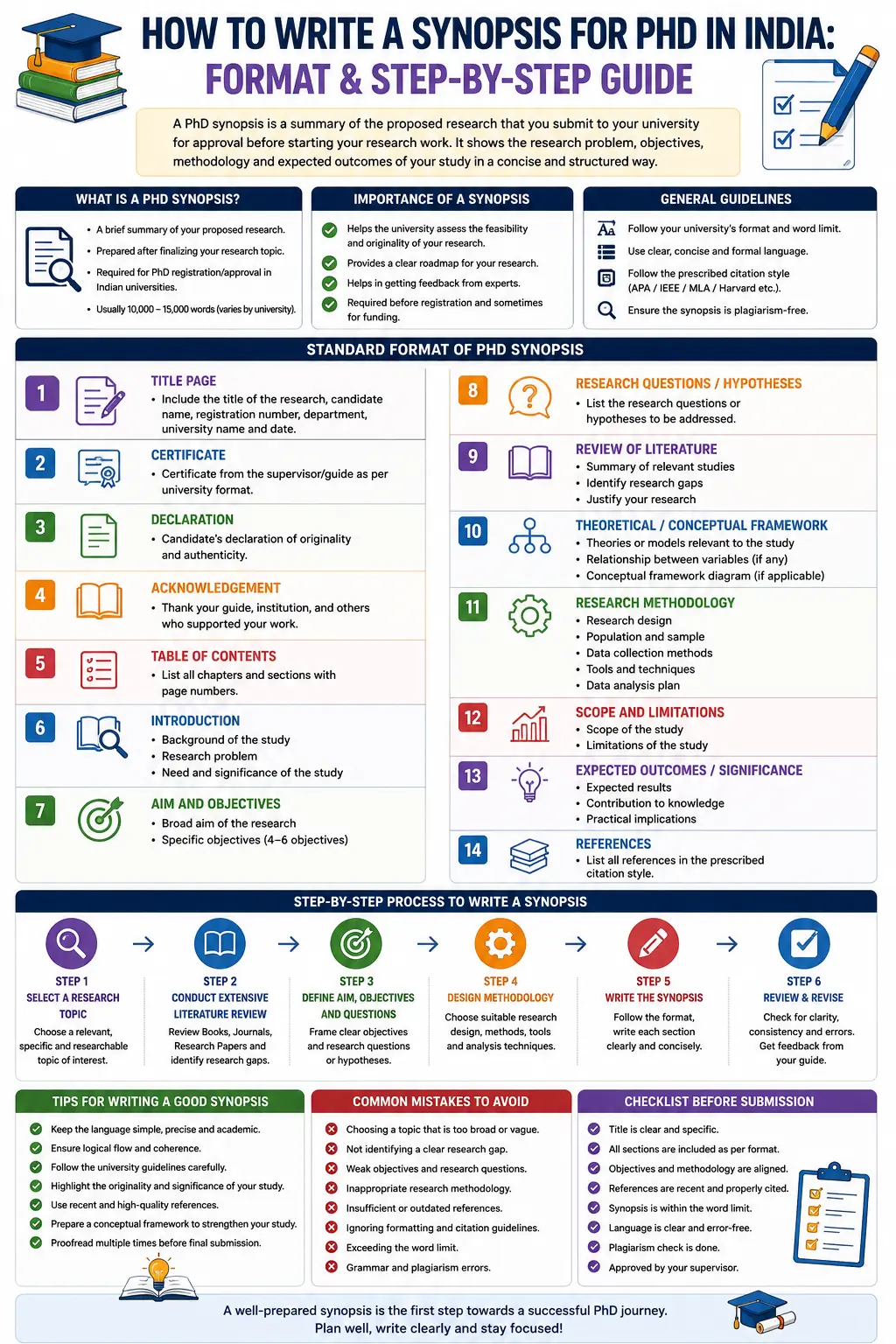
A well-written PhD synopsis is the first major milestone in your doctoral research journey. It is more than just a research proposal—it is a concise yet comprehensive blueprint of your proposed study that demonstrates the significance, feasibility, and academic value of your research. Before granting approval for your research, universities and research supervisors evaluate the synopsis to determine whether your study is original, methodologically sound, and aligned with the institution's academic standards.
For many research scholars in India, writing a PhD synopsis can be challenging. Questions such as What should be included? How long should it be? What format should I follow? are common. A poorly structured synopsis can delay registration or require multiple revisions, while a well-prepared synopsis can impress the research committee and lay a strong foundation for the entire thesis.
In this detailed guide, you will learn how to write a PhD synopsis in India, understand the standard format followed by most Indian universities, explore each section with examples, and discover practical tips to prepare a synopsis that stands out.
What Is a PhD Synopsis?
A PhD synopsis is a brief but detailed summary of your proposed research. It outlines the research problem, objectives, literature review, methodology, expected outcomes, and significance of the study. It helps the Research Advisory Committee (RAC), Doctoral Committee, or Departmental Research Committee assess whether your proposed work is relevant, original, and feasible.
Think of the synopsis as the roadmap for your doctoral research. It communicates:
- What you plan to study
- Why the research is important
- What gap in knowledge your study will address
- How you intend to conduct the research
- What contribution your research is expected to make
Although formats vary slightly across universities, the essential components remain largely the same.
Why Is a PhD Synopsis Important?
A synopsis serves several critical purposes throughout your doctoral journey. It:
- Demonstrates the originality of your research idea.
- Helps your supervisor understand your proposed study.
- Enables the research committee to evaluate the feasibility of the project.
- Provides a clear direction for your research.
- Acts as the foundation for writing the full thesis.
- Reduces the chances of changing your research direction midway.
Since the synopsis forms the basis of your research approval, investing time in preparing it carefully is essential.
Standard Format of a PhD Synopsis in India
While universities such as UGC-recognized institutions, IITs, NITs, Central Universities, and State Universities may have slight formatting differences, a standard PhD synopsis generally includes the following sections:
- Title of the Research
- Introduction
- Background of the Study
- Statement of the Problem
- Need and Significance of the Study
- Review of Literature
- Research Gap
- Research Objectives
- Research Questions or Hypotheses
- Theoretical or Conceptual Framework
- Research Methodology
- Scope of the Study
- Limitations of the Study
- Expected Outcomes
- Chapter Outline
- Timeline of Research
- References
Let us understand each section in detail.
Step 1: Choose a Clear and Specific Research Title
Your research title is the first thing evaluators notice. It should clearly communicate the topic and scope of your study.
Characteristics of a Good Title
- Clear and specific
- Reflects the research variables
- Indicates the target population or study area
- Avoids unnecessary jargon
- Neither too broad nor too narrow
Example
Weak Title
Digital Education
Improved Title
A Study on the Impact of Artificial Intelligence-Based Learning Platforms on Academic Performance of Undergraduate Students in Indian Universities
A precise title helps readers immediately understand the focus of your research.
Step 2: Write the Introduction
The introduction provides an overview of the research topic and sets the context for your study.
Include:
- General background
- Current trends
- Importance of the topic
- Brief introduction to the problem
- Purpose of the study
For example, if your research focuses on AI in education, explain the rapid growth of digital learning, government initiatives such as the National Education Policy (NEP), and the increasing use of AI-powered educational tools.
Keep the introduction informative and engaging without becoming overly detailed.
Step 3: Present the Background of the Study
The background explains the evolution of the research problem and provides context.
Discuss:
- Historical development of the topic
- Current scenario
- Existing challenges
- Recent developments
- Importance of studying the issue
This section helps readers understand why the research problem exists.
Step 4: Define the Statement of the Problem
This is one of the most important sections of the synopsis.
The problem statement identifies the specific issue your research seeks to investigate.
A strong problem statement should answer:
- What is the problem?
- Who is affected?
- Why does the problem exist?
- Why is further research necessary?
Example
Although AI-powered learning platforms are increasingly used in Indian higher education, limited research has examined their impact on students' academic performance and engagement across diverse educational settings.
A clear problem statement justifies the need for your research.
Step 5: Explain the Need and Significance of the Study
Here, explain why your research is important.
Discuss how your findings may benefit:
- Students
- Teachers
- Educational institutions
- Policymakers
- Researchers
- Industry professionals
For example, a study on AI adoption in higher education may help universities improve digital learning strategies and support evidence-based policy decisions.
Step 6: Conduct a Review of Literature
The literature review summarizes previous studies related to your topic.
Instead of listing articles one after another, organize the review by themes or concepts.
Discuss:
- Major findings
- Research methodologies used
- Agreements and disagreements among researchers
- Strengths and weaknesses of previous studies
- Areas requiring further investigation
Use recent, peer-reviewed journal articles published within the last five to ten years, while also including seminal studies where appropriate.
Step 7: Identify the Research Gap
After reviewing the literature, explain what previous research has not adequately addressed.
Examples of research gaps include:
- Limited studies in the Indian context
- Small sample sizes
- Outdated data
- Lack of comparative analysis
- Underexplored variables
Example
Most existing studies focus on developed countries, while empirical evidence regarding AI adoption among Indian university students remains limited.
The research gap should logically lead to your study.
Step 8: Write Research Objectives
Research objectives describe what your study aims to achieve.
Include one general objective and several specific objectives.
General Objective
To examine the impact of AI-powered learning platforms on academic performance among undergraduate students in Indian universities.
Specific Objectives
- To assess students' awareness of AI-based learning tools.
- To identify factors influencing AI adoption.
- To examine the relationship between AI usage and academic performance.
- To evaluate students' perceptions of AI-assisted learning.
Use action verbs such as examine, evaluate, identify, analyze, and assess.
Step 9: Develop Research Questions or Hypotheses
Your research questions should align with the objectives.
Example Research Questions
- What factors influence students' adoption of AI learning platforms?
- How does AI-assisted learning affect academic performance?
- What challenges do students face while using AI tools?
For quantitative studies, you may also formulate hypotheses.
Example Hypothesis
H1: There is a significant positive relationship between AI learning platform usage and students' academic performance.
Step 10: Build the Theoretical or Conceptual Framework
Explain the theory or model guiding your study.
For example:
- Technology Acceptance Model (TAM)
- Theory of Planned Behavior
- Diffusion of Innovation Theory
- Constructivist Learning Theory
- Herzberg's Two-Factor Theory
Describe:
- The theory
- Key concepts
- Relevance to your research
- Relationship with study variables
A conceptual framework diagram can also be included if required by your university.
Step 11: Describe the Research Methodology
This section explains how you will conduct your research.
Include the following elements:
Research Design
State whether the study is:
- Quantitative
- Qualitative
- Mixed Methods
Research Approach
Examples:
- Descriptive
- Exploratory
- Explanatory
- Experimental
Population
Identify the target population.
Example:
Undergraduate students enrolled in public and private universities in India.
Sample Size
Specify:
- Proposed sample size
- Sampling technique
Examples:
- Simple random sampling
- Stratified sampling
- Convenience sampling
- Purposive sampling
Data Collection Methods
Examples:
- Questionnaires
- Interviews
- Focus group discussions
- Observation
- Secondary data
Data Analysis Techniques
Mention the tools and statistical methods you plan to use.
Examples:
- SPSS
- R
- Python
- NVivo
- AMOS
- SmartPLS
Statistical techniques may include:
- Descriptive statistics
- Correlation analysis
- Regression analysis
- ANOVA
- Structural Equation Modeling (SEM)
- Thematic analysis
Step 12: Define the Scope of the Study
Clearly state the boundaries of your research.
Include:
- Geographic scope
- Time period
- Target population
- Variables covered
A well-defined scope keeps your study focused and manageable.
Step 13: Mention the Limitations of the Study
Every research project has limitations.
Examples include:
- Limited geographical coverage
- Time constraints
- Budget limitations
- Response bias
- Limited access to participants
Acknowledging limitations demonstrates academic honesty and realistic planning.
Step 14: Describe the Expected Outcomes
Explain what your research is expected to contribute.
Possible outcomes include:
- New theoretical insights
- Practical recommendations
- Policy implications
- Improved professional practices
- Development of future research directions
Avoid making exaggerated claims; focus on realistic contributions.
Step 15: Provide a Tentative Chapter Outline
Most universities expect a proposed chapter plan.
A typical structure includes:
- Chapter 1: Introduction
- Chapter 2: Review of Literature
- Chapter 3: Theoretical and Conceptual Framework
- Chapter 4: Research Methodology
- Chapter 5: Data Analysis and Results
- Chapter 6: Discussion
- Chapter 7: Conclusion and Recommendations
This outline demonstrates that you have a clear plan for completing the thesis.
Step 16: Prepare a Research Timeline
A timeline helps the committee assess the feasibility of your project.
Example:
Activity Timeline
Literature Review Months 1–3
Synopsis Approval Month 4
Data Collection Months 5–8
Data Analysis Months 9–10
Thesis Writing Months 11–14
Revision and Submission Months 15–18
Adjust the timeline based on your university's regulations and the nature of your research.
Step 17: List References
Your synopsis should end with a properly formatted reference list.
Follow the citation style prescribed by your university, such as:
- APA (7th Edition)
- MLA
- Harvard
- Chicago
- IEEE
Ensure that every in-text citation appears in the reference list and vice versa. Use recent, high-quality sources from peer-reviewed journals, books, conference papers, and government reports.
Formatting Guidelines for a PhD Synopsis
Although formatting requirements vary across institutions, a professional synopsis generally follows these standards:
- Font: Times New Roman
- Font Size: 12 pt
- Line Spacing: 1.5
- Margins: 1 inch on all sides (or as specified by the university)
- Page Numbering: Bottom center or bottom right
- Headings: Consistent formatting throughout
- Word Count: Typically 3,000–8,000 words or 10–30 pages, depending on university guidelines
Always verify your department's formatting instructions before submission.
Common Mistakes to Avoid
Many scholars make avoidable errors that weaken their synopsis. Watch out for these common mistakes:
- Choosing a title that is too broad or vague.
- Writing objectives that do not align with the research problem.
- Conducting a descriptive rather than critical literature review.
- Failing to identify a clear research gap.
- Selecting a methodology that does not match the research objectives.
- Using outdated or unreliable references.
- Ignoring university formatting and citation guidelines.
- Submitting a synopsis with grammatical or formatting errors.
- Including unsupported claims without evidence.
- Copying content from existing theses, which can lead to plagiarism issues.
Careful planning, proofreading, and supervisor feedback can help eliminate these problems.
Practical Tips for Indian PhD Scholars
If you are preparing a synopsis for an Indian university, keep the following suggestions in mind:
- Read your university's PhD regulations and synopsis template before writing.
- Align your topic with national priorities, industry needs, or emerging research trends where relevant.
- Use recent literature from Scopus, Web of Science, UGC CARE-listed journals, and reputable publishers.
- Ensure consistency between your title, objectives, research questions, methodology, and expected outcomes.
- Seek feedback from your supervisor after completing each major section rather than waiting until the entire synopsis is finished.
- Use plagiarism detection software to check originality before submission.
- Proofread multiple times to eliminate language and formatting errors.
A well-organized synopsis not only improves your chances of approval but also makes writing the full thesis significantly easier.
Final Thoughts
Writing a PhD synopsis is one of the most important stages of doctoral research because it establishes the direction, scope, and academic foundation of your study. A strong synopsis demonstrates that your research addresses a meaningful problem, builds on existing literature, follows a sound methodology, and has the potential to contribute valuable knowledge to your discipline.
Rather than viewing the synopsis as merely a formal requirement, treat it as the blueprint for your entire PhD journey. Invest time in selecting a focused topic, identifying a genuine research gap, developing clear objectives, and designing a practical research methodology. With careful planning, thorough literature review, and regular guidance from your supervisor, you can prepare a synopsis that not only secures research approval but also serves as a reliable roadmap for completing a high-quality doctoral thesis.
A clear, well-structured synopsis is the first step toward a successful PhD—and the stronger your foundation, the smoother your research journey will be.
Website: www.thesislikho.com
Call / WhatsApp: +91-96438 02216