
Writing a PhD thesis is one of the most challenging yet rewarding milestones in a research scholar's academic journey. Among all the chapters in your thesis, the introduction chapter is arguably the most important. It creates the first impression on your supervisor, research committee, and examiners while laying the foundation for the entire study.
Many Indian PhD scholars struggle with writing the introduction because they are unsure what information should be included, how much detail is appropriate, and how to organize the chapter effectively.
This comprehensive guide explains how to write a PhD thesis introduction, including its format, essential components, writing tips, common mistakes, and practical examples tailored for Indian researchers.
What Is a PhD Thesis Introduction?
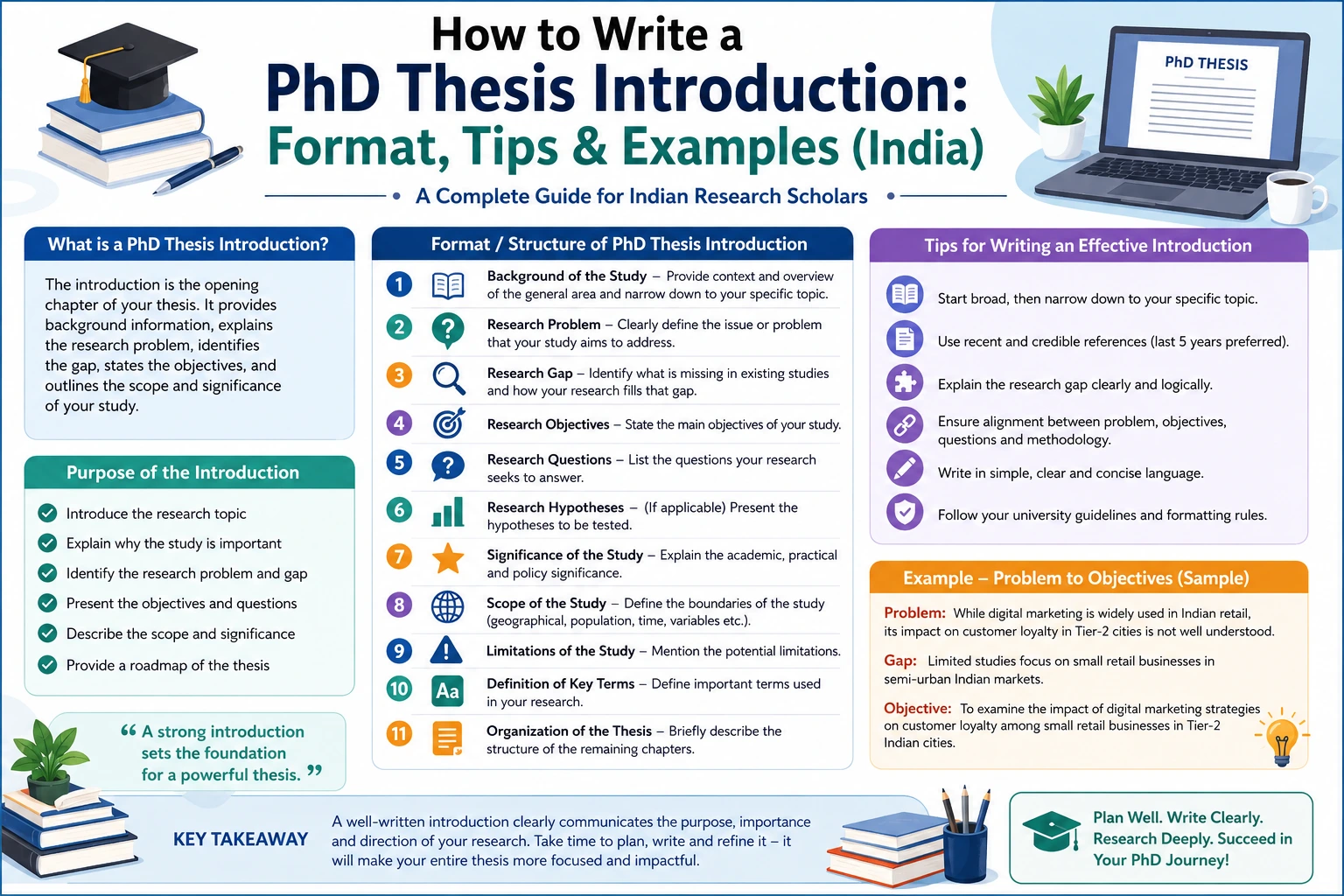
A PhD thesis introduction is the opening chapter of your dissertation that introduces readers to your research topic, explains why the study is important, identifies the research problem, presents the objectives, outlines the methodology, and describes the structure of the thesis.
Think of the introduction as a roadmap that helps readers understand:
- What your research is about
- Why the topic matters
- What gap exists in current knowledge
- How your research addresses that gap
- What readers can expect in the remaining chapters
A well-written introduction convinces examiners that your research deserves attention.
Why Is the Introduction Important?
The introduction serves multiple purposes.
It helps readers:
- Understand the background of your research
- Recognize the significance of the study
- Identify the research problem
- Understand your research objectives
- Learn about the methodology
- Gain confidence in your research approach
A strong introduction sets the tone for the rest of the thesis.
Standard Format of a PhD Thesis Introduction
Although universities may have specific formatting guidelines, most Indian universities follow a similar structure.
1. Background of the Study
Start by introducing the broader topic.
Explain:
- Historical context
- Current trends
- Existing issues
- Industry relevance
- Academic importance
Move gradually from general information to your specific research area.
Example
Digital transformation has significantly changed how Indian retail businesses interact with customers. The rapid adoption of e-commerce platforms, artificial intelligence, and mobile payment systems has transformed consumer purchasing behavior over the last decade.
2. Research Problem
After providing the background, identify the problem your research aims to solve.
Ask yourself:
- What issue exists?
- Why hasn't it been solved?
- What knowledge is missing?
Example
Although numerous studies have explored digital marketing strategies, limited research has examined their impact on customer loyalty among small retail businesses in Tier-2 Indian cities.
3. Research Gap
The research gap explains what previous studies have not addressed.
This section demonstrates your understanding of the literature.
Common research gaps include:
- Geographic gap
- Population gap
- Methodological gap
- Theoretical gap
- Industry gap
- Time gap
Example
Existing studies primarily focus on metropolitan cities, leaving limited evidence regarding consumer behavior in semi-urban Indian markets.
4. Research Objectives
Clearly list your research objectives.
Example:
The objectives of this study are:
- To examine customer satisfaction in online retail.
- To identify factors influencing customer loyalty.
- To evaluate the relationship between digital marketing and repeat purchases.
- To develop recommendations for Indian retail businesses.
Keep objectives measurable and specific.
5. Research Questions
Your research questions should align with the objectives.
Examples:
- What factors influence customer loyalty?
- Does digital marketing improve customer retention?
- Which digital marketing strategies are most effective?
6. Research Hypotheses (If Applicable)
Quantitative studies often include hypotheses.
Example:
H1: Social media engagement positively affects customer loyalty.
H2: Customer satisfaction significantly influences repeat purchase intention.
7. Significance of the Study
Explain why your research matters.
Discuss its contribution to:
Academic Contribution
- Extends existing literature
- Tests theoretical models
- Fills research gaps
Practical Contribution
- Helps organizations
- Supports managers
- Improves decision-making
Policy Contribution
- Assists government agencies
- Supports policy formulation
- Benefits society
8. Scope of the Study
Define the boundaries of your research.
Include:
- Geographic scope
- Industry scope
- Population
- Time period
- Variables studied
Example:
The study focuses on small retail businesses operating in Uttar Pradesh between 2023 and 2025.
9. Limitations of the Study
Every study has limitations.
Examples include:
- Limited sample size
- Time constraints
- Geographic restrictions
- Budget limitations
- Data availability
Being transparent improves research credibility.
10. Definition of Key Terms
Define important technical terms.
Example:
Customer Loyalty: The likelihood of customers repeatedly purchasing from the same retailer.
Digital Marketing: Marketing activities conducted using digital channels such as social media, email, websites, and search engines.
11. Organization of the Thesis
Briefly summarize each chapter.
Example:
- Chapter 1: Introduction
- Chapter 2: Literature Review
- Chapter 3: Research Methodology
- Chapter 4: Data Analysis
- Chapter 5: Findings
- Chapter 6: Conclusion and Recommendations
Example Structure of a PhD Thesis Introduction
A typical introduction follows this flow:
- Background
- Problem Statement
- Research Gap
- Objectives
- Research Questions
- Hypotheses
- Significance
- Scope
- Limitations
- Definitions
- Thesis Organization
Sample Introduction (Example)
Topic: Employee Engagement in Indian IT Companies
Employee engagement has become a critical factor influencing organizational performance in today's competitive business environment. Indian information technology companies face increasing challenges related to employee retention, productivity, and job satisfaction due to globalization and changing workforce expectations. Although several studies have examined employee engagement in multinational corporations, limited research has focused on medium-sized IT firms operating in India. This study investigates the factors affecting employee engagement among IT professionals in Bengaluru and Hyderabad. The findings aim to contribute to existing literature while providing practical recommendations for HR managers seeking to improve workforce engagement and organizational performance.
Tips for Writing an Effective PhD Thesis Introduction
Start Broad, Then Narrow
Begin with the larger research area before discussing your specific topic.
Avoid jumping directly into technical details.
Use Recent Literature
Support your introduction using recent research articles.
Most references should be published within the last five years unless citing foundational theories.
Explain the Research Gap Clearly
Do not simply state that "few studies exist."
Instead, explain:
- What previous studies found
- What they overlooked
- Why your study is necessary
Align Everything
Ensure consistency between:
- Problem statement
- Objectives
- Research questions
- Hypotheses
- Methodology
Misalignment is a common reason for thesis revisions.
Keep It Logical
Use smooth transitions between sections.
Each paragraph should naturally lead to the next.
Write Clearly
Avoid:
- Long sentences
- Unnecessary jargon
- Repetition
- Overly complex language
Clear writing is more persuasive.
Common Mistakes to Avoid
Many scholars make avoidable errors when drafting the introduction.
These include:
- Writing an introduction that is too short
- Including an extensive literature review
- Failing to identify the research gap
- Using outdated references
- Making unsupported claims
- Writing vague objectives
- Ignoring university guidelines
- Adding unnecessary technical details
A concise, focused introduction is more effective than a lengthy, repetitive one.
Ideal Length of a PhD Thesis Introduction
The length depends on university requirements and the overall thesis size.
General guidelines:
Thesis Length Recommended Introduction
40,000 words 3,000–4,000 words
60,000 words 4,000–5,000 words
80,000 words 5,000–7,000 words
100,000+ words 6,000–8,000 words
Always consult your university's thesis manual.
Checklist Before Finalizing Your Introduction
Before submitting your thesis, ensure that your introduction:
- Clearly introduces the topic
- Explains the research problem
- Identifies the research gap
- States the objectives
- Includes research questions
- Presents hypotheses (if applicable)
- Explains the significance of the study
- Defines the scope and limitations
- Defines key terms
- Outlines the thesis structure
- Uses recent and credible references
- Follows your university's formatting guidelines
A final review for clarity, coherence, and alignment with the rest of your thesis is essential.
Frequently Asked Questions (FAQs)
How long should a PhD thesis introduction be?
It typically ranges from 3,000 to 7,000 words, depending on your university guidelines and the overall length of the thesis.
Should the introduction include a literature review?
The introduction should include only a brief overview of existing research to establish context. The detailed literature review belongs in a separate chapter.
Can I write the introduction last?
Yes. Many researchers draft the introduction after completing other chapters because they have a clearer understanding of the study and its findings.
What should come first: the problem statement or research objectives?
The problem statement should precede the research objectives, as the objectives are developed to address the identified problem.
How many research objectives should a PhD thesis have?
Most doctoral studies include three to six well-defined objectives, depending on the complexity and scope of the research.
Conclusion
The introduction is more than just the first chapter of your PhD thesis—it is the foundation upon which your entire research is built. A compelling introduction clearly explains the research background, defines the problem, identifies the knowledge gap, outlines the objectives, and demonstrates the significance of the study. By presenting a logical structure and maintaining alignment between your research questions, methodology, and overall thesis, you create a strong first impression that guides readers through your work with confidence.
Whether you are pursuing a PhD in management, engineering, social sciences, education, commerce, or any other discipline in India, investing time in crafting a clear, well-organized introduction will strengthen the quality of your thesis and improve its acceptance by supervisors and examiners. Use the structure, tips, and examples provided in this guide as a roadmap to write an introduction that effectively sets the stage for your research journey.
Call / WhatsApp: +91 96438 02216
Website:www.ThesisLikho.com