
Introduction
A systematic review is considered one of the highest levels of evidence in academic research because it follows a transparent, rigorous, and reproducible methodology. However, readers, reviewers, and journal editors need to understand exactly how studies were identified, screened, assessed, and selected for inclusion.
This is where the PRISMA Flow Diagram becomes essential.
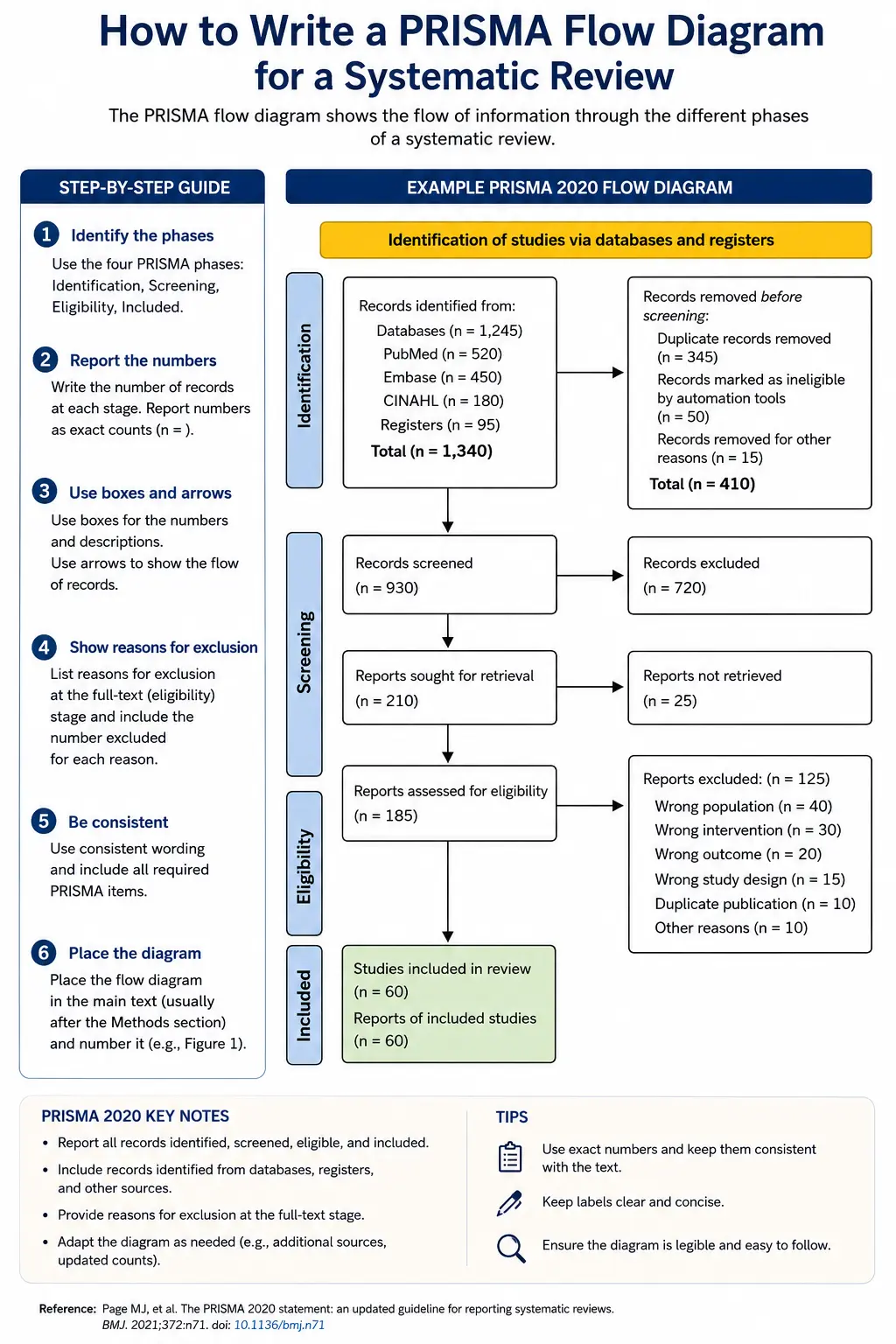
The PRISMA (Preferred Reporting Items for Systematic Reviews and Meta-Analyses) Flow Diagram provides a visual representation of the study selection process used in a systematic review. It shows how many records were identified through database searches, how duplicates were removed, how studies were screened, and why certain studies were excluded.
Today, most high-quality journals require researchers to include a PRISMA flow diagram when submitting systematic reviews. For PhD scholars, researchers, and postgraduate students, understanding how to create and report a PRISMA flow diagram correctly is a critical research skill.
In this guide, you will learn:
- What a PRISMA flow diagram is
- Why it is important
- Components of a PRISMA 2020 flow diagram
- Step-by-step instructions for creating one
- Examples and best practices
- Common mistakes to avoid
- How to report PRISMA in your thesis or journal article
What Is a PRISMA Flow Diagram?
A PRISMA Flow Diagram is a standardized chart that documents the process of selecting studies for a systematic review.
It visually tracks the movement of studies through different stages of the review process, including:
- Identification
- Screening
- Eligibility assessment
- Final inclusion
The diagram helps readers understand:
- Where studies were found
- How many records were removed
- Why articles were excluded
- How many studies were included in the final review
The flow diagram promotes transparency and reproducibility, two fundamental principles of scientific research.
What Does PRISMA Stand For?
PRISMA stands for:
Preferred Reporting Items for Systematic Reviews and Meta-Analyses
PRISMA is an internationally recognized reporting guideline designed to improve the quality of systematic reviews and meta-analyses.
The latest version, PRISMA 2020, introduced updated reporting standards and revised flow diagrams to improve transparency.
Why Is the PRISMA Flow Diagram Important?
Many researchers search multiple databases and retrieve hundreds or even thousands of articles.
Without a structured reporting system, readers cannot determine:
- How studies were selected
- Whether bias occurred during screening
- Whether inclusion criteria were applied consistently
A PRISMA flow diagram solves these issues.
Benefits of Using a PRISMA Flow Diagram
Enhances Transparency
Readers can clearly see every step of the selection process.
Improves Research Credibility
A systematic review becomes more trustworthy when study selection is documented.
Supports Reproducibility
Other researchers can replicate the search process.
Required by Journals
Many Scopus-indexed and Web of Science journals require PRISMA reporting.
Reduces Selection Bias
Researchers must justify exclusion decisions.
Understanding the Four Main Stages of the PRISMA Flow Diagram
The PRISMA flow diagram consists of four major phases.
1. Identification
This stage records all studies located through database searching and other sources.
Examples of databases include:
- Scopus
- Web of Science
- PubMed
- Google Scholar
- ScienceDirect
- JSTOR
Researchers record:
- Number of records identified
- Number of records from databases
- Number of records from other sources
2. Screening
At this stage:
- Duplicate records are removed.
- Titles and abstracts are screened.
Researchers exclude studies that clearly do not meet inclusion criteria.
Examples:
- Wrong population
- Wrong research topic
- Non-English studies
- Editorials or commentaries
3. Eligibility
The remaining studies undergo full-text review.
Researchers evaluate whether each article satisfies inclusion criteria.
Common reasons for exclusion:
- Full text unavailable
- Wrong methodology
- Insufficient data
- Not peer-reviewed
All exclusion reasons should be documented.
4. Included Studies
This final stage reports the studies included in:
- Qualitative synthesis
- Quantitative synthesis (meta-analysis)
These studies form the basis of the systematic review findings.
PRISMA 2020 Flow Diagram Structure
The updated PRISMA 2020 flow diagram includes additional reporting elements.
Researchers should report:
Records Identified From Databases
Example:
- Scopus = 600
- Web of Science = 450
- PubMed = 300
Total = 1,350 records
Duplicate Records Removed
Example:
- Duplicate records = 250
Remaining records = 1,100
Records Screened
Example:
- Titles and abstracts screened = 1,100
Records Excluded
Example:
- Irrelevant topic = 700
- Conference abstracts = 150
Total excluded = 850
Full-Text Articles Assessed
Example:
- Full-text articles reviewed = 250
Full-Text Articles Excluded
Reasons:
- Wrong study design = 80
- Missing data = 40
- Full text unavailable = 20
Total excluded = 140
Studies Included
Example:
- Included in qualitative synthesis = 110
- Included in meta-analysis = 85
Step-by-Step Guide to Creating a PRISMA Flow Diagram
Step 1: Define Your Research Question
Before searching databases, develop a clear research question.
Example:
"What is the impact of social media usage on academic performance among university students?"
A focused question helps establish inclusion and exclusion criteria.
Step 2: Develop Search Strategies
Identify keywords and search terms.
Example:
- Social media
- Academic performance
- Higher education
- University students
Combine terms using Boolean operators:
- AND
- OR
- NOT
Example:
"Social Media" AND "Academic Performance" AND "Students"
Document all search strategies carefully.
Step 3: Remove Duplicate Records
Many articles appear in multiple databases.
Use reference management software such as:
- EndNote
- Zotero
- Mendeley
- Rayyan
Example:
Records identified = 1,550
Duplicates removed = 300
Records remaining = 1,250
Step 4: Screen Titles and Abstracts
Review titles and abstracts against inclusion criteria.
Example:
Exclude studies that:
- Are unrelated to your topic
- Focus on different populations
- Are not empirical studies
Example:
Records screened = 1,250
Records excluded = 900
Records remaining = 350
Step 5: Retrieve Full-Text Articles
Download and assess full-text versions.
Review:
- Methodology
- Sample characteristics
- Outcome measures
- Relevance to research question
Example:
Full-text articles assessed = 350
Step 6: Finalize Included Studies
The remaining studies become part of the systematic review.
Example:
Studies included in review = 200
Meta-analysis studies = 120
These numbers appear in the final PRISMA box.
Example of a PRISMA Flow Diagram
A typical PRISMA process may look like:
Identification
Records identified:
- Scopus = 500
- PubMed = 400
- Web of Science = 300
Total = 1,200
Screening
Duplicates removed = 250
Records screened = 950
Records excluded = 700
Eligibility
Full-text articles assessed = 250
Articles excluded = 130
Included
Studies included in systematic review = 120
Studies included in meta-analysis = 85
This information forms the complete PRISMA flow diagram.
How to Report the PRISMA Flow Diagram in Your Thesis
Most universities expect a brief explanation accompanying the diagram.
Example:
"A total of 1,200 records were identified through database searches. After removing 250 duplicates, 950 records were screened. Following title and abstract screening, 250 articles underwent full-text assessment. Of these, 130 studies were excluded for not meeting inclusion criteria. Finally, 120 studies were included in the systematic review."
This narrative helps readers understand the selection process.
Tools for Creating a PRISMA Flow Diagram
Several tools can help researchers create professional diagrams.
PRISMA 2020 Flow Diagram Generator
The official PRISMA website offers a free diagram generator.
Benefits:
- PRISMA-compliant
- Easy to use
- Downloadable formats
Microsoft PowerPoint
Many researchers create diagrams manually using shapes and arrows.
Advantages:
- Customizable
- Easy formatting
Lucidchart
Useful for professional flowchart creation.
Canva
Offers templates suitable for academic diagrams.
Microsoft Visio
Advanced option for detailed flow diagrams.
Common Mistakes to Avoid
Not Recording Search Results Properly
Maintain detailed records from the beginning.
Inconsistent Numbers
Ensure totals match across all stages.
Example:
Studies screened should equal:
Records identified − duplicates removed
Missing Exclusion Reasons
Always explain why studies were excluded.
Mixing Screening and Eligibility Stages
Keep title/abstract screening separate from full-text assessment.
Ignoring PRISMA 2020 Guidelines
Use the latest PRISMA 2020 version whenever possible.
Best Practices for PRISMA Reporting
To produce a high-quality systematic review:
Maintain a Search Log
Track databases, dates, and keywords.
Use Reference Management Software
Reduces duplicate identification errors.
Document Every Decision
Keep records of inclusion and exclusion decisions.
Follow PRISMA 2020
Ensure compliance with current standards.
Double-Check Numbers
Consistency is critical for publication.
Report Exclusion Reasons Clearly
Transparency improves credibility.
Why PRISMA Is Important for PhD Scholars
PhD researchers increasingly conduct systematic reviews as part of:
- Literature reviews
- Thesis chapters
- Research publications
- Meta-analyses
A properly developed PRISMA flow diagram:
- Demonstrates methodological rigor
- Improves publication chances
- Meets journal requirements
- Enhances transparency
- Strengthens academic credibility
Understanding PRISMA is therefore an essential research skill for doctoral scholars.
Conclusion
The PRISMA Flow Diagram is a cornerstone of systematic review reporting. It provides a transparent visual summary of how studies were identified, screened, assessed, and selected for inclusion. By documenting every stage of the review process, researchers enhance the credibility, reproducibility, and quality of their work.
Whether you are a PhD scholar, master's student, or academic researcher, mastering the PRISMA flow diagram is crucial for producing high-quality systematic reviews and meeting publication standards. By following the PRISMA 2020 guidelines, maintaining accurate records, and clearly reporting study selection decisions, you can create a professional and publication-ready systematic review that stands up to peer review and contributes valuable evidence to your field.
Website: www.thesislikho.com
Call/WhatsApp: +91 96438 02216