
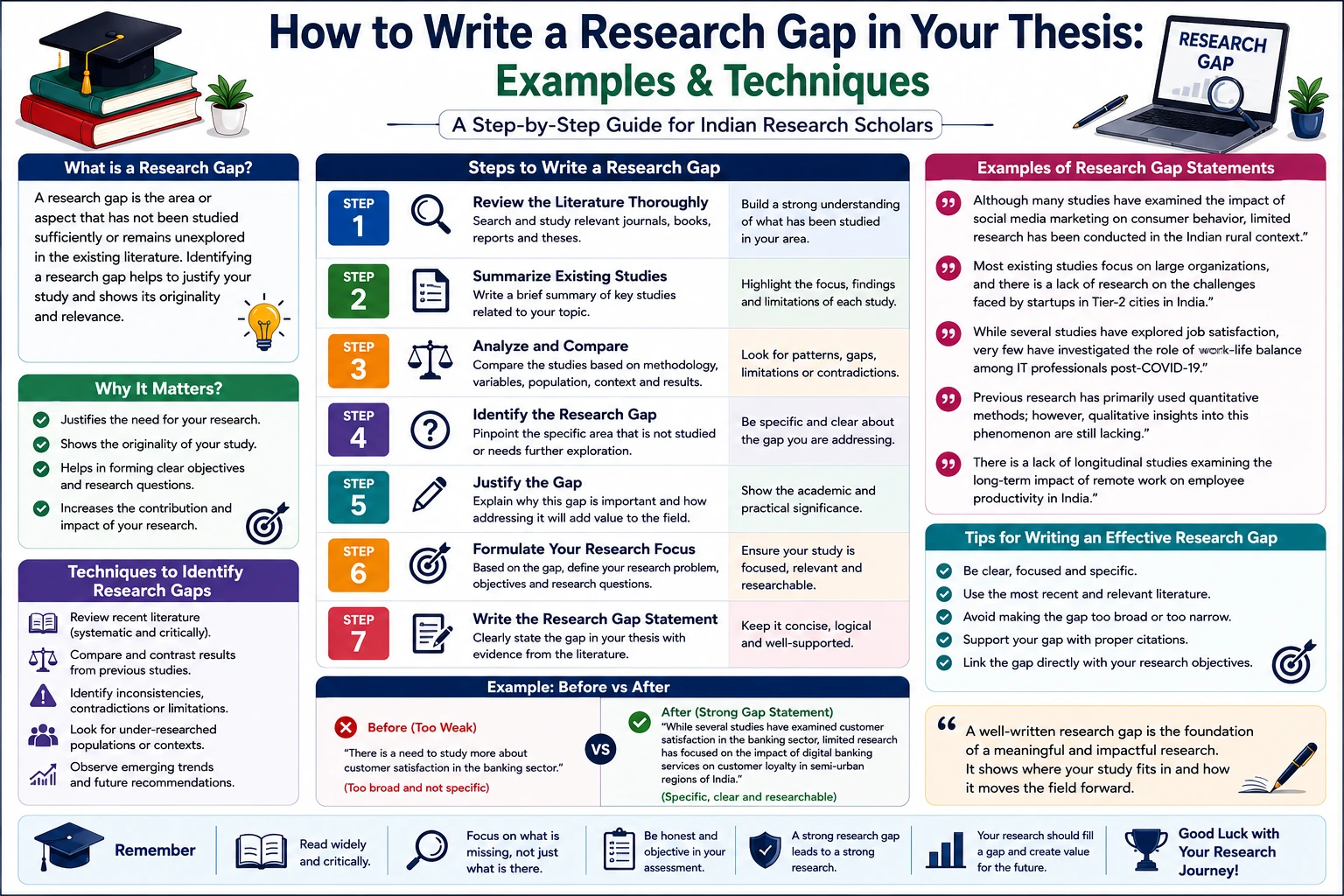
One of the most important—and often most challenging—parts of writing a thesis or dissertation is identifying the research gap. Whether you're preparing a master's dissertation, a PhD thesis, or a research proposal, your study must answer one critical question:
Why is this research needed?
The answer lies in the research gap.
A research gap is the missing piece of knowledge that your study aims to address. It explains what existing studies have overlooked, where findings are inconsistent, which populations remain under-researched, or how changing technologies, policies, and social conditions create new research opportunities. Clearly identifying this gap helps justify your study, demonstrate originality, and convince reviewers that your research deserves attention.
Many new researchers mistakenly believe they need to find a topic that has never been studied before. In reality, most successful research builds on previous work by examining unanswered questions, applying theories in new contexts, using different methods, or investigating emerging problems.
This practical guide explains what a research gap is, why it matters, how to identify one, and how to write it effectively in your thesis. You'll also find practical examples, proven techniques, and common mistakes to avoid.
What Is a Research Gap?
A research gap is an area where existing knowledge is incomplete, insufficient, contradictory, outdated, or unexplored. It represents an opportunity for researchers to contribute new evidence, test existing theories in different contexts, or solve unresolved problems.
In simple terms, the research gap explains:
- What previous studies have already discovered.
- What remains unknown.
- Why that missing knowledge is important.
- How your research will help address it.
For example, imagine that many studies have explored online learning among university students in developed countries. However, very few have examined how students in rural Indian colleges experience online education after the COVID-19 pandemic. That unexplored context represents a potential research gap.
A clearly defined research gap forms the foundation of a strong research proposal, literature review, and thesis.
Why Is a Research Gap Important?
Identifying a research gap is not simply an academic exercise—it is essential to demonstrating the value of your study.
A well-defined research gap helps you:
- Justify the need for your research.
- Show originality and innovation.
- Define clear research objectives.
- Develop meaningful research questions.
- Select appropriate research methods.
- Convince supervisors, reviewers, and examiners that your study contributes to existing knowledge.
Without a research gap, your thesis may appear to repeat what is already known rather than adding something meaningful to the field.
Types of Research Gaps
Research gaps can take many forms. Understanding these different types makes it easier to recognize opportunities during your literature review.
1. Knowledge Gap
A knowledge gap exists when researchers have not adequately studied a particular topic or phenomenon.
Example:
Although numerous studies examine digital banking adoption, limited research explores AI-powered financial advisory services among older adults in India.
2. Evidence Gap
Sometimes theories exist, but there is insufficient empirical evidence to support or challenge them.
Example:
Researchers suggest that hybrid work improves employee productivity, but empirical evidence from Indian manufacturing organizations remains limited.
3. Population Gap
Many studies focus on one group while overlooking another.
Example:
Previous research has primarily examined urban consumers, whereas rural consumers remain underrepresented.
Population gaps are common in education, healthcare, management, and social sciences.
4. Geographic Gap
Research findings from one country or region may not apply elsewhere.
Example:
Most studies on sustainable supply chain management have been conducted in Europe and North America, while evidence from Indian small and medium-sized enterprises remains scarce.
5. Methodological Gap
Researchers may repeatedly use the same methods while overlooking alternative approaches.
Example:
Existing studies rely mainly on quantitative surveys, creating an opportunity for qualitative interviews or mixed-methods research.
6. Theoretical Gap
Sometimes existing theories fail to explain emerging phenomena.
Researchers may extend an established model or combine multiple theories to provide better explanations.
7. Time Gap
Rapid technological, economic, or social changes can make earlier findings outdated.
Example:
Research conducted before widespread AI adoption may no longer accurately reflect current workplace practices.
Where Should You Write the Research Gap?
The research gap is typically presented in the literature review chapter, although its influence extends throughout the thesis.
Many researchers introduce the gap:
- At the end of the literature review.
- Immediately before the research objectives.
- Within the introduction after reviewing previous studies.
A common structure is:
- Review previous research.
- Identify strengths and limitations.
- Highlight unanswered questions.
- Present the research gap.
- Introduce your research objectives.
This sequence creates a logical transition from existing knowledge to your proposed study.
How to Identify a Research Gap
Finding a meaningful research gap requires careful reading and critical thinking.
Step 1: Conduct a Comprehensive Literature Review
Begin by reading high-quality journal articles, conference papers, books, and review articles related to your topic.
Focus particularly on research published within the past five years to understand current developments.
As you read, ask:
- What has already been studied?
- Which questions remain unanswered?
- Where do researchers disagree?
- Which limitations are repeatedly mentioned?
Taking structured notes will make patterns easier to identify.
Step 2: Look for "Future Research" Sections
One of the easiest ways to identify a research gap is by reviewing the recommendations at the end of published journal articles.
Authors often suggest:
- New populations.
- Alternative methods.
- Additional variables.
- Different industries.
- Comparative studies.
- Longitudinal research.
These recommendations frequently become the basis for future doctoral research.
Step 3: Compare Findings Across Studies
Sometimes different studies report conflicting results.
For example:
One study concludes that remote work increases productivity.
Another reports reduced collaboration and lower innovation.
These contradictions create opportunities for further investigation.
Step 4: Examine New Technologies and Trends
Rapid changes in technology, business, healthcare, education, and society create new research opportunities every year.
Emerging topics include:
- Artificial Intelligence
- Generative AI
- Climate change adaptation
- ESG reporting
- Digital healthcare
- Industry 5.0
- Blockchain
- Sustainable supply chains
Because these fields evolve quickly, new research gaps continue to emerge.
Techniques for Finding Research Gaps
Researchers use several proven techniques to identify meaningful gaps.
Citation Chaining
Read influential papers, then explore both the studies they cite and newer studies that cite them.
This helps trace the development of research over time.
Compare Different Contexts
Ask whether findings from one country, industry, or demographic group apply elsewhere.
For example:
Can findings from multinational corporations also apply to Indian startups?
This comparative approach often reveals valuable research opportunities.
Analyze Contradictory Evidence
Conflicting findings are valuable because they indicate unresolved questions.
Rather than viewing disagreement as a problem, treat it as an opportunity to investigate why results differ.
Contradictions may arise due to differences in:
- Sample size
- Research methods
- Cultural context
- Time period
- Industry
- Measurement scales
Understanding these differences helps formulate stronger research questions.
How to Write a Research Gap in Your Thesis
Once you have identified a meaningful gap in the literature, the next step is to communicate it clearly. A well-written research gap should explain what is already known, what is missing, why that missing knowledge matters, and how your study will address it.
A simple four-step framework can help you write a compelling research gap.
Step 1: Summarize Existing Research
Begin by briefly explaining what previous researchers have already discovered.
For example:
"Previous studies have extensively examined the relationship between employee engagement and organizational performance in multinational corporations. These studies consistently report that higher employee engagement contributes to improved productivity and job satisfaction."
This establishes the current state of knowledge.
Step 2: Identify What Is Missing
Next, explain what existing studies have overlooked.
For example:
"However, limited research has investigated this relationship among small and medium-sized enterprises (SMEs) in India, where organizational structures and workplace practices differ significantly."
Be specific. Avoid vague statements such as "more research is needed."
Step 3: Explain Why the Gap Matters
Readers need to understand why the gap deserves attention.
For example:
"Understanding employee engagement in Indian SMEs is important because these organizations employ a significant portion of the workforce and face unique challenges related to talent retention and organizational development."
This demonstrates the practical and academic importance of your study.
Step 4: Explain How Your Study Addresses the Gap
Finally, describe how your research will contribute.
For example:
"Therefore, this study examines the relationship between employee engagement and organizational performance among Indian SMEs using a mixed-methods approach to provide both statistical evidence and qualitative insights."
This creates a smooth transition into your research objectives.
Research Gap Examples
Example 1: Management
Existing Research
Numerous studies have examined customer satisfaction in e-commerce platforms.
Research Gap
Most existing studies focus on developed economies, while limited evidence exists regarding customer satisfaction among consumers using AI-powered shopping assistants in India.
Contribution
This study investigates how AI-driven personalization influences customer satisfaction and purchase intention among Indian online shoppers.
Example 2: Education
Existing Research
Researchers have extensively studied online learning during the COVID-19 pandemic.
Research Gap
Few studies have explored the long-term effectiveness of blended learning in rural higher education institutions after the pandemic.
Contribution
The study evaluates student engagement and academic performance in blended learning environments across rural Indian colleges.
Example 3: Computer Science
Existing Research
Machine learning has been widely applied for network intrusion detection.
Research Gap
Limited research compares explainable AI techniques with traditional deep learning models for cybersecurity applications in resource-constrained environments.
Contribution
This research develops and evaluates an explainable intrusion detection framework suitable for edge computing systems.
Example 4: Healthcare
Existing Research
Telemedicine adoption has increased rapidly worldwide.
Research Gap
Most studies emphasize urban hospitals, while patient experiences in rural primary healthcare centres remain underexplored.
Contribution
This study investigates barriers and facilitators influencing telemedicine adoption in rural healthcare settings across selected Indian states.
Example 5: Social Sciences
Existing Research
Social media's influence on political participation has received considerable attention.
Research Gap
Limited research has examined how first-time voters in small Indian cities use short-form video platforms for political information.
Contribution
The research explores the relationship between digital media consumption and political engagement among young voters.
Ready-to-Use Research Gap Template
You can adapt the following structure to your own research:
Previous studies have primarily focused on [existing area of research]. Although these studies provide valuable insights into [key findings], limited research has examined [missing area]. This limitation is important because [academic or practical significance]. Therefore, the present study aims to [how your research addresses the gap].
For example:
Previous studies have examined digital payment adoption among urban consumers in developed economies. However, limited research has explored the factors influencing digital payment adoption among rural micro-entrepreneurs in India. Understanding these factors is important for promoting financial inclusion and supporting digital economic growth. Therefore, this study investigates the determinants of digital payment adoption among rural entrepreneurs using a mixed-methods research design.
Tips for Writing a Strong Research Gap
A convincing research gap is clear, evidence-based, and directly linked to your research objectives. Keep these tips in mind:
- Base your gap on published literature, not personal opinion.
- Use recent, high-quality sources wherever possible.
- Be specific about what is missing.
- Explain why the gap is significant.
- Show how your study fills the gap.
- Ensure the gap aligns with your research questions and objectives.
- Avoid overstating originality—few topics are completely unexplored.
Remember that a well-defined gap strengthens the credibility of your research proposal and thesis.
Common Mistakes to Avoid
Many researchers struggle with research gap statements because of avoidable errors.
Mistake 1: Claiming No Research Exists
Statements such as "No one has studied this topic" are rarely accurate and are difficult to defend.
Instead, specify what aspect remains underexplored.
Mistake 2: Confusing a Research Topic with a Research Gap
A topic identifies the subject of the study.
A research gap explains why the study is necessary.
Mistake 3: Writing Vague Statements
Avoid phrases such as:
- More research is needed.
- This topic has not been fully explored.
- There is little literature.
Instead, explain exactly what is missing.
Mistake 4: Ignoring Contradictory Findings
Conflicting evidence often provides excellent research opportunities.
Discussing these inconsistencies strengthens your justification.
Mistake 5: Choosing an Unmanageable Gap
A gap should be meaningful but also feasible.
Ensure that your proposed research can realistically be completed within your available time, resources, and expertise.
Research Gap Checklist
Before finalizing your thesis, ask yourself:
- Have I reviewed sufficient recent literature?
- Have I identified what previous studies already know?
- Have I clearly explained what remains unknown?
- Have I justified why the gap is important?
- Have I shown how my study addresses the gap?
- Does the gap align with my research objectives?
- Can the gap realistically be investigated?
If you can answer "yes" to each question, your research gap is likely well developed.
Frequently Asked Questions
What is a research gap?
A research gap is an unanswered question, unexplored area, inconsistency, or limitation in existing knowledge that provides an opportunity for further investigation.
Where should I write the research gap in my thesis?
The research gap is usually presented in the literature review or introduction before the research objectives are introduced.
How many research gaps should a thesis have?
Most theses focus on one primary research gap, although complex studies may address several related gaps within a broader research problem.
Can I use limitations from previous studies to identify a research gap?
Yes. Authors often highlight limitations and suggest areas for future research, making these sections valuable sources for identifying research gaps.
Is a research gap the same as a problem statement?
No. A research gap explains what is missing in the existing literature, whereas the problem statement defines the specific issue your study investigates.
Conclusion
A clearly defined research gap is the foundation of a strong thesis, dissertation, or research proposal. Rather than searching for a completely unexplored topic, successful researchers identify meaningful opportunities within existing knowledge by examining unanswered questions, conflicting findings, underrepresented populations, new technologies, or changing contexts.
Writing an effective research gap involves more than stating that additional research is needed. It requires demonstrating a thorough understanding of the literature, identifying precisely what is missing, explaining why the gap is important, and showing how your study will contribute to addressing it.
By following the techniques, examples, and writing framework presented in this guide, you can develop a convincing research gap that strengthens your research proposal, supports your objectives, and highlights the originality of your work. A well-articulated research gap not only improves the quality of your thesis but also helps establish the significance and impact of your research within your academic discipline.
Call / WhatsApp: +91 96438 02216
Website:www.ThesisLikho.com