
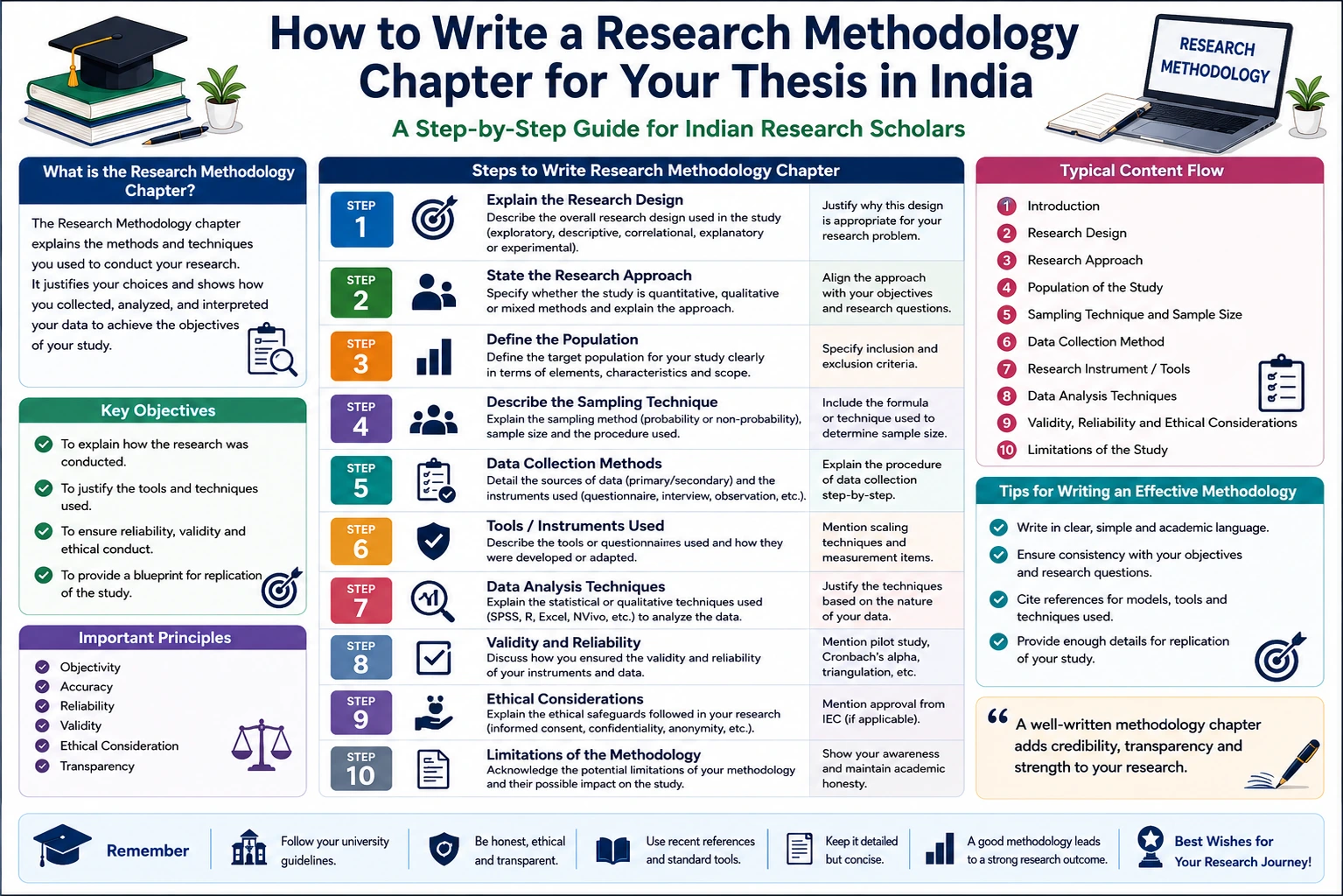
The research methodology chapter is one of the most important sections of a thesis or dissertation because it explains how your study was conducted. While the literature review establishes what is already known and the research gap justifies why your study is needed, the methodology chapter demonstrates that your research was designed and executed in a systematic, reliable, and ethical manner.
For many master's and PhD scholars in India, writing the methodology chapter can feel overwhelming. Questions such as "Which research design should I choose?", "How do I justify my sampling method?", "What is the difference between validity and reliability?", and "What should I include in the methodology chapter?" are common during thesis writing.
A well-written methodology chapter does more than describe the research process—it justifies every methodological decision. It explains why specific methods were chosen, how data were collected and analyzed, and how the study ensured accuracy, credibility, and ethical compliance. Examiners use this chapter to evaluate whether the research findings are trustworthy and whether another researcher could replicate the study.
In this practical guide, you'll learn the purpose of the methodology chapter, understand its standard structure, explore quantitative, qualitative, and mixed-methods approaches, and discover practical examples that can help you write a strong methodology chapter for your thesis.
Table of Contents
- What Is a Research Methodology Chapter?
- Why the Methodology Chapter Is Important
- Standard Structure of a Methodology Chapter
- Choosing the Right Research Approach
- Research Design
- Sampling Techniques
- Data Collection Methods
- Data Analysis Techniques
- Validity, Reliability, and Ethics
- Common Mistakes
- FAQs
- Conclusion
What Is a Research Methodology Chapter?
The research methodology chapter explains the methods and procedures used to conduct your study. It provides a detailed account of how you collected, analyzed, and interpreted your data while demonstrating that your research design was appropriate for addressing the research objectives.
In simple terms, the methodology chapter answers the following questions:
- What type of research was conducted?
- Why was this approach selected?
- Who participated in the study?
- How were participants selected?
- How was the data collected?
- How was the data analyzed?
- How did you ensure the quality and credibility of the findings?
- What ethical principles guided the research?
Rather than merely describing what was done, the methodology chapter should justify why each methodological choice was appropriate.
Why Is the Methodology Chapter Important?
The methodology chapter provides the foundation for the credibility of your research.
A strong methodology chapter:
- Demonstrates academic rigor.
- Justifies methodological decisions.
- Shows that the research objectives can be achieved.
- Enables other researchers to replicate the study.
- Strengthens the validity of your findings.
- Increases examiner confidence in the research.
Without a clear methodology, readers may question the reliability of your conclusions, regardless of how interesting your findings are.
Standard Structure of a Research Methodology Chapter
Although formatting requirements vary among universities, most methodology chapters include the following sections:
- Research Philosophy (if applicable)
- Research Approach
- Research Design
- Study Population
- Sampling Technique
- Sample Size
- Data Collection Methods
- Research Instruments
- Data Analysis Methods
- Validity and Reliability
- Ethical Considerations
- Chapter Summary
Each section contributes to explaining and justifying the overall research process.
Choosing the Right Research Approach
Selecting the appropriate research approach is one of the first methodological decisions.
The three most common approaches are:
- Quantitative Research
- Qualitative Research
- Mixed-Methods Research
Your choice depends on the research objectives, research questions, and type of data required.
Quantitative Research
Quantitative research focuses on numerical data and statistical analysis.
It is appropriate when the objective is to:
- Measure relationships between variables.
- Test hypotheses.
- Examine cause-and-effect relationships.
- Generalize findings to a larger population.
Examples of quantitative data collection methods include:
- Questionnaires
- Surveys
- Structured observations
- Experiments
Common statistical techniques include:
- Descriptive statistics
- Correlation analysis
- Regression analysis
- ANOVA
- Structural Equation Modelling (SEM)
Example
A study examining the relationship between employee engagement and job performance among IT professionals using survey responses from 500 employees.
Qualitative Research
Qualitative research explores experiences, opinions, behaviours, and meanings.
It is appropriate when researchers want to understand:
- Human experiences.
- Social phenomena.
- Individual perspectives.
- Organisational culture.
- Behavioural processes.
Common qualitative data collection methods include:
- Interviews
- Focus groups
- Case studies
- Participant observation
- Document analysis
Typical analytical techniques include:
- Thematic analysis
- Content analysis
- Narrative analysis
- Grounded theory
Example
A study exploring the experiences of first-generation university students through in-depth interviews.
Mixed-Methods Research
Mixed-methods research combines quantitative and qualitative approaches.
Researchers use this approach when numerical findings alone cannot fully explain a phenomenon.
For example:
A survey measures customer satisfaction while interviews explain why customers hold certain opinions.
Mixed-methods research often provides a more comprehensive understanding but requires additional planning and analysis.
Research Design
Research design refers to the overall strategy used to answer the research questions.
Several designs are commonly used in master's and PhD research.
Descriptive Research Design
Descriptive studies aim to describe characteristics of a population or phenomenon.
Example:
Examining online shopping preferences among university students.
Exploratory Research Design
Exploratory research investigates topics with limited previous knowledge.
Example:
Exploring the adoption of generative AI in Indian higher education.
Explanatory Research Design
Explanatory studies investigate causal relationships between variables.
Example:
Studying how leadership style influences employee engagement.
Case Study Research
Case studies involve an in-depth investigation of a specific organisation, event, individual, or community.
Example:
A case study examining digital transformation within a public sector bank.
Experimental Research
Experimental designs involve manipulating variables to examine cause-and-effect relationships.
These designs are common in medicine, psychology, and engineering but less frequent in management research.
Sampling Techniques
Sampling determines which participants will be included in your study.
Selecting an appropriate sampling technique improves the quality and credibility of your findings.
Sampling methods are generally divided into two categories.
Probability Sampling
Every member of the population has a known chance of selection.
Common probability sampling methods include:
- Simple random sampling
- Systematic sampling
- Stratified sampling
- Cluster sampling
These methods are preferred when researchers aim to generalise findings to a larger population.
Non-Probability Sampling
Not every member of the population has an equal chance of selection.
Common methods include:
- Convenience sampling
- Purposive sampling
- Snowball sampling
- Quota sampling
These approaches are frequently used in qualitative research and exploratory studies.
Sample Size
The appropriate sample size depends on:
- Research objectives.
- Population size.
- Statistical methods.
- Available resources.
- Research design.
For quantitative studies, researchers often justify sample size using statistical formulas or power analysis.
For qualitative research, sample size is usually determined by data saturation, meaning additional interviews no longer produce new insights.
Data Collection Methods
Once your research design and sampling strategy have been finalized, the next step is collecting data. The quality of your findings depends heavily on the accuracy and appropriateness of your data collection methods.
Data can generally be classified into two categories: primary data and secondary data.
Primary Data Collection
Primary data refers to information collected directly by the researcher for the specific objectives of the study.
Common primary data collection methods include:
Questionnaires
Questionnaires are widely used in quantitative research because they allow researchers to collect standardized information from a large number of participants.
Advantages include:
- Cost-effective
- Easy to administer
- Suitable for statistical analysis
- Large sample coverage
Example:
A survey measuring employee engagement using a five-point Likert scale.
Interviews
Interviews are commonly used in qualitative research to gain detailed insights into participants' experiences and opinions.
Types include:
- Structured interviews
- Semi-structured interviews
- Unstructured interviews
Semi-structured interviews are particularly popular in master's and PhD research because they provide flexibility while maintaining consistency.
Focus Group Discussions
Focus groups involve guided discussions with multiple participants.
They are useful when researchers wish to understand:
- Consumer behaviour
- Public opinion
- Product perceptions
- Social interactions
Observation
Observation involves systematically recording behaviours or events.
Observation may be:
- Participant observation
- Non-participant observation
This method is common in education, healthcare, anthropology, and organisational research.
Secondary Data Collection
Secondary data consists of information that has already been collected by other organizations or researchers.
Common sources include:
- Government reports
- Census data
- Journal articles
- Company annual reports
- Industry publications
- International organization databases
Secondary data can reduce research costs while providing access to large datasets.
Research Instruments
A research instrument is the tool used to collect data.
Examples include:
- Survey questionnaire
- Interview guide
- Observation checklist
- Psychological scales
- Assessment forms
When describing your instrument, include:
- Number of sections
- Measurement scale
- Source of items
- Adaptations made
- Pilot testing process
For example:
"The questionnaire consisted of four sections containing 32 items measured using a five-point Likert scale ranging from 'Strongly Disagree' to 'Strongly Agree.' Most items were adapted from previously validated instruments with minor modifications to suit the Indian context."
Data Analysis Techniques
The methodology chapter should explain how collected data were analysed.
The analytical technique depends on your research design.
Quantitative Data Analysis
Common techniques include:
Descriptive Statistics
Used to summarize data through:
- Mean
- Median
- Mode
- Standard deviation
- Percentages
- Frequency distributions
Inferential Statistics
Used to test hypotheses and relationships.
Common methods include:
- Correlation analysis
- Multiple regression
- t-tests
- ANOVA
- Chi-square tests
- Structural Equation Modelling (SEM)
Researchers should justify why each statistical test is appropriate.
Qualitative Data Analysis
Qualitative analysis focuses on identifying themes and patterns.
Common techniques include:
- Thematic analysis
- Content analysis
- Narrative analysis
- Grounded theory analysis
Researchers should describe how interviews were transcribed, coded, categorized, and interpreted.
Software Used
Many universities expect researchers to specify the software used for analysis.
Examples include:
Quantitative Software
- SPSS
- R
- Stata
- SAS
- Python
- Microsoft Excel
Qualitative Software
- NVivo
- MAXQDA
- ATLAS.ti
Mentioning the software enhances transparency and reproducibility.
Validity and Reliability
For quantitative research, validity and reliability demonstrate the quality of measurement.
Validity
Validity refers to whether the instrument measures what it is intended to measure.
Common types include:
Content Validity
Experts evaluate whether questionnaire items adequately represent the research concept.
Construct Validity
Examines whether measurement items accurately reflect theoretical constructs.
Criterion Validity
Assesses how well one measure predicts another established measure.
Reliability
Reliability refers to the consistency of measurement.
The most commonly reported indicator is Cronbach's Alpha, where values of 0.70 or above are generally considered acceptable in many research contexts.
Researchers should report both the reliability coefficient and how it was calculated.
Trustworthiness in Qualitative Research
Qualitative studies emphasize trustworthiness rather than statistical validity.
Key criteria include:
Credibility
Ensures findings accurately represent participants' experiences.
Strategies include:
- Member checking
- Triangulation
- Prolonged engagement
Transferability
Provides sufficient contextual detail so readers can judge whether findings may apply in similar settings.
Dependability
Demonstrates that the research process was logical, documented, and consistent.
Confirmability
Shows that findings are based on participants' perspectives rather than researcher bias.
Ethical Considerations
Ethical compliance is essential in both master's and PhD research.
Common ethical principles include:
Informed Consent
Participants should voluntarily agree to participate after understanding the purpose, procedures, risks, and benefits of the study.
Confidentiality
Researchers should protect participants' identities by removing personally identifiable information where appropriate.
Voluntary Participation
Participants should be free to withdraw from the study at any time without penalty.
Data Protection
Collected data should be stored securely and accessed only by authorized individuals.
Avoidance of Harm
Researchers should ensure that participation does not expose individuals to unnecessary physical, psychological, social, or financial risks.
Clearly describing ethical procedures demonstrates professionalism and strengthens the credibility of your research.
Research Methodology Chapter Template
You can adapt the following structure for most master's and PhD theses:
- Introduction
- Research Philosophy (if applicable)
- Research Approach
- Research Design
- Study Population
- Sampling Technique
- Sample Size
- Data Collection Methods
- Research Instruments
- Pilot Study (if conducted)
- Data Analysis Techniques
- Validity and Reliability (or Trustworthiness for qualitative studies)
- Ethical Considerations
- Chapter Summary
Always align this structure with your university's formatting guidelines.
Common Mistakes to Avoid
Many methodology chapters require revision because of avoidable errors.
Describing Methods Without Justification
Do not simply state what you did—explain why the chosen methods were appropriate for your research objectives.
Choosing Inappropriate Sampling
Ensure your sampling strategy aligns with the research design and target population.
Omitting Ethical Procedures
Failure to discuss ethics can raise concerns about the credibility of your research.
Providing Insufficient Detail
Readers should have enough information to understand—and, where appropriate, replicate—your study.
Confusing Methods with Methodology
Methods refer to the specific techniques used (such as surveys or interviews), while methodology explains the rationale behind choosing those methods.
Frequently Asked Questions
What is the purpose of the research methodology chapter?
It explains how the research was conducted and justifies the methods used to answer the research questions.
Can I use both qualitative and quantitative methods?
Yes. Mixed-methods research combines both approaches when they are appropriate for addressing the research objectives.
Should I explain why I selected a particular sampling technique?
Absolutely. Examiners expect you to justify your sampling decisions rather than simply naming the method.
Is a pilot study necessary?
Not always. However, pilot studies are often recommended for questionnaire-based research to test clarity, reliability, and feasibility before full-scale data collection.
What software should I mention?
List the software actually used in your research, such as SPSS, R, NVivo, MAXQDA, Stata, Excel, or Python, and briefly explain its role in the analysis.
Conclusion
The research methodology chapter is one of the most critical components of a thesis because it demonstrates the scientific rigor and credibility of your study. By clearly explaining your research approach, design, sampling strategy, data collection methods, analytical techniques, and ethical considerations, you enable readers to understand how your findings were generated and why they can be trusted.
A strong methodology chapter goes beyond describing procedures—it justifies every methodological choice and shows how each decision supports the research objectives. Whether you are conducting quantitative, qualitative, or mixed-methods research, transparency and logical reasoning are essential.
As you write your methodology chapter, remember to align your methods with your research questions, follow your university's guidelines, and provide enough detail for readers to evaluate the quality of your research. Careful planning and clear documentation will not only strengthen your thesis but also improve its contribution to academic knowledge and professional practice.
Call / WhatsApp: +91 96438 02216
Website:www.ThesisLikho.com