
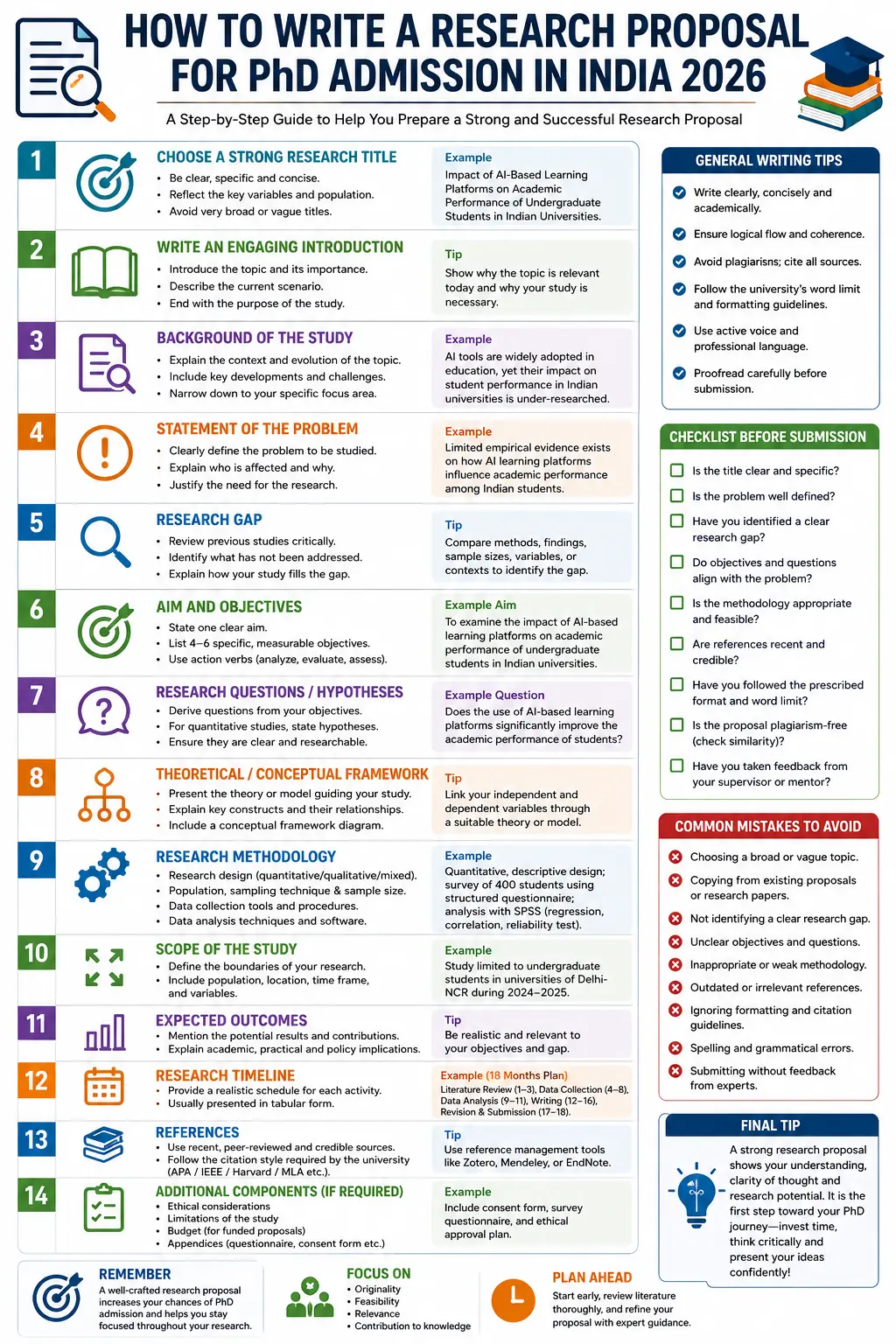
Applying for a PhD is one of the most important steps in an academic career, and the research proposal is often the deciding factor in the admission process. Whether you are applying to an IIT, NIT, Central University, State University, Deemed University, or a private institution in India, a well-written research proposal demonstrates your ability to identify a meaningful research problem, design a feasible study, and contribute original knowledge to your field.
In 2026, the competition for PhD admissions in India is expected to remain strong as more students and working professionals pursue doctoral studies in engineering, management, sciences, social sciences, education, healthcare, law, and emerging interdisciplinary fields. Admission committees are not just looking for good academic records—they want candidates who have a clear research vision, understand existing literature, and can propose a practical and impactful research plan.
Unfortunately, many applicants lose valuable opportunities because their research proposals are vague, poorly structured, or fail to explain the significance of the proposed study. A strong proposal, on the other hand, can significantly improve your chances of securing admission, attracting a supportive supervisor, and obtaining research funding.
This comprehensive guide explains how to write a research proposal for PhD admission in India in 2026, including the standard format, essential sections, practical examples, common mistakes, and expert writing tips.
What Is a PhD Research Proposal?
A research proposal is a formal academic document that outlines the research you intend to conduct during your PhD. It serves as a blueprint for your proposed study and helps the admission committee evaluate whether your research idea is original, relevant, feasible, and academically valuable.
A typical research proposal explains:
- What you want to study.
- Why the research is important.
- What gap in existing knowledge your study addresses.
- How you plan to conduct the research.
- What contribution your research is expected to make.
Unlike the final thesis, the proposal focuses on planning rather than reporting completed research.
Why Is a Research Proposal Important?
A research proposal is much more than an admission requirement. It allows universities and prospective supervisors to assess your readiness for doctoral research.
A strong proposal demonstrates:
- Clear understanding of the research problem.
- Awareness of existing literature.
- Ability to identify a genuine research gap.
- Knowledge of appropriate research methods.
- Logical and feasible research planning.
- Potential to contribute to your discipline.
For many universities, the proposal also forms the basis of your interview or research presentation.
Standard Structure of a PhD Research Proposal
Most Indian universities expect the following sections:
- Title
- Introduction
- Background of the Study
- Statement of the Problem
- Research Gap
- Aim and Objectives
- Research Questions or Hypotheses
- Review of Literature
- Theoretical or Conceptual Framework
- Research Methodology
- Scope of the Study
- Expected Outcomes
- Timeline
- References
Let us examine each section in detail.
Step 1: Choose a Strong Research Title
The title is the first impression your proposal creates.
A good research title should be:
- Clear
- Specific
- Concise
- Relevant
- Reflective of your research variables
Weak Title
Artificial Intelligence
Improved Title
Assessing the Impact of Artificial Intelligence-Based Learning Platforms on Academic Performance in Indian Higher Education Institutions
Your title should communicate the focus of the proposed research without being unnecessarily long.
Step 2: Write an Engaging Introduction
The introduction provides the context for your research.
Include:
- General background
- Current developments
- Importance of the topic
- Brief overview of the research problem
- Purpose of the study
For example, if your topic is renewable energy, discuss the global shift toward clean energy, India's sustainability goals, and the challenges that justify your proposed research.
A compelling introduction captures the reader's attention and sets the stage for the rest of the proposal.
Step 3: Explain the Background of the Study
The background provides a deeper understanding of the research area.
Discuss:
- Historical developments
- Existing conditions
- Current challenges
- Recent technological or policy changes
- Why the issue deserves investigation
This section should gradually narrow from the broad topic to the specific problem your study addresses.
Step 4: Define the Research Problem
The problem statement explains the issue your research seeks to solve.
A strong problem statement answers:
- What is the problem?
- Who is affected?
- Why is the problem important?
- Why is further research needed?
Example
Despite the increasing adoption of AI-based educational platforms in India, limited empirical evidence exists regarding their long-term impact on student engagement and learning outcomes across diverse higher education institutions.
The problem statement should clearly justify the need for your proposed study.
Step 5: Identify the Research Gap
One of the most important parts of the proposal is identifying what previous studies have not adequately addressed.
Common research gaps include:
- Limited studies in the Indian context.
- Outdated datasets.
- Underexplored variables.
- Contradictory findings.
- Small sample sizes.
- Lack of interdisciplinary approaches.
Example
Although previous research has examined AI adoption in education, few studies have investigated its influence on academic performance among undergraduate students in Indian public and private universities.
A clearly defined gap demonstrates the originality of your research.
Step 6: State the Research Aim and Objectives
Your research aim describes the overall purpose of the study.
Example Aim
To examine the impact of artificial intelligence-based learning platforms on student academic performance in Indian universities.
Specific objectives should break the aim into measurable tasks.
Example Objectives
- To assess students' awareness of AI learning platforms.
- To identify factors influencing AI adoption.
- To evaluate the relationship between AI usage and academic performance.
- To examine challenges associated with AI-assisted learning.
- To recommend strategies for improving AI integration in higher education.
Use action verbs such as analyze, evaluate, examine, identify, assess, compare, and determine.
Step 7: Develop Research Questions or Hypotheses
Research questions should align directly with your objectives.
Example Research Questions
- What factors influence students' adoption of AI learning platforms?
- How does AI usage affect academic performance?
- What challenges do students encounter while using AI-based educational tools?
If your study is quantitative, you may formulate hypotheses.
Example
H1: AI platform usage has a significant positive effect on students' academic performance.
Ensure that your questions or hypotheses are specific, researchable, and measurable.
Step 8: Conduct a Critical Literature Review
The literature review demonstrates your understanding of existing research.
Instead of summarizing articles one by one, organize the discussion around themes.
Include:
- Major theories.
- Key findings.
- Research methodologies.
- Areas of agreement and disagreement.
- Strengths and limitations of previous studies.
Use recent peer-reviewed journal articles, books, conference papers, and authoritative reports.
A critical review shows how your proposed study builds upon existing knowledge.
Step 9: Present the Theoretical or Conceptual Framework
Explain the theory or model that guides your research.
Examples include:
- Technology Acceptance Model (TAM)
- Theory of Planned Behavior
- Diffusion of Innovation Theory
- Resource-Based View
- Constructivist Learning Theory
- Health Belief Model
Describe:
- Origin of the theory.
- Key concepts.
- Relevance to your research.
- Relationship with your variables.
If appropriate, include a conceptual framework diagram illustrating the relationships among variables.
Step 10: Describe the Research Methodology
The methodology explains how you intend to conduct the study.
Research Design
Specify whether the study is:
- Quantitative
- Qualitative
- Mixed methods
Research Approach
Examples include:
- Descriptive
- Exploratory
- Explanatory
- Experimental
Population
Clearly identify the target population.
Example:
Undergraduate students enrolled in Indian universities.
Sampling
Specify:
- Sampling technique
- Proposed sample size
- Justification
Common techniques include:
- Random sampling
- Stratified sampling
- Convenience sampling
- Purposive sampling
Data Collection
Examples:
- Surveys
- Interviews
- Focus group discussions
- Observations
- Secondary databases
Data Analysis
Mention the tools and techniques you plan to use.
Examples:
Software:
- SPSS
- R
- Python
- NVivo
- SmartPLS
- AMOS
Methods:
- Descriptive statistics
- Correlation analysis
- Regression analysis
- ANOVA
- Structural Equation Modeling (SEM)
- Thematic analysis
Your methodology should align with your objectives and research questions.
Step 11: Define the Scope of the Study
Clearly describe the boundaries of your research.
Include:
- Geographic scope.
- Target population.
- Time period.
- Variables included.
- Context of the study.
Defining the scope helps keep your research focused and realistic.
Step 12: Explain the Expected Outcomes
Describe what your study is expected to contribute.
Potential contributions include:
- New theoretical insights.
- Practical recommendations.
- Industry applications.
- Policy implications.
- Future research directions.
Avoid making unrealistic claims. Focus on the potential value of your research.
Step 13: Prepare a Research Timeline
A realistic timeline demonstrates effective planning.
Adjust the schedule according to the expected duration of your PhD program.
Step 14: Include References
Your proposal should conclude with a complete list of references.
Follow the citation style prescribed by the university, such as:
- APA 7th Edition
- IEEE
- Harvard
- MLA
- Chicago
Use recent and credible academic sources, and ensure that every in-text citation appears in the reference list.
Formatting Guidelines
Although each university may have its own template, a professional research proposal typically follows these standards:
- Font: Times New Roman
- Font Size: 12 pt
- Line Spacing: 1.5
- Margins: 1 inch
- Page Numbers: Bottom center or bottom right
- Headings: Consistent formatting throughout
- Word Count: Generally 2,000–5,000 words, depending on university requirements
Always review the official guidelines of the institution before submission.
Common Mistakes to Avoid
Many applicants weaken their proposals through avoidable errors.
Common mistakes include:
- Choosing a topic that is too broad or lacks originality.
- Failing to identify a clear research gap.
- Writing vague objectives or research questions.
- Selecting a methodology that does not align with the objectives.
- Relying on outdated or unreliable references.
- Ignoring formatting and citation requirements.
- Making unsupported claims without evidence.
- Overlooking proofreading and language quality.
- Submitting content with plagiarism or improper citations.
Careful revision and supervisor feedback can help eliminate these issues.
Tips to Improve Your PhD Research Proposal
To strengthen your proposal and improve your chances of admission:
- Select a topic aligned with current research priorities and your long-term academic interests.
- Read recent Scopus, Web of Science, or UGC CARE-indexed journal articles to identify meaningful research gaps.
- Ensure consistency between your title, objectives, research questions, methodology, and expected outcomes.
- Demonstrate critical thinking by evaluating previous studies rather than merely summarizing them.
- Write in a clear, formal academic style and avoid unnecessary jargon.
- Use plagiarism detection software before submission to verify originality.
- Seek feedback from mentors or prospective supervisors and revise the proposal accordingly.
- Tailor your proposal to the department's research strengths and available expertise whenever possible.
A thoughtful, well-structured proposal reflects both your research potential and your commitment to doctoral study.
Final Thoughts
A research proposal is the foundation of your PhD application and often the first opportunity to demonstrate your ability to think like a researcher. It should clearly explain the problem you intend to investigate, justify why the study is important, identify a genuine gap in existing knowledge, and present a practical plan for conducting the research.
For applicants seeking PhD admission in India in 2026, investing time in preparing a strong proposal can significantly improve the likelihood of securing admission and finding a supervisor whose interests align with your research goals. Focus on clarity, originality, feasibility, and academic rigor throughout the document.
Remember that a successful proposal is not about having all the answers—it is about asking meaningful research questions and presenting a well-reasoned plan to answer them. With careful preparation, thorough literature review, and consistent refinement, your research proposal can become the first major step toward a successful and rewarding PhD journey.
Website: www.thesislikho.com
Call / WhatsApp: +91-96438 02216