
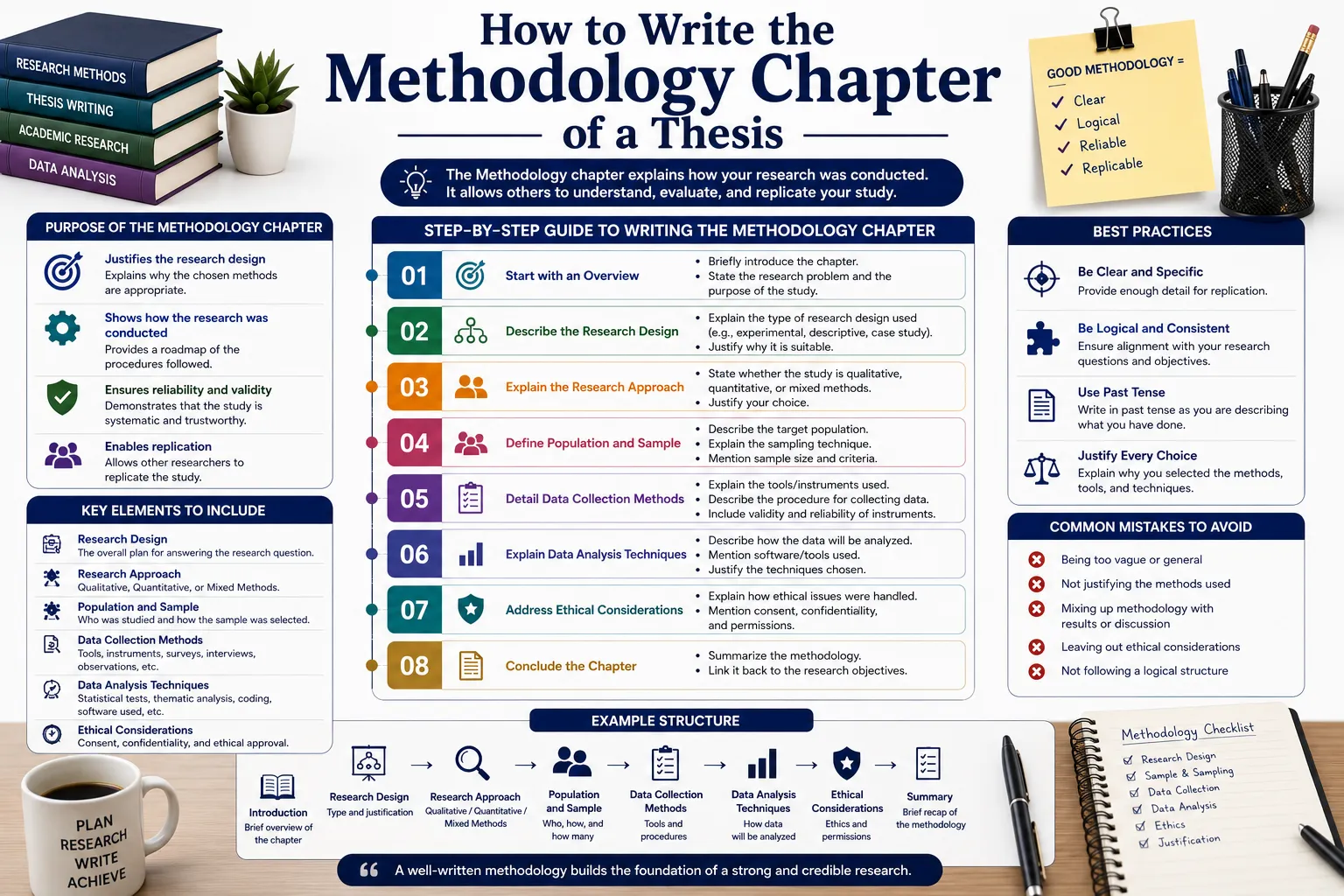
Of all the chapters in a thesis, the methodology chapter is the one examiners tend to read most critically — not because it needs the most creative writing, but because it's where they judge whether your findings can actually be trusted. A brilliant literature review and a well-chosen topic can still be undermined by a methodology chapter that's vague about sampling, thin on justification, or inconsistent with the analysis that follows.
This guide walks through how to write the methodology chapter of a thesis, section by section, with the level of specificity examiners actually look for. We've written it the way an experienced thesis mentor would talk you through your own first draft, because that's genuinely the kind of guidance ThesisLikho's PhD-qualified team provides to the thousands of scholars we've supported through exactly this chapter.
What the Methodology Chapter Actually Needs to Do
A methodology chapter has one core job: convince your reader that your chosen approach can actually answer your research question, and that you've executed it with enough rigor and transparency for someone else to follow — and ideally replicate — what you did. This isn't a formality. Examiners frequently scrutinize this chapter more closely than any other, because every conclusion in your results and discussion chapters ultimately rests on decisions made here.
The single most useful mental test as you draft each section: could a knowledgeable stranger, reading only this chapter, understand exactly what you did and why, well enough to picture themselves repeating your study? If a section leaves that stranger unsure of a key detail — how many participants, how they were selected, what exact statistical test was run — it needs more specificity before it's ready.
Opening: Research Philosophy and Design
Most methodology chapters open by briefly stating a research philosophy (positivist, interpretivist, or pragmatist, depending on your discipline's conventions) before moving into research design. This section doesn't need to be lengthy, but it should clearly connect your philosophical stance to your chosen approach — a positivist stance naturally supports quantitative, hypothesis-testing research, while an interpretivist stance naturally supports qualitative, meaning-focused research.
From there, state your overall research design explicitly: is this an exploratory, descriptive, or causal study? Is it qualitative, quantitative, or mixed methods? Naming these clearly and early gives your reader a frame for everything that follows, rather than making them infer your approach from scattered details later in the chapter.
Describing Your Population and Sampling Approach
This section should specify exactly who your target population is, how you selected your sample from that population, and why that specific sampling technique fits your research question. Vague statements like "participants were selected based on availability" without further explanation are a common, avoidable weak spot — even convenience or purposive sampling (both entirely legitimate at the thesis level) need a clear rationale, not just a label.
If your study involves interviews or focus groups, Purdue OWL's guidance on primary research is a useful frame here: interviews suit situations where you want in-depth, expert-level insight from a smaller number of people, while surveys suit situations where breadth of opinion across a larger group matters more than individual depth. Explicitly connecting your chosen method to this kind of reasoning — rather than simply stating what you did — is what turns a description into a justification.
Justifying Your Sample Size
Sample size expectations vary by research design, and stating a number without justification is one of the fastest ways to invite committee questions. For survey-based quantitative studies at the master's or MBA level, a commonly used reference point is 100 to 200 respondents as a reasonable minimum, though this should scale up for more complex statistical models. If you're running Structural Equation Modeling through SmartPLS or AMOS, a frequently cited rule of thumb suggests roughly ten times the number of indicators in your most complex construct, though a formal power analysis is increasingly recommended over relying on this shortcut alone. For qualitative interview studies, ten to fifteen participants is a commonly accepted range at the thesis level, guided by the principle of thematic saturation — the point where new interviews stop revealing genuinely new themes — rather than a fixed target number decided in advance.
Whatever figure you land on, always check your own university's specific methodology guidelines before finalizing it, since some departments specify their own minimums, and citing an incorrect "universal" number is a common reason a proposal or thesis draft gets sent back for revision.
Data Collection Instruments and Process
This section should describe your actual instrument — your questionnaire, your interview guide, your observation protocol — in enough detail that a reader understands its structure, not just its existence. For a survey, specify the scale type (a 5-point or 7-point Likert scale is standard), whether you adapted an existing validated instrument or developed a new one, and whether you piloted it before full rollout.
Purdue OWL's guidance on writing effective survey and interview questions is directly relevant here: questions should avoid leading or biased phrasing that nudges a respondent toward a particular answer, since this compromises the very data your analysis depends on. If you adapted your instrument from a previously published study, cite that source clearly and explain any modifications you made and why.
Also specify your data collection timeline and process explicitly — vague phrasing like "data was collected over several weeks" tells a reader almost nothing useful; naming your actual collection window, method of distribution, and response rate gives your chapter real substance.
Data Analysis Techniques
This is where many methodology chapters lose specificity right when it matters most. A statement like "the data will be analyzed using appropriate statistical methods" tells a reader nothing concrete. A stronger version names the exact technique: descriptive statistics followed by multiple regression analysis in SPSS, or a full measurement and structural model assessment in SmartPLS, including which fit indices and significance thresholds you applied.
For qualitative data, specify your coding approach — thematic analysis, content analysis, or a specific coding framework — and name the software you used (NVivo is the standard choice for most thesis-level qualitative coding) along with a brief description of how you moved from raw transcripts to final themes. Google Scholar's citation-tracking feature is genuinely useful at this stage of writing: tracing how other published studies in your specific area have applied and adapted a given analysis technique helps you both justify your own choice and catch any field-specific conventions you might otherwise miss.
Reliability and Validity
Reliability refers to how consistently your instrument produces the same results, while validity refers to whether it actually measures what it claims to measure. For quantitative studies, the most commonly reported reliability measure is Cronbach's Alpha, testing internal consistency across scale items. The widely cited convention treats 0.70 as the general minimum threshold for confirmatory research, with values as low as 0.60 sometimes considered acceptable for exploratory studies using newly developed scales, and 0.80 or above typically read as strong reliability. It's worth treating this as a convention rather than a strict pass/fail rule — methodologists increasingly caution against rigid thresholds, so reporting your actual value alongside a brief interpretation is stronger than simply stating the number in isolation.
For validity, common checks include content validity (expert review confirming your items genuinely reflect the construct you intend to measure), convergent validity (items measuring the same construct correlating strongly with each other, often assessed via Average Variance Extracted in SEM software), and discriminant validity (items measuring different constructs not overlapping excessively). For qualitative studies, the equivalent concepts are credibility, transferability, and dependability — applying quantitative reliability/validity language directly to a qualitative design is a recognized mismatch worth avoiding.
Ethical Considerations
Even a modest thesis survey needs to address informed consent, confidentiality or anonymity of participant data, and how collected data will be stored and eventually handled. If your research involves vulnerable populations, sensitive topics, or organizational data obtained through an internship or industry contact, this section needs correspondingly more detail, including how you secured any necessary permissions.
Most Indian universities require a short ethics statement or a signed informed consent template as an appendix — check your specific department's exact format requirement rather than assuming a generic template from another university's guide will be accepted without modification.
Limitations Section
An honest, well-articulated limitations section actually strengthens your methodology chapter rather than weakening it — examiners generally read the absence of any acknowledged limitation as a red flag, not a sign of a flawless study. Common limitations worth naming explicitly, where they genuinely apply, include a non-random or convenience-based sample (which limits generalizability), a modest sample size relative to the broader population, a single-region or single-industry scope, and any constraints imposed by your specific timeline or resource access.
The key is framing these honestly and specifically, rather than either omitting them or hedging so vaguely ("this study, like all research, has some limitations") that the statement adds nothing useful to the chapter.
Writing With Enough Specificity to Be Replicable
A useful habit throughout this entire chapter: whenever you're tempted to write a general statement, ask whether a specific number, name, or detail could replace it. "A survey was distributed" becomes "a 25-item, 5-point Likert-scale survey was distributed via email to 220 employees across three departments." "Data was analyzed statistically" becomes "descriptive statistics were followed by hierarchical multiple regression in SPSS, with mediation tested via the PROCESS macro." This single habit, applied consistently across every section, is what separates a methodology chapter examiners trust from one that reads as competent but vague.
Common Mistakes in Methodology Chapters
A recurring pattern in weaker methodology chapters is choosing a method because it felt easier to execute, rather than because it genuinely fit the research question — examiners can usually tell when this mismatch exists. Vague sampling justification is another common gap: stating a sample size and selection method without explaining why that specific approach suits the research question. Copy-pasting textbook definitions of methodological terms, rather than paraphrasing them in your own words with proper citation, is a frequent and entirely avoidable source of plagiarism-check flags. Skipping pilot testing of a survey or interview guide often means confusing wording only surfaces after full data collection is already complete, when it's too late to fix cheaply. And reporting a reliability figure like Cronbach's Alpha without any interpretation — just stating the number and moving on — misses an easy opportunity to strengthen your chapter's credibility.
A Realistic Example Walkthrough
Scenario — Ankit, a first-time master's thesis writer
Ankit's first methodology draft stated: "A survey will be conducted among consumers, and the data will be analyzed using SPSS." His supervisor's feedback was direct: there was nothing in this paragraph a reader could actually picture or replicate. Ankit's revised version specified a 20-item, 5-point Likert-scale questionnaire adapted from a previously validated brand-trust scale, distributed to 180 respondents selected via convenience sampling across two shopping malls in his city, piloted on 15 respondents beforehand to check for confusing wording, and analyzed using descriptive statistics followed by hierarchical multiple regression in SPSS, with Cronbach's Alpha reported for each construct. The underlying research hadn't changed at all — only the level of specificity had, and that alone was enough to move his chapter from "vague but plausible" to something his committee could actually evaluate and trust.
This is a pattern we see constantly in mentoring work: strong methodology chapters aren't necessarily more complex studies — they're simply written with enough concrete detail that a reader never has to guess what actually happened.
Scenario — Meghna, a qualitative thesis writer in an organizational behavior program
Meghna's first draft of her qualitative methodology chapter read reasonably well as prose but left her committee with a specific question: how, exactly, did she move from raw interview transcripts to her final six themes? Her original draft simply stated that "thematic analysis was conducted." Her revision walked through the actual process step by step — familiarization with the transcripts, initial line-by-line coding in NVivo, grouping codes into candidate themes, reviewing those themes against the full dataset, and finally naming and defining each one, with a brief example of how one raw quote was coded and eventually mapped to its final theme. The underlying analysis was identical in both drafts — what changed was making the previously invisible analytical process visible and traceable, which is exactly what a committee needs to trust a qualitative chapter's rigor.
If you'd like a second opinion on your own methodology chapter before it goes to your supervisor, our Thesis Writing Service offers exactly this kind of structural review from PhD-qualified mentors. For a deeper look at sampling technique selection specifically, see our companion guide
Citing Your Methodological Choices Properly
A detail that's easy to overlook: your methodology chapter needs citations just as much as your literature review does, though writers often forget this since the chapter feels more procedural than argumentative. Any adapted survey instrument, established analysis technique, or named statistical test drawn from prior literature needs a proper citation — both to give appropriate credit and to demonstrate that your approach has methodological precedent rather than being invented from scratch. UGC's INFLIBNET guidelines for Indian thesis submission require a standard, consistently applied citation style throughout the entire thesis, and this consistency needs to extend into the methodology chapter specifically, not just the literature review.
A practical habit worth adopting: whenever you name a specific technique (say, the PROCESS macro for mediation analysis, or a particular Likert-scale instrument), pause and confirm you've cited its original source, even if the citation is brief. This single habit both strengthens your chapter's credibility and avoids an easily overlooked category of citation gaps that can otherwise surface during a plagiarism or reference-consistency check.
How Chapter Structure Shifts for Qualitative vs. Quantitative Theses
While every methodology chapter covers the same broad territory — design, sampling, data collection, analysis, ethics, and limitations — the internal emphasis shifts noticeably depending on your overall approach.
A quantitative methodology chapter tends to front-load its rigor into the sampling and instrument sections, since generalizability depends heavily on getting these details right before any data is collected, and typically closes with a fairly mechanical, test-by-test description of planned statistical analysis. A qualitative methodology chapter, by contrast, usually spends comparatively more space describing the analytical process itself — how coding was conducted, how themes were developed and refined, and how the researcher's own position or potential bias was acknowledged and managed — since qualitative rigor is demonstrated through a visible, well-documented interpretive process rather than through a replicable statistical formula.
A mixed-methods chapter needs to do both, plus an additional section explaining specifically how the qualitative and quantitative components were integrated — sequential, parallel, or otherwise — since this integration step is exactly what distinguishes genuine mixed-methods research from two loosely related studies bound together in one document.
Pre-Submission Checklist
Before finalizing your methodology chapter, confirm that your research philosophy and design are explicitly stated rather than left implied, your sampling technique and sample size are both named and justified rather than simply stated, your data collection instrument is described in enough detail that a reader could picture exactly what participants encountered, your analysis technique names the specific test or coding approach used rather than a general description, your reliability and validity checks are explained with interpretation rather than a bare number, your ethics statement covers consent, confidentiality, and data handling, and your limitations are stated honestly and specifically rather than omitted or hedged into vagueness.
Getting Expert Support
Even experienced researchers benefit from a second, structured read on a methodology chapter before submission — a vague sampling justification or an under-specified analysis plan is far cheaper to fix on paper than after data collection has already been completed around it.
Frequently Asked Questions
How do you write the methodology chapter of a thesis?
State your research philosophy and design, describe and justify your population and sampling approach, detail your data collection instrument and process, name your specific analysis technique, report reliability and validity with interpretation, address ethical considerations, and honestly state your study's limitations — all with enough concrete detail that another researcher could follow and replicate your approach.
How long does it take to complete a thesis using this approach?
Drafting a solid methodology chapter typically takes two to four weeks once your overall research design is settled, though pilot testing and instrument refinement can add time before the chapter is genuinely ready for submission.
Is professional help available to write the methodology chapter of a thesis?
Yes — structured mentoring on methodology-chapter structuring, sample size justification, and reliability/validity reporting is a standard, legitimate form of academic support. ThesisLikho's PhD-qualified mentors offer this kind of guided review for thesis scholars.
Why should I write the methodology chapter of a thesis with this level of specificity?
A vague methodology chapter undermines every conclusion that follows it — examiners scrutinize this chapter specifically because your results and discussion depend entirely on whether your approach was sound and clearly executed.
When should you write the methodology chapter of a thesis?
Ideally once your research design, sampling approach, and instrument are finalized but before full-scale data collection begins — drafting it early forces you to spot gaps in your own plan while there's still time to pilot test and adjust, rather than discovering them after data collection is already complete.
Talk to a Thesis Expert
If you'd like a mentor to review your methodology chapter before you submit it to your supervisor, ThesisLikho's team is ready to help.