
The thesis abstract is often the first section that supervisors, examiners, journal reviewers, and researchers read—but it is usually the last section you should write. Despite being only a few hundred words long, the abstract plays a critical role in communicating the purpose, methodology, findings, and significance of your research. A well-written abstract can create a strong first impression and help readers quickly understand the value of your study.
For many master's and PhD students, writing the abstract is surprisingly difficult. After spending months or years conducting research, it can be challenging to summarize an entire thesis into a concise, clear, and engaging overview. Common questions include: How long should an abstract be? What should it include? Should references or citations be added? Can tables or figures be used?
The answer lies in understanding the purpose and structure of an academic abstract. Rather than serving as an introduction or conclusion, the abstract is a self-contained summary of your entire research. It should enable readers to understand the problem, objectives, methods, findings, and conclusions without reading the full thesis.
In this comprehensive guide, you'll learn how to write a thesis abstract that meets university expectations, explore the ideal format, review practical writing tips, and examine sample abstracts for different research methodologies.
What Is a Thesis Abstract?
A thesis abstract is a concise summary of your entire research project. It presents the essential elements of your study, including the research problem, objectives, methodology, key findings, and conclusions.
Unlike the introduction, which provides background information and explains why the research is important, the abstract gives readers a complete overview of what the research accomplished.
A well-written abstract allows readers to quickly determine:
- What the research investigated.
- Why the study was conducted.
- How the research was carried out.
- What the major findings were.
- Why the findings are important.
Because many databases index only the title and abstract, this section significantly influences whether other researchers choose to read your full thesis.
Why the Thesis Abstract Is Important
Although short, the abstract serves several important purposes.
A strong abstract:
- Creates a positive first impression.
- Demonstrates the quality of the research.
- Helps examiners understand the study quickly.
- Improves discoverability in academic databases.
- Assists researchers searching for relevant literature.
- Highlights the originality of the research.
- Encourages readers to continue reading the thesis.
In many cases, readers decide whether to explore the complete thesis based on the quality of the abstract alone.
What Should a Thesis Abstract Include?
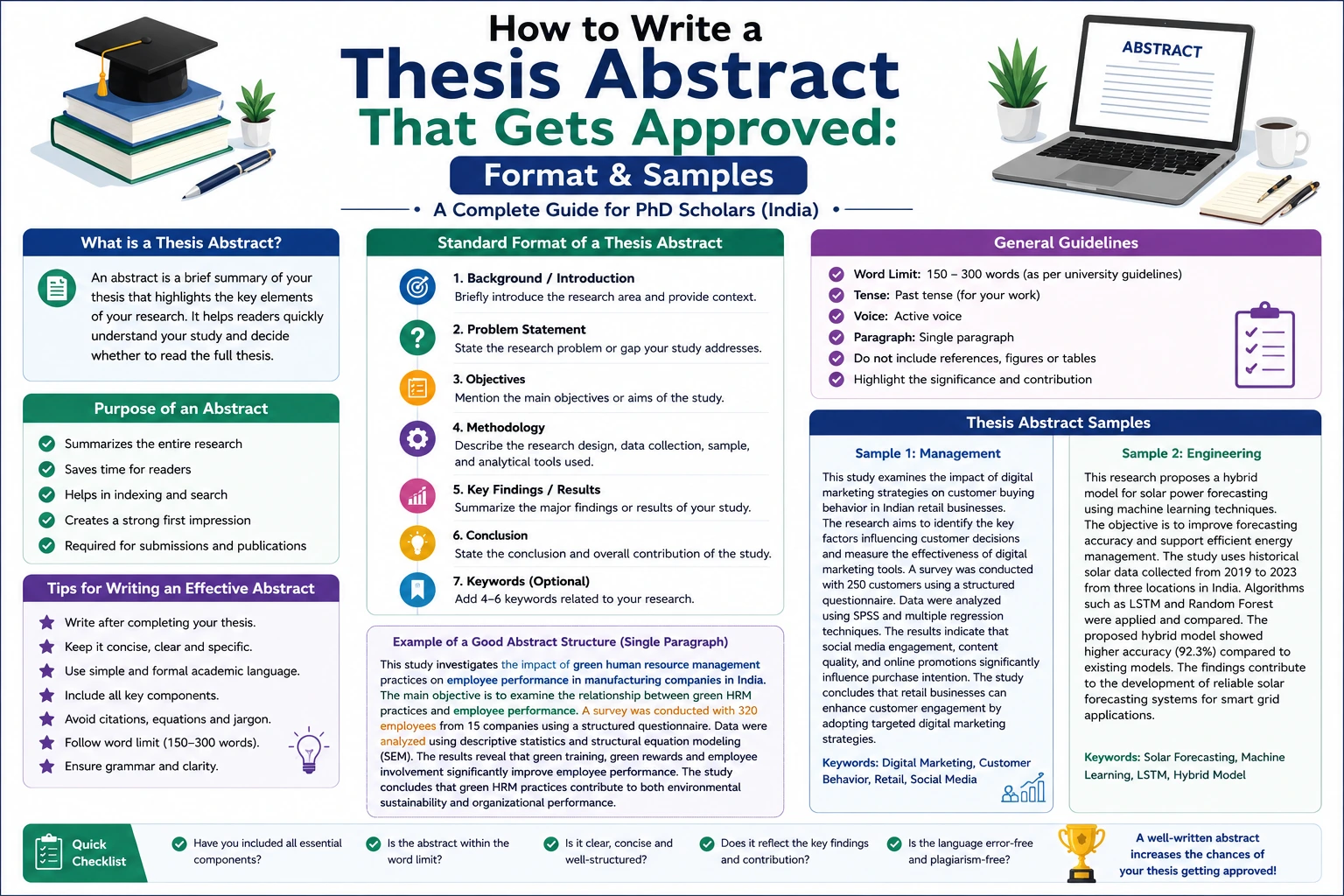
Most universities expect a thesis abstract to include five essential elements.
1. Background or Research Problem
Begin by briefly introducing the research problem or topic.
For example:
"Artificial intelligence is transforming customer service across multiple industries; however, limited evidence exists regarding its influence on customer trust in Indian retail banking."
This section should immediately establish the context of the study.
2. Research Objectives
Briefly state what the research aimed to achieve.
For example:
"This study examined the impact of AI-enabled customer service on customer satisfaction, trust, and loyalty among retail banking customers in India."
Avoid listing every objective individually. Instead, summarize them naturally.
3. Research Methodology
Readers should understand how the study was conducted.
Include information such as:
- Research design
- Sample
- Data collection methods
- Analytical techniques
For example:
"A quantitative research design was adopted. Data were collected from 450 respondents through structured questionnaires and analysed using structural equation modelling."
Keep methodological details concise.
4. Key Findings
This is the most important section of the abstract.
Summarize the major findings without discussing every statistical result.
For example:
"The findings indicate that AI-driven personalization significantly improves customer satisfaction, while digital trust partially mediates the relationship between AI adoption and customer loyalty."
Focus on the most meaningful outcomes.
5. Conclusion and Contribution
Conclude by explaining the significance of the research.
For example:
"The study contributes to technology adoption literature by extending existing theoretical models within the Indian banking context and provides practical recommendations for financial institutions implementing AI-powered customer service."
This final sentence should emphasize the value of your research.
Standard Thesis Abstract Format
Although formatting requirements differ slightly across universities, most thesis abstracts follow a similar structure.
Background
One or two sentences introducing the research problem.
Objective
One sentence explaining the purpose of the study.
Methodology
Two to four sentences summarizing the research design, sample, data collection, and analysis.
Findings
Three to five sentences highlighting the most important results.
Conclusion
One or two sentences explaining the significance and contribution of the study.
This logical sequence ensures that readers receive a complete overview without unnecessary detail.
How Long Should a Thesis Abstract Be?
The required length varies across universities and degree levels.
General guidelines include:
Degree Typical Word Count
Undergraduate 150–250 words
Master's Dissertation 200–350 words
PhD Thesis 300–500 words
Always consult your university's formatting guidelines before submission, as some institutions specify a maximum word count.
Step-by-Step Guide to Writing a Thesis Abstract
Step 1: Finish Your Thesis First
Although the abstract appears at the beginning of your thesis, it should be written after completing all chapters.
Only after finishing the research can you accurately summarize the objectives, methodology, findings, and conclusions.
Step 2: Identify the Most Important Information
Review your thesis and identify:
- Research problem
- Objectives
- Methodology
- Main findings
- Contributions
Avoid including unnecessary background information.
Step 3: Write the First Draft
Start by summarizing each section of your thesis in one or two sentences.
Do not worry about word count initially.
Focus on capturing the essential information accurately.
Step 4: Remove Unnecessary Details
Many first drafts are too long.
Delete:
- Detailed statistics
- Long explanations
- Literature review discussion
- References
- Citations
- Tables
- Figures
An abstract should remain concise while preserving the key message.
Step 5: Maintain Logical Flow
Ensure that your abstract follows a natural progression:
Problem → Objective → Methodology → Findings → Conclusion
Readers should easily understand how each section connects to the next.
Step 6: Use Clear Academic Language
Write in a formal yet readable style.
Prefer precise, straightforward language over complex sentences.
Avoid jargon unless it is essential to your discipline.
Step 7: Check the Word Limit
Finally, revise the abstract to meet your university's word count requirements while preserving clarity and completeness.
Thesis Abstract Samples
One of the easiest ways to understand how to write an effective abstract is by studying well-structured examples. While every thesis is unique, most successful abstracts follow the same logical flow: background, objective, methodology, findings, and conclusion.
Sample 1: Quantitative Research Abstract
Research Topic: Impact of Artificial Intelligence on Customer Satisfaction in Indian Retail Banking
Abstract
Artificial intelligence (AI) is rapidly transforming customer service within the banking industry. However, limited research has examined how AI-enabled customer interactions influence customer satisfaction and loyalty in the Indian retail banking sector. This study investigated the relationship between AI adoption, customer trust, customer satisfaction, and loyalty.
A quantitative research design was employed using a structured questionnaire administered to 420 retail banking customers across five metropolitan cities in India. The collected data were analysed using Structural Equation Modelling (SEM) to examine the proposed relationships.
The findings revealed that AI-powered services positively influence customer satisfaction and perceived service quality. Customer trust was found to partially mediate the relationship between AI adoption and customer loyalty. The results also indicate that personalized AI recommendations significantly improve customer engagement.
This research contributes to the growing literature on technology adoption by extending existing customer satisfaction models within the Indian banking context. The findings provide practical recommendations for financial institutions seeking to improve customer experience through AI-enabled services.
Sample 2: Qualitative Research Abstract
Research Topic: Experiences of First-Generation College Students in Indian Universities
Abstract
First-generation college students often encounter unique academic, financial, and social challenges during higher education. Despite increasing enrolment rates, limited research has explored their lived experiences in Indian universities.
This qualitative study investigated the educational experiences of first-generation undergraduate students using semi-structured interviews with thirty participants from public and private universities.
Thematic analysis identified four major themes: family expectations, financial barriers, institutional support, and peer relationships. Participants highlighted resilience and mentoring as critical factors contributing to academic success despite significant obstacles.
The study contributes to the understanding of educational equity in India and provides recommendations for universities to strengthen student support services, mentoring programmes, and financial assistance initiatives.
Sample 3: Mixed-Methods Research Abstract
Research Topic: Digital Learning Adoption Among Rural College Students
Abstract
Digital learning has become an essential component of higher education, particularly following the COVID-19 pandemic. However, evidence regarding its long-term effectiveness among rural college students in India remains limited.
This mixed-methods study combined questionnaire responses from 500 undergraduate students with in-depth interviews involving twenty faculty members. Quantitative data were analysed using descriptive and inferential statistics, while qualitative data were examined through thematic analysis.
The findings indicate that although students appreciate the flexibility of digital learning, inadequate internet connectivity, limited digital infrastructure, and reduced classroom interaction continue to affect learning outcomes. Faculty members emphasized the importance of blended learning models and institutional investment in digital resources.
The research offers practical recommendations for policymakers and higher education institutions while contributing to discussions on digital inclusion and educational technology adoption in developing regions.
Thesis Abstract Template
You can use the following template as a starting point for your own thesis. Replace the placeholder text with information specific to your study.
Background:
[Introduce the research problem and explain why it is important.]
Objective:
[State the purpose of the research or the primary research question.]
Methodology:
[Describe the research design, sample, data collection methods, and analysis techniques.]
Findings:
[Summarize the most important results of the study.]
Conclusion:
[Highlight the contribution, implications, and significance of the research.]
This format is accepted by many universities and can be adapted to suit discipline-specific requirements.
Tips for Writing an Excellent Thesis Abstract
Writing an effective abstract requires precision and clarity. Consider the following best practices:
- Write the abstract only after completing the entire thesis.
- Focus on the most important aspects of your research.
- Keep sentences concise and direct.
- Use terminology that is familiar within your discipline.
- Maintain consistency with the thesis title, objectives, and conclusions.
- Ensure that every sentence contributes meaningful information.
- Revise the abstract multiple times for clarity and readability.
A polished abstract often undergoes several rounds of editing before final submission.
Common Mistakes to Avoid
Many thesis abstracts require revision because of avoidable errors. Avoid these common mistakes to improve the quality of your writing.
Including Too Much Background
The abstract should briefly introduce the research problem, not provide a detailed literature review.
Adding References or Citations
Abstracts are designed to stand alone. Most universities do not allow references, citations, or footnotes in this section.
Reporting Every Statistical Result
Include only the most important findings. Detailed tables, figures, and statistical outputs belong in the results chapter.
Introducing New Information
The abstract should summarize the completed research. Avoid mentioning findings, theories, or arguments that are not discussed elsewhere in the thesis.
Writing Vague Conclusions
Instead of ending with generic statements such as "More research is needed," explain the actual contribution of your study and its practical or academic significance.
Thesis Abstract Checklist
Before submitting your thesis, review your abstract using this checklist:
- Clearly introduced the research problem.
- Stated the research objectives.
- Summarized the methodology.
- Highlighted the key findings.
- Explained the study's contribution.
- Stayed within the university's word limit.
- Avoided citations, references, and tables.
- Maintained consistency with the thesis.
- Used clear, concise academic language.
- Checked grammar, spelling, and formatting.
Completing this checklist can significantly improve the quality of your abstract and reduce the likelihood of revision requests.
Frequently Asked Questions
When should I write my thesis abstract?
The abstract should be written after completing the entire thesis so that it accurately reflects the research.
Can I include references in the abstract?
No. Abstracts are generally written without citations, references, footnotes, tables, or figures.
Should the abstract contain research findings?
Yes. A thesis abstract should briefly summarize the most important findings of the study.
Can I copy sentences from my thesis?
You may adapt key ideas from different chapters, but the abstract should read as a coherent, standalone summary rather than a collection of copied paragraphs.
Does every university require the same abstract format?
No. While the core elements are similar, universities may specify different word limits, formatting requirements, or additional elements such as keywords. Always follow your institution's thesis guidelines.
Conclusion
The thesis abstract is one of the most influential sections of your research because it provides readers with a concise overview of the entire study. A strong abstract communicates the research problem, objectives, methodology, findings, and contribution in a logical, well-structured manner while remaining clear, concise, and informative.
Writing the abstract after completing your thesis allows you to accurately summarize the most important aspects of your research. By following a standard structure, focusing on essential information, and avoiding common mistakes such as unnecessary background or excessive detail, you can create an abstract that meets university requirements and leaves a positive impression on supervisors and examiners.
Remember that your abstract is often the first—and sometimes the only—part of your thesis that many readers will see. Investing time in revising and refining this section will improve the overall presentation of your research and increase its visibility within the academic community.
Call / WhatsApp: +91 96438 02216
Website:www.ThesisLikho.com