
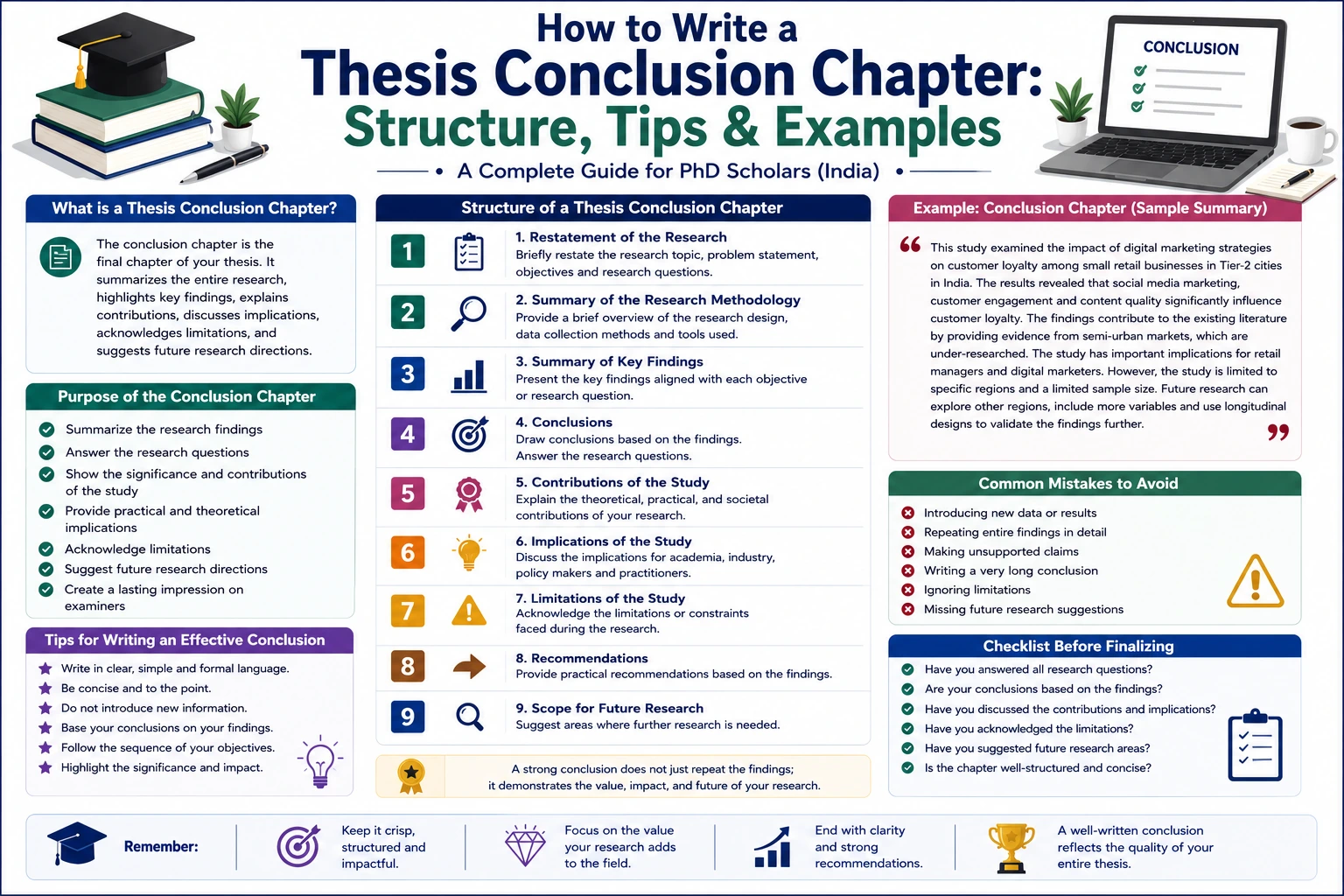
After months—or even years—of conducting research, reviewing literature, collecting data, analyzing results, and writing multiple chapters, you finally arrive at the last major section of your thesis: the conclusion chapter. Although it is the final chapter, it is far more than a simple summary. A well-written thesis conclusion ties together your entire research journey, highlights your key findings, demonstrates the significance of your study, acknowledges its limitations, and points toward future research opportunities.
For many students and PhD scholars, writing the conclusion can be surprisingly challenging. Questions such as "Should I summarize every chapter?", "Can I introduce new information?", or "How long should the conclusion be?" are common. The good news is that a strong conclusion follows a logical structure and has a clear purpose.
Whether you are writing a master's dissertation or a doctoral thesis, your conclusion is one of the last sections that examiners read. It leaves a lasting impression and gives you the opportunity to reinforce the value of your research. A thoughtful conclusion demonstrates that you understand your findings, appreciate their implications, and can place your work within the broader academic context.
In this practical guide, you'll learn how to write an effective thesis conclusion chapter, understand its purpose, explore its ideal structure, review writing tips, and examine examples that illustrate best practices.
What Is a Thesis Conclusion Chapter?
The conclusion chapter is the final substantive chapter of your thesis or dissertation. Its purpose is to bring the entire study together by revisiting the research problem, summarizing the key findings, explaining their significance, acknowledging limitations, and suggesting directions for future research.
Unlike the introduction, which outlines what you plan to investigate, the conclusion explains what your research achieved and why it matters.
A strong conclusion should answer questions such as:
- Did the study achieve its objectives?
- What are the main findings?
- How do these findings contribute to existing knowledge?
- What practical or theoretical implications do they have?
- What limitations should readers consider?
- What future research opportunities remain?
The conclusion is not simply a repetition of earlier chapters. Instead, it provides a synthesis of the research and demonstrates the overall value of the study.
Why the Conclusion Chapter Is Important
Many researchers devote most of their attention to the literature review, methodology, and data analysis, assuming the conclusion is merely a formality. In reality, the conclusion plays a critical role in shaping the examiner's final impression of your work.
A well-written conclusion:
- Reinforces the importance of your research.
- Demonstrates how the research objectives were achieved.
- Highlights your original contribution to the field.
- Connects the findings with broader academic discussions.
- Explains the practical relevance of the study.
- Shows critical reflection on the strengths and limitations of the research.
- Provides a clear direction for future studies.
Because it is one of the last sections examiners read, a compelling conclusion can strengthen the overall impact of your thesis.
What Should a Thesis Conclusion Include?
Although university guidelines may vary, most conclusion chapters contain several essential components.
1. Restatement of the Research Problem
Begin by briefly reminding readers of the central problem or question that motivated your research.
For example:
"This study examined the impact of artificial intelligence on customer engagement in India's retail banking sector to understand how AI-driven services influence customer satisfaction and loyalty."
Keep this section concise. The aim is to reconnect readers with the purpose of the study without repeating the introduction word for word.
2. Summary of the Research Objectives
Next, revisit the objectives or research questions introduced at the beginning of the thesis.
Rather than listing them mechanically, explain how the study addressed each objective.
For instance:
"The findings demonstrate that all four research objectives were successfully achieved through quantitative analysis and qualitative interviews."
This reassures readers that your research has fulfilled its intended purpose.
3. Summary of Key Findings
One of the most important sections of the conclusion is the summary of findings.
Rather than repeating every statistical result or interview quote, focus on the most significant discoveries.
For example:
- AI-powered personalization significantly improved customer satisfaction.
- Digital trust emerged as a major factor influencing technology adoption.
- Younger customers were more likely to engage with AI-enabled services than older customers.
The emphasis should be on interpreting the findings rather than reproducing detailed results.
4. Contribution to Knowledge
Doctoral research, in particular, is expected to contribute something new to the discipline.
Explain how your study advances existing knowledge.
Possible contributions include:
- Extending an existing theory.
- Testing a model in a new context.
- Developing a conceptual framework.
- Providing evidence from an under-researched population.
- Introducing a new methodological approach.
Clearly stating your contribution helps readers understand the originality of your work.
5. Practical Implications
Research should not only advance academic knowledge but also provide practical value where appropriate.
Discuss how your findings may benefit:
- Businesses
- Policymakers
- Educational institutions
- Healthcare organizations
- Government agencies
- Non-profit organizations
For example, research on employee engagement may help organizations improve workplace policies and retention strategies.
Ideal Structure of a Thesis Conclusion
A logical structure makes the conclusion easy to read and ensures that all important elements are included.
A commonly recommended structure is:
Section 1: Introduction to the Conclusion
Briefly restate the purpose of the study and remind readers of the research problem.
Section 2: Summary of Findings
Present the most important findings without unnecessary detail.
Section 3: Contributions
Explain the theoretical, methodological, and practical contributions of the study.
Section 4: Limitations
Acknowledge the limitations honestly while explaining why they do not undermine the overall value of the research.
Section 5: Recommendations
Provide practical recommendations based on your findings, where appropriate.
Section 6: Future Research
Suggest areas where future researchers can extend or improve upon your study.
Section 7: Closing Statement
End with a strong final paragraph emphasizing the significance of your research and its contribution to the field.
A confident, thoughtful closing statement leaves readers with a positive impression of your work.
Step-by-Step Guide to Writing the Conclusion
Step 1: Revisit Your Research Questions
Before writing, review your:
- Research objectives
- Research questions
- Hypotheses
- Key findings
This helps ensure that your conclusion remains aligned with the rest of the thesis.
Step 2: Focus on Synthesis, Not Repetition
Avoid copying sentences from earlier chapters.
Instead, combine your findings into broader insights that explain the overall meaning of your research.
For example, rather than listing every result individually, identify common themes and explain their significance.
Step 3: Keep the Discussion Balanced
A strong conclusion celebrates the strengths of the research while acknowledging its limitations.
Being transparent demonstrates academic maturity and enhances the credibility of your work.
Step 4: Explain the Significance of Your Findings
After summarizing the main findings, explain why they matter. This is your opportunity to connect your research to the broader academic and practical context.
Consider questions such as:
- How does your research advance existing knowledge?
- Does it confirm or challenge previous studies?
- Does it introduce a new perspective or model?
- Can practitioners, policymakers, or organizations benefit from your findings?
For example:
"The findings extend the Technology Acceptance Model by demonstrating that digital trust significantly influences AI adoption among Indian retail banking customers. This contributes to the growing body of literature on technology adoption in emerging economies."
Avoid making exaggerated claims. Instead, clearly explain the value of your work based on the evidence presented in your thesis.
Step 5: Discuss the Limitations
Every research study has limitations, and acknowledging them demonstrates academic honesty.
Common limitations include:
- Small sample size
- Limited geographical coverage
- Time constraints
- Data availability
- Resource limitations
- Methodological constraints
- Participant response bias
For example:
"Although this study provides valuable insights into consumer behaviour in metropolitan cities, the findings may not be directly generalizable to rural populations due to differences in digital infrastructure and purchasing behaviour."
Avoid presenting limitations as failures. Instead, explain them objectively while reinforcing the overall contribution of the study.
Step 6: Recommend Future Research
No research answers every question. A strong conclusion identifies opportunities for future researchers.
Future research recommendations might include:
- Studying different industries
- Expanding the sample size
- Conducting longitudinal research
- Comparing countries or regions
- Using alternative research methods
- Examining additional variables
- Testing the model in different demographic groups
For example:
"Future studies may examine the relationship between AI adoption and customer loyalty in public sector banks or compare findings across developing and developed economies."
These suggestions show that you understand the broader research landscape.
Step 7: End with a Strong Closing Paragraph
The final paragraph should leave readers with a clear understanding of the importance of your research.
A strong closing statement typically:
- Reaffirms the value of the study
- Highlights its contribution
- Ends with confidence and clarity
For example:
"This study contributes to the growing understanding of artificial intelligence adoption in India's banking sector by integrating theoretical insights with practical implications. It provides a foundation for future research while offering recommendations that may assist financial institutions in improving customer engagement through emerging technologies."
A memorable conclusion reinforces the impact of your research without introducing new evidence.
Thesis Conclusion Examples
Example 1: Quantitative Research
Research Topic: Employee Engagement and Job Performance
Conclusion Example:
"This study examined the relationship between employee engagement and job performance among employees in the Indian information technology sector. The findings indicate that employee engagement has a significant positive influence on both individual productivity and organizational commitment. The research contributes to existing literature by providing empirical evidence from the Indian IT industry and offers practical recommendations for organizations seeking to improve workforce performance through employee development initiatives."
Example 2: Qualitative Research
Research Topic: Experiences of First-Generation College Students
Conclusion Example:
"This research explored the academic experiences of first-generation college students through in-depth interviews. The findings revealed that family support, institutional guidance, and peer networks play essential roles in shaping students' educational journeys. While participants faced financial and social challenges, resilience and mentoring emerged as key factors supporting academic success. These findings contribute to the understanding of educational equity and provide valuable insights for higher education institutions."
Common Mistakes to Avoid
Many students weaken their conclusion chapter by making avoidable mistakes. Being aware of these issues can help you produce a stronger final chapter.
Introducing New Information
The conclusion should not introduce new theories, data, references, or analyses. Everything discussed should be based on the research already presented.
Simply Repeating Previous Chapters
Copying paragraphs from the introduction or discussion without adding synthesis makes the conclusion appear repetitive.
Instead, explain the overall meaning of the findings.
Ignoring Research Objectives
Your conclusion should clearly demonstrate how each research objective or question has been addressed.
Failing to do so may leave readers uncertain about whether the study achieved its purpose.
Overstating the Findings
Avoid making claims that extend beyond the evidence collected.
For example, do not claim that your findings apply to all populations if your study focused on a single city or industry.
Forgetting Practical Implications
Many theses explain the findings but fail to discuss how they can be applied in practice.
Whenever appropriate, describe how your research can benefit organizations, policymakers, educators, healthcare professionals, or other stakeholders.
Thesis Conclusion Writing Checklist
Before submitting your thesis, use this checklist to review your conclusion chapter:
- Restated the research problem clearly.
- Addressed all research objectives.
- Summarized the key findings without unnecessary repetition.
- Explained theoretical contributions.
- Discussed practical implications.
- Acknowledged study limitations honestly.
- Suggested meaningful directions for future research.
- Avoided introducing new information.
- Ended with a strong closing statement.
- Maintained consistency with the rest of the thesis.
Completing this checklist can help ensure that your conclusion is comprehensive and well organized.
Frequently Asked Questions
How long should a thesis conclusion chapter be?
The length depends on the overall thesis and university guidelines. In many master's dissertations, the conclusion ranges from approximately 1,500 to 3,000 words, while doctoral thesis conclusions are often longer. The focus should be on completeness and clarity rather than meeting a specific word count.
Can I include new references in the conclusion?
Generally, no. The conclusion should synthesize the research already discussed rather than introduce new literature.
Should I repeat my research objectives?
Yes, but avoid copying them verbatim. Instead, briefly explain how your research has addressed each objective.
Is it necessary to discuss limitations?
Yes. Acknowledging limitations demonstrates academic integrity and helps readers understand the scope of your findings.
Can I recommend future research?
Absolutely. Most universities expect researchers to identify opportunities for future studies based on the limitations and findings of their work.
Conclusion
The conclusion chapter is much more than the final section of a thesis—it is your opportunity to demonstrate the overall value of your research. A strong conclusion brings together the research problem, objectives, findings, and contributions in a clear and coherent manner while reflecting critically on the study's limitations and future possibilities.
Rather than repeating earlier chapters, focus on synthesizing the key insights and explaining why they matter. Show readers how your research contributes to the existing body of knowledge, highlight its practical implications, and provide thoughtful recommendations for future studies. By following a logical structure and maintaining a balanced, evidence-based approach, you can create a conclusion that leaves a lasting positive impression on examiners and readers alike.
Ultimately, an effective thesis conclusion reflects not only what you discovered but also why your research is important and how it can inspire further investigation. With careful planning, critical thinking, and clear writing, your conclusion can become one of the strongest chapters in your thesis.
Call / WhatsApp: +91 96438 02216
Website:www.ThesisLikho.com