
Introduction
One of the most important concepts in quantitative research is hypothesis testing. Whether you are pursuing a PhD in management, education, psychology, engineering, healthcare, economics, or social sciences, understanding hypothesis testing is essential for conducting rigorous and scientifically valid research.
Many doctoral scholars find statistical concepts intimidating at first. Terms such as null hypothesis, alternative hypothesis, p-value, significance level, and Type I error can seem complicated. However, the fundamental idea behind hypothesis testing is relatively simple: it is a systematic process used to determine whether there is enough evidence in a sample of data to support a specific claim about a population.
Hypothesis testing plays a central role in academic research because it helps researchers make evidence-based conclusions rather than relying on assumptions or personal opinions. It allows scholars to evaluate relationships between variables, compare groups, and determine whether observed differences are statistically meaningful.
In this comprehensive guide, we will explain hypothesis testing in simple language, discuss its importance in PhD research, explore different types of hypotheses, outline the step-by-step testing process, and provide practical examples that every doctoral scholar can understand.
What Is Hypothesis Testing?
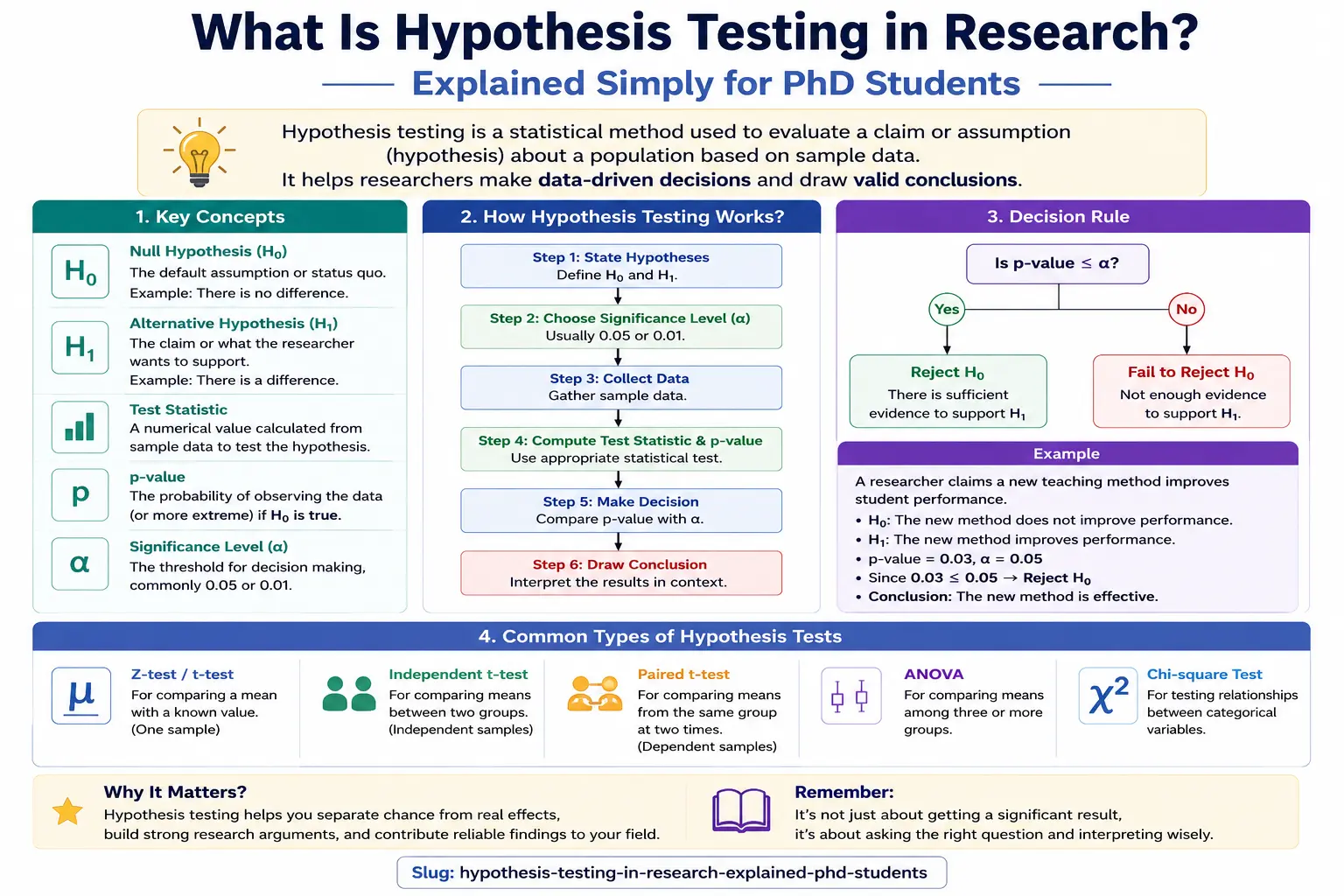
Hypothesis testing is a statistical method used to evaluate whether a claim about a population is supported by sample data.
In simple terms, researchers start with an assumption or prediction called a hypothesis and then collect data to determine whether the evidence supports that prediction.
The process helps answer questions such as:
- Does employee engagement improve productivity?
- Does online learning affect student performance?
- Does leadership style influence organizational commitment?
- Does social media marketing increase consumer purchase intention?
Rather than guessing, researchers use statistical techniques to determine whether observed results are likely to be genuine or merely due to chance.
What Is a Hypothesis?
A hypothesis is a testable statement about the relationship between two or more variables.
It represents a prediction that can be examined through research.
Example
"Employee motivation positively affects job performance."
In this example:
- Employee motivation = Independent Variable
- Job performance = Dependent Variable
The researcher seeks evidence to determine whether the predicted relationship exists.
Why Is Hypothesis Testing Important in Research?
Hypothesis testing is one of the foundations of scientific inquiry.
Supports Evidence-Based Decision Making
Researchers draw conclusions based on data rather than assumptions.
Enhances Research Objectivity
Statistical testing reduces personal bias.
Helps Validate Theories
Researchers can determine whether theoretical predictions hold true.
Facilitates Generalization
Findings from samples can be applied to larger populations.
Strengthens Research Credibility
Well-executed hypothesis testing improves the reliability and validity of findings.
Types of Hypotheses
Understanding different types of hypotheses is essential before conducting hypothesis testing.
1. Null Hypothesis (H₀)
The null hypothesis states that no relationship, difference, or effect exists.
It serves as the default assumption.
Example
"There is no significant relationship between employee motivation and job performance."
Researchers attempt to test whether sufficient evidence exists to reject this assumption.
2. Alternative Hypothesis (H₁ or Ha)
The alternative hypothesis states that a relationship, difference, or effect exists.
Example
"There is a significant positive relationship between employee motivation and job performance."
The alternative hypothesis represents the researcher's expectation.
Example of Null and Alternative Hypotheses
Research Topic
Impact of Online Learning on Student Performance
Null Hypothesis (H₀)
Online learning has no significant impact on student performance.
Alternative Hypothesis (H₁)
Online learning significantly impacts student performance.
The objective is to determine which hypothesis is better supported by the data.
Types of Alternative Hypotheses
Directional Hypothesis
Specifies the direction of the relationship.
Example
"Employee motivation positively affects productivity."
Non-Directional Hypothesis
Indicates a relationship exists but does not specify the direction.
Example
"There is a significant relationship between employee motivation and productivity."
Key Concepts in Hypothesis Testing
Several statistical concepts are fundamental to understanding hypothesis testing.
Population and Sample
Population
The entire group of interest.
Example:
All employees in India.
Sample
A subset of the population selected for research.
Example:
500 employees from Indian IT companies.
Researchers collect data from samples and draw conclusions about populations.
Statistical Significance
Statistical significance helps determine whether observed findings are likely due to chance.
If a result is statistically significant, researchers conclude that the observed effect probably reflects a real phenomenon.
Significance Level (Alpha)
The significance level, represented by α (alpha), is the threshold used to determine whether results are statistically significant.
The most common value is:
α = 0.05
This means researchers accept a 5% risk of reaching an incorrect conclusion.
P-Value Explained Simply
The p-value is one of the most important outputs in hypothesis testing.
It measures the probability of obtaining the observed results if the null hypothesis is true.
Interpretation
If:
p < 0.05
Reject the null hypothesis.
If:
p > 0.05
Fail to reject the null hypothesis.
Simple Example of a P-Value
Suppose a researcher studies whether employee training improves productivity.
After analyzing the data:
p = 0.02
Since:
0.02 < 0.05
The null hypothesis is rejected.
The researcher concludes that training significantly influences productivity.
The Step-by-Step Hypothesis Testing Process
Understanding the testing process is crucial for PhD students.
Step 1: Formulate Research Question
Example:
Does leadership style affect employee engagement?
Step 2: Develop Hypotheses
H₀
Leadership style has no significant effect on employee engagement.
H₁
Leadership style significantly affects employee engagement.
Step 3: Select Significance Level
Most researchers choose:
α = 0.05
Step 4: Collect Data
Researchers gather information through:
- Surveys
- Experiments
- Interviews (quantified)
- Organizational records
Step 5: Choose Statistical Test
The appropriate test depends on:
- Research objectives
- Variables
- Data type
Examples include:
- t-test
- ANOVA
- Chi-square test
- Correlation analysis
- Regression analysis
Step 6: Analyze Data
Statistical software such as:
- SPSS
- R
- Stata
- SAS
- Python
is commonly used.
Step 7: Calculate P-Value
The statistical test produces a p-value.
Step 8: Make Decision
If p < 0.05
Reject H₀.
If p > 0.05
Fail to reject H₀.
Step 9: Interpret Results
Explain findings in relation to research questions and theory.
Common Statistical Tests Used in Hypothesis Testing
t-Test
Used to compare means between two groups.
Example
Comparing productivity levels of trained and untrained employees.
ANOVA
Used to compare means across three or more groups.
Example
Comparing satisfaction levels among employees from different departments.
Chi-Square Test
Used to analyze relationships between categorical variables.
Example
Examining the relationship between gender and product preference.
Correlation Analysis
Measures the strength of relationships between variables.
Example
Relationship between job satisfaction and organizational commitment.
Regression Analysis
Examines how independent variables influence dependent variables.
Example
Impact of leadership style on employee performance.
Understanding Errors in Hypothesis Testing
No statistical decision is completely risk-free.
Researchers may make two types of errors.
Type I Error
Occurs when researchers reject a true null hypothesis.
Also called:
False Positive
Example:
Concluding that a training program improves productivity when it actually does not.
Type II Error
Occurs when researchers fail to reject a false null hypothesis.
Also called:
False Negative
Example:
Concluding that a training program has no effect when it actually improves productivity.
Hypothesis Testing Example for PhD Students
Research Topic
Impact of Employee Training on Productivity
Step 1
Research Question:
Does training improve employee productivity?
Step 2
H₀:
Training has no significant effect on productivity.
H₁:
Training significantly improves productivity.
Step 3
Collect survey and performance data from 300 employees.
Step 4
Conduct a t-test.
Step 5
Result:
p = 0.01
Step 6
Since:
0.01 < 0.05
Reject H₀.
Conclusion
Training significantly improves employee productivity.
Hypothesis Testing in Different Research Fields
Management Research
Examples:
- Leadership effectiveness
- Employee engagement
- Consumer behavior
- Organizational performance
Education Research
Examples:
- Teaching methods
- Online learning outcomes
- Student achievement
Healthcare Research
Examples:
- Treatment effectiveness
- Patient satisfaction
- Health interventions
Engineering Research
Examples:
- System performance
- Technology adoption
- Process optimization
Advantages of Hypothesis Testing
Objective Evaluation
Provides evidence-based conclusions.
Scientific Rigor
Strengthens research credibility.
Theory Validation
Tests existing theories systematically.
Generalizable Findings
Supports broader conclusions about populations.
Decision-Making Support
Provides reliable information for policy and practice.
Limitations of Hypothesis Testing
Dependence on Sample Quality
Poor samples produce unreliable results.
Risk of Misinterpretation
P-values are often misunderstood.
Focus on Statistical Significance
Statistically significant results may not always be practically important.
Assumption Requirements
Many statistical tests require specific assumptions.
Examples:
- Normal distribution
- Independence
- Equal variance
Common Mistakes Made by PhD Students
Writing Vague Hypotheses
Hypotheses should be specific and testable.
Confusing Correlation with Causation
Correlation does not automatically imply causation.
Ignoring Assumptions
Statistical tests require appropriate assumptions.
Misinterpreting P-Values
A small p-value does not prove a theory is absolutely true.
Focusing Only on Significance
Effect size and practical relevance also matter.
Tips for PhD Scholars
Start with Clear Research Questions
Strong hypotheses emerge from strong questions.
Align Hypotheses with Objectives
Ensure consistency throughout the study.
Choose Appropriate Statistical Tests
Different questions require different tests.
Learn Basic Statistics
A solid statistical foundation improves research quality.
Interpret Findings Carefully
Avoid overstating conclusions.
Hypothesis Testing vs Research Questions
Students often confuse these concepts.
Research Question
Does employee engagement affect productivity?
Hypothesis
Employee engagement positively affects productivity.
The research question guides inquiry, while the hypothesis provides a testable prediction.
Hypothesis Testing and Theory Development
Hypothesis testing contributes to theory development by:
- Confirming theoretical predictions
- Identifying inconsistencies
- Refining existing models
- Supporting evidence-based knowledge
Many influential theories have evolved through repeated hypothesis testing across multiple studies.
Conclusion
Hypothesis testing is a fundamental component of quantitative research and an essential skill for PhD students across all academic disciplines. At its core, hypothesis testing provides a systematic method for determining whether research findings support a specific claim or relationship between variables. By formulating null and alternative hypotheses, collecting data, applying statistical tests, and interpreting p-values, researchers can make informed decisions based on evidence rather than assumptions.
Although concepts such as statistical significance, p-values, and testing errors may initially seem challenging, understanding them is crucial for conducting high-quality doctoral research. Hypothesis testing not only strengthens the scientific rigor of a study but also enables scholars to validate theories, contribute to knowledge, and support evidence-based decision-making.
For PhD students, mastering hypothesis testing is an important step toward becoming a confident and competent researcher. With a clear understanding of the process, proper statistical tools, and careful interpretation of results, hypothesis testing becomes a powerful framework for generating meaningful and credible research findings.
Contact ThesisLikho Today
Call / WhatsApp: +91 96438 02216
Visit: ThesisLikho.com