
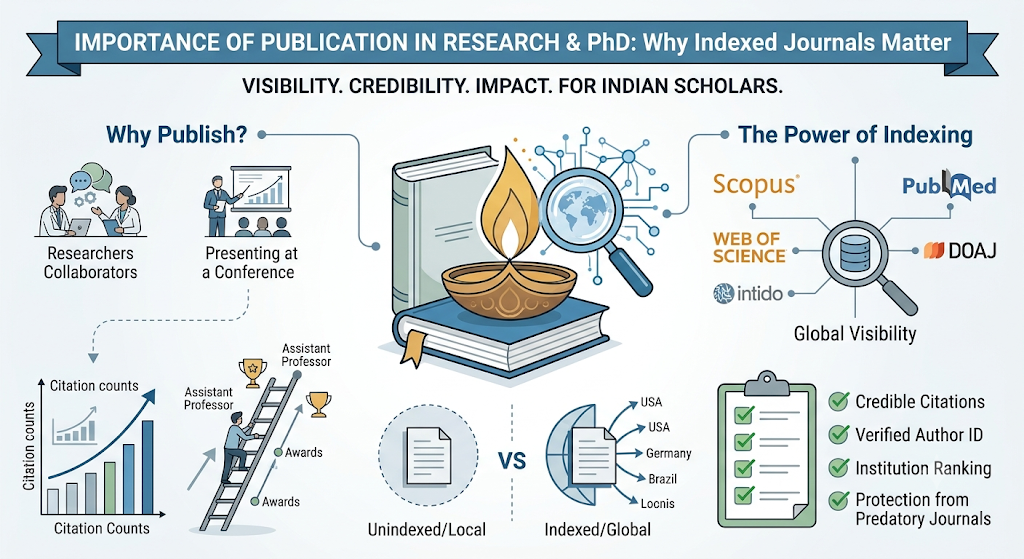
A PhD is not complete when the thesis is bound. It is complete when the knowledge you created reaches the people who can use it, question it and build on it. That is what publication does — and where you publish decides how far your work travels.
Every year, thousands of Indian research scholars spend four to six years on experiments, surveys, models and data analysis. Yet a large share of this work stays locked inside university libraries or on Shodhganga, read by a handful of examiners. Publishing in peer-reviewed, indexed journals changes that. In this article we look at why publication matters, what the latest regulations in India say, and why indexed publication gives your research the representation it deserves — using only publicly available data, with sources listed at the end.
1. Why Publication Matters in Research
It turns private work into public knowledge
Science advances through a shared, verifiable record. A finding that is not published cannot be cited, replicated or challenged. Peer review — where independent experts examine your methods and conclusions before publication — is the quality filter that separates a claim from accepted knowledge.
It is how your contribution is counted
Universities, funding agencies and recruitment committees measure research output primarily through publications and citations. Your h-index, citation count and author profile on Scopus, Web of Science or Google Scholar are all built from published papers. Without publications, your PhD has no measurable footprint.
It builds your career
For assistant professor recruitment under UGC rules, for Academic Performance Indicator (API) scores, for promotions under the Career Advancement Scheme, and for postdoctoral fellowships abroad, publications in recognised journals carry substantial weight. A scholar with two or three quality papers stands out sharply in an interview panel against one with none.
It strengthens your thesis
Papers published during the PhD act as independent validation. When an examiner sees that chapters of your thesis have already passed international peer review, confidence in the whole thesis rises. Reviewer comments also improve your methodology and writing long before final submission.
2. India's Research Output: The Bigger Picture
India has grown into one of the largest producers of scientific research in the world, which means competition for visibility has also grown.
Over the same period, Indian scholarly output rose from roughly 60,555 papers in 2010 to about 1,49,213 papers in 2020.[2] Government data also show that India's publication growth during 2011–2016 was about 8.4% a year in Scopus, compared with a world average of 1.9%, and India's share of global Scopus output rose from 4.0% in 2011 to 5.4% in 2016.[3] India also ranks 3rd globally in the number of science and engineering PhDs.[1]
The lesson for a PhD scholar is simple: with lakhs of papers coming out of India every year, a paper is only as visible as the platform it appears on.
3. What the Rules Say Now (2022–2026)
Two regulatory changes have reshaped how Indian scholars think about publication:
- UGC PhD Regulations, 2022: The UGC (Minimum Standards and Procedures for Award of Ph.D. Degree) Regulations, 2022 removed the earlier blanket UGC requirement that every PhD scholar must publish in a refereed journal before thesis submission.[4] However, many universities — especially in engineering, science and management — continue to set their own publication requirements through their ordinances and Research Advisory Committees. Always check your university's current ordinance.
- UGC-CARE list discontinued (2025): The UGC discontinued the UGC-CARE journal list with effect from 11 February 2025, and later, through a public notice dated 16 July 2025, issued "suggestive parameters" for choosing peer-reviewed journals.[5] The UGC also uploaded the final list of 1,474 CARE journals (as on 10 February 2025) purely for reference, stating that inclusion or exclusion does not imply its endorsement.[6]
The UGC explained that its expert committee found the CARE model introduced subjectivity, and that institutions are now free to develop their own mechanisms, with senior faculty asked to guide young researchers away from predatory journals.[7] Critics had also pointed to over-centralisation, delays in updating the list, and the inclusion of predatory journals.[8]
In practice, this shift places more responsibility on the scholar. With no single government list to rely on, internationally recognised indexing databases have become the most widely used, objective benchmark of journal quality in Indian universities.
4. What Is an Indexed Journal?
An indexed journal is one that has been evaluated and accepted by a recognised bibliographic database. These databases review journals on criteria such as editorial policy, peer-review process, publishing regularity, citation record and ethical standards, and they keep re-evaluating titles over time.
| Database | Run by | Why it matters |
|---|---|---|
| Scopus | Elsevier | Largest curated abstract and citation database; journals selected by an independent Content Selection & Advisory Board |
| Web of Science (SCIE, SSCI, AHCI, ESCI) | Clarivate | Source of the Journal Impact Factor; highly selective |
| PubMed / MEDLINE | US National Library of Medicine | Benchmark for medical and life-science research |
| DOAJ | Independent non-profit | Vetted directory of quality open-access journals |
Scopus has also stated that its total database, including inactive titles, holds 45,495 journals.[10] The gap between "total" and "active" titles is itself an important point: journals are regularly discontinued from coverage when they fail quality checks. Indexing is not a one-time badge — it is ongoing scrutiny.
5. Why Indexed Publication Gives Proper Representation
a) Global discoverability
Researchers, reviewers and funding agencies worldwide search Scopus and Web of Science first. If your paper is indexed, a scientist in Germany or Brazil working on the same problem can find, read and cite it. A paper in an unindexed local journal rarely appears in such searches, no matter how good the work is.
b) Credible, trackable citations
Citation counts, h-index and field-weighted metrics are calculated from indexed databases. Your contribution is formally "counted" only when it sits inside these systems. Citations to unindexed journals often go unrecorded.
c) A verified author identity
Indexed publication creates an automatic Scopus Author ID and links neatly with ORCID and Web of Science ResearcherID. This builds a permanent, public research profile that follows you across institutions and job applications.
d) Recognition by evaluators
Selection committees, NAAC and NIRF assessments, and many university PhD ordinances refer to Scopus or Web of Science indexing as a quality signal. NIRF's research-related parameters, for example, draw on publication and citation data from these databases. Your indexed papers directly strengthen your institution's ranking too.
e) Protection from predatory publishing
Predatory journals charge fees but offer little or no genuine peer review. Publishing in them can damage a scholar's reputation, and such papers may be rejected outright by evaluation committees. Because indexing involves independent review and continuous monitoring, it offers a strong — though not absolute — safeguard.
f) Fair comparison across disciplines and countries
India's ranking itself varies from 3rd to 9th depending on which database and counting method is used, as a study published in the Journal of Scientific & Industrial Research has shown.[11] Standardised indexing is what makes such comparisons possible at all. For individual scholars, it offers the same benefit: a common yardstick that reviewers everywhere understand.
6. Practical Checklist Before You Submit
- Verify indexing directly on the official Scopus Sources page or the Clarivate Master Journal List — never rely only on a journal's own website claim.
- Check that the journal is currently active in coverage, not discontinued.
- Match the ISSN, title and publisher exactly; cloned or "hijacked" journal websites are common.
- Read your university's latest PhD ordinance and RAC guidelines on publication requirements.
- Be cautious of unsolicited emails promising publication within days or "guaranteed acceptance".
- Review the journal's aims and scope, recent issues and peer-review timeline.
- Prefer journals with transparent article processing charges (APCs) and clear ethics policies (COPE membership is a good sign).
- Discuss your target journal with your supervisor, as the UGC itself recommends faculty guidance.
Conclusion
Publication is the bridge between your PhD and the wider research world. Even though UGC no longer imposes a universal pre-submission publication rule and the UGC-CARE list is gone, the importance of publishing has only grown. In a country that now produces well over a lakh of papers every year, indexed journals give your research visibility, credibility, measurable impact and protection from predatory outlets. Treat each paper not as a box to tick, but as the public face of years of your work — and choose a platform that represents it properly.
Need help preparing your manuscript for an indexed journal?
ThesisLikho supports PhD scholars with research guidance, journal selection, formatting and editing. Get in touch with our team.
Sources
- Science Reporter (CSIR-NIScPR), "India Jumps from 7th to 3rd Global Ranking in Scientific Publications," citing NSF Science & Engineering Indicators 2022. sciencereporter.niscpr.res.in/home/article/883
- AffairsCloud, "Science & Engineering Indicators 2022: India Jumped from 7th to 3rd." affairscloud.com
- DST / NSTMIS, R&D Statistics at a Glance 2019–20, India Science & Technology portal. indiascienceandtechnology.gov.in
- University Grants Commission, UGC (Minimum Standards and Procedures for Award of Ph.D. Degree) Regulations, 2022, Gazette of India, 7 November 2022. ugc.gov.in
- Hidayatullah National Law University, "Notice Regarding UGC-CARE Journals." hnlu.ac.in
- UGC Public Notice, 16 July 2025, "Suggestive Parameters for Choosing Peer-Reviewed Journals." PDF copy (Central University of Gujarat); final CARE list: ugc.gov.in
- Careers360, "UGC-CARE list scrapped, institutions free to identify quality journals: M Jagadesh Kumar," 11 Feb 2025. news.careers360.com
- Telangana Today, "UGC discontinues UGC-CARE listing of journals," 11 Feb 2025. telanganatoday.com
- Scopus product announcement, "Scopus data crosses the 100 million item threshold!", 3 Mar 2025. scopus.netfuel.co.uk
- Elsevier, "Building Strong Research Foundations with Scopus" (coverage figures as of March 2025). PDF
- Singh, V.K., Arora, P., Uddin, A., Bhattacharya, S. (2021). "India's rank and global share in scientific research." Journal of Scientific & Industrial Research, 80(1). arXiv:2007.05919