
Introduction
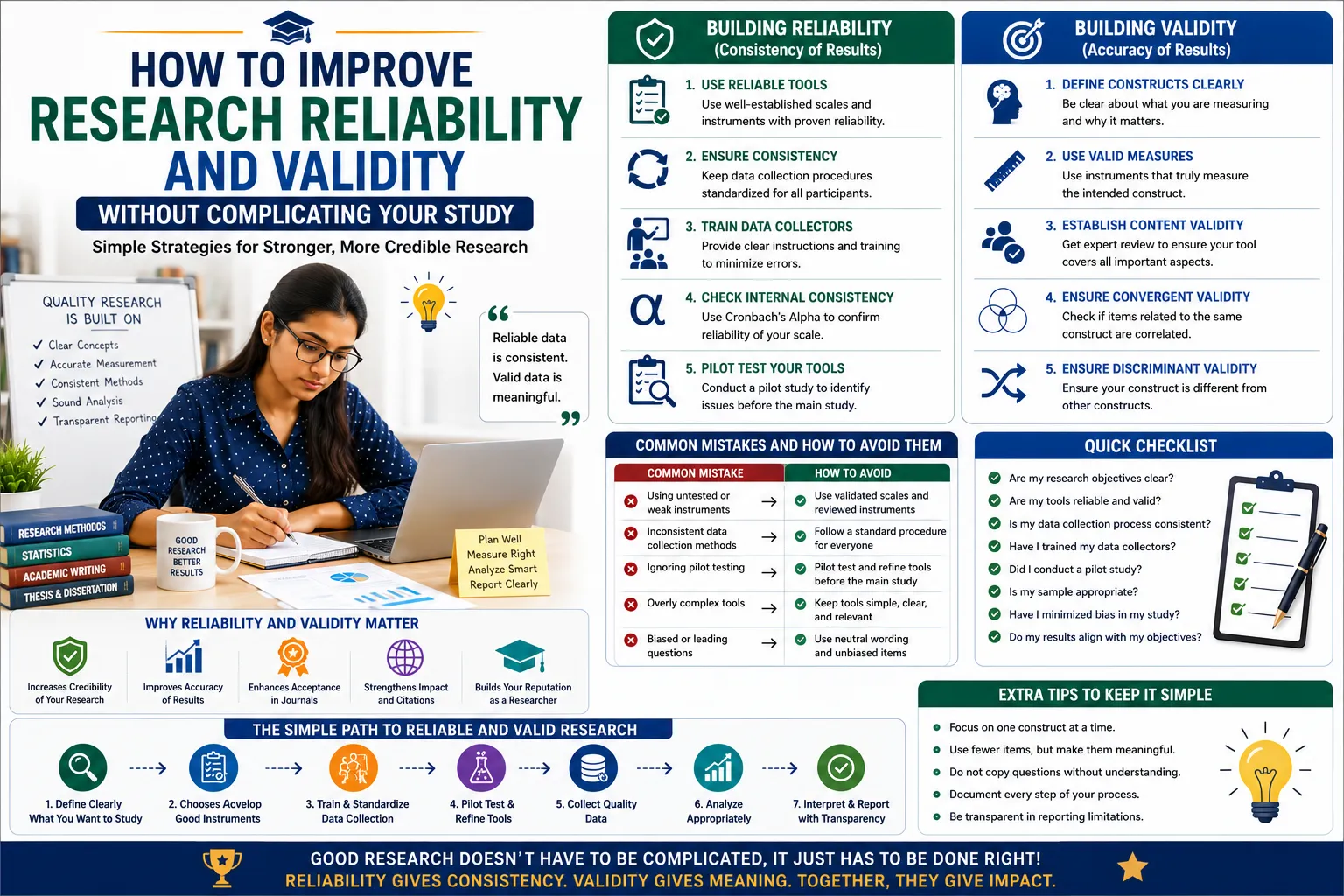
Every researcher wants one thing above all else—to produce findings that are accurate, trustworthy, and academically credible. Whether you are writing a PhD thesis, master's dissertation, research paper, or independent academic study, the quality of your research is judged not only by the results you present but also by how reliably and validly those results were obtained.
Unfortunately, many students assume that improving research reliability and validity requires complicated statistical models, expensive software, or highly advanced research methods. This misconception often leads researchers to overcomplicate their studies by adding unnecessary variables, lengthy questionnaires, complex analyses, or excessive data collection procedures. Instead of improving research quality, these additions can create confusion, increase errors, and make the study more difficult to manage.
The good news is that reliability and validity are not achieved through complexity—they are achieved through careful planning, consistency, and methodological rigor. Simple improvements such as writing clearer survey questions, selecting an appropriate sample, conducting a pilot study, and following standardized procedures can dramatically strengthen your research without increasing its complexity.
This comprehensive guide explains what reliability and validity mean, why they matter, and how you can improve both using practical, easy-to-implement strategies that fit almost any academic research project.
Understanding Reliability and Validity
Before discussing improvement strategies, it is essential to understand the difference between these two foundational concepts.
What Is Reliability?
Reliability refers to the consistency of a research instrument or method. If the same study were repeated under similar conditions, reliable methods would produce similar results.
For example, if a questionnaire measuring student satisfaction is administered to the same participants twice within a short period, the responses should remain relatively consistent unless their opinions have genuinely changed.
Reliable research minimizes random errors and increases confidence in the findings.
What Is Validity?
Validity refers to whether your research actually measures what it is intended to measure.
Imagine a survey designed to assess employee motivation that primarily asks questions about salary and office facilities. While these topics may influence motivation, they do not fully measure the concept itself. Such an instrument would have limited validity because it fails to capture the broader construct of motivation.
Validity ensures that the conclusions drawn from your research accurately reflect reality.
Why Reliability and Validity Matter
Improving reliability and validity benefits every stage of research.
A high-quality study is more likely to:
- Produce trustworthy findings
- Reduce measurement errors
- Support stronger conclusions
- Gain supervisor approval
- Meet university research standards
- Be accepted by peer-reviewed journals
- Contribute meaningful knowledge to your discipline
Without adequate reliability and validity, even sophisticated statistical analyses cannot compensate for poor data quality.
Reliability vs. Validity: Understanding the Difference
Although closely related, reliability and validity are not the same.
A study can be reliable but not valid.
For example, a bathroom scale that consistently shows a weight that is five kilograms higher than the actual weight is reliable because it produces consistent results. However, it is not valid because the measurement is inaccurate.
On the other hand, a valid instrument must also be reliable. If a measurement changes randomly every time it is used, it cannot accurately measure anything.
The goal of every researcher should be to achieve both consistency and accuracy.
1. Start With Clear Research Objectives
One of the simplest ways to improve validity is to define clear research objectives before designing your study.
Ask yourself:
- What problem am I trying to solve?
- What variables am I measuring?
- What information do I need?
- Who should provide this information?
Clearly defined objectives help ensure that every research activity contributes directly to answering your research questions.
2. Keep Your Research Questions Focused
Many researchers try to answer too many questions within a single study.
A focused research question improves both reliability and validity because it allows you to:
- Design better questionnaires
- Select appropriate participants
- Collect more relevant data
- Conduct clearer analyses
Instead of investigating multiple unrelated issues, concentrate on one well-defined research problem.
3. Use Established Research Instruments Whenever Possible
Creating a new questionnaire from scratch is not always necessary.
Many validated instruments already exist for measuring:
- Job satisfaction
- Customer loyalty
- Technology acceptance
- Academic motivation
- Stress
- Organizational commitment
- Leadership effectiveness
Using established instruments improves validity because these tools have already been tested in previous research.
If modifications are required, make only minor changes and explain them in your methodology.
4. Write Clear and Simple Questions
Complex wording creates confusion and reduces data quality.
Every question should be:
- Short
- Specific
- Easy to understand
- Free from technical jargon
- Relevant to your objectives
For example:
Poor question:
"How frequently do you engage in pedagogically beneficial educational activities?"
Improved question:
"How often do you participate in classroom learning activities?"
Simple language increases consistency and reduces misunderstandings.
5. Avoid Leading and Biased Questions
Leading questions influence participants' responses and reduce validity.
Example of a leading question:
"Do you agree that online education is better than classroom teaching?"
A more neutral version would be:
"How would you compare your experiences with online and classroom learning?"
Neutral wording allows participants to express their genuine opinions.
6. Ask One Question at a Time
Double-barreled questions combine two ideas into one.
Example:
"Are you satisfied with your salary and career growth opportunities?"
A participant may be satisfied with one aspect but not the other.
Instead, separate the question into two individual items.
This improves both accuracy and response consistency.
7. Conduct a Pilot Study
Pilot testing is one of the easiest and most effective ways to improve research quality.
A pilot study involves testing your questionnaire or interview guide with a small group of participants before beginning the main study.
Pilot testing helps identify:
- Confusing questions
- Missing response options
- Technical issues
- Time required to complete the survey
- Ambiguous wording
Making corrections before large-scale data collection prevents costly mistakes later.
8. Standardize Your Data Collection Process
Consistency is essential for reliability.
Whether you are conducting interviews, surveys, or observations, use the same procedures for every participant.
Examples include:
- Asking questions in the same order
- Providing identical instructions
- Using the same interview environment whenever possible
- Recording responses consistently
Standardization minimizes variability caused by the researcher rather than the participants.
9. Choose an Appropriate Sample
Even a perfectly designed questionnaire cannot produce valid results if the wrong participants are selected.
Your sample should accurately represent your target population.
For quantitative studies, probability sampling methods such as simple random or stratified sampling are often preferred.
For qualitative research, purposive sampling may be more appropriate when participants possess specialized knowledge or experience.
Selecting the right sample improves the generalizability and credibility of your findings.
10. Collect Data Ethically
Ethical research practices encourage honest participation.
Participants should:
- Understand the purpose of the study
- Participate voluntarily
- Know their information will remain confidential
- Have the right to withdraw at any time
When participants trust the research process, they are more likely to provide truthful and complete responses.
11. Reduce Researcher Bias
Researcher bias can unintentionally affect data collection and interpretation.
To minimize bias:
- Remain neutral during interviews.
- Avoid expressing personal opinions.
- Follow standardized procedures.
- Base conclusions on evidence rather than expectations.
- Document your methodology transparently.
Objectivity strengthens the validity of your study.
12. Keep Your Questionnaire Concise
Long questionnaires often lead to respondent fatigue.
As participants become tired, they may:
- Skip questions
- Select random answers
- Lose concentration
- Leave the survey unfinished
Include only questions that directly support your research objectives.
A shorter, focused questionnaire often produces higher-quality data than an unnecessarily lengthy one.
13. Use Appropriate Measurement Scales
Select response scales that match your research objectives.
Common options include:
Likert Scale
Ideal for attitudes and opinions.
Example:
- Strongly Disagree
- Disagree
- Neutral
- Agree
- Strongly Agree
Frequency Scale
Useful for behavioral studies.
Example:
- Never
- Rarely
- Sometimes
- Often
- Always
Rating Scale
Suitable for satisfaction or performance assessments.
Consistent response scales improve measurement reliability.
14. Train Everyone Involved in Data Collection
If multiple researchers or assistants are collecting data, provide standardized training.
Training should cover:
- Interview procedures
- Ethical considerations
- Recording responses
- Handling participant questions
- Managing unexpected situations
Well-trained data collectors reduce inconsistencies and improve reliability.
15. Maintain Accurate Records
Good documentation enhances research transparency.
Keep records of:
- Participant recruitment
- Consent forms
- Data collection dates
- Questionnaire versions
- Interview notes
- Data cleaning procedures
Comprehensive documentation allows others to understand and replicate your study if necessary.
16. Check Reliability Statistically
After collecting your data, evaluate reliability using appropriate statistical techniques.
Common methods include:
Cronbach's Alpha
Measures internal consistency for questionnaires with multiple items.
General interpretation:
- Above 0.90 – Excellent
- 0.80–0.89 – Good
- 0.70–0.79 – Acceptable
- Below 0.70 – Requires improvement
Test-Retest Reliability
Measures consistency over time by administering the same instrument to the same participants on two occasions.
Inter-Rater Reliability
Useful for observational research involving multiple observers.
These tests provide evidence that your instrument performs consistently.
17. Strengthen Validity Through Expert Review
Ask experienced researchers or subject specialists to review your research instrument before data collection.
Experts can identify:
- Missing concepts
- Ambiguous wording
- Irrelevant questions
- Logical inconsistencies
This process improves content validity and enhances the overall quality of your instrument.
Common Mistakes That Reduce Reliability and Validity
Many researchers unintentionally weaken their studies by making avoidable mistakes.
Common examples include:
- Using vague research objectives
- Asking leading questions
- Selecting inappropriate participants
- Skipping pilot testing
- Using inconsistent procedures
- Ignoring ethical guidelines
- Collecting incomplete data
- Including unnecessary questionnaire items
- Making unsupported conclusions
- Failing to document research procedures
Recognizing these issues early helps prevent problems during data collection and analysis.
Practical Checklist for Improving Research Quality
Before beginning your fieldwork, ask yourself:
- Have I clearly defined my research objectives?
- Are my research questions focused?
- Does every questionnaire item support an objective?
- Have I used simple and unbiased language?
- Have I conducted a pilot study?
- Is my sampling method appropriate?
- Have I obtained ethical approval where required?
- Will data be collected consistently?
- Have experts reviewed my research instrument?
- Have I planned how to test reliability and validity?
If the answer to all these questions is "yes," your study is well-positioned to produce credible and trustworthy findings.
Conclusion
Improving research reliability and validity does not require complicated methodologies, expensive software, or unnecessarily complex research designs. Instead, it depends on thoughtful planning, clear objectives, appropriate data collection methods, and consistent implementation.
By focusing on practical improvements—such as writing simple questionnaire items, selecting representative participants, conducting pilot testing, standardizing data collection procedures, using validated instruments, and seeking expert feedback—you can significantly enhance the quality of your research without adding unnecessary complexity.
Remember that the strongest academic studies are not always the most complicated ones. They are the studies that collect accurate data, answer meaningful research questions, and present findings that others can trust. Whether you are preparing a bachelor's project, master's dissertation, PhD thesis, or journal article, applying these straightforward strategies will help you produce research that is reliable, valid, and academically robust.
Ultimately, simplicity combined with methodological rigor is the key to high-quality research. By keeping your study focused and following proven best practices, you can build confidence in your findings while making the research process more efficient, manageable, and rewarding.
Call / WhatsApp: +91 96438 02216
Website:www.ThesisLikho.com