
Introduction
Choosing the right research approach is one of the most important decisions a PhD student will make during their doctoral journey. The research approach influences how data is collected, analyzed, interpreted, and ultimately how knowledge is generated. Among the most widely used approaches in academic research are inductive research and deductive research.
Understanding the difference between inductive and deductive reasoning is essential because these approaches shape the entire research process—from formulating research questions and hypotheses to selecting methodologies and interpreting findings. Many PhD students struggle to determine which approach is most suitable for their study, especially when developing their research proposal or writing the methodology chapter of their thesis.
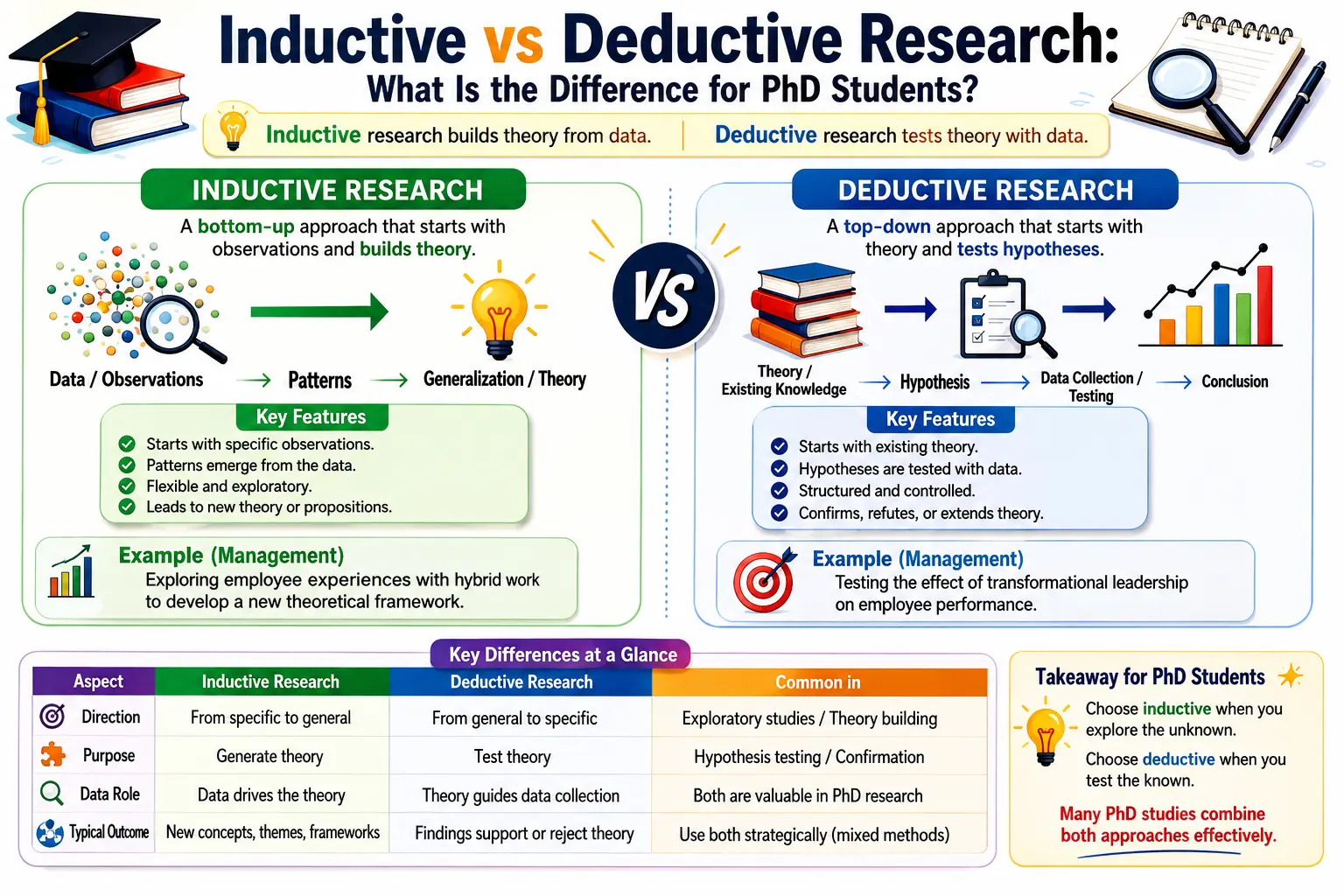
While deductive research begins with existing theories and tests them using empirical evidence, inductive research starts with observations and develops new theories based on patterns found in the data. Both approaches are valuable, but they serve different purposes and are suitable for different types of research problems.
In this comprehensive guide, we will explore the meaning of inductive and deductive research, their characteristics, differences, advantages, limitations, examples, and practical guidance for PhD students seeking to select the most appropriate research approach for their doctoral studies.
What Is Deductive Research?
Deductive research is a research approach that begins with an existing theory, concept, or hypothesis and tests it using collected data. It follows a logical sequence from general ideas to specific observations.
The deductive process is often described as a top-down approach because researchers move from broad theories toward specific conclusions.
Basic Process of Deductive Research
- Develop or identify an existing theory.
- Formulate hypotheses.
- Collect data.
- Analyze data.
- Confirm or reject hypotheses.
- Draw conclusions.
Example
Suppose previous studies suggest that employee motivation increases productivity.
A researcher may formulate the hypothesis:
"Employees with higher motivation levels demonstrate greater workplace productivity than employees with lower motivation levels."
The researcher then collects data to test whether the hypothesis is supported.
What Is Inductive Research?
Inductive research is a research approach that begins with observations, experiences, or collected data and develops theories or concepts based on identified patterns.
It is often referred to as a bottom-up approach because researchers move from specific observations to broader theoretical conclusions.
Basic Process of Inductive Research
- Observe phenomena.
- Collect data.
- Identify patterns and themes.
- Develop concepts.
- Generate theories.
- Propose general conclusions.
Example
A researcher interviews startup founders about their leadership practices and notices recurring themes such as adaptability, communication, and innovation.
Based on these observations, the researcher develops a new theory explaining successful startup leadership.
Understanding Research Reasoning
The primary distinction between inductive and deductive research lies in the direction of reasoning.
Deductive Reasoning
General Theory → Hypothesis → Data Collection → Confirmation or Rejection
Inductive Reasoning
Observation → Data Collection → Pattern Identification → Theory Development
Simply put:
- Deductive research tests theories.
- Inductive research creates theories.
Why PhD Students Must Understand Both Approaches
Doctoral research requires methodological rigor and clear justification of research design choices.
Understanding these approaches helps PhD students:
- Select appropriate methodologies
- Design effective research studies
- Develop strong research proposals
- Explain research decisions to supervisors
- Produce academically sound findings
- Contribute meaningfully to knowledge
Many thesis examiners specifically evaluate whether the chosen research approach aligns with the research objectives.
Key Characteristics of Deductive Research
1. Theory-Driven
Deductive studies begin with existing theories or conceptual frameworks.
Researchers aim to verify whether theoretical assumptions hold true in specific contexts.
2. Hypothesis Testing
Hypotheses play a central role.
Example:
- H1: Leadership style positively affects employee engagement.
- H2: Employee engagement improves organizational performance.
3. Structured Research Design
Deductive research typically follows predetermined procedures and methods.
4. Quantitative Orientation
Although not always quantitative, deductive research frequently uses:
- Surveys
- Experiments
- Statistical analysis
- Large sample sizes
5. Objective Analysis
Researchers attempt to minimize personal influence on findings.
Key Characteristics of Inductive Research
1. Data-Driven
Research begins with observations rather than theories.
2. Theory Generation
The goal is to develop new explanations or frameworks.
3. Flexible Design
Research designs may evolve as new insights emerge.
4. Qualitative Orientation
Inductive research often uses:
- Interviews
- Focus groups
- Observations
- Case studies
5. Contextual Understanding
Researchers seek deep understanding of participants' experiences and perspectives.
Examples of Deductive Research in PhD Studies
Example 1: Human Resource Management
Theory
Employee satisfaction improves retention.
Hypothesis
Higher job satisfaction leads to lower employee turnover.
Method
Survey of 500 employees.
Outcome
Statistical analysis determines whether the hypothesis is supported.
Example 2: Marketing Research
Theory
Brand loyalty increases customer purchase intention.
Method
Questionnaire-based research.
Objective
Test existing marketing theories.
Example 3: Education
Theory
Online learning improves academic performance.
Method
Experimental study comparing online and traditional learning environments.
Examples of Inductive Research in PhD Studies
Example 1: Organizational Culture
Researchers conduct interviews with employees to understand workplace culture.
After analyzing responses, they develop a framework explaining cultural influences on performance.
Example 2: Entrepreneurship
A PhD scholar studies startup founders through case studies.
Recurring themes lead to the development of a new entrepreneurial leadership model.
Example 3: Consumer Behavior
Researchers observe social media users and identify emerging patterns in digital purchasing decisions.
A new conceptual model is then proposed.
Advantages of Deductive Research
Strong Theoretical Foundation
Research builds upon established theories.
Objective Measurement
Data can be analyzed using statistical methods.
Replicability
Other researchers can repeat the study.
Generalizability
Large samples often allow broader conclusions.
Clear Research Process
The structured nature simplifies planning and implementation.
Limitations of Deductive Research
Limited Flexibility
Researchers may overlook unexpected findings.
Dependence on Existing Theory
Weak theories produce weak hypotheses.
Less Contextual Understanding
Human experiences and complex social phenomena may not be fully captured.
Risk of Oversimplification
Complex realities may be reduced to measurable variables.
Advantages of Inductive Research
Generates New Knowledge
Ideal for exploring under-researched topics.
Rich Insights
Provides detailed understanding of participants and contexts.
Flexibility
Researchers can adapt as new information emerges.
Useful for Emerging Fields
Particularly valuable when little prior research exists.
Captures Complexity
Allows examination of social, organizational, and behavioral dynamics.
Limitations of Inductive Research
Limited Generalizability
Findings often involve smaller samples.
Time-Consuming
Data collection and analysis can require significant effort.
Subjectivity
Researcher interpretations may influence findings.
Replication Challenges
Results may be difficult to reproduce exactly.
Research Methods Commonly Associated with Each Approach
Deductive Research Methods
- Surveys
- Experiments
- Structured questionnaires
- Longitudinal studies
- Statistical modeling
- Hypothesis testing
Example
Testing the impact of remote work on employee productivity using survey data.
Inductive Research Methods
- Interviews
- Focus groups
- Ethnography
- Observations
- Case studies
- Grounded theory
Example
Exploring employee experiences with remote work through interviews.
When Should PhD Students Use Deductive Research?
Deductive research is appropriate when:
Existing Theory Exists
You want to test established theories.
Clear Hypotheses Can Be Developed
Research questions are measurable.
Quantitative Data Is Available
Large datasets support statistical analysis.
Confirmation Is the Goal
You aim to validate theoretical assumptions.
Example Topics
- Employee engagement and productivity
- Consumer purchase behavior
- Leadership effectiveness
- Technology adoption models
When Should PhD Students Use Inductive Research?
Inductive research is appropriate when:
Limited Prior Research Exists
The topic is new or emerging.
Exploration Is Needed
You seek to understand experiences or behaviors.
Context Matters
The phenomenon depends heavily on environmental factors.
Theory Development Is the Goal
You aim to create new concepts or frameworks.
Example Topics
- AI adoption in small businesses
- Digital transformation experiences
- Organizational resilience
- Startup innovation practices
Can Inductive and Deductive Research Be Combined?
Yes.
Many modern PhD studies use a combination known as abductive research or mixed-method research.
Example
Phase 1: Conduct interviews to explore employee experiences (Inductive).
Phase 2: Develop hypotheses and test them through surveys (Deductive).
This combination allows researchers to gain rich insights while also validating findings statistically.
Inductive vs Deductive Research in Qualitative and Quantitative Studies
Although deductive research is commonly associated with quantitative methods and inductive research with qualitative methods, the relationship is not absolute.
Deductive Qualitative Research
Researchers may use qualitative interviews to test existing theories.
Inductive Quantitative Research
Large datasets can sometimes reveal unexpected patterns leading to theory development.
The choice depends on research objectives rather than methodology alone.
Common Mistakes PhD Students Make
Confusing Methodology with Research Approach
Qualitative does not automatically mean inductive.
Quantitative does not automatically mean deductive.
Choosing an Approach Without Justification
Always explain why the selected approach aligns with research objectives.
Mixing Approaches Inconsistently
Ensure methodological coherence throughout the study.
Ignoring Existing Literature
Even inductive studies require literature review and theoretical awareness.
Practical Tips for PhD Students
Start with Your Research Question
The research question often determines the most appropriate approach.
Consider Existing Knowledge
If strong theories exist, deductive research may be suitable.
Evaluate Research Objectives
If exploration is needed, consider induction.
Discuss With Supervisors
Experienced supervisors can provide valuable guidance.
Remain Methodologically Consistent
Align research design, data collection, and analysis with your chosen approach.
Conclusion
Understanding the difference between inductive and deductive research is essential for every PhD student. Deductive research begins with theories and seeks to test them through empirical evidence, making it ideal for hypothesis-driven studies and quantitative analysis. In contrast, inductive research starts with observations and develops new theories based on emerging patterns, making it particularly valuable for exploratory and qualitative investigations.
Neither approach is inherently superior. The best choice depends on your research questions, objectives, available literature, and desired contribution to knowledge. Deductive research is useful when testing established theories, while inductive research excels when exploring new phenomena and generating fresh insights.
For many modern doctoral studies, combining both approaches can provide the best of both worlds—deep understanding and empirical validation. By carefully selecting and justifying your research approach, you can build a stronger methodology, enhance the quality of your thesis, and make a meaningful contribution to your academic field.
Contact ThesisLikho Today
Call / WhatsApp: +91 96438 02216
Visit: ThesisLikho.com