
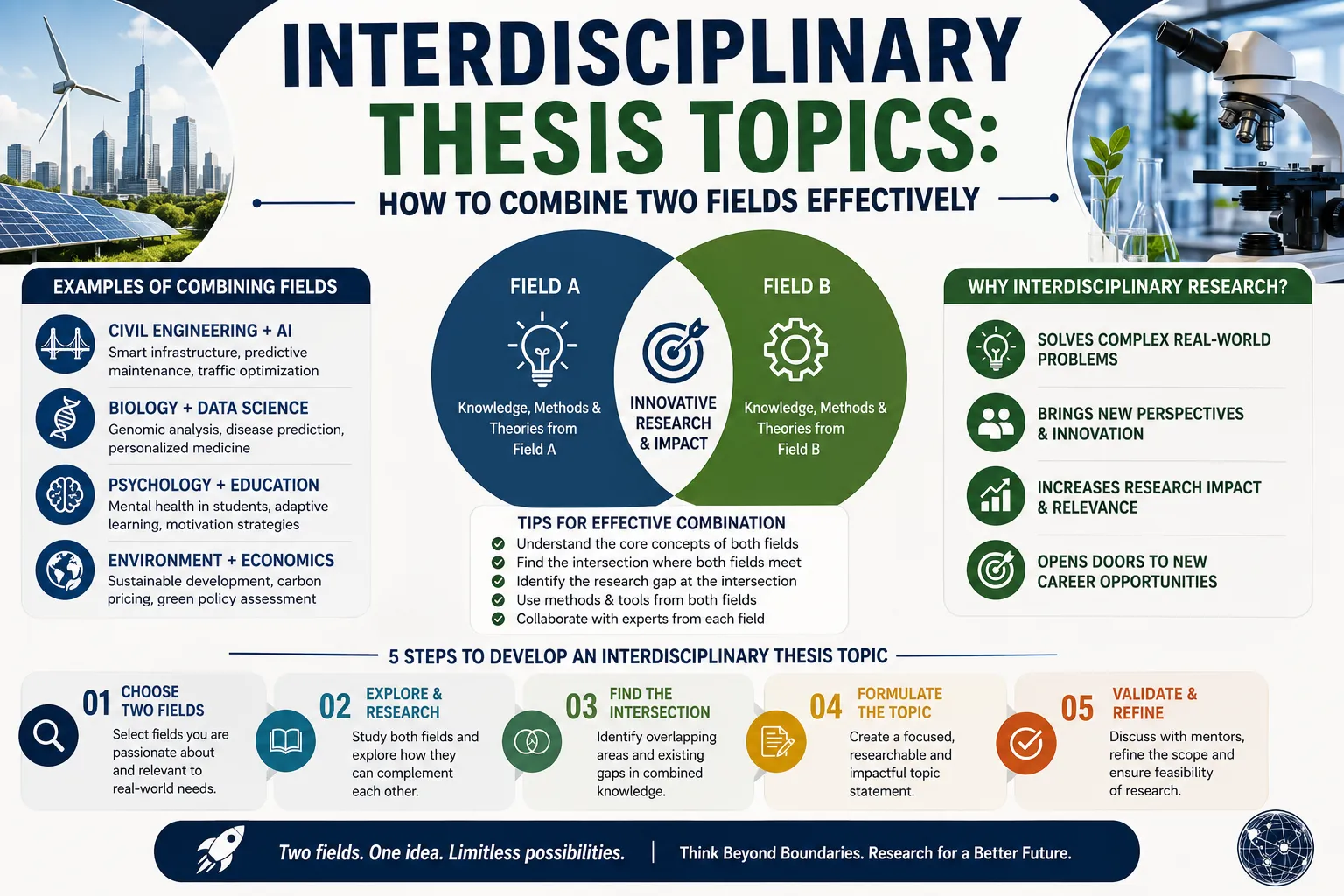
You're drawn to two fields at once — maybe psychology and data science, or public health and economics — and you suspect the most interesting research sits right at their intersection. That instinct is often right. But turning it into interdisciplinary thesis topics that actually work, rather than two separate mini-projects stapled together, requires a deliberate approach. This guide walks through how to combine two fields effectively, from choosing a defensible topic to managing co-supervision and structuring the final thesis.
Interdisciplinary research integrates concepts, theories, and methods from two or more academic disciplines to explore a single research problem, rather than relying on one field alone. Done well, it produces genuinely original contributions. Done poorly, it produces a thesis that satisfies neither discipline's examiners. The difference lies almost entirely in how deliberately you plan the integration from the start.
Why Interdisciplinary Thesis Topics Are Increasingly Valued
Universities, policymakers, and industries increasingly favour research that addresses complex, real-world challenges no single discipline can fully explain — from climate governance to AI ethics to health system design. Emerging areas like blockchain (spanning finance, law, and IT) and climate change (spanning environmental, political, economic, and social dimensions) are frequently highlighted as naturally interdisciplinary spaces for 2025–2026 research. Roughly 70% of interdisciplinary studies programs require a capstone or thesis project, with about 60% of such programs specifically emphasizing multi-field integration to tackle complex problems.
Step-by-Step: How to Combine Two Fields Effectively
Step 1: Identify a Genuine Shared Problem, Not Two Adjacent Topics
The most common mistake in interdisciplinary thesis topics is choosing two subjects that sit near each other without a genuine shared research problem connecting them. Ask yourself: is there one specific question that requires both fields to answer, or could this be split into two separate single-discipline theses? If the second is true, you don't yet have an interdisciplinary topic — you have two topics.
Step 2: Choose Fields Where Integration Adds Real Explanatory Power
Strong interdisciplinary combinations usually follow one of a few patterns:
- Method-borrowing: applying a technique from one field (e.g., machine learning) to a problem in another (e.g., agricultural yield prediction)
- Theory-testing across contexts: testing a theory built in one discipline (e.g., behavioural economics) within the domain of another (e.g., public health decision-making)
- Combined lens on one phenomenon: studying a single issue (e.g., urban migration) through both a sociological and an economic lens simultaneously
Step 3: Test Feasibility Before Committing
Interdisciplinary research requires more investment from students than single-discipline work, since it demands developing genuine expertise in more than one area. Before finalizing your topic, honestly assess whether you can build sufficient competence in your secondary field within your thesis timeline — or whether you'll need substantial co-supervision support to compensate.
Step 4: Find the Right Co-Supervisor Combination Early
This step alone can take significant time. One PhD student documenting the process spent nearly a semester meeting seven to eight professors before securing a workable collaboration. When approaching a prospective co-supervisor from your secondary field, research their current projects in advance and be ready to clearly explain your topic's novelty and feasibility — rejection at this stage is common and not a signal to abandon the idea.
Choosing supervisor combinations also requires deliberate balance across discipline, expertise, physical location, workload, and supervisory style, to avoid an arrangement that looks good on paper but is practically unworkable.
Step 5: Choose an Integrated Methodology, Not Two Parallel Ones
Different fields often carry different methodological traditions — quantitative versus qualitative, experimental versus theoretical. Mixed-methods research is particularly valuable here: combining statistical analysis with qualitative interviews, for example, can capture both breadth and depth in ways that satisfy examiners from both disciplines. Avoid running two disconnected methodological tracks that never actually speak to each other.
Step 6: Build Explicit Integration Into Your Thesis Structure
A traditional single-discipline thesis structure can usually still be followed, but transitions between sections must explicitly show how the two disciplines intersect at each stage — introduction, literature review, methodology, findings, and discussion should all weave both fields together rather than treating them as separate, sequential parts.
Step 7: Prioritize Depth Over Exhaustive Coverage
It is genuinely impossible, within normal thesis timelines, to cover every relevant contribution across two full disciplines. The realistic goal is to identify the most distinguished, directly relevant contributions from each field and relate your study clearly to them — rather than attempting an exhaustive review of both literatures.
Step 8: Prepare for Assessment Ambiguity
Interdisciplinary work may not fit neatly into traditional single-discipline evaluation frameworks, and supervisors from different fields may bring varying expectations. Clarify early — ideally in writing — how your work will be assessed and by whom, so expectations are aligned well before submission.
Interdisciplinary Topic Patterns
Interdisciplinary research combines concepts, methods, or theories from different fields to address complex research problems. The following are the most common integration patterns used in academic research.
Method-Borrowing: This approach applies a technique or methodology from one discipline to solve a problem in another field. Example: Using machine learning techniques to predict crop yields in agricultural research.
Theory-Testing Across Contexts: This pattern involves testing an existing theory in a different discipline or context to evaluate its broader applicability. Example: Applying behavioural economics principles to study decision-making in public health.
Combined Lens: This approach examines a single research problem through multiple disciplinary perspectives to gain a more comprehensive understanding. Example: Studying urban migration using both sociological and economic frameworks.
Practical Checklist: Is Your Interdisciplinary Topic Feasible?
- Does one specific research question genuinely require both fields to answer?
- Have you honestly assessed your ability to build competence in the secondary field?
- Have you identified a realistic, balanced co-supervisor combination?
- Is your methodology integrated rather than run as two separate parallel tracks?
- Does your planned thesis structure weave both disciplines together at each stage?
- Have you scoped a realistic, non-exhaustive literature review for both fields?
- Have assessment expectations been clarified in writing with both supervisors?
- Is the topic feasible within your program's standard timeline?
Two Practical Scenarios
Scenario 1 — Nutrition and Social Psychology
A doctoral scholar originally set out to study weight management purely from a nutrition science angle, but her early findings kept surfacing psychological factors influencing outcomes. Rather than ignoring this, she actively built a supervisory team spanning nutrition, social psychology, and education — networking deliberately to gather the expertise she needed. Reconciling different supervisors' perspectives became a genuine challenge, but resulted in a thesis that neither field alone could have produced.
Scenario 2 — Computer Science and Agricultural Studies
A scholar spent almost a full semester approaching seven to eight professors before finding a co-supervisor willing to support a project applying machine learning techniques to smallholder crop yield prediction. By researching each professor's current work beforehand and clearly articulating the project's novelty, the scholar eventually secured a workable co-supervision arrangement — illustrating that persistence, not just topic quality, is often what determines whether an interdisciplinary thesis gets off the ground.
Common Mistakes First-Time Interdisciplinary Thesis Writers Make
- Choosing two adjacent topics instead of one genuinely shared problem, resulting in a thesis that reads as two disconnected halves.
- Underestimating the time needed to secure co-supervision, often the single biggest early bottleneck.
- Running parallel, disconnected methodologies instead of a genuinely integrated approach.
- Attempting exhaustive literature coverage of both fields, which is rarely feasible within a normal thesis timeline.
- Leaving assessment expectations unclarified, risking conflicting demands from supervisors late in the process.
Frequently Asked Questions
What is interdisciplinary thesis topics: how to combine two fields effectively?
It refers to the deliberate process of identifying a single research problem that genuinely requires methods, theories, or perspectives from two academic disciplines — and structuring the resulting thesis so the fields are integrated throughout rather than treated as separate sections.
Why does combining two fields effectively matter for a thesis?
Poorly integrated interdisciplinary work risks satisfying neither discipline's examiners and often struggles with unclear assessment criteria; a deliberately integrated approach produces a coherent, original contribution that both supervisory perspectives can defend.
How does interdisciplinary thesis planning affect a thesis's timeline?
It can extend early planning time significantly, since finding a suitable co-supervisor combination and building competence in a secondary field both require additional investment before data collection even begins.
How long does it take to complete a thesis using this approach?
Interdisciplinary theses often take longer to plan in the early stages due to co-supervisor sourcing and methodological integration, though once these foundations are in place, the research and writing timeline is comparable to single-discipline work of similar scope.
Is professional help available for interdisciplinary thesis topics and combining two fields effectively?
Yes. ThesisLikho's PhD-qualified mentors have guided 10,000+ scholars through topic development, research methodology support, and thesis writing assistance, including scholars working across multiple disciplines.
Get Expert Guidance on Your Interdisciplinary Thesis
Combining two fields effectively takes careful early planning — from topic framing to methodology integration to managing multiple supervisory perspectives. If you'd like expert input on whether your interdisciplinary topic is feasible and well-structured before you commit, ThesisLikho's PhD-qualified team offers research methodology support, topic development, and complete thesis writing assistance across disciplines. If you need expert guidance with your interdisciplinary topic, research question, or thesis structure, you can explore our Thesis Writing Assistance service.
Talk to a Thesis Expert → https://thesislikho.com/writing-services/thesis-writing