
Introduction
Submitting a paper feels like the finish line, but for most researchers it's closer to the starting gun. What happens between hitting "submit" and seeing your name in print is a multi-stage process involving editorial screening, reviewer recruitment, independent evaluation, one or more rounds of revision, a final editorial decision, and then a production pipeline most authors never see coming. Not knowing what's normal at each stage is one of the biggest sources of unnecessary anxiety in academic life — is six weeks of silence a bad sign, or completely ordinary? Should a "major revision" feel like a rejection, or is it actually good news? This guide walks through the entire journal publication process step by step, from the moment your research paper submission lands on an editor's desk to the moment it's officially published with a DOI, so you know exactly what's happening at every stage, roughly how long it should take, and what separates a normal delay from one worth following up on.
How Does the Journal Publication Process Work?
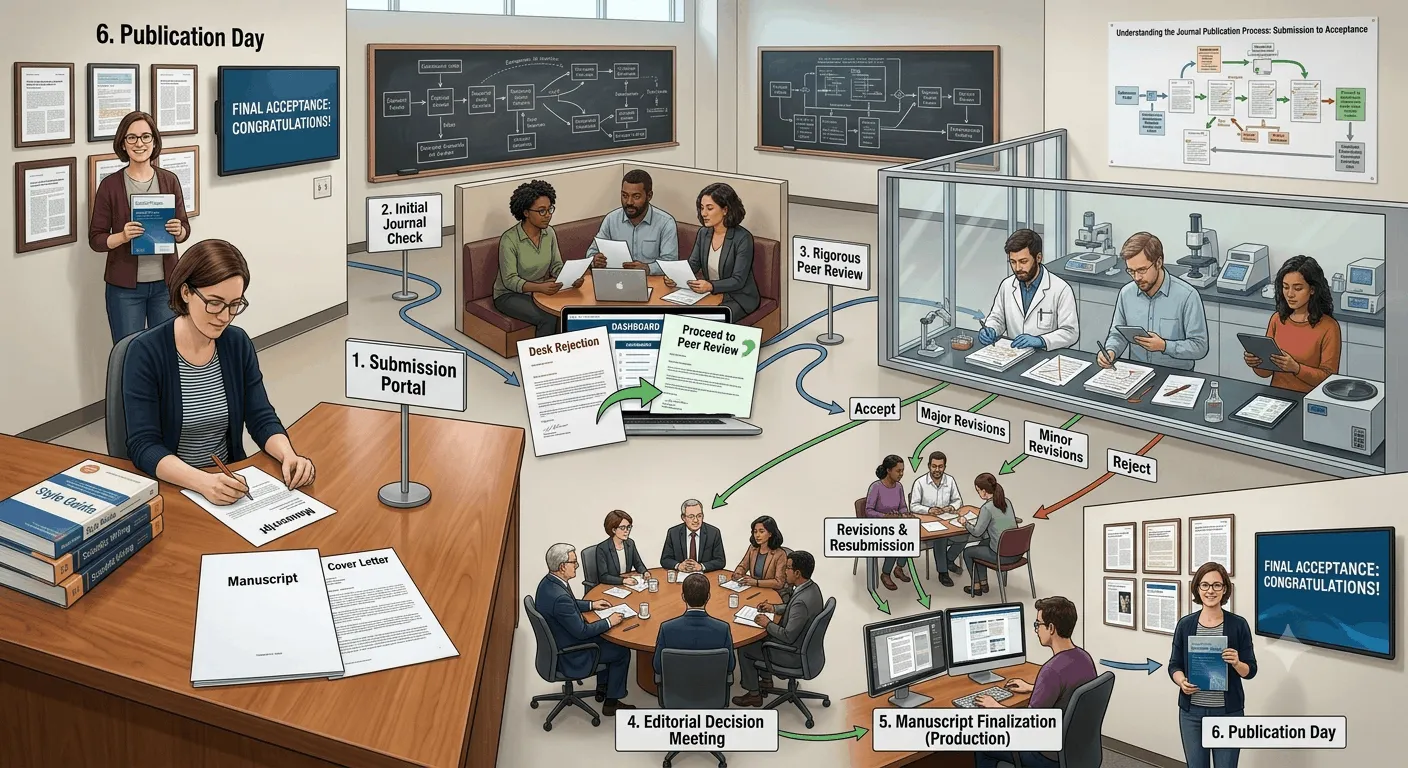
The journal publication process moves through five core stages: editorial screening (where an editor checks fit and completeness), peer review (where independent experts evaluate the work), the editorial decision (accept, revise, or reject), one or more rounds of author revision, and production (copyediting, typesetting, and final publication with a DOI). A manuscript can be rejected at any stage before the final decision, and most papers pass through at least one round of revision before acceptance. The entire process, from initial submission to final publication, commonly takes anywhere from a few months to well over a year, depending on the field, the journal, and how quickly reviewers respond.
Each of these five stages has its own internal logic, its own typical timeline, and its own set of things that can go right or wrong. Understanding them individually — rather than treating "peer review" as one long undifferentiated wait — makes the process far less opaque and gives you a much better sense of when a delay is normal and when it's worth a polite status inquiry.
Why Understanding the Full Pipeline Matters
Researchers who understand the full publication pipeline manage the emotional weight of the process far better than those who don't. A manuscript that sits without a decision for eight weeks feels alarming if you believe review "should" take two weeks; it feels completely ordinary once you know that social science and economics journals average four months just for a first round of peer review. Realistic expectations don't just reduce stress — they also change behavior in useful ways, such as knowing exactly when a status inquiry to the editorial office is reasonable versus premature.
There's a strategic dimension too. Understanding where rejection is most likely to happen — heavily front-loaded at the editorial screening stage for most flagship journals — helps you decide how to allocate your effort. If a paper is likely to be evaluated primarily on fit and framing before it ever reaches a reviewer's desk, then time spent sharpening your introduction and cover letter has an outsized return relative to time spent polishing prose that a reviewer may never see.
Steps in Academic Journal Publication
Step 1: Research Paper Submission and Journal Selection
The research paper submission process begins well before you upload a file. Choosing a journal whose scope, audience, and typical article types match your paper is the single highest-leverage decision in the entire pipeline, because a mismatch here can end the process within hours. Once a journal is selected, the manuscript is formatted to its specific guidelines and submitted through an online system such as Editorial Manager, ScholarOne, or OJS, along with a cover letter and any required supporting documents.
Editage's guide to the process is direct about how central this first decision is: researchers should carefully select a journal that aligns with the scope and focus of their study, and it is essential to review the journal's guidelines for authors and formatting requirements to ensure compliance before submitting through the journal's online submission system. This isn't a formality — it's the decision that determines whether everything that follows even gets a chance to happen.
Step 2: Editorial Screening (Desk Review)
Once a manuscript arrives, an editor — often the editor-in-chief or a handling editor for that subject area — performs an initial assessment before the paper goes anywhere near a peer reviewer. This is the fastest stage in the entire process and, at competitive journals, also the stage where the largest share of manuscripts exit the pipeline. During editorial screening, the editor evaluates the manuscript's fit with the journal's scope, its overall quality, and its adherence to formatting guidelines; if the manuscript is deemed unsuitable, it is rejected at this stage and the researcher receives a notification of rejection.
Timelines here vary enormously by journal prestige and operational speed. At flagship journals, editorial triage moves fast: one analysis of a major multidisciplinary journal found a median of 8 days from submission to first editorial decision, with most submissions declined without ever reaching peer review. Across a broader set of journals, though, the average time from submission to first editorial decision sits closer to 52 days, even though fast-screening operations at some major publishers can issue desk rejections in under a week. If your manuscript clears this stage, it moves to reviewer selection.
Step 3: Reviewer Selection and Invitation
Finding qualified, willing reviewers is one of the slowest and least visible parts of the entire pipeline, and it's almost entirely outside the author's control. The editor typically identifies several potential reviewers with relevant expertise and invites them one at a time or in small batches, since not everyone accepts. As one detailed walkthrough of the process explains, the editor will select three to four reviewers and invite them to peer review the manuscript, and this selection takes time because the editor needs to do research to identify appropriate experts; reviewers themselves also take a couple of days to accept or decline the invitation, and it can be genuinely hard to find willing peer reviewers.
This stage explains a lot of the "silent" weeks authors experience after clearing editorial screening. It isn't that nothing is happening — it's that the editor may be working through a list of five or six potential reviewers before securing enough acceptances to proceed, particularly in narrow subfields with a small pool of qualified experts.
Step 4: The Peer Review Process Itself
Once reviewers accept, they're typically given a defined window to read the manuscript closely and submit a written evaluation. During this phase, reviewers assess the study's methodology, originality, significance, and clarity, and they typically categorize their overall recommendation even though the final decision rests with the editor. Reviewers thoroughly evaluate the manuscript's content, methodology, originality, and significance, assess its strengths and weaknesses, identify errors or gaps, and may suggest revisions, additional experiments, or further analysis.
Turnaround time for this stage is where field-level differences become most visible. Once a reviewer accepts an invitation, they typically have two to four weeks to read the manuscript and write the review, though reviewers sometimes ask for extensions when they're pressed for time, which delays the process further. Aggregated across fields, the differences are substantial: peer review itself typically adds another six to sixteen weeks depending on the field, with social sciences and economics averaging seventeen to eighteen weeks for a first round, psychology averaging around fourteen weeks, and medicine coming in comparatively faster at roughly eight weeks.
Understanding the Different Types of Peer Review
Not all peer review works the same way, and knowing which model your target journal uses changes how you prepare your manuscript, particularly around anonymization. Peer review authorities generally describe three to four dominant models. In single-blind (also called single-anonymous) review, the reviewers know that you are the author of the article, but you don't know the identities of the reviewers — this remains the most common model, particularly in science and medicine. In double-blind (double-anonymous) review, the reviewers don't know that you are the author of the article, and you don't know who the reviewers are either, a model particularly common in humanities and some social science journals. A third, increasingly common model is open peer review, where both parties' identities are disclosed to each other, and in some cases the reviews themselves are published alongside the accepted paper.
Each model carries real trade-offs. Publication-ethics researchers note that double-blind review is treated by the Committee on Publication Ethics as a meaningful structural protection against certain categories of bias, and is standard practice at journals including The Lancet and JAMA, though effective anonymization requires real effort from authors to scrub self-citations and identifying details from the manuscript itself.
Step 5: The Editorial Decision
Once the editor has received enough completed reviews — commonly around three — they weigh the recommendations and issue a decision. This is rarely a simple binary. The decision typically falls into several categories: acceptance without major revisions, minor revisions, major revisions, or rejection. It's worth knowing upfront that a "major revision" decision, while it can feel discouraging on first read, is very often a sign of real engagement with your work rather than a near-rejection — editors don't usually invest reviewer time in a paper they intend to reject outright.
If revisions are requested, the editor will specify a deadline, and this deadline is more flexible than authors often assume. The number of weeks given for revision depends on whether minor or major revisions are needed, and authors can generally ask for an extension, which is usually granted.
Step 6: Revising and Resubmitting
This stage is where many authors underinvest relative to its importance. A revision isn't just about making the requested changes — it's about clearly demonstrating to the editor and reviewers that you took their feedback seriously, point by point. Best practice guidance from established publishers is specific about this: once you have revised your submission, proofread and spell-check it again carefully, then write a covering letter to the editor stating what you have done for each reviewer, and if you haven't done what a reviewer requested, provide detailed reasons why not.
After resubmission, the paper typically goes back to the same reviewers where possible, since they already have context on the original version. Where possible, the revised paper will be reviewed by the original reviewers to check whether their comments have been addressed; if they're not available, other subject experts will be invited instead. It's reasonable to expect this second round to move faster than the first, unless the reviewers raise new concerns that weren't part of the original review.
Step 7: Final Acceptance
Final acceptance is itself often a two-part milestone rather than a single moment, particularly at journals with a rigorous production process. Many journals issue what's sometimes called "provisional" or "in-principle" acceptance first, followed by a distinct final acceptance after a last technical check. As one publisher's author-facing explanation puts it, at the provisional acceptance stage the editor is satisfied with the scientific quality of the work and has chosen to accept it in principle, but before the paper can proceed to production and typesetting, the journal office performs a third and final technical check, requesting any formatting changes or additional details required. Only after that technical check is resolved does the formal acceptance letter arrive, which indicates the paper is being passed from the editorial department to the production department, with all information editorially approved and the journal's publication requirements met.
Step 8: Production, Typesetting, and Publication
Acceptance is not the same as publication, and the gap between the two surprises a lot of first-time authors. After final acceptance, the manuscript enters a production pipeline: copyediting, typesetting, proof generation, and often early online publication ahead of formal issue assignment. Authors are given proofs to check, but the scope of allowed changes narrows considerably at this stage. Proofs are typically received one to two months after the editor has accepted the manuscript, although the delay can be considerably longer; the author is required to check the proofs for technical or spelling mistakes, but substantial changes to the content of the paper are not permitted. At this point, the paper is considered "in press" and may be cited as such, and with many journals it becomes available online in a "papers in press" section well before it's formally assigned to an issue.
Publication turnaround from acceptance varies significantly by publisher and field. At one flagship interdisciplinary journal the median time from acceptance to online publication is 43 days, while some specialized journals move in a matter of days once a paper clears final acceptance. A paper is generally considered formally published once it appears with its complete referencing information — year, volume number, issue number, and page numbers — in the online or hard-copy version of the journal.
How Long Does the Whole Process Take?
There's no single honest answer to this question, and any source that gives you one number without a range is oversimplifying. What's clear from aggregated data is that the process is long, variable, and heavily front-loaded with risk. One 2026 analysis of publication timelines found that submission to first editorial decision typically takes between 7 and 60-plus days depending on the journal, revisions introduce another three to ten weeks for the author followed by two to four more weeks for a final editorial decision, and acceptance to online publication adds yet another layer of delay measured in weeks to months.
The cascading risk of rejection is worth planning for explicitly, since it's rarely discussed in formal guidance but shapes real researcher timelines enormously. Researchers whose work is rejected sequentially across journals A, B, and C can accumulate twelve to twenty-four months of waiting time before a paper finds a home, and in rare but documented cases, papers have sat unassigned to any editor for over a year at a major publisher before any action was taken at all. None of this means the system is broken beyond use — it means building buffer time into your own planning, particularly around grant reporting deadlines or job-market timelines, is simply realistic risk management rather than pessimism.
Journal Publication Process: Stage-by-Stage Timeline
Editorial Screening: Once you submit your manuscript, the editor performs an initial assessment to determine whether it matches the journal's scope, meets quality standards, and follows the required formatting guidelines. This stage can take anywhere from less than one week to around eight weeks, depending on the journal.
Reviewer Selection: If the manuscript passes the initial screening, the editor invites three to four qualified reviewers with expertise in the subject area. Finding available reviewers may take a few days to several weeks.
Peer Review: During peer review, reviewers evaluate the study's methodology, originality, significance, data quality, and overall contribution to the field. This is usually the longest phase and typically takes 6–18 weeks, although timelines vary across disciplines.
Editorial Decision: After receiving reviewer reports, the editor makes a decision. The manuscript may be accepted, accepted with minor revisions, returned for major revisions, or rejected. This decision is generally made after receiving around three completed peer reviews.
Revision and Resubmission: If revisions are requested, authors respond to each reviewer comment individually and submit a revised manuscript. This stage usually takes 3–10 weeks, and many journals grant extensions when needed.
Second Review Round: For manuscripts requiring substantial revisions, the updated version is often sent back to the original reviewers for another evaluation. Since reviewers focus mainly on the requested changes, this round is typically faster than the initial review.
Final Acceptance: Once the editor is satisfied that all concerns have been addressed, the manuscript undergoes final technical and formatting checks before being formally accepted. This stage generally takes a few days to several weeks
.
Production and Publication: After acceptance, the manuscript moves into production, where it is copyedited, typeset, proofread, and prepared for online or print publication. Depending on the journal, this process can take a few weeks to several months before the article is officially published.
Common Mistakes Authors Make During the Publication Process
A recurring mistake is treating silence during peer review as automatically bad news. Given that peer review alone can run four months or longer in some fields, checking in after two or three weeks of no updates is premature and can read as impatience to an editorial office managing hundreds of manuscripts. A more useful benchmark is to check the journal's own published average review time, if available, and only send a polite status inquiry once you've meaningfully exceeded it.
Another common error is responding to reviewer criticism defensively rather than systematically. The strongest revisions treat every reviewer comment as a checklist item requiring an explicit response, even when the response is a respectful disagreement with clear reasoning. Authors who skip disputed comments rather than addressing them directly often trigger a second, more skeptical round of review, since the editor and reviewers can see exactly which points went unanswered.
A third mistake, particularly common among early-career researchers, is underestimating the production stage. Assuming that "accepted" means "essentially published" leads to poor planning around CVs, grant reports, and job applications, when in reality weeks to months can still separate acceptance from a citable, indexed publication with a DOI.
Do's and Don'ts for Navigating the Publication Process
Do track your submission's status through the journal's online system rather than relying on memory of email timestamps, since most platforms show a live status update. Do address every reviewer comment individually in your response letter, even briefly, rather than only addressing the ones you agree with. Do ask for a revision extension if you need one — it's a routine, low-risk request that editors expect and generally grant. Do build realistic buffer time into any external deadline (job applications, grant reports, tenure packets) that depends on a paper being published, not just accepted.
Don't assume a request for major revisions is a near-rejection; it typically signals that the editor sees enough merit to invest further reviewer time in the paper. Don't submit to multiple journals simultaneously unless the specific journals explicitly allow it, since this violates near-universal publishing ethics norms and can result in rejection from both. Don't treat the proof-checking stage as a chance to make substantive edits; most journals restrict this step to correcting genuine errors. Don't assume every field moves at the same pace — a six-week wait that's alarming in one discipline is entirely normal in another.
Frequently Asked Questions
How does the journal publication process work from start to finish?
The process moves through editorial screening for scope and quality, reviewer selection and invitation, the peer review evaluation itself, an editorial decision (accept, revise, or reject), one or more rounds of author revision, final acceptance following a technical check, and finally production and publication with a DOI. A manuscript can exit the process through rejection at any stage before final acceptance.
What are the main steps in academic journal publication?
The core steps are: selecting and submitting to an appropriate journal, editorial screening for fit and formatting, peer review by independent experts, an editorial decision, revision and resubmission if requested, final acceptance after any remaining technical checks, and production (copyediting, typesetting, and publication). Most manuscripts pass through at least one revision cycle before acceptance.
How long does the peer review process usually take?
Peer review timelines vary substantially by field. Once a reviewer accepts an invitation, they're typically given two to four weeks to complete their review, though extensions are common. Aggregated across a full round, medicine journals average around eight weeks, psychology around fourteen weeks, and social sciences and economics journals average seventeen to eighteen weeks for a first round.
What's the difference between single-blind and double-blind peer review?
In single-blind (single-anonymous) review, reviewers know the author's identity, but the author doesn't know the reviewers' identities. In double-blind (double-anonymous) review, neither party knows the other's identity. Single-blind remains the most common model in science and medicine, while double-blind is more common in humanities and some social science journals. A third model, open peer review, discloses both parties' identities to each other.
Does "major revisions" mean my paper will likely be rejected?
Not necessarily. A major revision decision generally means the editor and reviewers see enough scientific merit to invest further time evaluating a revised version, rather than rejecting the paper outright. Papers that receive major revisions and are resubmitted with a thorough, point-by-point response to reviewer comments are frequently accepted in a subsequent round.
What happens after a manuscript is accepted?
Acceptance is often followed by a final technical or formatting check before the paper moves into production. From there, the manuscript goes through copyediting and typesetting, the author receives proofs to check for errors (not substantive content changes), and the paper is typically published online — sometimes ahead of its formal issue assignment — before appearing with complete volume, issue, and page information.
How long does it take from submission to final publication?
There's no single fixed timeline, since it depends heavily on the journal and field. Realistic estimates suggest anywhere from a few months at the fastest end to well over a year in many cases, and considerably longer if a paper is rejected and resubmitted to additional journals. Planning around a range rather than a fixed date is the more realistic approach.
Can I submit my manuscript to more than one journal at the same time?
No, simultaneous submission to multiple journals is considered a serious breach of publishing ethics at virtually all reputable journals and can result in rejection from every journal involved, along with potential reputational consequences. Submit to one journal at a time and wait for a decision (or a formal withdrawal) before submitting elsewhere.
Why does peer review sometimes take so much longer than expected?
Delays typically stem from difficulty finding willing, qualified reviewers, reviewers requesting extensions once they've accepted, or an editor needing more than the initial round of invited reviewers to secure enough completed reviews. None of these delays necessarily reflect anything about the quality of your manuscript.
Is a paper "published" as soon as it's accepted?
No. Acceptance and publication are distinct milestones, often separated by weeks to months of production work, including copyediting, typesetting, and proof review. A paper is generally considered formally published once it appears with complete referencing information (year, volume, issue, and page numbers), though many journals make accepted papers available online as "in press" before that point.
Conclusion
The journal publication process is long, multi-staged, and shaped heavily by variables outside any single author's control — reviewer availability, field-specific norms, and a given journal's operational speed all play a role. But it isn't a black box. Editorial screening filters primarily on fit, quality, and formatting; peer review evaluates the substance of the work through independent expert eyes; the editorial decision translates that feedback into a clear next step; revision is your opportunity to demonstrate real engagement with that feedback; and production quietly turns an accepted manuscript into a citable, indexed publication. Knowing what typically happens — and roughly how long each stage should take in your field — turns a process that often feels like waiting in the dark into one you can navigate with realistic expectations and a clear sense of when to be patient and when a status inquiry is genuinely warranted. Whatever stage your research paper submission is at right now, understanding this pipeline is the best tool you have for managing it with less anxiety and more strategic clarity.