
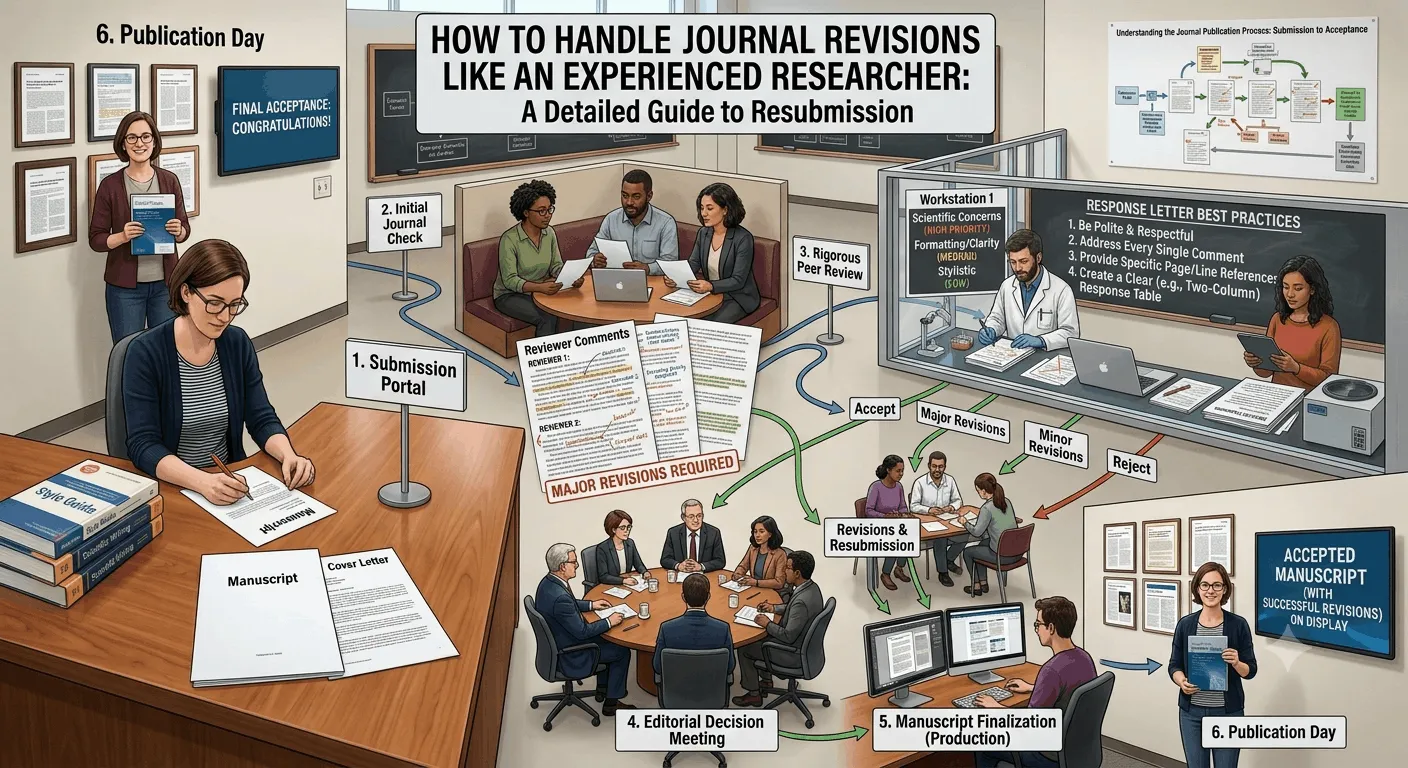
Introduction
The email arrives with a subject line like "Decision on Manuscript #2026-0417," and before you've even opened the attached reviews, your stomach drops a little. That reaction is almost universal, and it's worth naming directly: receiving reviewer comments, especially critical ones, triggers a defensive instinct in nearly every researcher, no matter how experienced. What separates researchers who navigate journal revisions well from those who struggle isn't a thicker skin — it's a repeatable method for turning reviewer feedback into a stronger manuscript without losing momentum, tone, or goodwill along the way. This guide walks through exactly how to respond to reviewer comments, how to structure a response letter editors actually want to read, how to handle conflicting or seemingly unreasonable requests, and how to revise a research paper after peer review in a way that measurably improves your odds on resubmission. If you're staring at a "major revisions" decision right now wondering where to even start, this is the practical, step-by-step version of what an experienced co-author would tell you over coffee.
How Do You Respond to Reviewer Comments?
You respond to reviewer comments by creating a point-by-point response letter that addresses every single comment from every reviewer individually, quotes or paraphrases each comment, states clearly whether you agree, partially agree, or disagree, and explains precisely what you changed in the manuscript and where. The response should open with a brief, sincere thank-you to the editor and reviewers, organize feedback by reviewer, and never skip a comment — even ones you plan to push back on need a respectful, evidence-based explanation rather than silence.
This point-by-point format is close to a universal standard across publishers and disciplines, which is good news: once you learn it, you can apply the same structure to every future revision regardless of journal or field. The sections below break the process into concrete steps, from your very first read of the decision letter through final resubmission.
Why the Response Letter Matters as Much as the Revision Itself
It's tempting to think of the response letter as paperwork that accompanies the "real" work of revising the manuscript. That's a mistake. The response letter is often the first thing an editor reads when your revised paper comes back in, and it shapes how carefully — and how generously — that editor and the returning reviewers read everything that follows. A confused, incomplete, or defensive response letter can make even substantial, well-executed revisions look sloppy or evasive.
There's also a practical reason reviewers care so much about the letter's structure: most reviewers are volunteering their time on your second read, on top of their own research and teaching obligations. A guide from a major publisher makes this explicit, noting that because reviewers are busy and reviewing voluntarily, it's important to try to make re-reviewing as easy as possible — which in practice means a response letter that lets a time-pressed reviewer find, in seconds, exactly how their specific concern was addressed.
Steps to Revise a Research Paper After Peer Review
Step 1: Read the Decision Letter Carefully — and Reframe What "Major Revisions" Means
Before responding to anything, it helps to correctly interpret what your decision actually signals. Many researchers treat "major revisions" as functionally equivalent to rejection, which is both inaccurate and unhelpful to their own revision process. As one detailed guide to the process puts it plainly: "Major Revisions" is actually good news — it means the editor sees potential in your work, and most published papers go through at least one round of major revision. A separate practical guide reinforces the same point with a useful statistic-adjacent claim: if your decision is major revisions or revise and resubmit, the editor sees publishable potential in your paper — they could have rejected it outright, and they did not; acceptance rates after major revisions are usually higher than first-submission acceptance rates, so as long as you respond well, you're in a strong position.
Give yourself permission to feel the initial sting of critical comments, then set that feeling aside before drafting anything. Several researchers who've navigated the process describe deliberately waiting a day or two before engaging seriously with harsh feedback, precisely so the response comes from strategy rather than emotion.
Step 2: Organize Every Comment Before You Write a Single Response
Before drafting responses, extract every individual comment from every reviewer and the editor into one organized document. Skipping this step is one of the most common causes of an incomplete response letter, since it's easy to accidentally merge two related comments or lose track of a small point buried in a longer paragraph. Practical guidance on this step is consistent across sources: copy each reviewer and editor comment into a response document, grouped by source, and number or bullet each point clearly.
At this stage, also mark up your actual manuscript so you can trace each comment to its eventual fix. Insert comment bubbles or use tracked changes to identify where each revision occurs, which makes it easy to navigate between the feedback and the edits later.
Step 3: Tackle Structural Changes Before Cosmetic Ones
Once every comment is organized, resist the urge to start with the easiest edits first. Substantial or structural changes — a reframed research question, an added analysis, a reorganized discussion section — can ripple outward and affect other parts of the paper, so addressing them first prevents wasted effort on sections that might get restructured anyway. Guidance from Taylor & Francis is direct about sequencing: start with the biggest changes and be sure to track them, since this may involve significantly restructuring or modifying certain points the reviewers thought differently about, and addressing this early keeps you from wasting time making minor edits to text that may get deleted later.
If reviewers requested new or revised statistical analysis, this is also the stage to handle it properly rather than as an afterthought. If reviewers request changes in the statistical analysis or presentation of data, provide new and updated tables and figures, keep the old and new versions in the response letter for comparison, and explain whether the new analysis has resulted in any different data interpretation.
Step 4: Draft the Point-by-Point Response Letter
With the manuscript revised, write the response letter itself using the structure that editors across disciplines consistently expect. A clear breakdown of this structure includes an opening section thanking the editor and reviewers, followed by organized, separated responses to each reviewer's individual points. As one detailed guide frames it: every effective response to reviewers follows this proven structure — an opening letter to the editor of three to four sentences thanking them for the opportunity to revise and expressing gratitude for the reviewers' feedback, followed by the full point-by-point response.
Within each point-by-point entry, follow a consistent three-part pattern: quote or closely paraphrase the original comment, state your response (agree, partially agree, or disagree, with reasoning), and specify exactly what changed and where. Guidance on this format emphasizes specificity over vague reassurance: describe concretely how you addressed the comment rather than only saying "we have revised the manuscript" — for example, state that you added a new subsection on a specific page analyzing a specific point. A concrete worked example from a manuscript-revision guide shows the pattern in practice, responding to a request to address a contradiction with prior published findings by acknowledging the point directly and explaining what was added to address it.
Step 5: Handle Comments You Disagree With — Without Skipping Them
This is where many researchers falter, either by capitulating to every request regardless of merit or by dismissing disagreeable comments too bluntly. Neither approach serves you well. The consistent guidance across editors and publishing guides is that disagreement is entirely acceptable, but silence is not. One guide states the expectation clearly: you must address every comment, even the ones you disagree with — for requests you won't fulfill, write a polite, evidence-based rebuttal explaining why the requested change would not improve the paper or is outside the scope of the study; editors expect authors to push back professionally on unreasonable requests, but what editors don't accept is ignoring a comment entirely.
The strength of a respectful disagreement comes from evidence, not tone alone. Guidance on this distinction is precise: start with acknowledgment, then present your evidence — this is where you win or lose. Cite specific sources, quote exact figures, reference established methods, and never argue from authority. It's also worth recognizing which disagreements are winnable in the first place. As the same source notes, if a disagreement is your opinion versus the reviewer's opinion, you'll lose — but if you can provide objective evidence for your position, disagreement is viable.
Tone matters more here than almost anywhere else in academic writing, because a response letter that reads as defensive can undo months of careful revision work. One detailed guide puts the stakes plainly: a defensive or dismissive response can turn a sympathetic reviewer into a hostile one, and even a phrase as innocuous-sounding as "this comment is outside the scope of our paper" can land as dismissive without careful reframing around what the study's actual research question was designed to address.
Step 6: Resolve Conflicting Reviewer Comments Strategically
Almost every experienced author eventually hits this scenario: two reviewers give genuinely contradictory instructions, such as one asking you to expand a figure and another asking you to cut it entirely. This is not a sign your paper lacks merit — it's an ordinary feature of peer review, since reviewers bring different priorities and reading strategies to the same manuscript. A guide focused specifically on this scenario frames it reassuringly: conflicting reviewer comments are an inevitable part of peer review, not a sign that your research has no value — when handled calmly and systematically, they can help you refine your arguments and strengthen the overall quality of your manuscript.
When comments genuinely conflict, look first for a middle path that addresses the underlying concern behind each request rather than the literal instruction. Detailed guidance on this approach suggests: when reviewers truly disagree, you can often find a compromise that addresses the core concerns of both without fully satisfying either — this might mean moderate additions rather than extensive detail, or selective cuts rather than dramatic shortening. When no genuine middle ground exists, choose a direction and justify it explicitly in your response letter, citing which choice better serves the paper's core argument or the journal's scope, and if the conflict remains genuinely irreconcilable, don't hesitate to ask the editor directly for guidance rather than guessing. For truly irreconcilable conflicts, acknowledge the contradiction in your response and ask the editor for guidance — editors expect and welcome this, since resolving exactly this kind of tension is part of their role.
Step 7: Address Requests That Feel Genuinely Impossible
Occasionally a reviewer asks for something that isn't just difficult but truly outside what's feasible — a new longitudinal study with a different population, data you don't have legal access to, or an experiment that would require resources or time well beyond a normal revision window. These requests test a different skill than ordinary disagreement: precision about limits rather than argument about merit. Guidance on this scenario is specific: be specific about what's impossible and why, whether the constraint is resource-based, ethical, or logistical, and frame the response around what would genuinely be required to fulfill the request, so the editor can see the constraint is real rather than a convenient excuse.
Step 8: Finalize, Track Changes, and Resubmit
Before resubmitting, complete two final passes. First, proofread the response letter itself with the same rigor you'd apply to the manuscript, since it's frequently the first document an editor reads in full. Second, make sure your manuscript clearly distinguishes new and revised text from unchanged content, since this is what allows reviewers to re-review efficiently rather than rereading the entire paper from scratch. Established guidance from a major publisher lists this among the core resubmission requirements: clearly show the major revisions in the text, either with different color text, highlighting, or Microsoft Word's Track Changes feature, and return the revised manuscript and response letter within the time period the editor specifies.
Most journals expect two versions of the manuscript at this stage — a clean copy and a marked-up copy — alongside the response letter itself. Most journals require both a clean copy and a marked-up copy of the revised manuscript, submitted together with the point-by-point response document and a short cover letter to the editor.
Manuscript Revision Tips for Common Reviewer Comment Types
Different categories of reviewer comments call for different responses, and recognizing the category quickly speeds up your whole revision process. Comments about missing methodological detail are usually the most straightforward to resolve, since they typically require adding specific information you already have rather than generating new data — reword the relevant Methods paragraph, add the missing parameter, and cite exactly where the addition appears. Comments requesting new analyses or additional experiments require more judgment: if genuinely feasible within your timeline and resources, doing the work usually strengthens the paper considerably; if not feasible, this is the scenario calling for the specific, constraint-based rebuttal described above.
Comments pointing out unclear or confusing passages deserve particular respect even when your first instinct is that the reviewer simply misread the section. If an expert reviewer found a passage confusing, it's very likely that other readers will too. Guidance on this exact situation recommends treating misunderstanding as valuable signal rather than dismissing it: if a reviewer misunderstood something in your paper, the fix isn't to explain that they were wrong — it's to improve the clarity of the passage so future readers don't run into the same confusion.
Comments about scope — where a reviewer effectively asks you to answer a different research question than the one your study was designed around — call for the clearest, most confident pushback of any comment type, provided it's framed respectfully. A detailed guide distinguishes this scenario precisely: scope misunderstandings happen when reviewers want you to answer a different research question than the one you're asking — that's not your paper's job, and you shouldn't pretend it is.
Reviewer Comments Response: Quick-Reference Guide
Missing Methodological Detail: If a reviewer requests additional methodological information, add the missing details directly to the manuscript and clearly mention the exact page or section where the changes were made. Avoid giving vague assurances without specifying what was revised.
Requested New Analysis or Experiment: Complete the requested analysis or experiment whenever it is practical and feasible. If the request cannot be fulfilled due to time, resources, or other valid constraints, explain the reason clearly instead of ignoring the comment.
Unclear or Confusing Passage: If a reviewer finds a section difficult to understand, revise the text for greater clarity, even if you believe it was already clear. Improving the manuscript is more effective than simply explaining why the reviewer misunderstood it.
Scope Mismatch (Different Research Question): When a reviewer asks for work that falls outside your study's objectives, politely clarify the actual research question and explain why the requested addition is beyond the scope of the manuscript. Avoid pretending to answer a question your study was never designed to address.
Conflicting Reviewer Requests: When reviewers provide contradictory suggestions, try to find a balanced solution that addresses the main concern behind each comment. If no compromise is possible, justify your decision with clear reasoning or seek guidance from the editor rather than ignoring the conflict.
Genuinely Infeasible Request: If a reviewer requests something that is impossible because of resource limitations, ethical restrictions, or logistical constraints, explain the limitation honestly and specifically. Avoid responses that sound vague, evasive, or dismissive.
Opinion-Based Preference Presented as a Requirement: If a reviewer expresses a personal preference rather than an evidence-based requirement, support your original approach with objective evidence, relevant literature, or established research practices instead of relying on authority or personal opinion.
Common Mistakes Authors Make During Revision
The most damaging pattern isn't disagreeing with reviewers — it's disagreeing in a way that reads as self-protective rather than paper-focused. One detailed source frames this precisely: the most damaging disagreements are rarely the strongest ones scientifically; they are the ones that sound like the authors are defending themselves rather than repairing the paper. A useful standard to hold yourself to throughout revision: every disagreement should still leave the editor with a stronger paper than the one that entered revision, regardless of whether you ultimately agree with the specific comment.
A second common mistake is letting frustration with a reviewer's tone bleed into the response letter. Reviewer comments can genuinely feel contradictory, patronizing, or occasionally unprofessional, and it's completely natural to feel defensive, particularly when significant additional work — rerunning models, additional lab work, or new experiments — is on the line. But the professional standard holds regardless: respond to a comment's substance and underlying intent rather than reacting to its phrasing or tone.
A third mistake is treating the response letter as a formality to dash off quickly once the "real" manuscript revisions are done. Given that this letter is often the first thing an editor reads in full, and that it directly shapes how generously your revisions get evaluated, it deserves independent proofreading and review — ideally from a colleague who hasn't been immersed in the paper and can catch tonal issues you might miss.
Do's and Don'ts for Handling Reviewer Comments
Do open your response letter with a genuine, specific thank-you rather than a generic one-line acknowledgment. Do address every single comment individually, even ones the editor described as optional or minor. Do use exact page and line numbers when describing where a change appears in the revised manuscript. Do wait a day or two after receiving harsh feedback before drafting your response, so the letter reflects strategy rather than raw reaction.
Don't skip or bundle multiple reviewer comments together just because they seem related — respond to each one individually, even if the response is short. Don't argue from authority or seniority ("as experienced researchers in this field, we believe...") when disagreeing with a reviewer; argue from evidence instead.
Don't let a defensive tone creep into responses to harsh or seemingly unfair comments — reviewers volunteer their time, and tone protects your credibility even when you're pushing back.
Don't guess your way through irreconcilable conflicting reviewer comments; ask the editor for guidance directly when a genuine impasse exists.
Frequently Asked Questions
How do you respond to reviewer comments professionally?
Create a point-by-point response letter that thanks the editor and reviewers, then addresses every comment individually — quoting or paraphrasing each one, stating whether you agree or disagree with clear reasoning, and describing exactly what changed in the manuscript and where. Never skip a comment, even ones you plan to respectfully push back on.
How do I revise a research paper after peer review?
Start by carefully reading the decision letter and correctly interpreting it (major revisions is generally good news, not a near-rejection). Organize every comment from every reviewer into one document, tackle structural changes before cosmetic ones, update any requested analyses or data, then draft your point-by-point response letter alongside the revised manuscript with tracked changes clearly visible.
What should a response letter to reviewers include?
A response letter should include a brief opening thanking the editor and reviewers, then organized sections addressing each reviewer's comments individually. Each entry should quote or paraphrase the original comment, state your response, and specify exactly what was changed in the manuscript, including page or line references. Most journals also expect a clean copy and a tracked-changes copy of the revised manuscript alongside the letter.
Does "major revisions" mean my paper will be rejected?
No. A major revisions decision generally signals that the editor sees real potential in the work and wants to see it improved before making a final decision — they could have rejected the paper outright and chose not to. Acceptance rates following a well-executed major revision are typically higher than first-submission acceptance rates.
Is it okay to disagree with a reviewer's comment?
Yes, disagreement is an accepted and expected part of the process, as long as it's respectful, evidence-based, and doesn't skip the comment entirely. Acknowledge the reviewer's point first, then present your reasoning with specific evidence — citations, data, or established methodological precedent — rather than simply asserting your original approach was correct.
What do I do if two reviewers give conflicting feedback?
Conflicting reviewer comments are common and don't indicate a weak paper. Look for a middle-ground solution that addresses the underlying concern behind each request. When no compromise is possible, choose a direction, justify your reasoning explicitly in the response letter, and if the conflict is genuinely irreconcilable, ask the editor directly for guidance rather than guessing.
What if a reviewer asks for something that's genuinely impossible to do?
Be specific and direct about why the request isn't feasible, whether the constraint is resource-based, ethical, or logistical. Vague refusals read as evasive, while a precise explanation of the real constraint — for example, data you don't have legal access to, or a study design that would require resources beyond a normal revision window — is generally accepted by editors as a legitimate limitation.
How long do I have to revise a manuscript after receiving reviewer comments?
Deadlines vary by journal and by whether the requested revisions are minor or major, but extensions are common and usually granted when requested with reasonable notice. It's better to ask for more time than to submit a rushed, incomplete response by an unrealistic deadline.
Should I use track changes when revising my manuscript?
Yes, in almost all cases. Most journals expect both a clean copy and a marked-up copy (using track changes or highlighted text) so that reviewers can quickly locate what changed without rereading the entire manuscript from scratch.
What tone should I use when responding to harsh or unprofessional reviewer comments?
Maintain a professional, courteous tone regardless of how the comment is phrased, and respond to its substance and underlying intent rather than its tone. A defensive or dismissive response can turn a reviewer who was previously neutral or sympathetic into a more critical one on the next round, so tone discipline is a practical strategy, not just etiquette.
Conclusion
Handling journal revisions well isn't about having a thick skin or being naturally unbothered by criticism — it's about following a method that's been proven across disciplines and publishers: organize every comment before responding, address structural issues first, respond to each point individually with concrete evidence of what changed, disagree respectfully and only with evidence behind you, and resolve conflicting or infeasible requests by engaging directly with the editor rather than guessing. A well-constructed reviewer comments response can turn a "major revisions" decision — which is far closer to good news than most researchers initially believe — into an acceptance, while a rushed or defensive one can undo months of solid research. The next time reviewer comments land in your inbox, resist the instinct to react immediately. Read them fully, give yourself a day, then work through this process systematically. It's the single most reliable way to revise a research paper after peer review and come out the other side with a genuinely stronger, more publishable manuscript.