
Introduction
Proper citation is one of the most important aspects of academic writing. Whether you are writing a PhD thesis, research paper, conference paper, journal article, or dissertation, citing sources correctly helps maintain academic integrity and avoids plagiarism.
For engineering, technology, computer science, electronics, telecommunications, and related disciplines, the IEEE Citation Style is among the most widely accepted referencing formats worldwide. Most IEEE journals, conferences, and engineering institutions require researchers to follow this citation style.
For Engineering PhD scholars in India, understanding IEEE referencing is essential because many Scopus-indexed journals, SCI journals, and IEEE publications strictly follow this format.
This comprehensive guide explains everything you need to know about IEEE Citation Style, including citation rules, reference formatting, examples, common mistakes, and best practices.
In this article, you will learn:
- What IEEE Citation Style is
- Why IEEE referencing is important
- How in-text citations work
- How to format references
- Citation examples for different sources
- IEEE citation tools and software
- Common errors to avoid
- Tips for PhD scholars in India
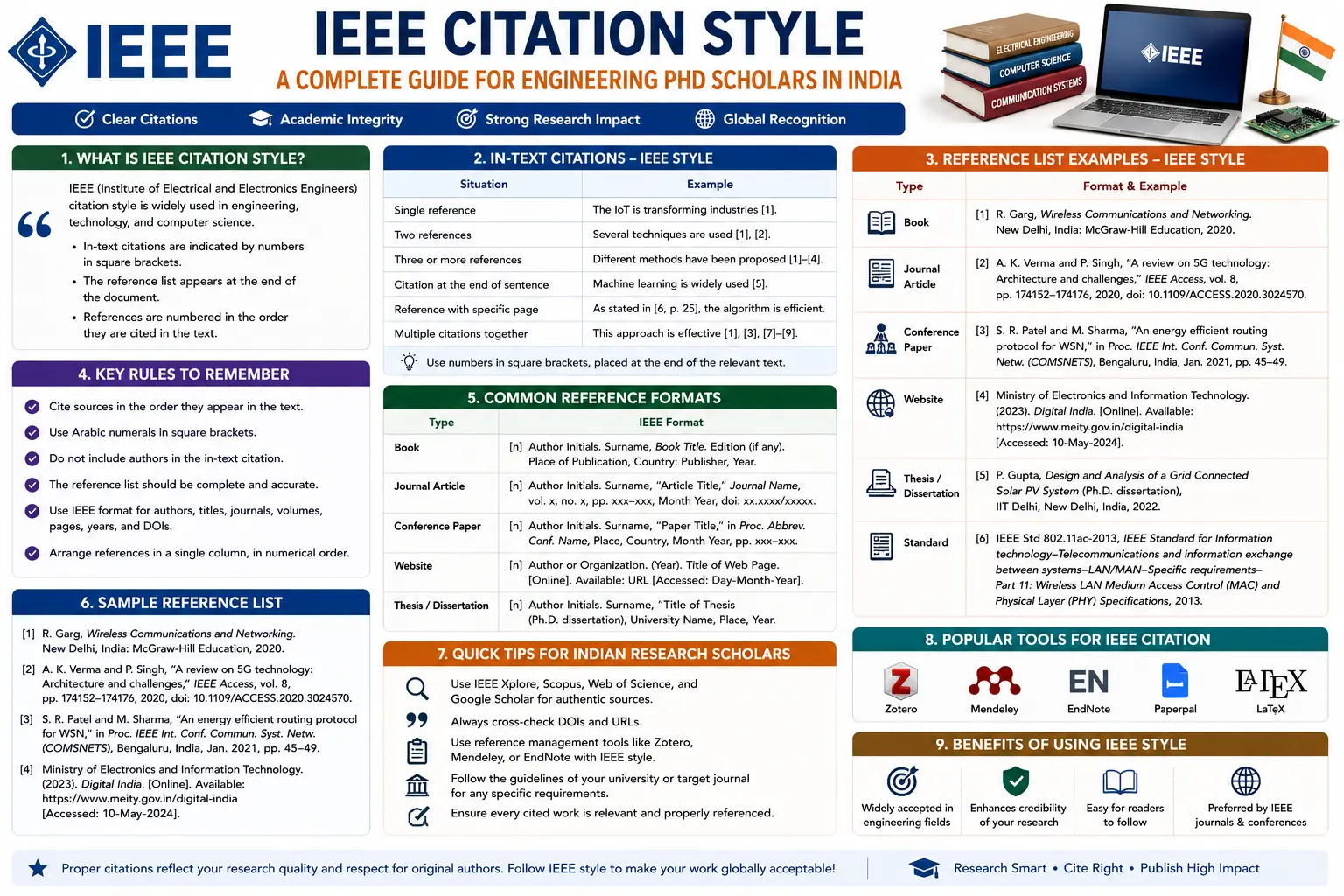
What Is IEEE Citation Style?
IEEE (Institute of Electrical and Electronics Engineers) Citation Style is a numbered referencing system used primarily in:
- Engineering
- Computer Science
- Information Technology
- Electronics
- Electrical Engineering
- Telecommunications
- Artificial Intelligence
- Robotics
- Data Science
Unlike APA or Harvard style, IEEE uses numbered citations enclosed within square brackets.
Example:
Artificial Intelligence is transforming modern healthcare systems [1].
The number corresponds to a complete reference listed at the end of the document.
What Is IEEE?
The Institute of Electrical and Electronics Engineers (IEEE) is one of the world's largest professional organizations dedicated to advancing technology and engineering.
IEEE publishes:
- Journals
- Conference proceedings
- Standards
- Technical magazines
- Research databases
Many prestigious engineering journals require strict adherence to IEEE referencing guidelines.
Why Is IEEE Citation Style Important?
Using IEEE correctly offers several benefits.
Maintains Academic Integrity
Proper citations acknowledge the work of other researchers.
Prevents Plagiarism
Failure to cite sources can lead to academic misconduct.
Enhances Credibility
Well-cited research demonstrates scholarly rigor.
Required by Engineering Journals
Many IEEE and Scopus-indexed journals reject manuscripts that do not follow citation guidelines.
Improves Research Quality
Readers can verify and explore referenced studies easily.
Key Features of IEEE Citation Style
IEEE has several distinctive characteristics.
Numerical Citation System
Sources are assigned numbers.
Example:
Machine learning has become an essential technology in healthcare applications [2].
Square Brackets
Citations appear in square brackets.
Correct:
[1]
Incorrect:
(Author, Year)
Sequential Numbering
References are numbered according to their first appearance.
Example:
First source → [1]
Second source → [2]
Third source → [3]
Numbers remain the same throughout the document.
Reference List Order
References are arranged numerically, not alphabetically.
Example:
[1] First cited source
[2] Second cited source
[3] Third cited source
How In-Text Citations Work in IEEE Style
IEEE uses citation numbers rather than author names.
Example:
Recent developments in deep learning have improved image recognition accuracy [1].
Multiple References
When citing multiple sources:
Example:
Several studies support this finding [2], [4], [7].
Consecutive References
Use a range.
Example:
Several researchers have investigated this issue [5]–[10].
Mentioning Authors in Text
Example:
According to Sharma et al. [8], machine learning models outperform traditional methods.
The citation number still appears after the author's name.
Structure of an IEEE Reference List
The reference list appears at the end of the document under the heading:
References
Each source begins with its citation number.
Example:
[1] A. Sharma, "Machine learning applications in healthcare," Journal of Medical Systems, vol. 45, no. 2, pp. 15–22, 2024.
IEEE Citation Format for Journal Articles
Journal articles are among the most commonly cited sources in engineering research.
Format
Author Initials. Surname, "Article title," Journal Name, vol., no., pp., year.
Example
[1] R. Kumar and S. Gupta, "Artificial intelligence in smart healthcare systems," IEEE Access, vol. 12, no. 4, pp. 1502–1514, 2024.
IEEE Citation Format for Books
Format
Author Initials. Surname, Book Title, Edition. City: Publisher, Year.
Example
[2] J. Smith, Data Analytics Fundamentals, 3rd ed. New Delhi: Pearson, 2023.
IEEE Citation Format for Book Chapters
Format
Author, "Chapter title," in Book Title, Editor, Ed. City: Publisher, Year, pp.
Example
[3] R. Sharma, "Artificial Intelligence in Healthcare," in Advanced Healthcare Technologies, P. Gupta, Ed. New Delhi: Springer, 2024, pp. 50–72.
IEEE Citation Format for Conference Papers
Conference papers are extremely important in engineering research.
Format
Author, "Paper title," in Conference Name, Location, Year, pp.
Example
[4] S. Verma and R. Singh, "Blockchain security frameworks," in Proceedings of the International Conference on Emerging Technologies, Mumbai, India, 2024, pp. 120–126.
IEEE Citation Format for Theses and Dissertations
Format
Author, "Title," Degree type thesis, Institution, Location, Year.
Example
[5] A. Mehta, "Machine learning models for smart cities," Ph.D. dissertation, Indian Institute of Technology Delhi, New Delhi, India, 2023.
IEEE Citation Format for Websites
Many researchers struggle with website citations.
Format
Author or Organization, "Page title." Accessed: Date. [Online]. Available: URL
Example
[6] IEEE, "Artificial Intelligence Standards." Accessed: June 20, 2026. [Online]. Available: https://www.ieee.org
Always include the access date.
IEEE Citation Format for Reports
Format
Author, Title, Organization, Report Number, Year.
Example
[7] NITI Aayog, National Strategy for Artificial Intelligence, Government of India, Report No. AI-2025, 2025.
IEEE Citation Format for Online Journal Articles
Format
Author, "Title," Journal, vol., no., year, doi.
Example
[8] A. Patel and R. Shah, "AI-driven healthcare diagnostics," IEEE Access, vol. 11, pp. 15000–15020, 2025, doi:10.1109/ACCESS.2025.123456.
IEEE Citation Format for Standards
Engineering scholars frequently cite standards.
Format
Standard Number, Standard Title, Year.
Example
[9] IEEE Standard 802.11, Wireless LAN Medium Access Control and Physical Layer Specifications, 2024.
How to Cite Figures and Tables in IEEE Style
When reproducing figures or tables:
Example:
Source: Adapted from [12].
or
Source: Reproduced from [15].
Always obtain permission if required.
IEEE Reference List Example
References
[1] R. Kumar and S. Gupta, "Artificial intelligence in smart healthcare systems," IEEE Access, vol. 12, no. 4, pp. 1502–1514, 2024.
[2] J. Smith, Data Analytics Fundamentals, 3rd ed. New Delhi: Pearson, 2023.
[3] R. Sharma, "Artificial Intelligence in Healthcare," in Advanced Healthcare Technologies, P. Gupta, Ed. New Delhi: Springer, 2024, pp. 50–72.
[4] S. Verma and R. Singh, "Blockchain security frameworks," in Proceedings of the International Conference on Emerging Technologies, Mumbai, India, 2024, pp. 120–126.
[5] A. Mehta, "Machine learning models for smart cities," Ph.D. dissertation, IIT Delhi, New Delhi, India, 2023.
Common IEEE Citation Mistakes
Using Author-Year Citations
Incorrect:
(Smith, 2024)
Correct:
[1]
Incorrect Reference Order
References should follow citation sequence, not alphabetical order.
Missing Page Numbers
Always include page ranges when available.
Missing Conference Details
Conference papers require:
- Conference name
- Location
- Year
- Page numbers
Incorrect Author Format
Correct:
A. Sharma
Incorrect:
Sharma, A.
Best Reference Management Tools for IEEE Style
Managing references manually becomes difficult during a PhD.
Several tools can automate IEEE formatting.
Mendeley
Popular among Indian researchers.
Features:
- PDF organization
- Automatic citations
- IEEE templates
Zotero
Free and open-source.
Suitable for:
- Thesis writing
- Journal submissions
- Literature reviews
EndNote
Widely used in universities.
Provides advanced citation management.
RefWorks
Useful for institutional research projects.
Tips for Engineering PhD Scholars in India
Citation Software
Avoid manual formatting errors.
Verify Every Reference
Ensure all citations appear in the reference list.
Follow Journal Guidelines
Some IEEE journ
Learn IEEE Early
Do not wait until thesis submission.
Maintain Citation Records
Store references while conducting literature reviews.
Use
als may have additional formatting requirements.
Update References Regularly
Use the latest versions of standards, reports, and journal articles.
When Should You Use IEEE Citation Style?
IEEE style is recommended when writing:
- Engineering PhD theses
- Technical reports
- IEEE conference papers
- Journal manuscripts
- Computer science research papers
- Artificial intelligence studies
- Data science projects
- Electrical engineering dissertations
- Electronics and communication research
Always verify the journal's author guidelines before submission.
Conclusion
IEEE Citation Style is the preferred referencing format for engineering, technology, computer science, and related disciplines. Its numbered citation system provides a concise and professional way to acknowledge sources while maintaining readability in technical documents.
For Engineering PhD scholars in India, mastering IEEE referencing is essential for publishing in Scopus-indexed journals, IEEE conferences, and international research platforms. By understanding citation rules, formatting references correctly, using citation management tools, and avoiding common mistakes, researchers can improve the quality, credibility, and professionalism of their academic work.
A strong understanding of IEEE Citation Style not only helps prevent plagiarism but also ensures that your thesis, dissertation, or research paper meets international academic standards and publication requirements.
Website: www.thesislikho.com
Call/WhatsApp: +91 96438 02216