
Last updated: November 2026
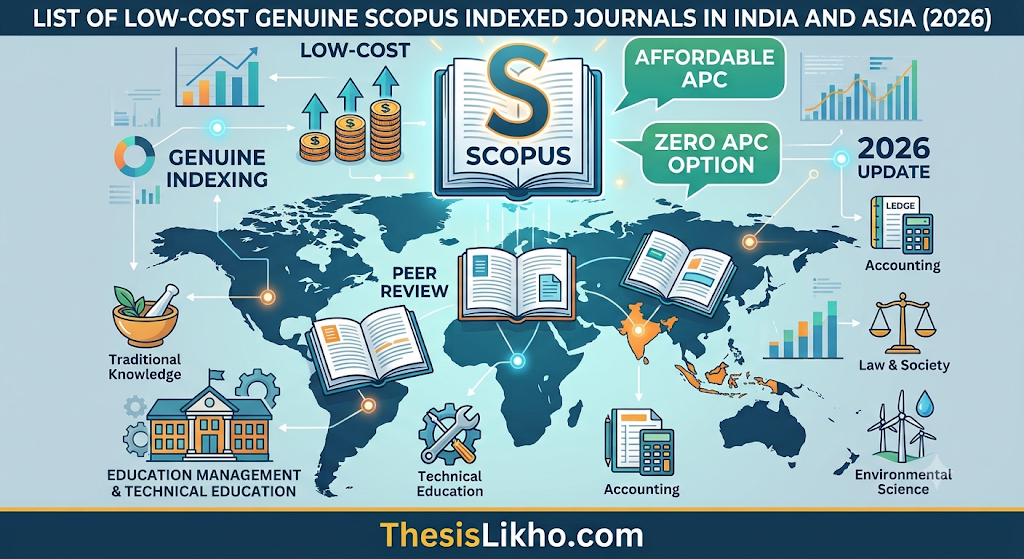
Are you searching for genuine Scopus indexed journals with affordable publication charges and relatively faster review processes? Finding the right journal is one of the most challenging stages of academic publishing. PhD scholars, research students, university faculty members and independent researchers often struggle to identify journals that offer reasonable Article Processing Charges (APCs), authentic indexing and reliable peer-review procedures.
Publication costs can become a significant financial burden, particularly for researchers who do not receive institutional funding. However, several academic institutions and university publishers across India and Asia publish scholarly journals with zero or comparatively affordable publication charges.
This article provides a starting list of journals from India, Malaysia and Indonesia across different academic disciplines. It also explains how to verify Scopus indexing, understand publication fees and identify legitimate expedited editorial processes.
What you will discover in this article:
- Affordable Scopus indexed journals in India and Asia.
- Zero-APC and low-APC publication options.
- Journal names, publishers and subject specialisations.
- Official journal websites and APC information.
- Fast-track review versus guaranteed acceptance.
- Methods to verify genuine Scopus indexing.
1. What Are Low-Cost Fast-Track Scopus Indexed Journals?
Scopus is one of the world's major abstract and citation databases, covering scholarly publications across science, technology, medicine, social sciences, arts and humanities.
A Scopus indexed journal is a scholarly publication included in the Scopus database. However, not every journal charges an APC. Some university-funded and institutionally supported journals publish research articles without charging authors.
Understanding Article Processing Charges (APC)
An Article Processing Charge is a fee that certain academic publishers collect to support editorial and publication activities. These may include manuscript processing, copyediting, typesetting, online hosting and open-access distribution.
APCs differ considerably between publishers. Some journals offer free publication, while others charge authors according to their institutional affiliation, country or manuscript category.
Understanding Fast-Track Publication
Fast-track publication generally refers to an expedited editorial workflow. It may include faster initial screening, reviewer allocation or editorial assessment.
However, faster processing does not mean guaranteed acceptance. A genuine academic journal must maintain appropriate peer-review standards regardless of the author's willingness to pay.
Important: Be cautious of individuals or agencies promising guaranteed Scopus publication within 7, 10 or 15 days. No genuine journal should guarantee acceptance merely in exchange for payment.
2. List of Genuine Low-Cost Scopus Indexed Journals in India and Asia
The following journals are examples of Asian academic publishing opportunities. Their official websites provide information about their scope, publication policies and charges. Always check their current Scopus coverage before submitting your manuscript.
1. Indian Journal of Traditional Knowledge (IJTK)
Country: India
Publisher: CSIR-National Institute of Science Communication and Policy Research (CSIR-NIScPR)
Subject Areas: Traditional medicine, Ayurveda, ethnobiology, indigenous knowledge, natural resources and interdisciplinary research.
APC: Zero, according to the journal's published policy.
Indian Journal of Traditional Knowledge is an academic publication focusing on traditional knowledge systems, indigenous practices and related interdisciplinary research.
It is particularly relevant for researchers working on traditional healthcare systems, ethnomedicine, biodiversity, indigenous technologies and cultural knowledge.
Official website: Indian Journal of Traditional Knowledge
2. Malaysian Online Journal of Educational Management (MOJEM)
Country: Malaysia
Publisher: University of Malaya
Subject Areas: Educational management, school leadership, education policy and institutional administration.
Published APC information:
- University of Malaya authors: RM 500
- Other Malaysian institutional authors: RM 800
- International authors: USD 250
MOJEM provides a publication platform for researchers studying educational leadership, institutional effectiveness, school administration and education management.
The journal is particularly relevant for research scholars working on school leadership, educational policies, teacher management and institutional development.
The journal does not advertise an expedited review or guaranteed acceptance service.
Official website: Visit MOJEM
APC details: View publication charges
3. Journal of Technical Education and Training (JTET)
Country: Malaysia
Publisher: Universiti Tun Hussein Onn Malaysia
Subject Areas: Technical education, vocational education, TVET, educational technology and professional training.
Published APC information:
- Malaysian authors: MYR 500
- International authors: USD 140
JTET is a peer-reviewed journal focusing on technical and vocational education and training. It provides opportunities for researchers investigating vocational learning, industry-based education, skills development and educational innovation.
Official website: Visit JTET
4. Management and Accounting Review (MAR)
Country: Malaysia
Publisher: Universiti Teknologi MARA
Subject Areas: Accounting, finance, taxation, auditing, corporate governance and management.
Published APC information: RM 1,300 for accepted articles, according to the previously published fee schedule.
Management and Accounting Review is a scholarly journal for researchers working in accounting, financial management, business administration and corporate governance.
It can be considered by researchers whose manuscripts address contemporary financial challenges, accounting practices, organisational management and related business disciplines.
Official website: Visit MAR
5. Indonesian Journal of Socio-Legal Studies (IJSLS)
Country: Indonesia
Publisher: Faculty of Law, Universitas Indonesia
Subject Areas: Legal studies, law and society, public policy, governance and interdisciplinary research.
APC: Zero, according to its published policy.
The Indonesian Journal of Socio-Legal Studies offers a platform for academic research examining the relationship between law, society, institutions and public policy.
It is relevant for researchers working on legal reforms, social justice, governance, human rights and interdisciplinary legal studies.
Official website: Visit IJSLS
6. Jurnal Presipitasi: Media Komunikasi dan Pengembangan Teknik Lingkungan
Country: Indonesia
Publisher: Universitas Diponegoro
Subject Areas: Environmental engineering, environmental science, pollution control, waste management and sustainability.
Published APC information: IDR 1,500,000 from Volume 23, Issue 1 (2026), as stated in the journal's published information.
Jurnal Presipitasi publishes research related to environmental engineering and sustainable environmental management. It is relevant for researchers working on water quality, waste treatment, pollution management and environmental technologies.
Official website: Visit Jurnal Presipitasi
3. Comparative Table of Affordable Scopus Journals
The following table provides a quick comparison of the six journal options discussed above.
| Journal | Country | Research Area | Published APC |
|---|---|---|---|
| Indian Journal of Traditional Knowledge | India | Traditional Knowledge | Zero |
| MOJEM | Malaysia | Education | USD 250 (international) |
| JTET | Malaysia | Technical Education | USD 140 (international) |
| Management and Accounting Review | Malaysia | Management and Finance | RM 1,300 |
| IJSLS | Indonesia | Law and Society | Zero |
| Jurnal Presipitasi | Indonesia | Environmental Science | IDR 1,500,000 |
Note: These are indicative published fee details, not guaranteed quotations. Charges may change. Confirm the current fee, author eligibility and indexing coverage directly with each journal before submission. APCs may also be subject to applicable taxes.
4. How to Verify Whether a Journal Is Genuinely Scopus Indexed
One of the biggest challenges in academic publishing is distinguishing genuine Scopus indexed journals from misleading or predatory publications.
Researchers should follow these essential verification steps before submitting their manuscripts.
Step 1: Check the Official Scopus Sources Database
Search the journal by its complete title or ISSN using the official Scopus Sources database. This is the most important step in confirming its indexing status.
Step 2: Verify the Coverage Years
A journal may have been indexed in Scopus in previous years but may subsequently have been discontinued. Always examine its coverage information and check whether the current year is included.
Step 3: Match the ISSN and Publisher
Check whether the ISSN, journal title, publisher and official website match the details displayed in Scopus. Predatory publishers sometimes imitate established journal identities.
Step 4: Examine the Peer-Review Process
A genuine scholarly journal should clearly explain its editorial process, reviewer selection, publication ethics, plagiarism policies and manuscript evaluation procedures.
Step 5: Read Previously Published Research
Examine recently published articles to evaluate research quality, methodology, citation practices and relevance to the journal's stated subject areas.
Step 6: Confirm the APC Directly
Publication charges should be clearly available through the publisher's official website. Avoid making payments to unauthorised individuals or intermediaries.
5. Is Fast-Track Scopus Publication Possible?
Fast-track editorial processing is possible in some academic journals. However, researchers should distinguish between faster editorial handling and guaranteed publication.
A typical scholarly publication process involves the following stages:
- Initial screening: Evaluation of manuscript relevance, formatting and originality.
- Peer review: Independent assessment by subject experts.
- Revision: Incorporation of reviewer and editorial recommendations.
- Acceptance: Formal approval following satisfactory evaluation.
- Online publication: Publication of the accepted manuscript.
- Scopus indexing: Inclusion of eligible content in the database according to the journal's coverage and indexing arrangements.
These stages are different and may take different amounts of time. Researchers should never assume that an acceptance letter automatically means their paper is already searchable in Scopus.
Before submitting, check the journal's average review time, publication frequency and current manuscript processing status.
6. Common Mistakes to Avoid When Selecting a Scopus Journal
Researchers often make avoidable mistakes while choosing journals for their research papers. Some common mistakes include:
- Selecting journals only because they promise publication within a few days.
- Confusing Google Scholar indexing with Scopus indexing.
- Ignoring discontinued Scopus coverage.
- Submitting manuscripts outside the journal's scope.
- Paying publication fees before receiving official confirmation.
- Ignoring plagiarism and research ethics requirements.
- Assuming every university journal is automatically Scopus indexed.
- Relying entirely on publication agents instead of checking the publisher's website.
7. Which Scopus Journal Should You Choose?
The best journal depends on the research topic, methodology, originality and intended academic audience.
- Traditional medicine and indigenous knowledge: Indian Journal of Traditional Knowledge
- Educational leadership and administration: Malaysian Online Journal of Educational Management
- Technical and vocational education: Journal of Technical Education and Training
- Accounting and financial management: Management and Accounting Review
- Legal studies and public policy: Indonesian Journal of Socio-Legal Studies
- Environmental engineering: Jurnal Presipitasi
Do not select a journal merely because its publication fee is low. A suitable journal should have a relevant scope, credible editorial practices, appropriate indexing coverage and transparent publication policies.
Conclusion
Affordable academic publishing opportunities are available across India and other Asian countries. University-supported journals and institutional publishers can provide researchers with zero-APC or comparatively affordable publication options.
However, low publication charges should never be confused with guaranteed acceptance or faster publication. Research quality, journal relevance and genuine peer review remain the most important considerations.
Before submitting a manuscript, verify the journal's current Scopus coverage, ISSN, publisher, APC and editorial guidelines through official sources.
Remember: A genuine publication is not simply about getting your paper accepted. It is about contributing reliable, ethical and meaningful research to the academic community.
References and Official Journal Websites
- Elsevier – Scopus Content Policy and Selection: Official resource
- Scopus Sources – Journal Indexing Verification: Official database
- CSIR-NIScPR – Indian Journal of Traditional Knowledge: Journal website
- University of Malaya – MOJEM: Journal website
- Universiti Tun Hussein Onn Malaysia – JTET: Journal website
- Universiti Teknologi MARA – Management and Accounting Review: Journal website
- Universitas Indonesia – Indonesian Journal of Socio-Legal Studies: Journal website
- Universitas Diponegoro – Jurnal Presipitasi: Journal website
Need Help Finding the Right Scopus Journal?
Choosing the right journal requires careful consideration of research scope, indexing status, publication charges and editorial requirements.
For more research insights, publication guidance and academic resources, visit:
Research | Publish | Succeed