
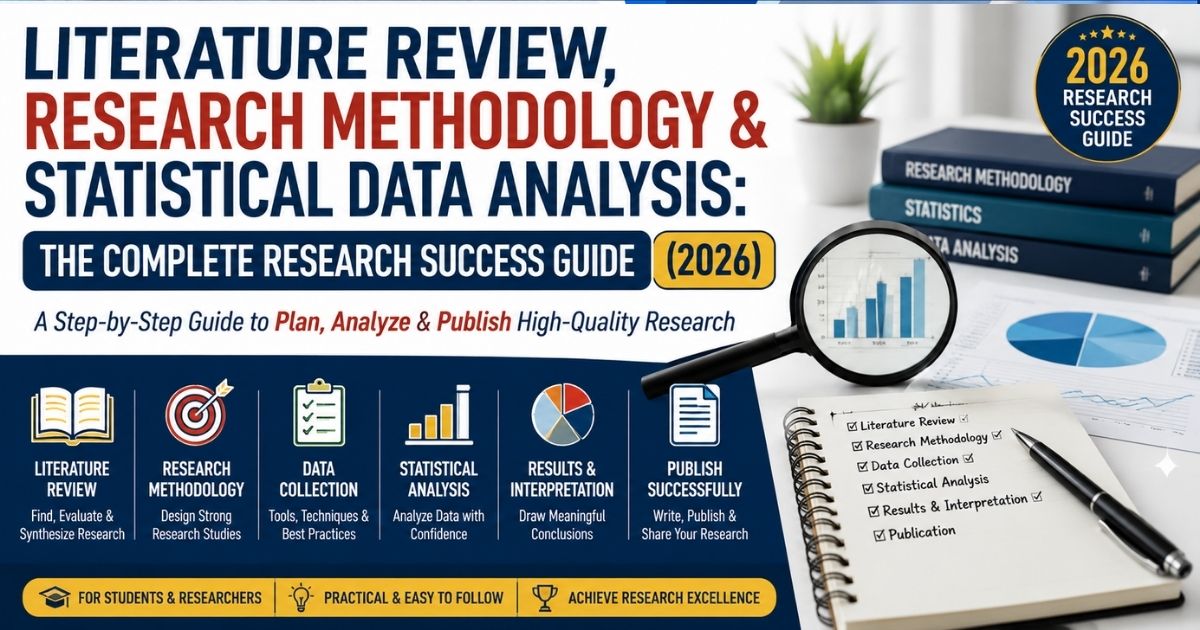
Research is more than collecting data—it's about building a strong academic foundation that leads to meaningful conclusions. Three essential pillars determine the success of any thesis, dissertation, research paper, or journal publication: Literature Review, Research Methodology, and Statistical Data Analysis.
Whether you are a PhD scholar, Master's student, MBA candidate, MD/MS resident, engineering researcher, or social science academic, understanding these three components is critical for producing high-quality research that meets university standards and has the potential for publication in Scopus-indexed and Web of Science journals.
This comprehensive guide explains each stage in detail, common mistakes to avoid, best practices, and how professional research support can improve the quality of your academic work.
Why Literature Review, Research Methodology & Statistical Data Analysis Matter
Every successful research project follows a structured scientific process. Without a strong literature review, a clear methodology, and accurate statistical analysis, even an excellent research idea may fail to deliver reliable results.
These three elements help researchers:
- Build a strong theoretical foundation
- Identify research gaps
- Design scientifically valid studies
- Collect reliable data
- Analyze results accurately
- Publish in reputed journals
- Produce evidence-based conclusions
Universities and journal reviewers evaluate these sections carefully because they directly influence the credibility of your research.
What is a Literature Review?
A Literature Review is a systematic evaluation of published research related to your topic. It demonstrates your understanding of previous studies, identifies research gaps, and provides the foundation for your own investigation.
A high-quality literature review does not simply summarize articles—it critically analyzes, compares, and synthesizes existing evidence to justify the need for your research.
Objectives of a Literature Review
A well-written literature review helps you:
- Understand existing knowledge
- Identify unanswered research questions
- Avoid duplication of research
- Build a conceptual framework
- Develop research objectives and hypotheses
- Support your research methodology
Types of Literature Review
Different research projects require different review methods.
Narrative Literature Review
Provides a descriptive overview of published research.
Systematic Literature Review
Uses predefined criteria to identify, evaluate, and synthesize all relevant studies.
Scoping Review
Explores the breadth of available evidence in a research area.
Integrative Review
Combines findings from diverse research designs.
Meta-Analysis
Statistically combines results from multiple studies to produce a stronger evidence base.
Sources for Literature Review
Reliable sources include:
- Scopus-indexed journals
- Web of Science journals
- PubMed
- IEEE Xplore
- SpringerLink
- ScienceDirect
- Google Scholar
- University libraries
- Government publications
- Professional organizations
Using recent, peer-reviewed literature improves the credibility and relevance of your review.
Steps to Write an Effective Literature Review
Writing a literature review requires a systematic approach.
Step 1 – Define Your Research Question
Clearly identify the topic and scope of your review.
Step 2 – Search Academic Databases
Use relevant keywords, Boolean operators, and filters to locate high-quality research.
Step 3 – Screen and Select Studies
Evaluate studies based on relevance, quality, publication date, and methodology.
Step 4 – Critically Analyze the Literature
Compare findings, identify trends, discuss contradictions, and highlight research gaps.
Step 5 – Organize the Review
Structure the review thematically, chronologically, or methodologically to improve readability.
What is Research Methodology?
Research Methodology is the blueprint of your study. It explains how the research is designed, how data will be collected, and how the findings will be analyzed.
A transparent and well-structured methodology allows other researchers to understand and replicate your work.
Importance of Research Methodology
A sound methodology ensures:
- Scientific validity
- Reliable data collection
- Ethical compliance
- Reproducibility
- Accurate interpretation of results
Without a proper methodology, research findings may lack credibility and acceptance.
Types of Research Methodology
Quantitative Research
Focuses on numerical data and statistical analysis.
Examples include surveys, experiments, and observational studies.
Qualitative Research
Explores experiences, perceptions, and behaviors through interviews, focus groups, and observations.
Mixed-Methods Research
Combines quantitative and qualitative approaches for a more comprehensive understanding of the research problem.
Components of Research Methodology
A complete methodology chapter typically includes:
- Research design
- Research objectives
- Research questions
- Hypotheses
- Study population
- Sampling technique
- Sample size
- Data collection methods
- Research instruments
- Ethical considerations
- Statistical analysis plan
Research Design Explained
Choosing the right research design is critical for achieving valid results.
Experimental Research
Examines cause-and-effect relationships through controlled experiments.
Descriptive Research
Describes characteristics or behaviors of a population.
Analytical Research
Analyzes existing information to evaluate relationships and patterns.
Cross-Sectional Research
Collects data at a single point in time.
Longitudinal Research
Studies changes over an extended period.
What is Statistical Data Analysis?
Statistical Data Analysis transforms raw data into meaningful insights. It enables researchers to test hypotheses, identify patterns, and make evidence-based conclusions.
Accurate statistical analysis enhances the scientific quality of dissertations, theses, and journal publications.
Why Statistical Analysis is Important
Statistical analysis helps researchers:
- Validate hypotheses
- Identify relationships between variables
- Measure significance
- Improve decision-making
- Produce reliable conclusions
- Support publication in high-impact journals
Types of Statistical Analysis
Descriptive Statistics
Summarizes data using:
- Mean
- Median
- Mode
- Standard deviation
- Frequency distributions
- Percentages
Inferential Statistics
Draws conclusions about a population from sample data.
Common tests include:
- t-test
- ANOVA
- Chi-square test
- Correlation analysis
- Regression analysis
- Logistic regression
- Survival analysis
Popular Statistical Software
Researchers commonly use:
- SPSS
- R Programming
- Python
- Stata
- SAS
- MATLAB
- GraphPad Prism
- Microsoft Excel (basic analysis)
The choice of software depends on your research design and analytical requirements.
Common Mistakes in Literature Review, Research Methodology & Statistical Data Analysis
Avoid these common errors:
- Using outdated references
- Relying on non-peer-reviewed sources
- Poor research question formulation
- Inappropriate sampling techniques
- Incorrect statistical tests
- Lack of ethical approval
- Weak interpretation of results
- Inconsistent referencing
- High plagiarism
- Failure to justify methodology
Addressing these issues early can significantly improve the quality and acceptance of your research.
Tips for Writing a High-Quality Research Dissertation
To produce a strong thesis or dissertation:
- Define a clear research objective.
- Conduct a comprehensive literature review.
- Choose an appropriate research design.
- Use validated data collection tools.
- Apply suitable statistical tests.
- Present results objectively.
- Discuss findings in relation to existing literature.
- Follow your university's formatting guidelines.
- Proofread thoroughly before submission.
- Check originality with plagiarism detection tools.
These practices improve both academic quality and publication readiness.
Publishing Your Research in Scopus-Indexed Journals
Many researchers aim to publish their work after completing a dissertation.
To improve your chances:
Select the Right Journal
Choose a journal that aligns with your research domain and scope.
Follow Author Guidelines
Adhere to formatting, referencing, and submission requirements.
Present Strong Methodology
Editors and reviewers pay close attention to the rigor of your research methodology and statistical analysis.
Ensure Originality
Avoid plagiarism and clearly highlight your study's unique contribution.
Why Professional Research Support Can Make a Difference
Many students seek expert guidance to improve the quality of their research.
Professional support can assist with:
Literature Review Development
Identify relevant studies, organize themes, and highlight research gaps.
Research Methodology Design
Develop a scientifically sound methodology aligned with research objectives.
Statistical Data Analysis
Perform accurate statistical testing, interpret results, and prepare publication-ready tables and graphs.
Academic Editing
Improve clarity, grammar, formatting, and adherence to university or journal guidelines.
Publication Guidance
Receive support for journal selection, manuscript preparation, and submission to Scopus-indexed journals.
Frequently Asked Questions (FAQs)
What is the purpose of a literature review?
A literature review evaluates existing research, identifies knowledge gaps, and establishes the foundation for your study.
Why is research methodology important?
Research methodology ensures that your study follows a systematic, valid, and reproducible process for collecting and analyzing data.
What is statistical data analysis in research?
Statistical data analysis involves applying mathematical techniques to interpret data, test hypotheses, and draw reliable conclusions.
Which software is best for statistical analysis?
Common tools include SPSS, R, Python, Stata, SAS, GraphPad Prism, and Excel, depending on the complexity of the research.
Can professional experts help with dissertation research?
Yes. Many researchers seek guidance for literature reviews, methodology development, statistical analysis, academic editing, and publication support to improve the quality and impact of their work.
Conclusion
A successful thesis or dissertation depends on three interconnected components: a comprehensive Literature Review, a scientifically sound Research Methodology, and accurate Statistical Data Analysis. Together, they ensure that your research is credible, well-structured, and capable of contributing meaningful knowledge to your field.
By following a systematic approach, using high-quality academic sources, applying appropriate research methods, and conducting rigorous statistical analysis, you can produce research that meets university standards and has the potential for publication in prestigious journals.
Get Expert Research Support
If you need assistance with your research project, professional guidance can help at every stage, including:
- Literature Review Writing
- Research Methodology Development
- Statistical Data Analysis (SPSS, R, Python, Stata)
- Research Proposal Writing
- Thesis & Dissertation Writing
- Data Interpretation
- Academic Editing & Proofreading
- Plagiarism Checking
- Journal Manuscript Preparation
- Scopus-Indexed Journal Publication Support
Take the next step toward completing a high-quality, publication-ready dissertation with expert academic guidance tailored to your research goals.
Call / WhatsApp: +91 96438 02216
Website:www.ThesisLikho.com