Your Problem May Not Be a Lack of Research Papers
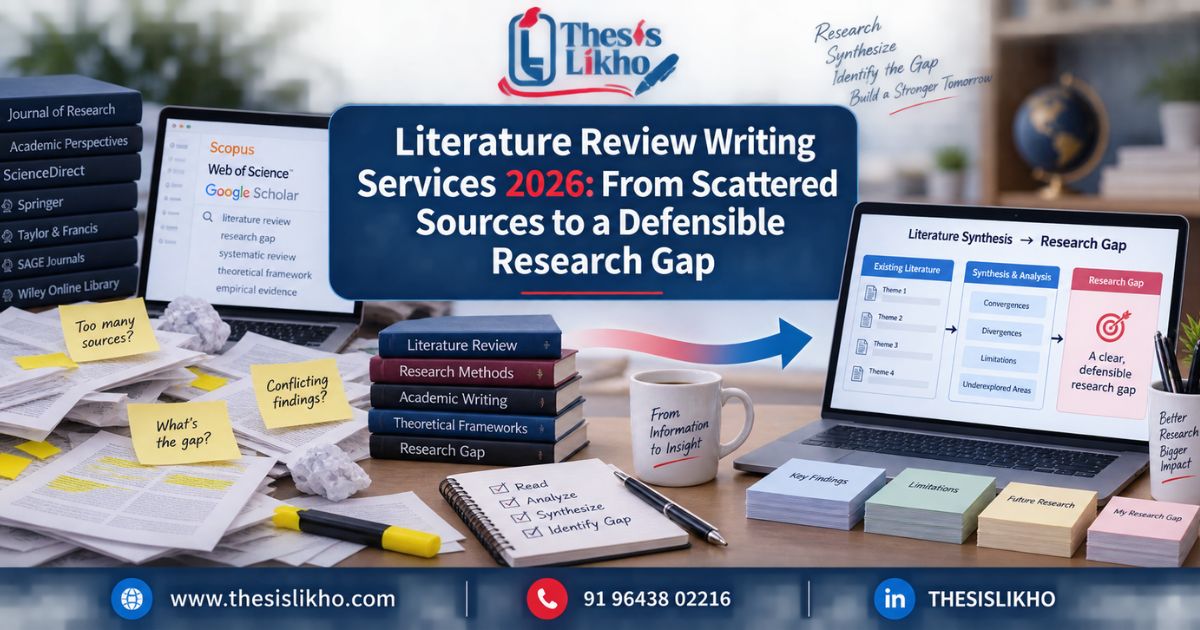
Many PhD and Master's scholars already have a folder full of articles, notes and downloaded PDFs. Yet their literature review still reads like disconnected summaries: one author found this, another author found that, and a final paragraph suddenly claims a “research gap.” The real problem is not always source availability. It is the absence of a defensible path from evidence to gap. Literature Review Writing Services should help scholars classify research, compare methods, test contradictions and show exactly what remains unresolved. This article presents a seven-check diagnostic model for turning scattered literature into a coherent thesis argument and explains where Thesis Literature Review Help or Systematic Literature Review Assistance can add genuine academic value.
Quick Answer: A defensible research gap is not an unsupported claim that “few studies exist.” It emerges when credible literature reveals an unresolved population, context, method, theory, measurement or evidence problem. Effective literature-review support makes that reasoning visible through source verification, evidence mapping, comparison and critical synthesis.
Have many sources but still cannot define the research gap?
Request a confidential literature-review assessment.
Quick Highlights
Review requirement: What strong support should deliver
Source verification Traceable citations that support the stated claims
Evidence coverage Relevant databases, concepts, synonyms and screening logic
Literature mapping A structured matrix of methods, findings and limitations
Critical synthesis Patterns, contradictions and contextual differences
Research-gap development A precise gap demonstrated by reviewed evidence
Objective alignment Objectives and methods that respond directly to the gap
Academic integrity Authentic sources, transparent decisions and no fabricated citations
Table of Contents
- Why Literature Reviews Fail Even with Many Sources
- The Evidence-to-Gap Diagnostic Model
- Check 1: Is Every Important Source Verifiable?
- Check 2: Does the Evidence Cover the Real Question?
- Check 3: Are Studies Mapped Before Writing?
- Check 4: Are Findings Compared or Merely Listed?
- Check 5: Are Methods and Limitations Analysed?
- Check 6: Is the Claimed Research Gap Defensible?
- Check 7: Does the Gap Lead to the Research Objectives?
- Narrative Review vs Systematic Review Support
- Research-Gap Strength Matrix
- Common Warning Signs in Literature Review Services
- How ThesisLikho Can Help
- Frequently Asked Questions
- Conclusion
Why Literature Reviews Fail Even with Many Sources
A literature review fails when it cannot explain how previous knowledge leads to the proposed research. Length, number of citations and recent publication dates do not automatically create analytical depth.
Common failure patterns include:
- Articles collected without a defined review question
- Databases selected without disciplinary logic
- Search terms that miss related concepts or synonyms
- Sources accepted without verification
- One paragraph written for each article
- Findings presented without comparing study designs
- Contradictory evidence ignored
- Limitations copied from article conclusions
- A research gap announced but not demonstrated
- Objectives that do not respond to the identified gap
A strong review is an argument supported by evidence. It should show how the field has developed, where evidence is reliable, where uncertainty remains and why the new study is necessary.
The Evidence-to-Gap Diagnostic Model
The following model tests whether a literature review is ready to support a thesis proposal or research chapter.
Diagnostic checkKey questionEvidence of readiness
Source validity Can every important citation be verified? Complete, traceable references
Coverage Does the search represent the research question? Appropriate databases and concepts
Evidence mapping Are studies organised before drafting? Structured literature matrix
Synthesis Are studies compared across common criteria? Themes, patterns and contradictions
Method critique Are design strengths and limitations examined? Method-based evaluation
Gap validation Does the gap follow from reviewed evidence? Specific, supported gap statement
Objective alignment Does the study respond directly to the gap? Gap-to-objective connection
If one check fails, later parts of the review may also become weak. For example, incomplete source coverage can produce a false gap, while a poorly defined gap can produce irrelevant objectives.
Check 1: Is Every Important Source Verifiable?
Source verification is the first quality barrier. A citation that looks academically correct may still contain a wrong title, incorrect author, missing journal or nonexistent DOI.
What to Verify
- Author names
- Publication year
- Article or book title
- Journal or publisher
- Volume, issue and pages
- DOI or stable link
- Retraction or correction status where relevant
- Whether the cited source supports the actual claim
Why This Matters
Unverified references can damage the credibility of the entire thesis. They also make it difficult for a supervisor, examiner or future researcher to trace the evidence.
Practical Test
Select ten central citations from the chapter. Open each source and compare it with the claim in the thesis. If several citations cannot be traced or do not support the sentence, a full reference audit is required.
Where Support Adds Value
Ethical Thesis Literature Review Help can identify incomplete references, citation mismatches and unsupported statements. It should flag missing evidence instead of inventing a reference.
Check 2: Does the Evidence Cover the Real Question?
A search may retrieve many articles while still missing the evidence needed to answer the review question.
Review the Search Concepts
Break the research problem into components such as:
- Population or unit of analysis
- Core concept or phenomenon
- Intervention, exposure or policy
- Outcome or dependent variable
- Context, sector or geography
- Study design, where relevant
Develop synonyms, technical terms, spelling variants and controlled vocabulary where available. A narrow keyword may exclude relevant studies that use different terminology.
Review the Source Coverage
Database choice should match the discipline. Management, medical, legal, engineering and humanities research do not share one universal database plan. Institutional repositories and reference lists may supplement database searches but should not substitute for a defensible strategy.
Why This Matters
A gap cannot be defended if the search did not cover the sources where relevant evidence is likely to appear. “No study was found” may simply mean the search was incomplete.
Practical Test
Identify three known, highly relevant studies. Run the planned search. If it fails to retrieve them, revise the terms or database selection before claiming comprehensive coverage.
Check 3: Are Studies Mapped Before Writing?
Writing directly from open browser tabs often produces repetition and weak comparisons. Evidence mapping creates a structured view of the field before paragraphs are drafted.
Build a Literature Matrix
Useful columns include:
- Author and year
- Country or research context
- Research problem
- Theory or framework
- Study design
- Sample and data source
- Variables or themes
- Analysis method
- Main findings
- Limitations
- Relevance to the new study
Identify Clusters
Once the matrix is complete, group studies by:
- Theme
- Theory
- Method
- Population
- Geography
- Period
- Finding
- Contradiction
Why This Matters
Mapping prevents the chapter from becoming a sequence of isolated summaries. It also reveals under-researched contexts, repeated methodological weaknesses and areas where evidence conflicts.
Practical Test
Remove the author names from your planned headings. If the structure collapses, the review is probably organised by articles rather than by ideas.
Check 4: Are Findings Compared or Merely Listed?
Critical synthesis connects studies through analytical relationships.
Move Beyond Summary
Instead of writing:
Study A found one result. Study B found another result. Study C examined a related issue.
A synthesis should explain:
- Which findings are consistent
- Which findings conflict
- Whether different methods explain the conflict
- Whether results vary by population or context
- Which theory best explains the pattern
- What remains uncertain
Build a Paragraph Around One Claim
A strong synthesis paragraph usually contains:
- A clear analytical claim
- Evidence from multiple sources
- Comparison or contrast
- Methodological or contextual explanation
- Connection to the research gap
Why This Matters
Synthesis shows the scholar's academic contribution. The value lies not in repeating what each author said but in explaining what the combined evidence means.
Practical Test
Review each paragraph. If it discusses only one source and ends without linking to another study or the research problem, it may be descriptive rather than analytical.
Check 5: Are Methods and Limitations Analysed?
Two studies can investigate the same topic and reach different conclusions because they use different samples, measures, periods or analytical methods.
Compare Methodological Choices
Assess:
- Research design
- Sample size and selection
- Data source
- Measurement quality
- Analysis method
- Bias and confounding
- Research setting
- Duration
- Ethical and reporting transparency
Do Not Copy Limitation Statements
Authors may understate or overlook weaknesses in their own studies. A critical review should evaluate the method independently while remaining fair and evidence-based.
Why This Matters
Methodological analysis can reveal a stronger gap than simply finding an understudied topic. For example, a subject may have many studies but still lack longitudinal evidence, qualitative depth, validated measures or research in a specific population.
Practical Test
Choose five major studies and explain why their methods produced reliable or limited evidence. If the answer discusses only findings, methodological appraisal is missing.
Check 6: Is the Claimed Research Gap Defensible?
A research gap should identify a precise unresolved problem and demonstrate it through the reviewed evidence.
Common Types of Research Gaps
Gap typeWhat it meansEvidence required
Population gap A relevant group is insufficiently studied Existing studies focus on different populations.
Context gap Evidence may not transfer to another setting Research is concentrated in other regions or sectors.
Method gap Existing designs cannot answer an important question Most studies use cross-sectional or self-reported data.
Theory gap Current explanations are incomplete or untested Findings are reported without testing competing frameworks.
Evidence gap Findings are scarce, inconsistent or uncertain Studies disagree or rely on weak-quality evidence.
Measurement gap Key constructs are poorly operationalised Tools lack validity or measure only part of the concept.
Time gap Major changes make older evidence insufficient Technology, policy or behaviour has changed materially.
A Strong Gap Statement Should Explain
- What the literature already establishes
- What remains unresolved
- Why the unresolved issue matters
- What evidence demonstrates the gap
- How the proposed research will address it
Weak Gap Language
- “Very few studies are available.”
- “No one has studied this topic.”
- “More research is needed.”
These statements require supporting evidence. Without a documented search and comparison, they remain assumptions.
Practical Test
Ask whether another researcher could challenge the gap by naming one relevant study. If one overlooked article destroys the argument, the gap is too absolute or poorly verified.
Check 7: Does the Gap Lead to the Research Objectives?
The literature review should not end at the gap. It should create a logical bridge to the proposed research.
Build a Gap-to-Objective Map
Evidence from reviewIdentified gapResearch objectiveRequired method
Findings vary across contexts Contextual gap Examine the phenomenon in the selected context Context-appropriate empirical design
Measures lack validation Measurement gap Validate or adapt the instrument Reliability and validity assessment
Studies show association only Method gap Examine direction or mechanism Suitable longitudinal, experimental or explanatory design
Qualitative experiences are missing Evidence gap Explore participant experiences Qualitative interviews and thematic analysis
Why This Matters
Objectives that do not respond to the gap create a disconnected thesis. The review may be strong, but the proposed method will not advance the identified problem.
Practical Test
For every objective, point to the exact synthesis paragraph that justifies it. If no paragraph supports an objective, either the review or the objective needs revision.
Narrative Review vs Systematic Review Support
Not every thesis literature chapter is a systematic review. The required support should match the claimed method.
Criteria Narrative thesis review Systematic review
Main aim Build context, theory and critical argument Answer a focused question transparently.
Search plan Structured but may remain flexible Predefined and reproducible
Eligibility criteria May be broader or evolving Explicitly defined before screening
Screening record Helpful but not always formal Essential for transparent reporting
Appraisal Critical evaluation of key evidence Formal method suited to study designs
Synthesis Thematic, conceptual or narrative Systematic narrative or quantitative synthesis
Reporting Thesis or discipline requirements Appropriate systematic-review reporting framework
Systematic Literature Review Assistance should include more than a PRISMA-style diagram. It should support a focused question, planned search, selection criteria, record management, appraisal, synthesis and transparent documentation.
Current PRISMA reporting resources and relevant methodology guidance should be consulted when the review is genuinely systematic. University and journal requirements should also be checked before finalising the method.
Research-Gap Strength Matrix
Use this quick audit before finalising the literature chapter:
Quality levelSource coverageSynthesisGapObjective alignment
Weak Convenience sources Article-by-article summary General claim Objectives added separately
Developing Several relevant sources Some thematic grouping Gap mentioned with limited evidence Partial alignment
Strong Appropriate and documented sources Comparative and critical synthesis Specific gap demonstrated by evidence Each objective responds to the gap
Defensible Transparent source strategy with verified citations Methods, findings and contradictions integrated Scope and limits clearly stated Gap, objectives and methods fully connected
Common Warning Signs in Literature Review Services
Avoid services that:
- Promise a complete review without first examining the research question
- Sell the same literature chapter to multiple scholars
- Produce references that cannot be verified
- Treat word replacement as original academic writing
- Claim that a PRISMA diagram alone makes a review systematic
- Ignore contradictory or negative evidence
- Promise guaranteed publication or university approval
- Guarantee zero similarity
- Refuse to explain databases, search terms or screening logic
- Deliver long text without an evidence matrix or source record
Reliable Literature Review Writing Services should make the evidence trail clearer, not hide how the review was produced.
How ThesisLikho Can Help
ThesisLikho provides structured, ethical literature-review support for PhD and Master's scholars who need more than surface-level rewriting. The work begins with the scholar's approved topic, research question, existing sources and supervisor feedback. The purpose is to strengthen the evidence trail and academic reasoning while keeping the scholar responsible for the research and final submission.
Support may include:
- Review-question and keyword refinement
- Database and source-planning guidance
- Literature-matrix design and evidence mapping
- Thematic, conceptual or methodological organisation
- Critical comparison of studies
- Research-gap testing and refinement
- Gap-to-objective alignment
- Citation and reference verification
- Academic editing and supervisor-comment revision
- Systematic-review documentation where the chosen method requires it
Support does not include fabricated citations, invented screening records, purchased authorship, manipulated similarity reports or guaranteed university/journal acceptance.
What you receive depends on the actual gap in your work—not a generic chapter package. Share your topic, discipline, current chapter, university requirements and supervisor comments for an initial scope assessment.
Request a Confidential Literature Review Assessment on WhatsApp
Frequently Asked Questions
1. What do Literature Review Writing Services actually provide?
Support may include question refinement, source planning, literature mapping, thematic synthesis, gap analysis, academic editing, citation verification and reference formatting. Deliverables should be defined before work begins.
2. When should a scholar seek Thesis Literature Review Help?
Support may be useful when sources are scattered, the chapter is too descriptive, the research gap is unclear, references are inconsistent, or supervisor comments require major restructuring.
3. What makes a research gap defensible?
A defensible gap is specific, supported by credible literature, limited to the reviewed evidence and directly connected to the proposed objectives and methodology.
4. Is a systematic literature review always better?
No. The best review type depends on the research question and intended contribution. A narrative review can be appropriate for theoretical or interpretive work, while a systematic review requires a focused and reproducible process.
5. What should Systematic Literature Review Assistance include?
It should support question formulation, protocol planning, database searching, eligibility criteria, screening, appraisal, synthesis and transparent reporting—not only writing or flowchart preparation.
6. Can AI write a reliable literature review automatically?
AI may assist with organisation or keyword ideas, but it can miss context and invent citations. Every source, claim and reference must be verified by the scholar or a qualified reviewer.
7. How is the cost of literature-review support decided?
Cost depends on scope, review type, databases, screening volume, subject complexity, synthesis method, citation condition, word count, deadline and revision requirements.
8. Can a service guarantee plagiarism-free or zero-similarity content?
No fixed score should be guaranteed. Ethical support can improve attribution, synthesis and original expression while preserving necessary terminology, quotations and references.
Conclusion
The purpose of Literature Review Writing Services is not to fill a chapter with more citations. It is to create a defensible chain from verified sources to evidence patterns, methodological limitations, an unresolved research gap and aligned objectives. Scholars seeking Thesis Literature Review Help should expect evidence mapping, critical synthesis and transparent references. Those using Systematic Literature Review Assistance should expect a reproducible method and documented decisions, not a flow diagram added after the writing is complete. A strong literature review does more than describe the past: it proves why the proposed research is necessary and shows exactly how the new study can contribute.
WhatsApp: +91 96438 02216
Website: https://thesislikho.com/