
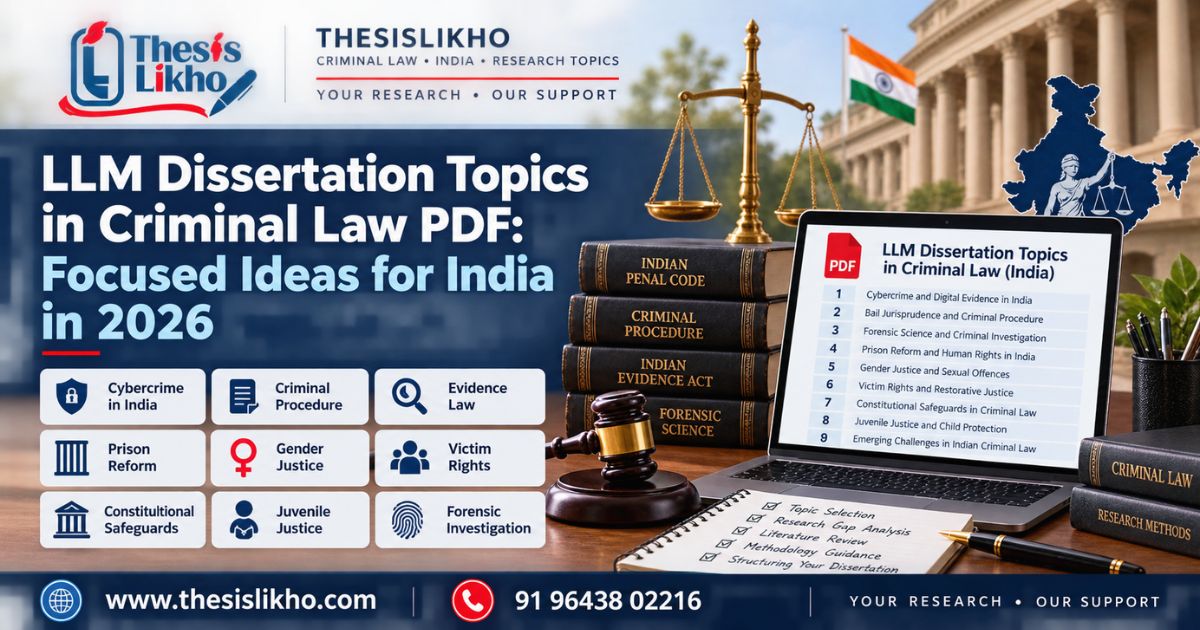
Students searching for LLM dissertation topics in criminal law PDF usually want more than a long list of attractive titles. They need a topic they can discuss with a supervisor, support with Indian legal sources and finish within their programme’s time limit. A title such as “criminal justice reforms in India” gives little direction: it does not identify the precise rule, dispute or research question. This guide offers a printable shortlist of focused topic ideas, shows how to turn one into a proposal and explains which primary sources to check. It also distinguishes a topic idea from a proven research gap. India’s criminal-law framework includes the Bharatiya Nyaya Sanhita (BNS), Bharatiya Nagarik Suraksha Sanhita (BNSS) and Bharatiya Sakshya Adhiniyam (BSA); verify the provisions and their application before fixing your title.
Quick answer: Choose an LLM criminal-law topic by identifying one legal issue, narrowing it to a specific provision or procedure, and writing a question you can answer with accessible statutes, judgments and scholarship. The shortlist below can be printed or saved as a PDF. Confirm current law, available evidence and university requirements before submitting a proposal.
Table of contents
- What makes a criminal-law dissertation topic suitable?
- Why are broad topic lists difficult to use?
- Printable LLM criminal-law topic shortlist
- How to turn a topic into a research proposal
- What to check in each dissertation stage
- Sources and materials to prepare
- Common mistakes and corrections
- Final topic and PDF checklist
- When is expert review useful?
- Frequently asked questions
Quick highlights
Main problemA broad topic list does not identify an answerable legal questionRecommended approachSelect one issue, verify current law, review decisions and narrow the scopeMaterials neededOfficial legislation, relevant judgments, scholarship and programme guidelinesMajor risksOutdated IPC/CrPC/Evidence Act references, unsupported originality claims or inaccessible dataFinal actionPrepare a one-page proposal and save the reviewed shortlist as a PDF
What makes a criminal-law dissertation topic suitable?
A suitable topic identifies a specific legal question and a realistic way to investigate it. For example, “digital evidence in India” names an area. “How should courts assess a defined authenticity objection to a particular form of electronic evidence?” provides a question that can guide the selection of legislation, decisions and commentary.
For an LLM dissertation, define the legal issue, jurisdiction, type of material and period you will examine. You may use a doctrinal method to analyse legal texts and judgments, a comparative method to examine two justified jurisdictions, or an empirical method where relevant data and approvals are genuinely available. Your title should reflect the work you can actually perform.
Check which law applies to the events and decisions in your research. The Ministry of Home Affairs provides access to the three new criminal laws, and an official government response states that they came into force on 1 July 2024. A historical comparison may still need the earlier IPC, CrPC or Indian Evidence Act; do not silently treat provisions from different periods as interchangeable.
Why are broad topic lists difficult to use?
- They provide titles without questions. The student cannot tell what argument or evidence the dissertation requires.
- They confuse “new” with “unresearched.” A recent statute may already have substantial commentary.
- They mix legal periods. A proposed comparison may overlook when a provision came into force or applied.
- They promise unavailable evidence. Interviews, police records or case files may require access and ethics approval.
- They cover too many laws at once. A short dissertation cannot critically analyse every criminal-law reform.
- They are copied into proposals. A popular title does not establish an original, feasible contribution.
Use a list to discover a question to test. It cannot replace reading the primary legal materials.
Printable LLM criminal-law topic shortlist
The following are research directions, not claims that a gap has already been proven. Verify each against current provisions, judgments and recent scholarship before use.
Criminal procedureElectronic reporting of offences under the BNSS
What procedural safeguards matter when an initial report is submitted electronically?InvestigationDigital records in criminal investigations
How should authenticity and continuity of a specified digital record be demonstrated?EvidenceAuthentication of electronic evidence under the BSA
What issues arise when a party challenges the origin or integrity of a defined record?EvidenceExpert evidence involving digital forensics
How have selected courts evaluated the limits of expert conclusions?BailReasoned bail decisions in a defined class of offences
Which factors appear decisive in a selected body of judgments, and are they applied consistently?Undertrial rightsProcedural protection for long-term undertrial prisoners
How does the relevant legal framework address delay, and what do selected decisions reveal?Victim participationThe victim’s role at a specified procedural stage
What rights are provided, and where does their exercise remain legally uncertain?WitnessesProtection of vulnerable witnesses in criminal trials
How do selected procedural safeguards balance testimony and fair-trial rights?SentencingConsistency in sentencing for a narrowly defined offence
What reasons do courts give for differences between comparable cases?CybercrimeJurisdiction in cross-border online offences
Which jurisdictional question arises in a specified type of investigation or prosecution?Gender justiceEvidentiary treatment of digital communications in sexual-offence trials
How do courts assess relevance, authenticity and privacy in selected decisions?Children and criminal justiceA defined safeguard in child-related criminal proceedings
How is the safeguard interpreted alongside the applicable special legislation?
For the evidence and procedure topics, start with the official texts of the BNSS and the new criminal laws collected by the Ministry of Home Affairs. Use the Supreme Court’s judgment search to locate relevant decisions, then confirm the authoritative judgment text and its applicable legal period.
Worked example: narrow one topic
Broad idea: Electronic evidence in criminal trials.
Defined issue: Authentication of a specified category of electronic record when its source is disputed.
Working question: How have selected courts assessed challenges to the origin and integrity of that record, and what does the applicable evidence law require?
Possible sources: Current statutory text, relevant decisions and academic analysis.
Method: Doctrinal analysis of a clearly defined set of cases.
Remaining task: Search recent scholarship to establish whether a meaningful question remains unanswered. Do not call the working question a “research gap” before completing that review.
How to turn a topic into a research proposal
Step 1: Choose one legal issue
Select the part of criminal law you want to examine: an offence, procedural safeguard, evidentiary rule or remedy. Write down why its interpretation matters. Check: Can you describe the issue in two sentences?
Step 2: Verify the applicable framework
Read the relevant official legislation and note commencement, amendments and any special law that may apply. Risk: Analysing a present-day issue using only an older provision or an unofficial summary.
Step 3: Locate the closest judgments
Search decisions by the legal issue, not just your proposed title. Record the question decided, facts relevant to the holding and the law applicable at the time. Check: Do the cases actually address your question?
Step 4: Review existing scholarship
Compare recent articles, books and dissertations. Identify what they explain and what remains uncertain. ThesisLikho’s research gap guide offers a framework for turning that comparison into a supported gap statement.
Step 5: Narrow the question
Specify a jurisdiction, provision, case category or period where useful. Avoid a title that requires a complete evaluation of the entire criminal justice system. Check: Can the question be answered within your university’s dissertation scope?
Step 6: Select a feasible method
For a doctrinal dissertation, explain how you will select and compare legal sources. If you propose interviews or case-file analysis, confirm access and ethics requirements first. Risk: Promising conclusions that your evidence cannot support.
Step 7: Write a one-page concept note
Include a working title, legal problem, main question, preliminary literature gap, primary sources, method and limits. Send it to your supervisor and revise the question before treating the title as final.
What to check in each dissertation stage
Topic and proposal
Does the title point to one answerable legal issue?Literature review
Have you compared the closest arguments instead of listing sources?Methodology
Are your case-selection and interpretation methods explained?Analysis
Does each chapter address the stated research question?Discussion
Do you distinguish what the law says from your proposed reform?Citations
Are statutes, sections, cases and quotations checked against originals?Formatting
Does the paper follow your university’s citation and layout rules?Final submission
Have the supervisor-approved document and final PDF been inspected?
For help developing the method, read ThesisLikho’s research methodology chapter guide. Its broader LLM topic guide can help if you are still deciding on a specialisation.
Sources and materials to prepare
- Official legislation: Use it to establish the precise legal rule and applicable version.
- Authoritative judgments: Use them to analyse interpretation, not merely to decorate a bibliography.
- Recent scholarship: Use it to test whether your proposed question has already been answered.
- A case and literature table: Record each source’s issue, reasoning, date and relevance.
- University dissertation guidelines: Check permitted scope, required method and citation style.
- Supervisor comments: Record agreed changes to the title and research question.
The India Code collection lists the three 2023 criminal statutes; the Supreme Court search portal supports case discovery. Check the full text and subsequent developments when citing either.
Common mistakes and corrections
Copying a topic title directly from a PDFRepetitive, unfocused proposalDevelop your own legal question and scopeClaiming “no research exists”Unsupported originality claimDocument a literature search and state the precise uncertaintyMixing old and new provisionsIncorrect legal frameworkIdentify the law applicable to each event and caseCiting a case from a short online summaryMisstated holdingRead and cite the judgment itselfIncluding every type of cybercrimeUnmanageable scopeSelect one offence, procedure or evidentiary issueProposing interviews without accessInfeasible dissertationConfirm access and approval or use a suitable doctrinal methodTreating policy preference as legal analysisWeak argumentAnalyse sources before offering recommendationsExporting a PDF without checking itMissing pages or broken footnotesOpen the final export and inspect it page by page
Final topic and PDF checklist
- The working title identifies one defined criminal-law issue.
- The applicable statute and legal period have been verified.
- The closest judgments and scholarship have been reviewed.
- The research question and method align.
- The proposed gap is supported by sources.
- Every statutory and case citation has been checked.
- University formatting instructions have been followed.
- The supervisor has reviewed the proposal where required.
- The saved PDF opens correctly, with readable tables and working page order.
To save this shortlist as a PDF: Use your browser’s Print → Save as PDF option. Choose a readable page layout and inspect the resulting file. This creates a personal copy of this article; it is not a university-approved topic list or a prewritten dissertation.
When is expert review useful?
An additional review can help if your question spans several statutes, the case law appears inconsistent, or you cannot explain what your method will establish. Ask the reviewer to test the accuracy of the legal sources, the scope of the question and the proposal’s feasibility. ThesisLikho offers research topic selection guidance; your supervisor and university remain responsible for approving academic work.
Frequently asked questions
Can I download LLM dissertation topics in criminal law as a PDF?
You can use Print → Save as PDF to retain the topic shortlist on this page. Check the file after exporting, particularly tables and links. If ThesisLikho later adds a separate downloadable PDF, its button should link to a real, reviewed file. A saved list supplies ideas; it does not establish that a topic is original or approved.
What is a good LLM dissertation topic in criminal law in India?
A good topic poses a specific question about an identifiable legal rule, decision or procedure. It should have accessible primary sources, enough scholarship for critical discussion and a scope that fits your programme. For example, a defined evidentiary issue is more workable than a general title about “all criminal justice reforms.”
Should my 2026 dissertation discuss the IPC or the BNS?
That depends on the question and the legal period studied. The BNS is part of the new criminal-law framework that came into force in 2024, while earlier law can remain relevant to historical facts, decisions or a justified comparison. Identify the applicable provisions and transition issues through official sources rather than replacing old section references mechanically.
Are BNSS and digital-evidence topics automatically original?
No. A law’s recency does not prove a research gap. Read the text, relevant decisions and recent commentary, then identify a narrow unresolved question. If existing work already answers your proposed question, refine the issue or select another one. Describe originality in terms of the contribution your dissertation can actually support.
Can I write an LLM criminal-law dissertation without interviews?
Yes, if a doctrinal method can answer your question and your university permits it. You can critically analyse legislation, judgments and scholarship using transparent source-selection criteria. Interviews or surveys may help a question about legal practice, but they should be proposed only when access, research design and any required ethics approval are feasible.
How many topics should I show my supervisor?
Bring two or three developed options. For each, provide a working question, the main law, two or three important sources, a possible gap and a feasible method. That gives your supervisor something concrete to assess. A long PDF containing only titles makes it harder to judge whether you can complete the research.
Conclusion
Use LLM dissertation topics in criminal law PDF searches to build a shortlist, then test each idea against official Indian law, judgments, existing scholarship and your university’s rules. Select the topic whose question and evidence you can defend, not simply the most current-sounding title. For feedback on your proposed question and research plan, contact ThesisLikho.
WhatsApp: +91 96438 02216
Website: https://thesislikho.com/